Biology › Practicals › Required practical 10: woodlice in a choice chamber
Required practical 10: woodlice in a choice chamber
Woodlice lose water easily and are eaten by animals that hunt in the light, and they gather in dark, damp places. A choice chamber lets you change one of those conditions at a time and count where the animals end up. The counts are tested with chi-squared, because even animals that do not care which side they are on will not split exactly in half.
The capability this develops
This guide is one investigation under capability P12: Field sampling, distribution and behavioural response, which sets out the techniques the investigation belongs to, the calculations it carries and the errors that cost marks in all of them. The notes behind the biology are in Nervous coordination, receptors and muscles.
Where this sits on the specifications
No numbered heading on the qualifications mapped so far records this investigation’s practical work yet, so it is matched here by the activity numbers below.
Some boards number their practical activities, and those lists were read here from their specifications. This investigation is numbered on them as:
Use your awarding organisation’s current specification and its practical handbook as the authority on which activities your course requires and how they are assessed.
The principle
An animal that moves towards or away from a stimulus is showing a response that keeps it in favourable conditions. A movement directed by the stimulus, straight away from the light for example, is a taxis. A change in speed or in how often the animal turns, with no direction to it, is a kinesis, and it too leaves more animals in the favourable conditions, because they slow down and stop turning once they reach them.
A choice chamber is a shallow dish divided into two or four compartments under a gauze floor, with a hole in the centre of the lid. To set humidity, put a drying agent, anhydrous calcium chloride or silica gel, beneath the gauze on one side and a little water on the other. To set light, cover the lid over one half with black card. Change one variable at a time: in a humidity run the whole chamber is lit evenly, and in a light run both sides have the same water underneath.
A count of where the animals are at the end shows where they settled, not how they got there. Telling a taxis from a kinesis needs the paths of single animals.
- Taxis
- A movement of a whole organism directed towards or away from a stimulus.
- Kinesis
- A change in the speed of movement or the rate of turning in response to a stimulus, with no direction to the movement.
- Null hypothesis
- The statement that there is no difference, or no effect, which a statistical test is used to accept or reject.
Apparatus
- A choice chamber: a shallow dish divided into two halves under a gauze floor, with a lid that has a hole in the centre
- Black card to cover half the lid, and a little water to put beneath the gauze on both sides
- Woodlice, collected locally, kept in damp leaf litter
- A soft paintbrush for moving them
- A stopwatch
- A humidity probe and a light meter, if available, to check the two halves
Safety
Handle the animals gently with a soft paintbrush, keep runs short, and return them to where they were found. Keep the drying agent under the gauze, and check its CLEAPSS Hazcard and your school's risk assessment before starting.
Variables
Independent variable
Light: one half of the lid covered with black card and the other half uncovered. The side that is dark is swapped between runs.
Dependent variable
The number of woodlice on each side after 10 minutes, with a rule decided beforehand for an animal on the line.
Control variables
- Humidity. The same water under the gauze on both sides, so the only difference between them is light.
- Temperature. The chamber kept away from a lamp or a sunny window, which would warm one side as well as light it.
- The number of animals. Ten in every run, released together through the central hole.
- The time. Every run counted at 10 minutes.
- The animals. Fresh woodlice for each run, so no animal is counted twice.
Method
Setting up the chamber
- Put the same small volume of water beneath the gauze on both sides, cover one half of the lid with black card, and leave the chamber to settle.
- Close the chamber for about 10 minutes, with the animals in damp leaf litter beside it. Each side reaches its humidity; the animals settle after handling.
Running a trial
- Release ten animals together through the central hole and close it. No animal starts nearer one side.
- Count the animals on each side every 30 s for 10 minutes, or once at a fixed end time, with a rule decided beforehand for an animal on the line. In a light run, lift the card only briefly to count the dark side. A time series shows how fast they redistribute.
- Repeat with fresh animals, swapping which side holds the stimulus. A bias towards one side cancels out.
Describe the drawing
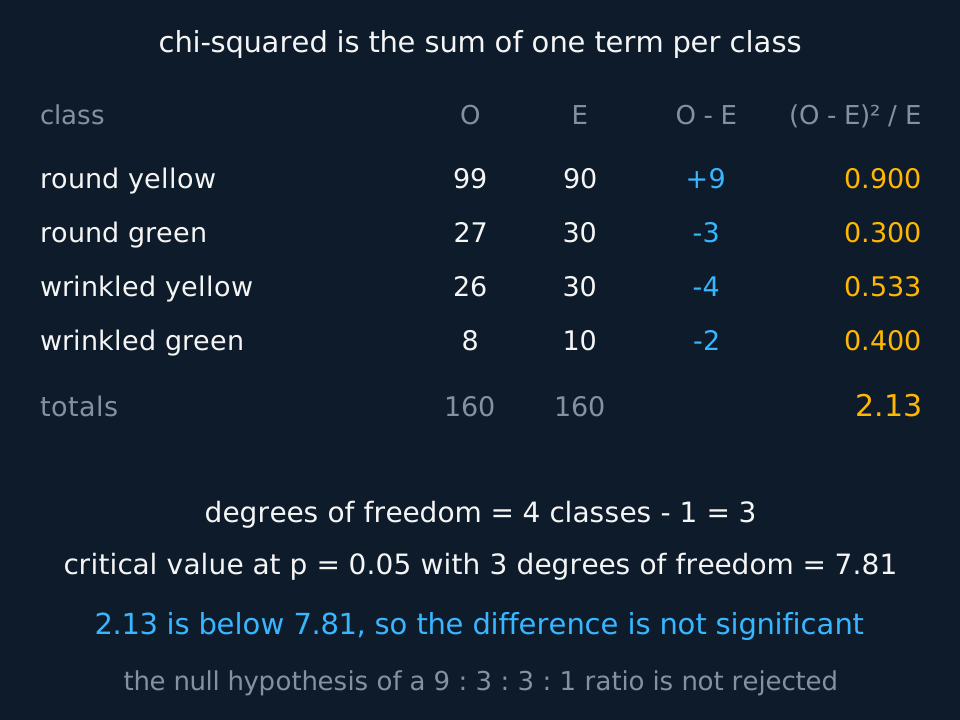
A five-column working table for a chi-squared test on a dihybrid cross. The rows are the four phenotype classes; the columns give the observed count, the expected count worked out from the nine to three to three to one ratio, the difference between them, and that difference squared over the expected value. The terms are totalled to the test statistic, and three lines beneath give the degrees of freedom, the critical value at the five per cent level, and the comparison between the two.
The control run, and the maze
- Run the chamber once with both sides identical. The animals should then split about evenly; if not, the chamber, a window or a draught is biasing them. Keep it away from a lamp, which warms one side as well as lighting it.
- A T-maze gives one choice per trial: the animal walks up the stem and turns left or right, with the stimulus in one arm.
- Woodlice tend to turn the opposite way to their previous turn, so a forced turn before the junction biases the choice. Approach the junction straight, or alternate the side of the forced turn.
Sample data
These counts are idealised. They are the totals the lesson works, 27 in the dark and 13 in the light, with the run-by-run counts made up to add to them. Nothing here is a record of an experiment.
| Run | Dark side | Woodlice in the dark at 10 minutes | Woodlice in the light at 10 minutes |
|---|---|---|---|
| 1 | Left | 7 | 3 |
| 2 | Right | 6 | 4 |
| 3 | Left | 7 | 3 |
| 4 | Right | 7 | 3 |
| Total | 27 | 13 |
Null hypothesis: there is no significant difference between the observed numbers and those expected if light had no effect.
With no effect the split would be 1:1, so E = 40 ÷ 2 = 20 on each side, above 5. (27 − 20)² ÷ 20 = 2.45 and (13 − 20)² ÷ 20 = 2.45, so chi-squared = 4.90. Degrees of freedom = 2 categories − 1 = 1.
4.90 is greater than 3.84, so the null hypothesis is rejected: significantly more woodlice settled in the dark than chance would give.
Two control runs with both halves uncovered gave 5 and 5, and 4 and 6. That is 9 and 11 out of 20, a chi-squared of (9 − 10)² ÷ 10 + (11 − 10)² ÷ 10 = 0.20, well below 3.84, so the chamber itself was not sending the animals to one side.
Reading the graph
The two sides are categories, so the chart is a bar chart: the mean number of woodlice per run on each side, with a bar showing the range. The light side's bar is at 3.25 and the dark side's at 6.75.
What the test says. Chi-squared compares the counts with the counts expected if light had no effect. A value above the critical value at p = 0.05 means a difference this large would arise by chance less than one time in twenty, so the null hypothesis is rejected. It does not prove that light caused the difference, and it says nothing about how large the preference is.
Why swapping sides matters. Two runs had the dark side on the left and two on the right, and the dark side won in all four. Had the animals been drawn to the left end for some other reason, the dark side would have lost in runs 2 and 4, when it was on the right.
The time series. Counted every 30 s, the number in the dark rises over the first few minutes and then levels off. How fast it rises measures how quickly the animals respond, which a single count at 10 minutes cannot.
To tell a taxis from a kinesis, follow single animals across a gridded arena or film them from above, and measure speed and turns per minute on each side. Paths that head straight away from the light are a taxis; faster movement or more turning in dry air, with no direction to the paths, is a kinesis.
Evaluation
Each of these is a real source of error in this investigation, and the middle column is the part an answer earns marks for: what it does to the result, and in which direction.
| Source of error | What it does to the result | What to do about it |
|---|---|---|
| Woodlice gather where other woodlice are | Animals follow each other, so the ten in a run are not ten independent choices. Chi-squared assumes they are, and the result looks more significant than it should. | Run animals one at a time, or in smaller groups, and use more runs. |
| Humidity assumed, not measured | If one side is damper, the animals may be choosing humidity rather than darkness, and the light result is confounded. | Put a humidity probe in each half before the run, and record both readings. |
| Light leaking under the card's edge | The dark side is not fully dark, so the difference between the sides is smaller than intended and the response looks weaker. | Fold the card down over the edge of the lid, and check the dark side with a light meter. |
| A lamp or window warming one side | Temperature changes along with light, so the result cannot be put down to light alone. | Light the room evenly from above, keep the chamber away from windows and lamps, and check both sides with a thermometer. |
| Lifting the card to count | Each look lets light into the dark side for a moment, which can send animals out of it. | Count once, at the end time, so the card is lifted a single time. |
| Animals reused between runs | A woodlouse that has been handled several times, or has been in the dark for long, may behave differently, and the runs are no longer independent. | Use fresh animals for every run and return them afterwards. |
Questions
Question 1 (2 marks)
Explain why the dark side is swapped between runs.
Check your answer
the animals may prefer one end of the chamber for another reason, such as a draught or uneven light from a window;
swapping cancels out any such bias, so a consistent result can be put down to light.
Question 2 (3 marks)
State the null hypothesis for this investigation, and use the table to explain whether it should be accepted or rejected. The critical value at p = 0.05 with one degree of freedom is 3.84.
Check your answer
there is no significant difference between the numbers in the light and the dark and the numbers expected if light had no effect;
chi-squared = (27 − 20)² ÷ 20 + (13 − 20)² ÷ 20 = 4.90;
4.90 is greater than 3.84, so the null hypothesis is rejected.
Question 3 (2 marks)
Explain why the same amount of water is put under the gauze on both sides in a light run.
Check your answer
humidity also affects where woodlice settle;
so it must be the same on both sides, leaving light as the only difference.
Question 4 (2 marks)
Explain how settling in the dark helps a woodlouse to survive.
Check your answer
dark places are usually damp, so less water is lost by evaporation;
and the woodlouse is less likely to be seen by predators.
Question 5 (3 marks)
Woodlice move faster and turn more often in dry air. State whether this is a taxis or a kinesis, and explain why it leaves more woodlice in damp places.
Check your answer
kinesis;
the movement is not directed towards or away from the stimulus;
in damp air they slow down and turn less, so they stay there once they reach it.
Coverage maps are available for AQA 7401/7402, OCR Biology A H020/H420, Cambridge International 9700, Pearson Edexcel Biology A (Salters-Nuffield) 8BN0/9BN0 and Pearson Edexcel Biology B 8BI0/9BI0. Use the relevant route map to check what InkBiology covers, and your awarding organisation’s current specification as the final authority on examinable content.