Physics › Capacitance
Capacitance
Charge and energy storage in capacitors, including RC charging, discharging and time constants.
Year 13 · 4 topics.
- Capacitors and the dielectric
- Energy stored and capacitor combinations
- Charging and discharging
- The time constant and exponential decay
Practise this unit
What capacitance covers
Storing charge and energy on a pair of conductors, and the exponential timing of charging and discharging through a resistor. It follows electric fields, and it shares its mathematics with radioactive decay, so the two are worth revising near each other. AQA's required practical 9 on the time constant is examined from here.
The main ideas
- Capacitance as charge stored per volt, and the farad as a coulomb per volt.
- The parallel-plate formula, and what a dielectric does: polar molecules rotating to align with the field, which raises the capacitance.
- Energy stored as the area under a graph of pd against charge, and the three equivalent expressions for it.
- Charging and discharging as a flow of electrons in the leads, with no charge crossing the gap.
- The shapes of the charge, pd and current graphs for both processes, with current read from a gradient and charge from an area.
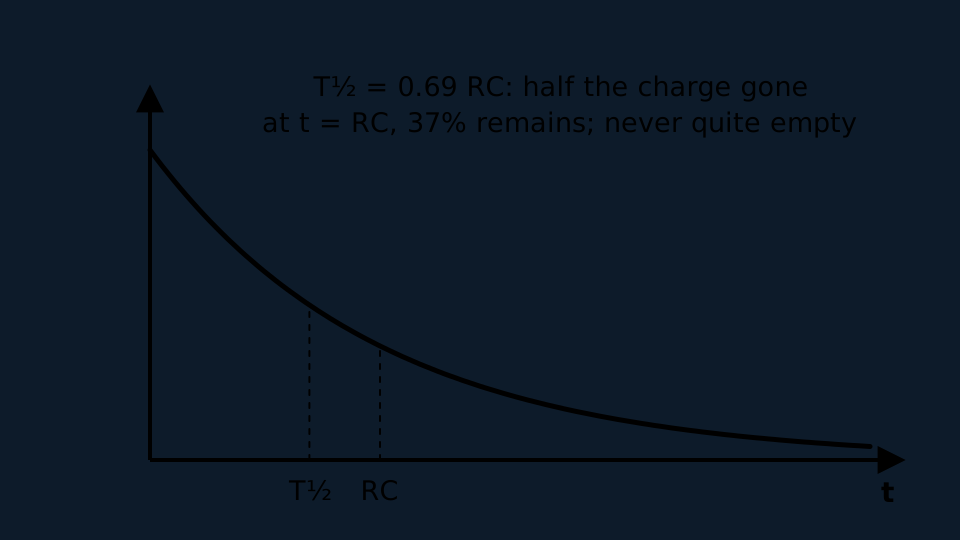
- The time constant as the circuit's own clock, the half-life that goes with it, and finding RC from a log-linear plot.
Key equations
- the definition of capacitance
- the parallel-plate capacitor
- energy stored, in whichever form matches the data given
- the time to fall to 37 per cent of the start value
- discharge of charge, current or pd
- the time to fall to half. The 0.69 is ln 2, the same constant that converts a radioactive half-life to a decay constant
Every equation the capacitance notes display is collected, with its conditions, on the capacitance equations page.
Common errors
- The energy stored is half QV, not QV, because the pd climbs while the charge is arriving. The first coulomb is added against almost no pd and the last against the full pd.
- After one time constant 37 per cent of the charge is still there, and after two about 13.5 per cent. An exponential never reaches zero, which is why questions ask for a fraction remaining rather than a time to empty.
- During charging the charge and pd rise while the current falls, so the current graph keeps the same shape it has during discharge and the other two do not.
- Energy goes as the square of the pd, so doubling the charging voltage stores four times as much.
Suggested order
Capacitors and energy stored first, then charging and discharging for the graph shapes before any algebra, then the time constant. If radioactive decay is already done, the exponential mathematics is identical and only the symbols change.