Physics › Capacitance › Capacitors and energy stored
Capacitors and energy stored
A capacitor is two plates separated by a gap, rated by how much charge it stores per volt across it. Filling the gap with the right material raises that rating, and the energy stored is the area under a pd-against-charge graph, which grows as the square of the voltage.
Pick your board and the few notes written for the other boards quietly fold away, here and in the practice players. Nothing is deleted: every folded piece reopens on a tap.
Builds on Coulomb's law and electric field strength and Electric potential.
IN THIS TOPIC
- Define capacitance with C = Q/V and use the parallel-plate formula.
- Describe how a polar dielectric molecule rotates in the field, and why that raises C.
- Find the stored energy from the area under a V against Q graph.
- Choose between the three energy forms to match the data a question gives you.
- For CIE and OCR, derive the series and parallel combination formulas and use them.
COMMON MISCONCEPTION
A capacitor is a small battery.
What capacitance measures
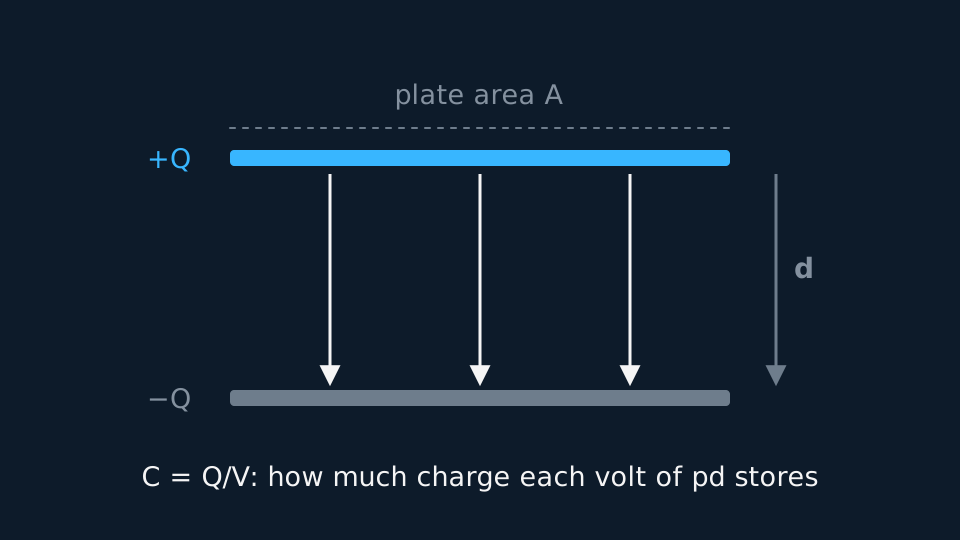
Connect two conducting plates across a supply and charge flows until one plate holds +Q, the other −Q, and the pd across the pair matches the supply. The capacitance rates how much charge arrives per volt.
measured in farads, coulombs per volt. One farad is an enormous rating, so real components live in microfarads, nanofarads and picofarads, and the prefix arithmetic from Year 12 matters here. Note the convention. Q names the charge on one plate, while the capacitor as a whole stays neutral, +Q and −Q cancelling exactly.
CIE widens that definition past the two-plate component. Any isolated conductor has a capacitance of its own, defined the same way as the charge on it per unit potential, except that the potential is now measured against zero at infinity rather than across a gap to a facing plate. For a sphere the electric potential lesson has already done the work. A conducting sphere of radius r carrying charge Q sits at , so dividing the charge by the potential leaves
and the rating depends on the radius and nothing else. A sphere the size of the Earth would come to about 700 μF, which is a blunt way of saying how large a farad is. The other boards define capacitance for the paired-plate component alone, so this paragraph belongs to CIE candidates only.
WORKED EXAMPLE
How much charge a flash stores
A camera-flash capacitor of 2200 μF is charged to 5.0 V. Find the charge stored.
Q = CV = 2200 × 10−6 × 5.0 = 0.011 C.
Eleven millicoulombs sounds small until you recall the scale of the coulomb. That is some 7 × 10¹⁶ electrons parked on one plate, waiting.
The definition worked as a recipe. Capacitance is the charge parked per volt, so the charge is the capacitance times the volts you supplied.
Geometry, and the dielectric
For the parallel-plate design the rating follows from the geometry and the filling.
bigger plates and a smaller gap store more charge per volt, and the factor εr, the relative permittivity or dielectric constant of the insulating filling, multiplies the rating.
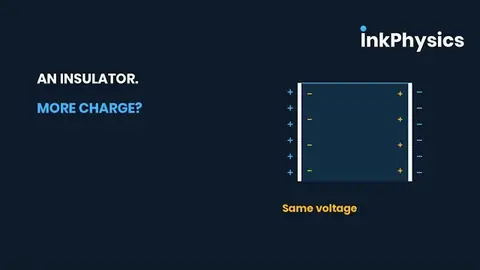
You are asked to describe why at the level of a single molecule. A polar molecule carries a slight positive charge at one end and a slight negative charge at the other. With no field the molecules point every way. Switch the field on and each one feels a turning effect and rotates to align with the field, negative ends towards the positive plate. That layer of aligned charge partly cancels the field in the gap, so a smaller pd appears for the same stored charge, and C = Q/V rises.
Rotation is the mechanism to describe, and it is not the only route to the same end. A non-polar dielectric such as polythene has no permanent dipoles to turn, so the field instead pulls each molecule's electron cloud slightly off centre and induces a dipole where there was none. Induced or permanent, the story finishes identically. Aligned dipoles leave a sheet of bound charge on each face, that sheet opposes the applied field, and the capacitance climbs.
The energy, and why the half
Charging a capacitor means pushing charge on against the pd already there. Moving a small extra charge ΔQ through a pd V costs work VΔQ, so plot pd on the vertical axis against charge on the horizontal and each strip of area under the line is one instalment of work. The energy stored is the whole area under that line. The first coulomb arrives with the plates nearly uncharged and costs almost nothing. The last is pushed on against the full pd. Average over the filling and you have the area of a triangle.
Since Q = CV the line is straight and passes through the origin, so its gradient is 1/C and the triangle comes to ½QV. Plot the axes the other way round, charge against pd, and the same data give a line of gradient C, which is the reading to take when a question asks for the capacitance. Only the pd against charge plot has an area that is the work done, though. While the line is straight the swapped plot happens to give the same number, so the slip hides itself here and would not on a component whose graph bends. Put V on the vertical axis whenever the energy is what you are after.
with the other two forms reached by substituting Q = CV. The square in ½CV2 means doubling the charging voltage quadruples the energy. A battery makes its energy chemically and holds its pd nearly steady until it dies. A capacitor only stores energy in its field, its pd collapses as the charge drains away, and it can dump the whole store in milliseconds. Hence the camera flash.
GUIDED PRACTICE
The energy, and the quadrupling
Find the energy stored by the 2200 μF capacitor at 5.0 V, and then at 10 V, choosing the form of the energy equation that uses what you know.
Show the working
E = ½CV2 = ½ × 2200 × 10−6 × 5.02 = 0.028 J.
At 10 V you get four times as much, 0.11 J, because the voltage is squared. Doubling the pd doubles the charge and the average pd it was stored at, and the two doublings multiply.
INDEPENDENT PRACTICE
Why the flash is bright
The same capacitor dumps its 5.0 V store, 0.028 J, through a flash tube in about 1.0 ms. Estimate the average power, and compare it with charging the capacitor from a small 0.50 W charger.
Show the working
P = E/t = 0.028/(1.0 × 10−3) = 28 W during the flash.
Charging at 0.50 W takes a leisurely fraction of a second, and the flash hands the same energy back more than fifty times faster. Capacitors store little and deliver it quickly, and that asymmetry is their entire career.
Capacitors in series and in parallel, for CIE and OCR
Two boards ask what a group of capacitors adds up to. CIE wants the combined-capacitance formulas derived from C = Q/V and then used, and OCR wants them used and wants circuits built from capacitors and resistors analysed with them. The other two boards ask for none of it, so read this section only if CIE or OCR A is your specification. Nothing new is needed. Both results follow from the defining equation and one conservation law.
Start with parallel, the easier of the two. Wiring the capacitors between the same pair of points puts the same pd across every one of them. Each then stores the charge its own rating calls for, Q1 = C1V and Q2 = C2V and so on, and the total charge the supply has had to push out is the sum of those. Write the sum as Q = C1V + C2V + …, divide by the pd they all share, and the definition C = Q/V hands back a single rating for the whole group,
which the geometry agrees with. Capacitors side by side are plates side by side, so a parallel group is one capacitor of larger plate area, and A sits on top of the plate formula.
Series turns on conservation of charge, and that is the sentence the derivation mark is hiding in. Look at the stretch of conductor running from the inner plate of the first capacitor to the inner plate of the second. It joins to nothing else, so it is an isolated island, and it started out neutral. It must stay neutral. When the supply drags charge +Q onto the far plate of the first capacitor, the island's near end is left holding −Q and its far end +Q, and the same argument repeats down the chain. Every capacitor in a series string carries the same charge Q, however far apart their ratings are.
What they do not share is the pd. Those add to the supply's, V = V1 + V2 + …, and each one is Vn = Q/Cn by the definition rearranged, while the group as a whole obeys V = Q/C. Substitute all of them into the sum and the shared Q cancels off every term, leaving
and the geometry agrees a second time. Capacitors nose to tail are plates further apart, and d sits underneath in the plate formula.
Both results run opposite to the resistor rules you already know, and that inversion is where most of the marks in this topic go missing. The reason is what each quantity measures. Resistance measures opposition, so more of it makes charge harder to move; capacitance measures capacity, so more of it makes charge easier to store. Putting another component in the path in series always makes matters harder, and harder reads as a larger R and a smaller C.
Ask instead which quantity is doing the adding and the symmetry comes out exact. In series what adds is the pd needed per unit of throughput, volts per amp for a resistor and volts per coulomb for a capacitor, and volts per coulomb is 1/C. In parallel what adds is the response per volt, amps per volt for a resistor and coulombs per volt for a capacitor, and coulombs per volt is C itself.
Two free checks come out of that. A series combination is always smaller than the smallest capacitor in it, and a parallel combination is always larger than the largest. Test every answer against those before you write it down.
WORKED EXAMPLE
A series pair, and the pd it splits
A 2.0 μF capacitor and a 4.0 μF capacitor are joined in series across a 9.0 V supply. Find the combined capacitance, the charge on each, and the pd across each.
Reciprocals first. 1/C = 1/2.0 + 1/4.0 = 0.75 in reciprocal microfarads, so C = 1/0.75 = 1.3 μF, below the smaller of the two as a series result must be.
The group stores Q = CV = (4/3) × 9.0 = 12 μC, working in microfarads and volts so the charge lands in microcoulombs. That same 12 μC sits on both capacitors, because the island between them stayed neutral.
Now split the pd. V1 = Q/C1 = 12/2.0 = 6.0 V and V2 = 12/4.0 = 3.0 V, and they add to 9.0 V, which is the check the question is built around.
The smaller capacitor took the larger share of the pd, the reverse of a resistor chain once again. Both hold the same charge, so the one with the poorer rating needs more volts to hold it.
GUIDED PRACTICE
The same pair in parallel, then through a resistor
Rewire those 2.0 μF and 4.0 μF capacitors in parallel across the same 9.0 V supply, and find the combined capacitance and the total charge stored. The supply is then disconnected and the pair is left to discharge through a 22 kΩ resistor. A discharge like that runs on its time constant, the product RC, which the lesson two on from here takes apart properly. Find it for the parallel pair, and say how it compares with the series arrangement's.
Show the working
C = C1 + C2 = 2.0 + 4.0 = 6.0 μF, above the larger of the two, and Q = CV = 6.0 × 9.0 = 54 μC. Four and a half times the charge the series pair held, on the same supply.
With the resistor in the loop this is an ordinary resistor-capacitor discharge, and the combination behaves as one 6.0 μF capacitor. RC = 22 000 × 6.0 × 10−6 = 0.13 s.
The series pair, rated 1.3 μF, would give RC = 22 000 × 1.3 × 10−6 = 0.029 s, quicker by the same factor of four and a half. Lower the combined capacitance and there is less charge to shift at the same pd, so the same resistor empties the circuit sooner. That is what a capacitor-and-resistor analysis comes down to at this level. Reduce the group to one capacitance, then treat it as a single component.
ASSESSMENT FOCUS
- C = Q/V defines the rating, and Q means the magnitude of the charge on one plate. The pair together is neutral.
- CIE alone applies the definition to an isolated conductor as well, where the potential is measured from zero at infinity, and an isolated sphere of radius r rates 4πε0r. Give the definition in that form and the sphere formula follows from V = Q/(4πε0r) in one line.
- CIE and OCR only: derive the parallel result from a shared pd and added charges, and the series result from a shared charge and added pds. The series derivation earns its mark on the sentence about conservation of charge, that the conductor between the two capacitors is isolated and stays neutral, so write it rather than assume it.
- Series capacitance comes out smaller than the smallest capacitor, parallel larger than the largest, and the smaller capacitor in a series pair takes the larger pd. Every one of those is upside down from the resistor rules, so check a combination against them before writing it down.
- The polar-molecule description earns its marks in sequence. Two charged ends, a turning effect in the field, rotation into alignment, and the rise in C that follows. Tell it in that order.
- In the plate formula every symbol moves C the way intuition expects, with A up, d down and εr up. Check those limits before you trust your algebra.
- Energy questions go quickest if you pick the form that matches the data you were given. Use ½QV when both are known, ½CV2 from the rating and the voltage, and ½Q2/C when charge is what you hold.
- The justification for the half is itself examinable. Each extra coulomb is pushed on against a growing pd, so the average pd during charging is V/2 and the area under the line is a triangle.
- Watch the axes when a graph is involved. Work is pd times charge moved, so the energy is the area under pd against charge, and every board words it that way. The gradient of the plot with the axes swapped, charge against pd, is the capacitance.
CHECK YOURSELF
A capacitor has plates of area 0.020 m² separated by 1.0 mm, with a dielectric of relative permittivity 2.5. Find its capacitance, and the charge and energy it stores at 12 V.
Show a hint
Geometry first, then Q = CV, then the energy form that uses what you now hold.
Show the answer
= (0.020 × 8.85 × 10−12 × 2.5) / (1.0 × 10⁻³) = 4.4 × 10⁻¹⁰ F, about 0.44 nF.
= 4.4 × 10−10 × 12 = 5.3 × 10⁻⁹ C.
= 0.5 × 4.4 × 10−10 × 144 = 3.2 × 10⁻⁸ J. Tiny numbers throughout, so the farad rarely appears without a prefix in front of it.
Capacitance is charge parked per volt; the dielectric raises it.
Energy is the triangle under V against Q, and it grows as the voltage squared.
WORKBOOK
Printable practice for this topic: original exam-style questions with room to work, and a fully worked answer book. Free to use; please do not redistribute or sell.
Or read them with their mark schemes on the capacitors and energy stored questions page.
WHERE TO GO NEXT
- Gradients and areas under graphs is the maths this lesson leans on, worked through from GCSE.
CHECK YOUR PROGRESS
Rate how confident you feel with each objective for this lesson. Ratings are saved in this browser, on this device, unless you sign in.
- Define capacitance with C = Q/V and use the parallel-plate formula.
- Describe how a polar dielectric molecule rotates in the field, and why that raises C.
- Find the stored energy from the area under a V against Q graph.
- Choose between the three energy forms to match the data a question gives you.
- For CIE and OCR, derive the series and parallel combination formulas and use them.
Open the full revision checklist to track your progress across the whole unit.