Physics › Capacitance › Charging and discharging
Charging and discharging
No charge crosses the gap between a capacitor's plates: charging moves electrons through the external circuit onto one plate and off the other. On discharge the charge, the pd and the current fall together, all with the same exponential shape. Charging starts the current at V/R and sends it to zero.
Choose your exam board to show the notes and questions relevant to your specification. You can change this setting at any time, and content for other boards remains available.
Builds on Capacitors and the dielectric and Circuits and Kirchhoff's laws.
IN THIS TOPIC
- Describe charging and discharging as a flow of electrons in the leads, with no charge crossing the gap.
- Sketch and explain the Q, V and I against t graphs for discharge.
- Sketch and explain the charging graphs, in which the current falls while the charge and pd rise.
- Read gradients and areas: current from the magnitude of the Q–t gradient, charge from the I–t area.
COMMON MISCONCEPTION
A capacitor charges at a steady rate until it is full.
Charging is exponential, not steady. As charge builds, the capacitor's pd rises and the pd driving the current falls, so the charging current decays; it never becomes strictly full.
Nothing crosses the gap
Charging does not transfer charge into the capacitor across the gap. An insulator, the dielectric, sits between the plates, and no charge crosses it at any stage.
During charging, the supply moves electrons through the external circuit: it removes electrons from the plate connected to its positive terminal and delivers the same number to the plate connected to its negative terminal. The first plate is then short of electrons and carries +Q, the second holds the excess and carries −Q, and the two magnitudes are equal because one current passes round the single loop, supplying one plate at the same rate as it drains the other. An ammeter in either lead reads the same current at every instant. What changes in the gap is the electric field, which grows as the plates charge and in which the energy is stored.
The current falls as the process runs. Each electron added to the negative plate repels the next, and each electron removed from the positive plate makes the next harder to remove, so the pd across the capacitor rises and opposes the supply pd. The current therefore decreases, and it stops when the capacitor pd equals the supply pd.
Discharging reverses the process. With the supply removed and a resistor connecting the plates, the pd between the plates drives electrons through the external resistor from the negatively charged plate to the positively charged one. The plates neutralise each other through the external circuit and not across the gap, and the current falls towards zero as the pd does.
Discharge, and the shared exponential

Describe the drawing
Discharge above: the plate charge drains away and charge, pd and current all ride one exponential, 37% left after one time constant, 14% after two. Charging below: charge and pd climb the mirror-image curve while the current starts at its maximum and decays. Two rise, one falls, and nothing here happens at a steady rate.
When a charged capacitor drives a current through a resistor, three quantities fall together. The pd follows the charge through V = Q/C, and the current follows the pd through I = V/R, so Q, V and I all follow the same falling curve. The shape follows from the mechanism: a fully charged capacitor drives a large current and loses charge quickly, but as the charge falls so does the pd, and so does the current, and so does the rate of loss. Because the rate of loss is proportional to the charge remaining, the decay is exponential: steep at first, progressively gentler, and approaching zero without reaching it.
WORKED EXAMPLE
The initial charge and current
A 1000 μF capacitor charged to 9.0 V discharges through a 4.7 kΩ resistor. Find the initial charge and the initial current.
The charge is on board before the switch closes, so Q0 = CV0 = 1000 × 10−6 × 9.0 = 9.0 mC.
At the first instant the whole pd sits across the resistor, giving I0 = V0/R = 9.0/4700 = 1.9 mA.
Both are values at t = 0, so they come from ordinary circuit theory and need no exponential; the exponential describes only the shape that follows.
Charging through a resistor
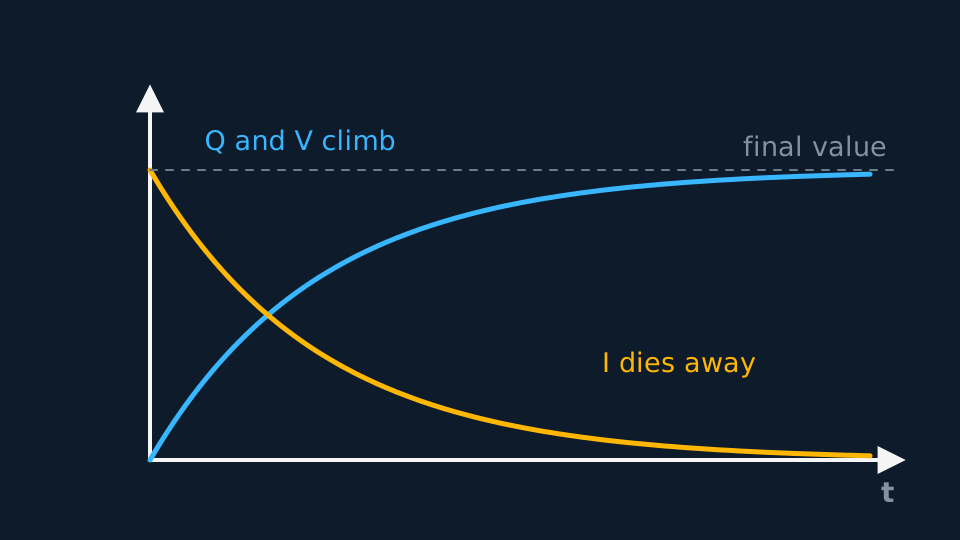
Connect an uncharged capacitor to a supply through a resistor and the charge and the capacitor pd rise towards their final values, as mirror images of the discharge curves. The current behaves in the opposite way: at the first instant the capacitor is uncharged and provides no opposing pd, so the current starts at its maximum, I0 = V/R. As charge builds up, the capacitor's rising pd opposes the supply, the pd across the resistor falls, and the current decays towards zero. When fully charged, the capacitor pd equals the supply pd and no current flows. Two quantities rise and one falls, and none of them changes at a steady rate.
Gradients and areas
Describe the drawing
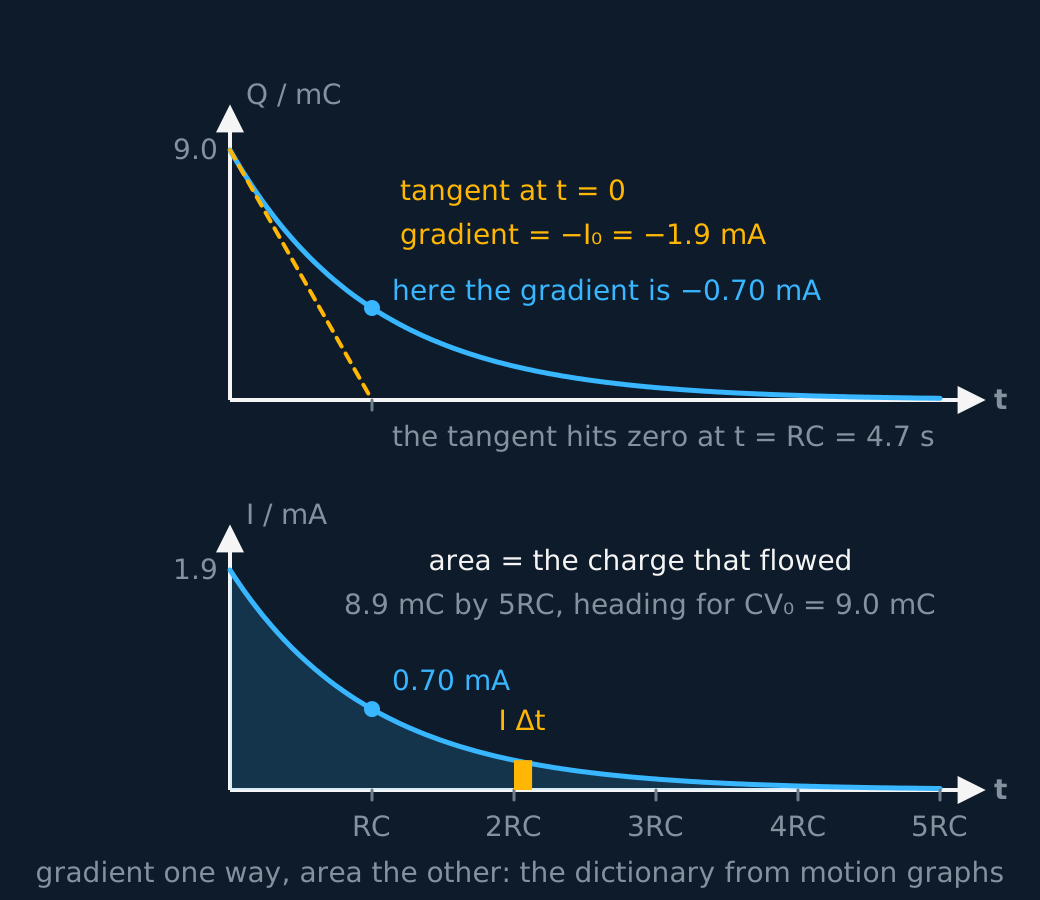
Two stacked graphs of the same discharge of a 1000 microfarad capacitor from 9.0 volts through 4.7 kilohms. Above, the charge falling from 9.0 millicoulombs, with the tangent at the start drawn in amber: its gradient is minus the initial current of 1.9 milliamps, and it reaches zero charge at exactly one time constant, 4.7 seconds, while the curve itself is still a third full there. Below, the current falling along the same shape with the whole region under it shaded and one narrow strip of width I delta t picked out in amber, the shaded total being 8.9 millicoulombs after five time constants and heading for the 9.0 millicoulombs the plates began with. The gradient of one graph is the current, and the area under the other is the charge.
These graphs are read as well as sketched. On the Q against t graph the gradient gives the current, since I = ΔQ/Δt; it is steepest at the start of either process and flattens towards zero. Fix the sign convention before quoting a value. Every graph, equation and answer here treats the discharge current as a magnitude, a positive quantity falling towards zero. The gradient of Q against t is negative during a discharge, which indicates only that charge is leaving the plates, so take its magnitude.
On the I against t graph the area underneath is the charge transferred, as in the electricity unit. Over a complete charging process, the total area under the decaying current curve equals the final charge CV.
GUIDED PRACTICE
Say what the gradient is
For the discharge above (Q0 = 9.0 mC, I0 = 1.9 mA), state what the gradient of the charge-time graph represents, give its value at t = 0, and say what the area under the current-time graph must total.
Show the working
The gradient of Q against t represents the current, negative here because charge is leaving the plates, and at t = 0 its magnitude is the initial current, 1.9 mA, which is the steepest point of the curve.
The area under I against t is the total charge that flows, 9.0 mC, however long the tail takes. Gradient gives current and area gives charge, in the same way as for motion graphs.
ASSESSMENT FOCUS
- When asked how a capacitor charges, describe electrons rather than charge in general: the supply moves electrons onto one plate and off the other in equal numbers, and none of them crosses the gap. State the point about the gap explicitly, since picturing a capacitor as a container that fills with charge gets it wrong.
- Sketching marks are awarded for the landmarks: correct starting value, correct final value, steepest gradient at t = 0, and a curve that flattens without meeting its asymptote.
- State the direction of every curve before its shape. Discharge sends Q, V and I down together, while charging sends Q and V up and I down.
- The explanation of the shape requires the feedback statement: the current depends on the pd, the pd depends on the charge, so the rate of change falls as the process runs. The charging current at t = 0 is I0 = V/R, set by the resistor alone, because an uncharged capacitor provides no opposing pd at that instant.
- The magnitude of the gradient of Q against t gives I, and the area under I against t gives Q, in the same way as for motion graphs. A discharge gradient is negative, and it is the magnitude that gives the current.
CHECK YOURSELF
A 12 V supply charges a capacitor through a 10 kΩ resistor. State the current the moment the switch closes, and the current and capacitor pd after a long time, explaining each value.
Show a hint
At the first instant the capacitor has no pd across it; after a long time its pd equals the supply pd.
Show the answer
At t = 0 the uncharged capacitor has no pd, so all 12 V sits across the resistor and = 12 / 10 000 = 1.2 mA.
After a long time the capacitor pd has climbed to 12 V, matching the supply.
With no pd left across the resistor the current falls to zero. The capacitor is fully charged and no further charge is transferred.
On discharge, Q, V and the current magnitude decay exponentially along the same curve.
On charging, Q and V rise while the current starts at V/R and falls to zero.
WORKBOOK
Printable practice for this topic: original exam-style questions with room to work, and a fully worked answer book. Free to use; please do not redistribute or sell.
Or read them with their mark schemes on the charging and discharging questions page.
WHERE TO GO NEXT
- Required practical 9: charging and discharging a capacitor puts this topic in the lab, and the written papers ask about it.
- Exponentials and logarithms is the maths this lesson leans on, worked through step by step.
- Gradients and areas under graphs is the maths this lesson leans on, worked through step by step.
USED LATER IN
CHECK YOUR PROGRESS
Rate how confident you feel with each objective for this lesson. Ratings are saved in this browser, on this device, unless you sign in.
- Describe charging and discharging as a flow of electrons in the leads, with no charge crossing the gap.
- Sketch and explain the Q, V and I against t graphs for discharge.
- Sketch and explain the charging graphs, in which the current falls while the charge and pd rise.
- Read gradients and areas: current from the magnitude of the Q–t gradient, charge from the I–t area.
Open the full revision checklist to track your progress across the whole unit.