Physics › Particles › Quarks and the hadrons built from them
Quarks and the hadrons built from them
Every hadron on this course is built from up, down and strange quarks, a baryon from three of them and a meson from a quark with an antiquark. The proton is uud and the neutron udd, while the pions and kaons are quark-antiquark pairs. Adding up the quarks' values checks a composition for charge, baryon number and strangeness, or deduces one.
Choose your exam board to show the notes and questions relevant to your specification. You can change this setting at any time, and content for other boards remains available.
Quarks and antiquarks, part 1 of 2. Part 2 is Decays at quark level.
Builds on Classification of particles.
IN THIS TOPIC
- Use the booklet's table of charge, baryon number and strangeness for the u, d and s quarks and their antiquarks.
- Build the proton, neutron, antiproton, antineutron, pions and kaons from quarks.
- Check any composition by adding thirds, for charge, baryon number and strangeness alike.
COMMON MISCONCEPTION
Protons and neutrons are fundamental.
Protons and neutrons are not fundamental: each is made of three quarks, uud for the proton and udd for the neutron, as shown by deep inelastic electron scattering.
The quark table
Every hadron AQA tests is built from three quark flavours. An up quark carries charge +⅔ e, baryon number +⅓ and strangeness 0. A down carries −⅓ e, +⅓ and 0. A strange carries −⅓ e, +⅓ and strangeness −1, the flavour the quantum number is named after. Each has an antiquark, written with a bar (, , ), with every sign flipped. The full table comes printed in the data booklet, so the examinable skill is building with it.
Three flavours is the whole requirement on every board but one, and where you should stop unless you sit CIE. CIE names all six flavours, on the grounds that a quark is a fundamental particle and the family is complete at six: up, down, strange, charm, top and bottom. The extra three only repeat the pattern already on the page, charm and top carrying +⅔ e and bottom −⅓ e, with each antiquark taking the opposite charge, and CIE asks for no other property of them whatever. Edexcel adds a single historical note, that the symmetry of the model predicted the top quark before anyone found one.
Baryons: three quarks
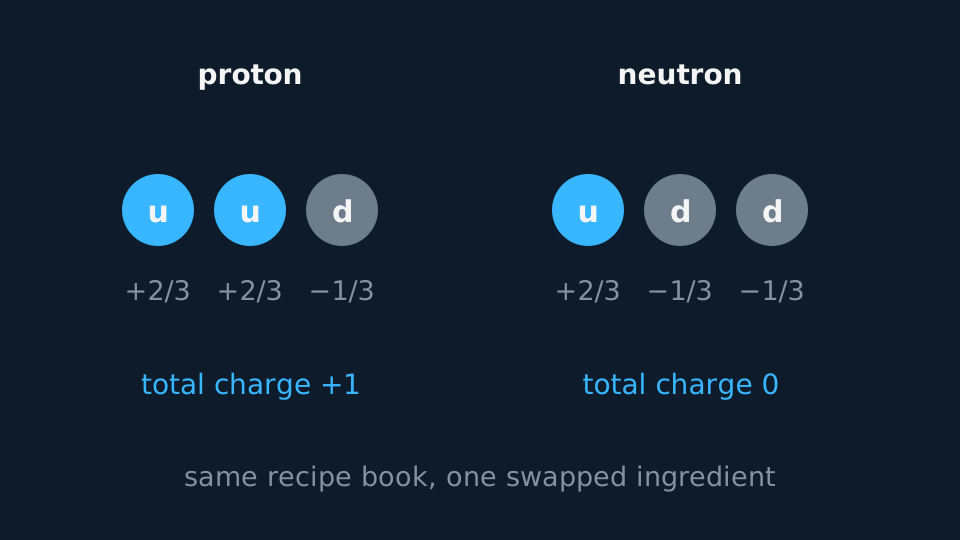
A baryon is three quarks, so its baryon number is three thirds, which comes to +1 as it must. The proton is uud and the neutron is udd, their charges falling straight out of the fractions. Antibaryons take the mirror recipes, the antiproton being and the antineutron , with charges −1 and 0 and baryon number −1 each.
Mesons: a quark and an antiquark
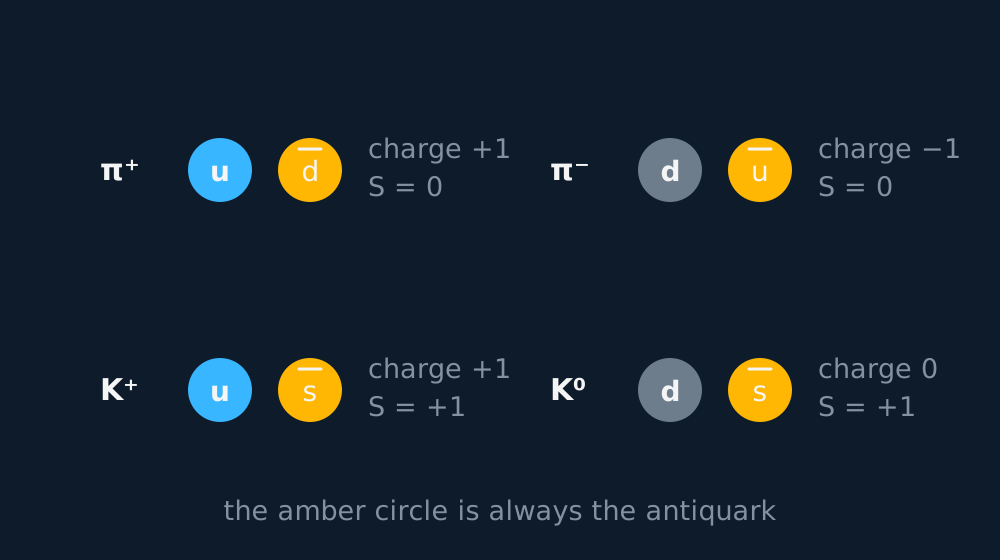
A meson is a quark bound to an antiquark, so its baryon number is ⅓ − ⅓ = 0, exactly as the classification demanded. The pion family holds no strange quarks at all, so every pion has S = 0. Each kaon contains one strange or anti-strange quark, and that single quark is where its strangeness of ±1 lives. A K containing has S = +1, and one containing s has S = −1. Only u, d and s and their antiquarks build the hadrons anyone examines. Even on CIE the heavier three never have to be assembled into anything, so the rest of the family stays off the paper.
WORKED EXAMPLE
Building a kaon from the table
The K+ has quark content u. Verify its charge and strangeness from the quark table.
Take charge first. The u contributes +⅔ and the , being an anti-strange, contributes +⅓, giving +1 and matching the kaon's label.
Now strangeness. The u carries none, and the carries S = +1, the strange quark itself being the one with S = −1. That gives S = +1.
Baryon number finishes the check at ⅓ − ⅓ = 0, as any meson must.
GUIDED PRACTICE
The antiproton, assembled
Write the antiproton's quark content and verify its charge and baryon number.
Show the working
Mirror the proton's uud, and the antiproton is .
Charge comes to −⅔ − ⅔ + ⅓ = −1, and baryon number to three antiquarks at −⅓ each, so −1. Every sign flipped, exactly as the mirror demands.
INDEPENDENT PRACTICE
A mystery baryon
A particle has charge −1, baryon number +1 and strangeness 0, and contains no strange quarks. Deduce a possible quark content from u and d alone.
Show the working
Baryon number +1 means three quarks. With u at +⅔ and d at −⅓, the only trio that reaches −1 is ddd, since −⅓ −⅓ −⅓ = −1.
Three identical down quarks make a real particle, the Δ−. The deduction used only the charge and baryon-number values from the table, and particles of this kind were predicted from the model before they were observed.
The neutron's decay at quark level has moved to the next part of this lesson.
Any decay, taken apart the same way has moved to the next part of this lesson.
ASSESSMENT FOCUS
- Learn the recipes cold. Proton uud, neutron udd, antiproton , antineutron . Mesons are a quark with an antiquark, pions at strangeness 0 and kaons at ±1. The quark properties table itself is printed in the booklet, so read the values from it in the exam.
- Verify any composition by adding thirds. Charges must sum to a whole number of e, and a trio of quarks must give B = +1.
- CIE alone wants all six flavours by name and by charge: up, down, strange, charm, top and bottom, with charm and top at +⅔ e and bottom at −⅓ e. Nothing further about the heavy three is asked. On AQA, OCR and Edexcel, three flavours is the whole answer.
- Antiquarks flip every sign, charge and baryon number and strangeness together. Flipping the charge alone leaves an antiparticle with the wrong baryon number and strangeness.
CHECK YOURSELF
Using quark charges, show that the proton's charge is +1 and the neutron's is 0. Then deduce the quark composition of a baryon of charge 0 and strangeness −1, using up, down and strange quarks only.
Show a hint
Add thirds. A baryon is three quarks, and strangeness −1 fixes one of them.
Show the answer
Proton, uud, gives ⅔ + ⅔ − ⅓ = +1. Neutron, udd, gives ⅔ − ⅓ − ⅓ = 0. Both come out as whole charges, as every hadron must.
Strangeness −1 needs exactly one s quark, which carries −⅓ e. The remaining two must carry +⅓ e between them, and from u at +⅔ and d at −⅓ the only pair that does is ud, so the baryon is uds.
Checking in thirds is the whole method, and it works in both directions: forwards to test a composition somebody gives you, backwards to deduce one they do not.
Baryons are three quarks. Mesons are a quark with an antiquark.
Antiquarks flip every sign.
Add thirds: every hadron's charge comes out whole.
WORKBOOK
Printable practice for this topic: original exam-style questions with room to work, and a fully worked answer book. Free to use; please do not redistribute or sell.
Or read them with their mark schemes on the quarks and the hadrons built from them questions page.
CHECK YOUR PROGRESS
Rate how confident you feel with each objective for this lesson. Ratings are saved in this browser, on this device, unless you sign in.
- Use the booklet's table of charge, baryon number and strangeness for the u, d and s quarks and their antiquarks.
- Build the proton, neutron, antiproton, antineutron, pions and kaons from quarks.
- Check any composition by adding thirds, for charge, baryon number and strangeness alike.
Open the full revision checklist to track your progress across the whole unit.