Physics › Required practicals › Boyle's law and Charles's law
REQUIRED PRACTICAL 8Boyle's law and Charles's law
Investigating how the pressure of a fixed mass of gas varies with volume at constant temperature, and how volume varies with temperature at constant pressure.
Theory: Ideal gases and the gas laws
What you are trying to do
Test Boyle's law by compressing a fixed mass of gas at constant temperature, and Charles's law by warming one at constant pressure.
Apparatus
- Boyle's law: a sealed column of trapped air with an oil piston, pressure gauge and pump (the standard Boyle's law apparatus). Read the gauge's own label: some read absolute pressure and some read the excess above atmospheric, and the analysis depends on which
- Charles's law: a capillary tube of air sealed by a bead of concentrated sulfuric acid or oil, alongside a thermometer in a water bath
- Beaker, heater and stirrer for the bath; a ruler fixed to the capillary tube
Variables
- Independent: the absolute pressure of the trapped gas (Boyle); the temperature (Charles)
- Dependent: the volume of the trapped air, read as a column length
- Control: the mass of trapped gas in both parts; the temperature (Boyle); the pressure, atmospheric throughout (Charles)
Method
- Boyle: raise the pressure in small steps. After each step, wait before reading the volume: compression warms the gas, and the law you are testing holds at constant temperature only.
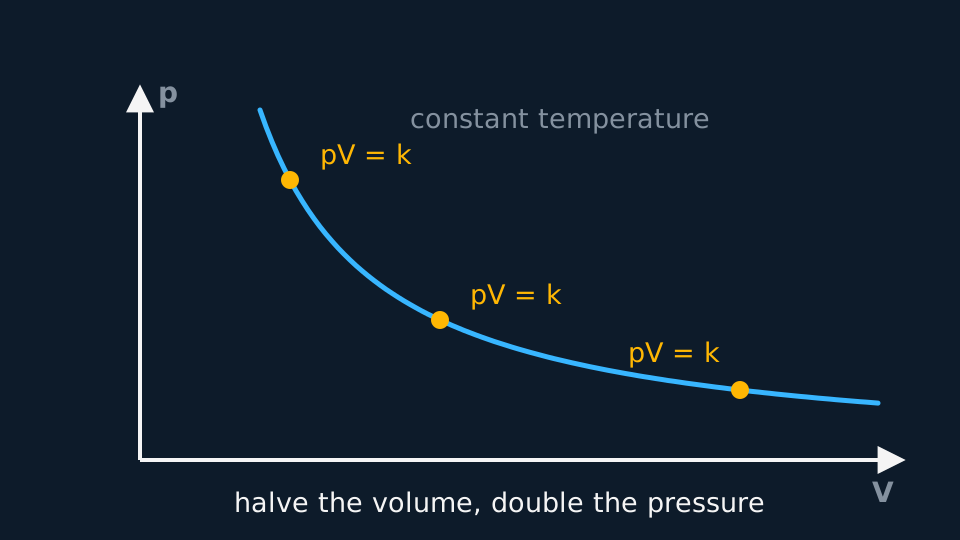
- Read the volume (or column length, for a uniform bore) at five or more pressures, going up and then coming back down, and check whether the return readings retrace the outward ones.
- Record every pressure as an absolute pressure, because pV = constant is a statement about absolute pressure and about nothing else. A gauge reading the excess above atmospheric has to have atmospheric pressure added to it before anything is plotted: take that from the laboratory barometer, or use 101 kPa if there is none. The tables and graphs below are all in absolute pressure.
- Charles: heat the water bath gently, stirring throughout, and read the trapped column's length at a series of temperatures as it expands under the constant weight of the bead and atmosphere.
Analysis
- Boyle: plot absolute pressure p against 1/V and fit an unconstrained straight line. A straight line through the origin is consistent with the law; equivalently, every row's pV product is the same number. A significant intercept may indicate a pressure zero error or unaccounted dead volume.
- The pressures have to be absolute. Writing p for the absolute pressure and pgauge = p − patm for the excess a gauge shows, pV = k rearranges to pgauge = k(1/V) − patm. Plot the gauge readings and the line is still straight, with the same gradient k, but it cuts the pressure axis at −patm rather than at the origin, and every pV product comes out different. An intercept of about −100 kPa is therefore evidence of gauge pressures that were not converted, not of a failure of Boyle's law. A smaller intercept has other candidate causes, including a gauge zero error and gas held in dead space beyond the scale.
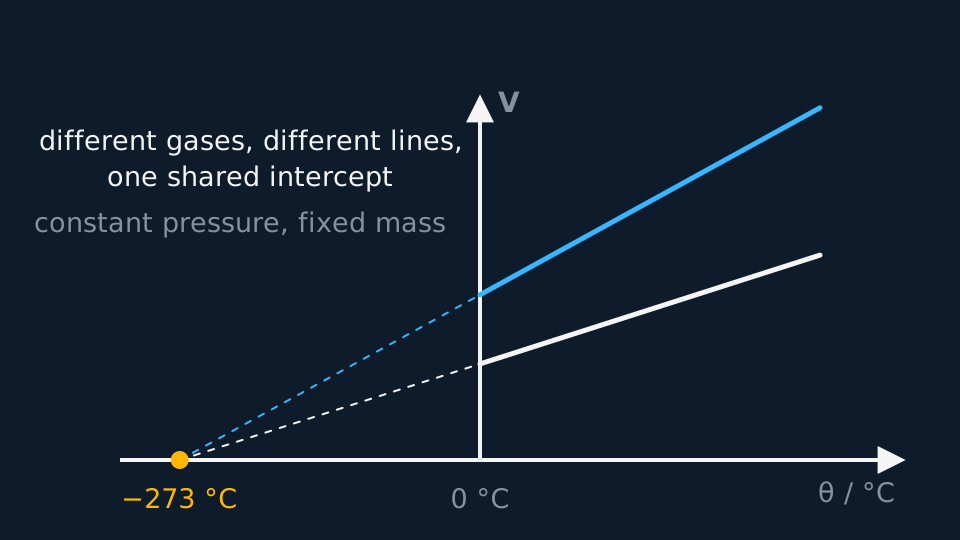
- Charles: plot V against temperature in °C and fit a straight line. Extrapolating it back to V = 0 estimates absolute zero; with kelvin on the axis the model predicts a line through the origin.
- What each half establishes. A steady pV supports Boyle's law for air at room temperature across the pressures you covered, and no further: nothing here tests a gas near liquefaction, where the law fails. The Charles line extrapolated to zero volume lands near −273 °C. That figure is a model-based extrapolation, not a measurement: it assumes the linear relation continues far outside the range you measured, whereas real air liquefies long before −273.15 °C is reached. A hundred degrees of readings pointing at an intercept nearly three hundred degrees beyond the coldest of them is an estimate, and quoting it to the nearest degree claims a precision the range cannot carry.
- What the trapped column hides. You read the length of gas in the tube, but the gas also fills whatever dead space lies beyond the scale, so every volume is short by the same unknown amount. In Boyle's law that shows as a pV product which drifts steadily instead of holding; in Charles's law it shifts the intercept without bending the line. Reading the column while cooling as well as while warming costs nothing and is worth doing: if the two runs do not retrace, the trapped air was not in equilibrium with the bath, or gas has escaped, or the apparatus itself shows hysteresis. The failure to retrace does not by itself say which.
A worked set of readings: Boyle's law
Trapped air at constant room temperature. Every pressure is an absolute pressure, so the first row is the gas sitting at atmospheric pressure with the pump idle:
| p (absolute) / kPa | V / cm³ | pV / kPa cm³ |
|---|---|---|
| 100 | 36 | 3600 |
| 120 | 30 | 3600 |
| 150 | 24 | 3600 |
| 200 | 18 | 3600 |
| 240 | 15 | 3600 |
Idealised illustrative data, chosen so the working is easy to follow. Real readings scatter about the line rather than sitting on it, and your own graph will have points either side of the best fit.
The product pV is 3600 kPa cm³ in every row, and p against 1/V is a straight line through the origin, which is what Boyle's law predicts. Read the same column as gauge pressures and every true pressure would be about 101 kPa higher, so pV would slide from 7236 down to 5115 kPa cm³ across the run instead of holding, which is what a missed conversion looks like.
A worked set of readings: Charles's law
The length of the trapped air column (uniform bore, so length stands in for volume) warming at atmospheric pressure:
| θ / °C | L / mm |
|---|---|
| 0 | 60.0 |
| 20 | 64.4 |
| 40 | 68.8 |
| 60 | 73.2 |
| 80 | 77.6 |
| 100 | 82.0 |
Idealised illustrative data, chosen so the working is easy to follow. Real readings scatter about the line rather than sitting on it, and your own graph will have points either side of the best fit.
The line has gradient 0.220 mm per °C and reaches L = 0 at θ = −273 °C: the extrapolation lands on absolute zero.
Evaluating the result
Idealised Boyle readings with one taken in a hurry. Compressing a gas warms it, and the reading at 150 kPa was taken while the trapped air was still about 18 degrees above the room. The third column is the product pV, which Boyle's law says is the same number in every row.
| p (absolute) / kPa | V / cm³ | pV / kPa cm³ |
|---|---|---|
| 100 | 36.00 | 3600 |
| 120 | 30.00 | 3600 |
| 150 | 25.47 | 3821 |
| 200 | 18.00 | 3600 |
Idealised illustrative data, chosen so the working is easy to follow. Real readings scatter about the line rather than sitting on it, and your own graph will have points either side of the best fit.
Three rows give 3600 kPa cm³ and the hurried one gives 3821. On a graph of p against 1/V it lies above the line. Gas still warm from compression has not finished contracting, so incomplete thermal equilibration puts a point on that side; the direction narrows the candidates without settling them. Wait for the column to settle, read it again, and keep both readings with the reason recorded. If the return sweep as a whole does not retrace the outward one, do not conclude a leak from the direction of the gap alone. Leakage, incomplete equilibration, hysteresis in the apparatus and gauge drift can all produce such a gap. Check the seal, allow longer between readings, and repeat the sweep before deciding which it was.
Where the uncertainty comes from
- Temperature control (Boyle): Everything here rests on isothermal changes: small steps, patient waits, and the up-and-down check.
- Absolute or gauge pressure: A systematic error of about 100 kPa if the conversion is missed, which is larger than the whole spread of a school Boyle run. State the convention beside the table.
- Reading a column: A uniform bore turns volume into length; parallax at the meniscus or bead is the main reading error.
- Thermometer and bath: Stir constantly and give the trapped air time to reach the bath's temperature; the thermometer reads the water, not the air, unless you let them agree.
- The extrapolation: Absolute zero sits far outside the measured range, so a small gradient error moves the intercept a long way. Quote it as an estimate.
What earns the marks
✓Marks
- Give the reason for slow, stepped pressure changes: keeping the compression isothermal.
- Linearise: p against 1/V, and V against T, and state what each gradient represents.
- Say that the pressures are absolute, and add atmospheric pressure to a gauge reading before plotting. A pV product formed from gauge pressures is not constant, so it does not test the law.
- Stir the bath, and wait for thermal equilibrium before reading.
- The extrapolation to −273 °C is the expected finish of the Charles analysis; know that all gases point at the same intercept.
Safety
!Caution
Pressurised glassware requires safety spectacles, and the Boyle apparatus should not be pumped beyond its rated pressure. Take care with hot water and the heater, and an acid-sealed capillary is handled by the teacher.
Method and analysis here follow the standard approach; your school may vary the apparatus. Always follow your teacher’s risk assessment in the lab.