Biology › Cell cycles, reproduction and development › Sexual reproduction in flowering plants
Sexual reproduction in flowering plants
A flowering plant makes its male nuclei inside pollen grains and its egg inside an embryo sac, and it uses both male nuclei it delivers. This lesson follows each from meiosis in the flower, down the pollen tube, to the double fertilisation that gives a diploid zygote and a triploid endosperm.
Before this Meiosis and the sources of genetic variation · Gametes, fertilisation and early development
COMMON MISCONCEPTION
Pollination and fertilisation are the same event.
Pollination is only the arrival of pollen on a stigma. Fertilisation happens later and further in: a pollen tube has to grow down the style and through the micropyle before two male nuclei are released in the embryo sac, where one fuses with the egg and the other with the two polar nuclei.
What you should be able to do
- Name the parts of a flower and give the job of each, including the parts of the stamen and of the carpel.
- Describe how a pollen grain forms in the anther, naming each division as meiosis or mitosis.
- Describe how the embryo sac forms in the ovule, and give the position of each of its eight nuclei.
- Explain how the male nuclei reach the embryo sac, including the roles of the tube nucleus, the pollen tube and the enzymes it secretes.
- Describe double fertilisation, and state the number of chromosome sets in the zygote and in the endosperm.
- Plan and explain an investigation into the effect of sucrose concentration on pollen tube growth or germination.
The flower and its parts
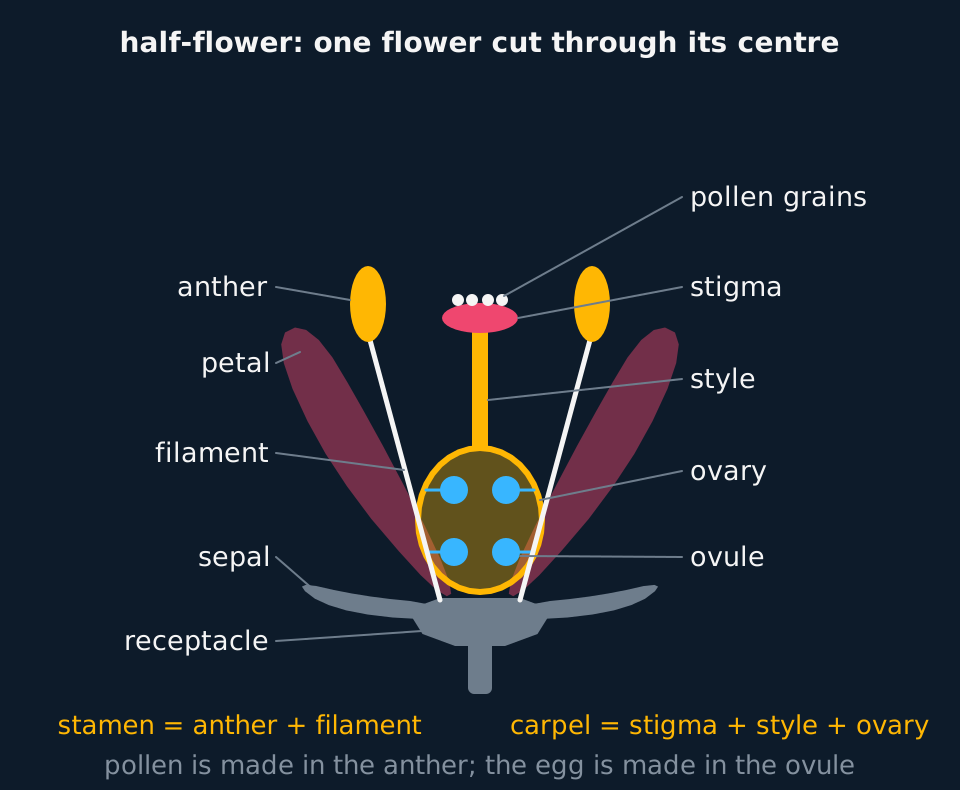
A flower is a shoot that has been adapted for sexual reproduction, and its parts are arranged in rings on the swollen tip of the stalk, the receptacle. From the outside in they are the sepals, the petals, the stamens and, at the centre, one or more carpels. The sepals enclose and protect the flower while it is a bud. The petals of an insect-pollinated flower are usually large and coloured, and they attract the pollinators; a wind-pollinated grass has small, dull petals or none.
The stamen is the male part. It is a stalk, the filament, carrying an anther at its tip, and the anther is where pollen grains are made. The filament holds the anther where pollen will be picked up by an insect or caught by the wind, and carries water and nutrients to it in its vascular tissue.
The carpel is the female part. At its top is the stigma, the surface that receives pollen; below that is the style, the column a pollen tube grows down; and at the base is the ovary, a hollow chamber holding one or more ovules. Each ovule will contain one egg cell, and after fertilisation each ovule becomes a seed and the ovary becomes the fruit.
Describe the drawing
A flower cut in half from top to bottom. At the centre is the carpel: a stigma at the top with pollen grains on it, a style running down from it, and an ovary at the base containing four ovules, each attached to the ovary wall. On either side a stamen rises from the receptacle: a thin filament carrying an anther at its tip. Petals curve outwards behind the stamens and small sepals sit below them on the receptacle, which joins the stalk. The stamen is the anther and filament; the carpel is the stigma, style and ovary. Pollen is made in the anther and the egg cell in the ovule.
Name the exact structure rather than the whole organ. Pollen is made in the anther, not in the stamen as a whole, and an egg cell is made in an ovule, which is inside the ovary. A flower with both stamens and carpels, like the one drawn, can in principle pollinate itself. Self-pollination moves pollen to a stigma of the same flower or the same plant; cross-pollination moves it to a stigma on another plant of the same species, and gives more genetic variation in the offspring.
- Stamen
- The male part of a flower: a filament carrying an anther, in which pollen grains are made.
- Carpel
- The female part of a flower: a stigma, a style and an ovary containing one or more ovules.
- Pollination
- The transfer of pollen grains from an anther to a stigma.
- Micropyle
- The small gap in the integuments at one end of an ovule, through which a pollen tube usually enters.
How a pollen grain forms in the anther
A typical anther has four pollen sacs, and each is lined by a layer of cells called the tapetum, which supplies nutrients to the cells developing inside it and contributes material to their walls. Filling the sac are diploid pollen mother cells.
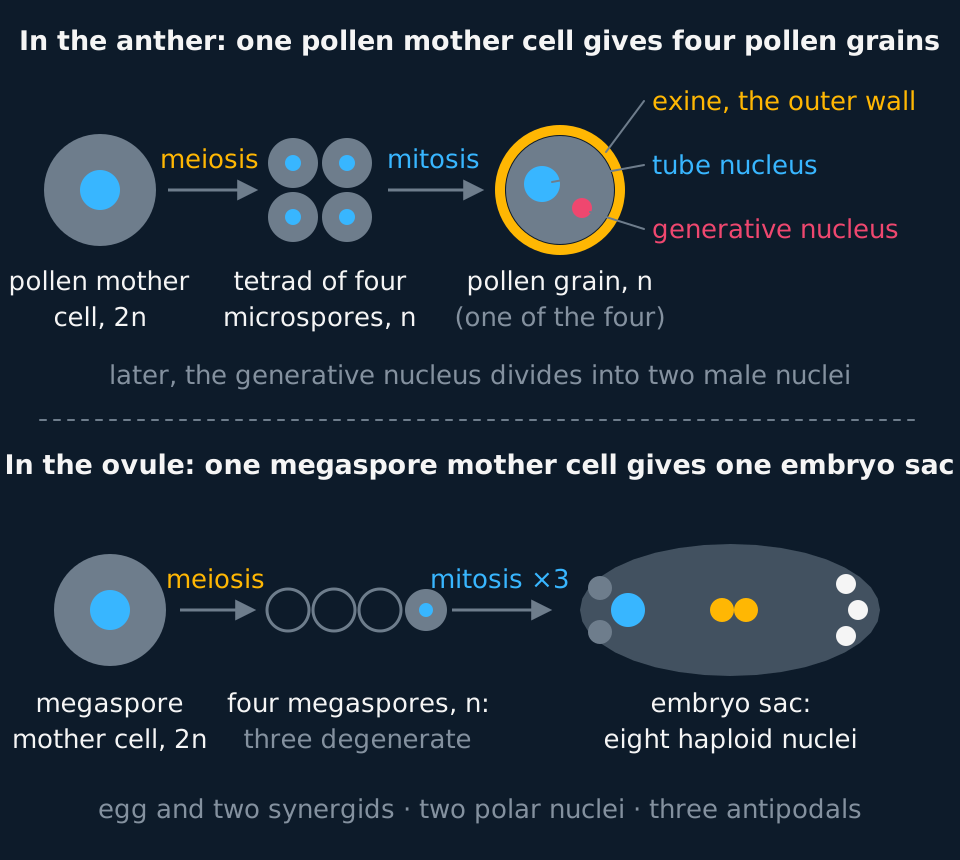
Each pollen mother cell divides by meiosis to give four haploid cells, which stay together for a time as a tetrad. These are the microspores, and the four of them are genetically different from one another and from the parent for the reasons given in meiosis and the sources of genetic variation: crossing over and independent assortment.
The tetrad separates, and each microspore develops into a pollen grain. Its haploid nucleus divides by mitosis into two: a large tube nucleus and a smaller generative nucleus. Both are haploid and both carry identical alleles, because they come from one nucleus by mitosis. At the same time a two-layered wall forms around the grain. The inner layer is the intine. The outer layer, the exine, is made largely of sporopollenin, which is very resistant to decay, and is thin at one or more pores where a pollen tube can later emerge.
Describe the drawing
Two rows. In the anther, a diploid pollen mother cell divides by meiosis into a tetrad of four haploid microspores. Each microspore's nucleus divides by mitosis, giving a pollen grain with a tough outer wall, the exine, a large tube nucleus and a smaller generative nucleus, which later divides by mitosis into two male nuclei. In the ovule, a diploid megaspore mother cell divides by meiosis into a row of four haploid megaspores, three of which degenerate. The survivor's nucleus divides by mitosis three times, giving an embryo sac of eight haploid nuclei: an egg cell and two synergids at one end, two polar nuclei in the middle and three antipodal cells at the other end.
When the pollen is mature the anther wall dries and splits open along a line on each side, which is called dehiscence, and the grains are released. The generative nucleus divides once more by mitosis to give two male nuclei, the male gametes. In many species this happens in the pollen tube after the grain has germinated; in some, the grasses among them, it happens inside the grain before it is released. Either way the result is the same: two haploid male nuclei, genetically identical to each other.
A pollen grain is not itself a gamete. It is a small haploid structure that carries the male gametes and delivers them, which is why a question about the male gamete of a flowering plant is answered with the male nucleus, not the pollen grain.
- Tube nucleus
- The larger of the two nuclei formed when a microspore's nucleus divides by mitosis; it controls the growth of the pollen tube.
- Generative nucleus
- The smaller nucleus of a pollen grain, which divides by mitosis to give the two male nuclei.
How the embryo sac forms in the ovule
An ovule is attached to the inside of the ovary wall by a short stalk. Its central tissue is the nucellus, and around that are one or two protective layers, the integuments, which do not quite close at one end. The gap they leave is the micropyle.
One cell of the nucellus near the micropyle enlarges to become the diploid megaspore mother cell (sometimes called the embryo sac mother cell). It divides by meiosis to give a row of four haploid megaspores. Three of them degenerate, and in most flowering plants the one that survives is the one furthest from the micropyle.
The surviving megaspore grows, taking over much of the nucellus, and its nucleus divides by mitosis three times without the cell dividing, giving 2, then 4, then 8 haploid nuclei. Four lie at each end at first, and then one from each end moves to the centre. Cell membranes and walls form around six of the others, and the result is the mature embryo sac:
| Position | What is there | What it does |
|---|---|---|
| Micropyle end | The egg cell, with two synergids beside it | The egg nucleus fuses with a male nucleus; the synergids attract the pollen tube and one receives it |
| Centre | Two polar nuclei in a large central cell | They fuse with the second male nucleus to form the endosperm nucleus |
| Far end | Three antipodal cells | No part in fertilisation; in most species they degenerate |
So the embryo sac has eight haploid nuclei in seven cells, since the two polar nuclei share the central cell. This pattern is found in most flowering plants and is the one the specification expects; a minority of species build their embryo sac a little differently. In some species the two polar nuclei fuse before fertilisation into a single diploid nucleus, which changes nothing about the endosperm being triploid in the end.
Compare the two pathways side by side. Both begin with one diploid mother cell dividing by meiosis, and both then use only mitosis. The difference is in what is kept: in the anther all four products of meiosis become pollen grains, while in the ovule three of the four are lost and the fourth produces a whole embryo sac.
- Embryo sac
- The structure inside an ovule, formed from one megaspore by three mitotic divisions, holding the egg cell, two synergids, two polar nuclei and three antipodal cells.
Pollination and the pollen tube
Pollination is the transfer of pollen from an anther to a stigma. It is not fertilisation, and the two are separated by the growth of a pollen tube that, in a long style, can take hours or more.
A pollen grain that lands on a stigma of the same species absorbs water and takes in the sugary fluid the stigma secretes, and it germinates: a pollen tube grows out through one of the pores in the exine. The tube grows only at its tip, and it grows through the stigma and down the style towards the ovary. Pollen on the stigma of a different species usually fails at this stage, because recognition between the grain and the stigma does not happen.
Four parts of the pollen grain each have a role in getting the male nuclei from the stigma to the embryo sac.
The pollen tube is the route. It is an outgrowth of the pollen grain's own cell, so the nuclei and cytoplasm move down inside it, protected from drying out, and it can be many times longer than the grain it came from.
The tube nucleus stays near the growing tip and controls the tube's growth. It is the nucleus whose genes are transcribed to make the proteins the tube needs, the hydrolytic enzymes among them. Once the tube has reached the embryo sac its work is done and it degenerates.
The enzymes are secreted from the tip of the tube. They are hydrolytic enzymes, including enzymes that break down pectin, and they digest a path through the tissues of the style. The products of that digestion are absorbed by the tube and used, with the sugars taken up from the stigma, as respiratory substrates and as raw material for new tube wall.
The generative nucleus follows behind the tube nucleus and, if it has not already done so, divides by mitosis to give the two male nuclei. Neither male nucleus moves itself: they are carried down by the tube's growth.
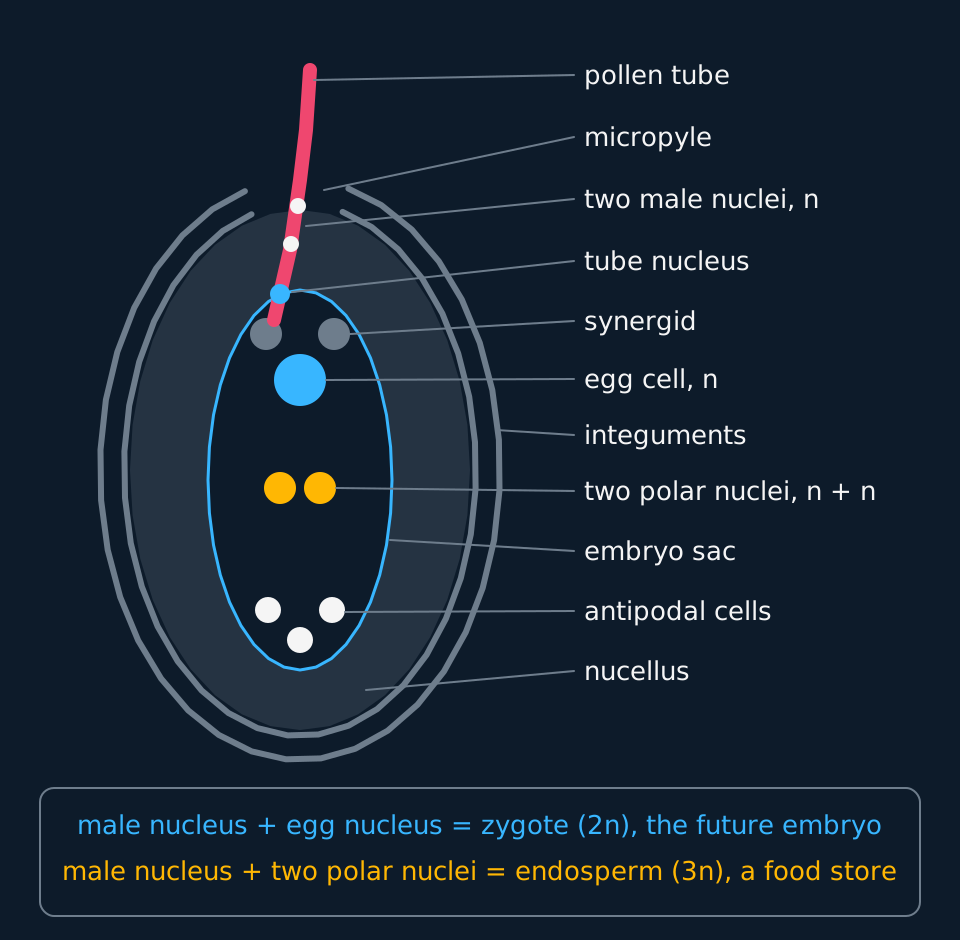
The tube's direction is set by chemicals. Chemicals released from the ovule, from the synergids in particular, attract the tip, so the tube grows towards them, which is chemotropism (see plant responses). The tube reaches the ovary, enters an ovule through the micropyle, passes through the nucellus and enters one of the two synergids. Its tip then bursts and releases the two male nuclei into the embryo sac.
TRY IT: One ovule, one tube
A poppy flower has a very large number of ovules in its ovary. Explain why at least that many compatible pollen grains must land on its stigma for every ovule to become a seed.
Check your answer
Each pollen tube carries only two male nuclei and enters only one ovule, where both are used in a single double fertilisation.
So one pollen grain can lead to at most one seed, and every ovule that becomes a seed needs a pollen tube of its own. The number of grains that germinate and grow a tube all the way down the style must be at least the number of seeds, and in practice more grains than that land, because some do not germinate.
Double fertilisation
Both male nuclei are used, and each fuses with a different partner. That is what the word double refers to: two fusions, in one embryo sac, at about the same time.
Describe the drawing
An ovule in section, wrapped in two integuments that leave a gap at the top, the micropyle, and filled with nucellus tissue. Inside it lies the embryo sac: two synergids and the egg cell at the micropyle end, two polar nuclei in the middle and three antipodal cells at the far end. A pollen tube grows down through the micropyle and into one synergid. The tube nucleus is near the tip of the tube, with the two haploid male nuclei just behind it. A box below gives the two fusions: one male nucleus with the egg nucleus makes a diploid zygote, which becomes the embryo, and the other male nucleus with the two polar nuclei makes a triploid endosperm nucleus, which becomes the food store.
One male nucleus fuses with the nucleus of the egg cell. Haploid plus haploid gives a diploid zygote, and the zygote divides by mitosis to become the embryo of the seed.
The other male nucleus fuses with the two polar nuclei in the central cell. Three haploid nuclei fuse, so the result is a triploid endosperm nucleus, with three sets of chromosomes. It divides repeatedly by mitosis to form the endosperm, a tissue that stores food, mainly starch, and in many seeds oil and protein as well, for the embryo to use as it grows.
The synergids and the antipodal cells take no part in either fusion and usually degenerate. The endosperm forms only once a male nucleus has reached the central cell, and the two male nuclei arrive together, so endosperm normally develops only in an embryo sac whose egg is also being fertilised. A plant does not build food stores in ovules whose eggs were never fertilised.
Counting chromosome sets in the garden pea
The garden pea has a diploid number of 14. State the number of chromosomes in a pollen mother cell, a generative nucleus, a male nucleus, an egg cell, a polar nucleus, a zygote and an endosperm nucleus.
Show the working
The pollen mother cell is diploid and has 14. Meiosis halves that, so the microspore has 7, and the mitotic divisions after it keep it at 7: the generative nucleus and each male nucleus have 7.
On the female side the megaspore mother cell has 14, meiosis gives megaspores with 7, and three rounds of mitosis keep every nucleus at 7, so the egg cell and each polar nucleus have 7.
The zygote is one male nucleus and the egg: 7 + 7 = 14. The endosperm nucleus is one male nucleus and two polar nuclei: 7 + 7 + 7 = 21, three sets.
- Double fertilisation
- The fusion, in the embryo sac of a flowering plant, of one male nucleus with the egg nucleus to form a zygote and of the other with the two polar nuclei to form a triploid endosperm nucleus.
- Endosperm
- The triploid food-storing tissue of a seed, formed by mitosis from the nucleus produced when a male nucleus fuses with the two polar nuclei.
From ovule to seed, and ovary to fruit
After fertilisation the parts of the flower take on new roles. The zygote divides by mitosis into an embryo with a young root, the radicle, a young shoot, the plumule, and one or two seed leaves, the cotyledons. The endosperm grows around it. The integuments harden into the seed coat, the testa, and the micropyle survives as a tiny pore in it, through which water can enter when the seed germinates. The whole ovule is now a seed, and the ovary wall develops into the fruit around it. The petals, stamens, stigma and style usually wither.
| Before fertilisation | After fertilisation |
|---|---|
| Zygote | Embryo: radicle, plumule, cotyledons |
| Endosperm nucleus | Endosperm, the food store |
| Integuments | Testa, the seed coat |
| Micropyle | Small pore in the testa |
| Ovule | Seed |
| Ovary wall | Fruit wall |
Seeds differ in where the food finally ends up. In cereals such as maize, wheat and barley the endosperm persists and is the main store in the ripe grain, which is why a germinating barley grain digests endosperm starch with amylase made under the control of gibberellin. In peas and beans the endosperm is absorbed by the growing embryo before the seed is ripe, and the food is stored in two large cotyledons instead.
Core practical: sucrose concentration and pollen tube growth
Pollen germinates and grows a tube in a sucrose solution on a microscope slide, which makes the growth of the tube easy to watch and to measure. The core practical asks how the concentration of sucrose affects it.
A typical method: make up a series of sucrose solutions, for example 0, 5, 10, 15, 20 and 25 g per 100 cm³ of water. Place one drop of each on its own labelled cavity slide. Transfer pollen from a freshly opened anther to each drop by touching the anther to the surface or with a fine paintbrush, and add a coverslip to limit evaporation, which would raise the concentration. Keep all the slides at the same temperature, and examine each under the microscope at fixed times, for example every 15 minutes for an hour.
There are two dependent variables to choose from. For germination, count the grains in a field of view and the number of those with a tube; a common rule is that a grain has germinated once its tube is longer than the grain's diameter. Express the result as a percentage and count several fields per slide. For growth, measure the length of a set number of tubes with an eyepiece graticule calibrated against a stage micrometer, and calculate the mean.
Control variables: the species, and the age of the flowers the pollen came from; the temperature; the volume of each drop; the time at which each slide is examined; and the criterion for counting a grain as germinated. Some recipes add a small amount of boric acid or a calcium salt, which pollen tubes need; if yours does, every solution must contain the same amount.
The usual result is an optimum. In distilled water or very dilute sucrose, the water potential outside is higher than inside the grain, water enters by osmosis, and many grains or tube tips burst. At high concentrations the outside water potential is lower, water leaves, and tubes grow little or not at all. In between, the tube takes in water without bursting and the sucrose is also a respiratory substrate for its growth. Where the optimum falls varies between species, so do not quote a figure as a general answer.
Safety. Pollen can trigger allergies, so a student with hay fever or asthma should avoid handling it directly, and everyone should wash their hands afterwards. Microscope slides and coverslips break into sharp fragments. Boric acid is classified as toxic to reproduction, so if the medium contains it, use the solution prepared for you rather than the solid, and follow the CLEAPSS Hazcard and your school's risk assessment.
TRY IT: Reading an optimum
A student grows pollen on sucrose solutions and records the percentage of grains that have germinated after one hour. At 0 g per 100 cm³ it is 4%, at 10 g it is 46%, at 15 g it is 62% and at 25 g it is 8%. The figures are constructed for this exercise. Explain the results at 0 g and at 25 g, and say what the student should do to find the optimum more precisely.
Check your answer
At 0 g the solution has a much higher water potential than the pollen grain, so water enters by osmosis and many grains burst or are damaged before a tube can grow, and there is no sucrose to respire.
At 25 g the solution has a lower water potential than the grain, so water leaves by osmosis and the grain cannot take up the water its tube needs to grow.
The optimum lies somewhere around 15 g, but the readings either side are 5 g apart. The student should repeat the experiment with smaller steps between about 10 and 20 g, with several fields counted at each, and calculate a mean for each concentration.
In the exam
- Say which division happens at each step. Meiosis once, in the pollen mother cell or the megaspore mother cell, and mitosis for every division after that.
- The male gametes of a flowering plant are the two male nuclei. A pollen grain carries them and is not itself the gamete.
- Give the tube nucleus, the pollen tube and the enzymes a job each: the nucleus controls growth, the tube carries the male nuclei, and the enzymes digest a path through the style.
- In double fertilisation name both fusions and both products: male nucleus with egg gives a diploid zygote, male nucleus with two polar nuclei gives a triploid endosperm.
- Pollination and fertilisation are separate events. Pollination ends at the stigma; fertilisation happens in the embryo sac.
- In the core practical, explain the effect of sucrose in terms of water potential and osmosis, and add that sucrose is a respiratory substrate for the growing tube.
Check yourself
Describe how the male nuclei of a flowering plant are formed and how they reach the embryo sac, and explain why the endosperm that forms has three sets of chromosomes.
Answer
In the anther, a diploid pollen mother cell divides by meiosis into four haploid microspores. Each microspore's nucleus divides by mitosis into a tube nucleus and a generative nucleus, and the generative nucleus divides by mitosis again into two haploid male nuclei, either in the grain or later in the pollen tube.
After pollination the grain absorbs water and sugar on the stigma and a pollen tube grows out through a pore in the exine. The tube nucleus, near the tip, controls its growth, and the tip secretes hydrolytic enzymes that digest a path through the style. The tube grows towards chemicals released by the ovule, enters through the micropyle and releases the two male nuclei into the embryo sac.
One male nucleus fuses with the egg nucleus to give a diploid zygote. The other fuses with the two polar nuclei. Each of the three is haploid, so the endosperm nucleus they form has three sets of chromosomes, and the endosperm grows from it by mitosis, which keeps that number.
Questions
Question 14 marks
Describe how a pollen grain containing two male nuclei develops from a pollen mother cell in the anther.
Mark scheme
- B1 the pollen mother cell is diploid and divides by meiosis
- B1 giving a tetrad of four haploid cells, or microspores, each of which becomes a pollen grain
- B1 the microspore nucleus divides by mitosis into a tube nucleus and a generative nucleus, and a wall with an outer exine forms around the grain
- B1 the generative nucleus divides by mitosis to give two haploid male nuclei
Question 24 marks
Describe how the embryo sac forms inside an ovule.
Mark scheme
- B1 a diploid megaspore mother cell in the nucellus divides by meiosis
- B1 this gives four haploid megaspores, three of which degenerate
- B1 the nucleus of the surviving megaspore divides by mitosis three times, giving eight haploid nuclei
- B1 these form an egg cell and two synergids at the micropyle end, two polar nuclei in the centre and three antipodal cells at the other end
Question 34 marks
After pollination, the male nuclei have to travel from the stigma to the embryo sac. Explain the roles of the tube nucleus, the pollen tube and the enzymes it secretes in getting them there.
Mark scheme
- B1 the pollen tube grows from the grain through the stigma and down the style, carrying the male nuclei inside it
- B1 the tube nucleus, near the tip, controls the growth of the tube, for example by its genes being transcribed to make the enzymes
- B1 the tip secretes hydrolytic enzymes that digest a path through the tissues of the style, and the products are absorbed and used by the growing tube
- B1 the tube grows towards chemicals from the ovule, enters through the micropyle and releases the male nuclei into the embryo sac
Question 44 marks
A student investigated the effect of sucrose concentration on the germination of pollen grains. The table shows the results, which are constructed for this question. Describe and explain the results.
| Sucrose concentration / g per 100 cm³ | Mean percentage of grains germinated after one hour |
|---|---|
| 0 | 4 |
| 5 | 18 |
| 10 | 46 |
| 15 | 62 |
| 20 | 35 |
| 25 | 8 |
Mark scheme
- B1 germination rises from 4% at 0 g to a peak of 62% at 15 g per 100 cm³, then falls to 8% at 25 g
- B1 at low concentrations the solution has a higher water potential than the grain, so water enters by osmosis and grains or tube tips burst
- B1 at high concentrations the solution has a lower water potential, so water leaves by osmosis and the tube cannot take up the water it needs to grow
- B1 sucrose is also a respiratory substrate, providing ATP for tube growth, which helps explain the rise from 0 g
Question 53 marks
Describe the process of double fertilisation in a flowering plant.
Mark scheme
- B1 the pollen tube releases two male nuclei into the embryo sac
- B1 one male nucleus fuses with the egg nucleus to form a diploid zygote
- B1 the other male nucleus fuses with the two polar nuclei to form a triploid endosperm nucleus
Question 63 marks
Maize has a diploid number of 20. Complete the table by giving the number of chromosomes in each nucleus.
| Nucleus | Number of chromosomes |
|---|---|
| pollen mother cell | ? |
| generative nucleus | ? |
| male nucleus | ? |
| polar nucleus | ? |
| zygote | ? |
| endosperm nucleus | ? |
Mark scheme
- B1 pollen mother cell 20 and generative nucleus 10
- B1 male nucleus 10 and polar nucleus 10
- B1 zygote 20 and endosperm nucleus 30
Question 73 marks
State the function of each of these parts of a flower: the anther, the stigma and the ovary.
Mark scheme
- B1 anther: where pollen grains are made, and from which they are released
- B1 stigma: the surface that receives pollen, on which the pollen grain germinates
- B1 ovary: contains and protects the ovules, and becomes the fruit after fertilisation
Question 83 marks
Describe how a student could measure the mean length of pollen tubes growing on a microscope slide.
Mark scheme
- B1 calibrate an eyepiece graticule against a stage micrometer at the magnification used
- B1 measure the length of each tube in eyepiece units and convert to micrometres using the calibration
- B1 measure a set number of tubes, chosen at random or in several fields of view, at a fixed time, and calculate the mean
Question 93 marks
Compare the formation of pollen grains in the anther with the formation of the embryo sac in the ovule.
Mark scheme
- B1 both begin with a diploid mother cell dividing by meiosis to give four haploid cells
- B1 in the anther all four haploid cells become pollen grains, whereas in the ovule three of the four megaspores degenerate and only one develops
- B1 in the pollen grain the nucleus divides by mitosis to give two nuclei, then the generative nucleus divides again, whereas the megaspore nucleus divides by mitosis three times to give eight nuclei
Question 103 marks
A pea flower is pollinated and later produces a pod containing seeds. Explain which parts of the flower become the seeds, the seed coats and the pod.
Mark scheme
- B1 each ovule becomes a seed, after the zygote inside it has divided by mitosis to form an embryo
- B1 the integuments of each ovule become its seed coat, the testa
- B1 the ovary wall becomes the pod, which is the fruit
Question 112 marks
Explain why the endosperm of a seed is triploid.
Mark scheme
- B1 the endosperm nucleus forms when one male nucleus fuses with two polar nuclei, each of which is haploid
- B1 so it has three sets of chromosomes, and the endosperm grows from it by mitosis, which keeps all three sets
Question 122 marks
In one field of view a student counts 48 pollen grains, 30 of which have a pollen tube longer than the diameter of the grain. Calculate the percentage of grains that have germinated.
Mark scheme
- M1 30 divided by 48, multiplied by 100
- A1 62.5%, or 63% to two significant figures
Question 132 marks
Explain why the two male nuclei delivered by one pollen tube are genetically identical to each other.
Mark scheme
- B1 both are formed from the generative nucleus by mitosis
- B1 mitosis produces nuclei with identical copies of the parent nucleus's DNA, so there is no crossing over or independent assortment to make them differ
Question 142 marks
The endosperm develops only after a male nucleus has fused with the polar nuclei. Suggest an advantage to the plant of the endosperm forming in this way rather than before fertilisation.
Mark scheme
- B1 the endosperm forms only in ovules where an egg is being fertilised at the same time
- B1 so the plant does not spend starch and other stored food on ovules that will never contain an embryo
Worth remembering
- Stamen is anther plus filament; carpel is stigma, style and ovary, with ovules inside the ovary.
- Pollen mother cell (2n) by meiosis to four microspores (n), then mitosis to a tube nucleus and a generative nucleus.
- The generative nucleus divides by mitosis into two male nuclei, which are the male gametes.
- Megaspore mother cell (2n) by meiosis to four megaspores; one survives and three mitoses give eight haploid nuclei.
- The embryo sac holds an egg and two synergids at the micropyle end, two polar nuclei in the centre and three antipodals at the far end.
- The tube nucleus controls growth, the enzymes digest the style, and the tube enters the ovule through the micropyle.
- Male nucleus with egg gives a 2n zygote; male nucleus with two polar nuclei gives a 3n endosperm.
- Ovule becomes seed, integuments become testa, ovary wall becomes fruit.
CHECK YOUR PROGRESS
Rate how confident you are with each objective for this lesson. Ratings are saved in this browser, on this device, unless you sign in.
- Name the parts of a flower and give the job of each, including the parts of the stamen and of the carpel.
- Describe how a pollen grain forms in the anther, naming each division as meiosis or mitosis.
- Describe how the embryo sac forms in the ovule, and give the position of each of its eight nuclei.
- Explain how the male nuclei reach the embryo sac, including the roles of the tube nucleus, the pollen tube and the enzymes it secretes.
- Describe double fertilisation, and state the number of chromosome sets in the zygote and in the endosperm.
- Plan and explain an investigation into the effect of sucrose concentration on pollen tube growth or germination.
Open the full revision checklist to see every objective in the curriculum in one place.
Practise this lesson
WORKBOOK
The written questions from this topic, on paper with room to work, and a separate book of mark schemes. The 2 questions that are set on a diagram stay on this page, where the diagram can be drawn. Free to use; please do not redistribute or sell.