Biology › Hormonal communication, plant responses and homeostasis › Plant responses: tropisms, auxins and the classic experiments
Plant responses: tropisms, auxins and the classic experiments
A plant cannot move away from anything, so its response to the world is to grow differently. A handful of substances made in one part of the plant and moved to another decide which cells elongate, and tropisms such as the bending of a shoot towards light are the visible result.
Before this Water potential and turgor in a plant cell · Transcription factors and the control of gene expression
COMMON MISCONCEPTION
Light destroys the auxin on the lit side of a shoot, so there is less of it there and that side grows less.
The evidence supports movement, not destruction. Auxin collected in agar from the lit and shaded halves of an illuminated coleoptile totals the same as in the dark; only its distribution has changed. Insert a barrier down the middle and the asymmetry disappears.
What you should be able to do
- Define a tropism and name the common ones with their stimulus and direction.
- State what Darwin's, Boysen-Jensen's and Went's experiments each establish, and what they do not.
- Explain how auxin causes a cell to elongate, using the cell wall.
- Explain why the same auxin distribution bends a shoot upwards and a root downwards.
- Describe apical dominance and the evidence that auxin from the apical bud causes it.
- Describe the effects of gibberellins and of abscisic acid.
- Give a commercial use of a plant growth substance and explain how it works.
- Describe the two forms of phytochrome and how red light, far-red light and darkness convert one into the other.
- Describe etiolation and explain how phytochrome brings about photomorphogenesis when a seedling reaches light.
- Explain how phytochrome controls flowering in long-day and short-day plants, using the results of night-break experiments.
- Explain how IAA and phytochrome each change the transcription of genes.
- Investigate the effect of gibberellin on amylase production in cereal grains with a starch agar assay, and process the clear zones into areas.
Tropisms and how they are named
A tropism is a growth response of a plant in which the direction of growth is determined by the direction of the stimulus. Growth towards the stimulus is positive and growth away from it is negative, and the stimulus gives the tropism its name: phototropism for light, gravitropism for gravity, hydrotropism for water, thigmotropism for touch, chemotropism for a chemical.
Shoots are positively phototropic and negatively gravitropic; roots are the other way round on both counts, and positively hydrotropic besides. Each has a stated advantage. A shoot growing towards light reaches the light its leaves need to photosynthesise; a root growing downwards and towards water finds both anchorage and the soil water and minerals it must absorb. A pollen tube growing down a style towards chemicals released by the ovule is chemotropism doing the same job for reproduction.
Naming matters here. The substances involved are made in several tissues rather than in glands, they often act on the cells that made them or on cells millimetres away, and they are not carried in a circulatory system, so plant growth substance or plant growth regulator is a better description than 'hormone'. Exam-board note: 'plant hormone' is accepted and OCR A uses it; AQA says growth factors and Pearson Edexcel B plant growth substances. The differences from animal hormones account for plant responses being slow and local rather than rapid and general.
- Tropism
- A growth response of a plant in which the direction of growth is determined by the direction of the stimulus.
- Auxin
- A plant growth substance, in practice indole-3-acetic acid, that promotes cell elongation in shoots.
- Apical dominance
- The inhibition of lateral bud growth by the apical bud.
- Statolith
- A dense, starch-filled organelle that settles to the lower side of a cell and so detects gravity.
The classic experiments, and the limits of each
The evidence on this topic comes from experiments on coleoptiles, the protective sheath around the shoot of a germinating cereal, which is straight, fast-growing and easy to cut. Each experiment supports one conclusion, and the conclusions should be kept separate.
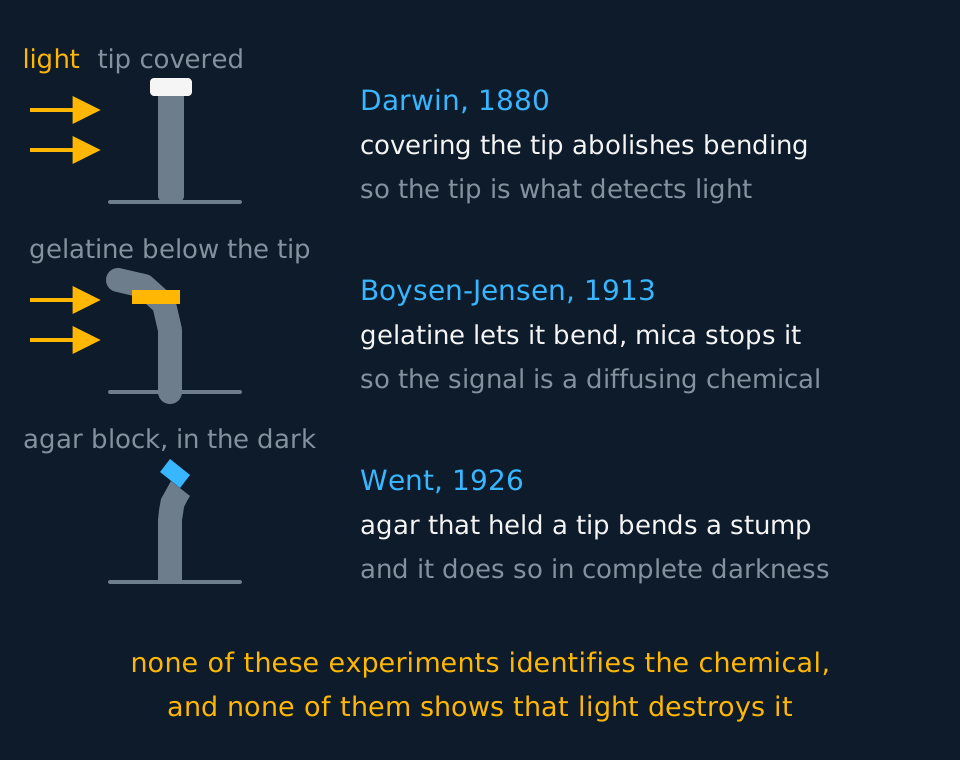
Describe the drawing
Three coleoptile experiments drawn one above another. In the first a shoot with an opaque cap over its tip stands straight in light from the left. In the second a shoot with a thin gelatine layer just below the tip bends towards that light. In the third a decapitated stump with a small agar block set on one side bends away from the block with no light at all. Beside each is the worker, the result and the one conclusion it supports, and a warning below that none of them names a molecule.
Charles and Francis Darwin, 1880. A coleoptile lit from one side bends towards the light. Cover the tip with an opaque cap and it does not bend, although it goes on growing; cover a band further down and it still bends. So the tip is where the light is detected. The Darwins showed nothing at all about what travels from the tip, or whether anything does.
Boysen-Jensen, 1913. Cut the tip off, replace it with a thin block of gelatine between tip and stump, and bending still happens. Replace the gelatine with mica, which nothing can diffuse through, and bending stops. So whatever passes from the tip to the growing region can cross a non-living gap, which points to a chemical that diffuses rather than a mechanical pull. Wet gelatine also conducts ions, so this result alone does not rule out an electrical signal; Went's experiment does. Still no molecule is identified.
Went, 1926. Stand cut tips on agar blocks so that the substance diffuses into the agar, then place a block on one side of a decapitated stump in complete darkness. The stump bends away from the side the block sits on. That result does two things at once: it shows the substance alone causes bending with no light involved, and it makes the degree of curvature a way of measuring how much substance a block holds. Went called it a growth substance; the name auxin was proposed in 1931 by Kögl and Haagen-Smit. Went had not identified it chemically, since indole-3-acetic acid was isolated later, and his own explanation of phototropism went beyond what these experiments could show.
Separate each result from its interpretation. The lateral redistribution model taught by every board is well supported in coleoptiles and is the model to use; in other organs the details of how the growth difference arises remain under investigation. Describe what the experiment did, state the result and then draw only the conclusion that result supports.
How auxin makes a cell longer
Auxin, in practice indole-3-acetic acid or IAA, is made in the tip of a shoot and in young leaves, and is transported away from the tip through the plant, including sideways by carrier proteins in the cell membranes. The elongation it causes is a physical change in the cell wall.
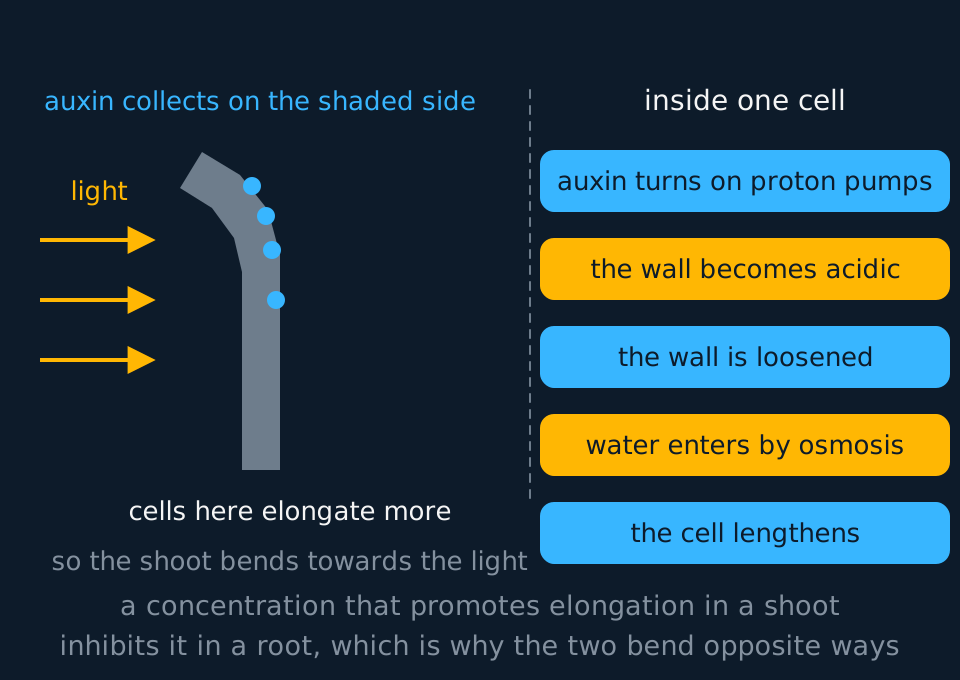
Describe the drawing
On the left a shoot lit from one side, drawn bending towards the light, with auxin shown as dots gathered along its shaded flank where the cells have elongated most. On the right the same story inside a single cell, as five stacked steps: auxin switches on proton pumps, the wall becomes acidic, the wall is loosened, water enters by osmosis and the cell lengthens.
Auxin binds to receptors in the growing cells and stimulates the proton pumps in their cell surface membranes, which actively transport hydrogen ions out into the cell wall. The pH of the wall falls to about 5, and at that pH proteins called expansins become active and loosen the bonds between cellulose microfibrils. A loosened wall is more plastic, so the turgor pressure that was already there is able to stretch it, water enters by osmosis, and the cell lengthens along its axis. Cells on the shaded side of a shoot, receiving more auxin, elongate more than those on the lit side, and the shoot bends towards the light.
The response depends on concentration. Auxin promotes elongation over a range of concentrations and inhibits it above that range, and roots are inhibited at concentrations perhaps a thousand times lower than shoots. A single concentration can therefore promote elongation in a shoot and inhibit it in a root, which is the basis of the section that follows.
Why a root and a shoot bend opposite ways
Lay a germinating seedling on its side in the dark. The shoot turns upwards and the root turns downwards, and the same explanation handles both.
Gravity is detected by statoliths, dense starch-filled organelles that sediment to the lower side of particular cells, which in the root are the columella cells of the root cap. Their settling is followed by auxin being redistributed to the lower side of the organ, and while exactly how the one leads to the other is still being worked out, the redistribution itself is well established.
In the shoot, more auxin on the lower side means the lower cells elongate more than the upper ones, so the shoot curves upwards: negative gravitropism.
In the root, more auxin on the lower side means the lower cells elongate less, because root cells are inhibited at concentrations that would stimulate a shoot. The upper side therefore elongates more and the root curves downwards: positive gravitropism.
The same stimulus and the same redistribution produce opposite curvatures, because the two tissues respond differently to the same concentration. A graph of growth rate against auxin concentration with separate curves for roots and shoots shows this directly.
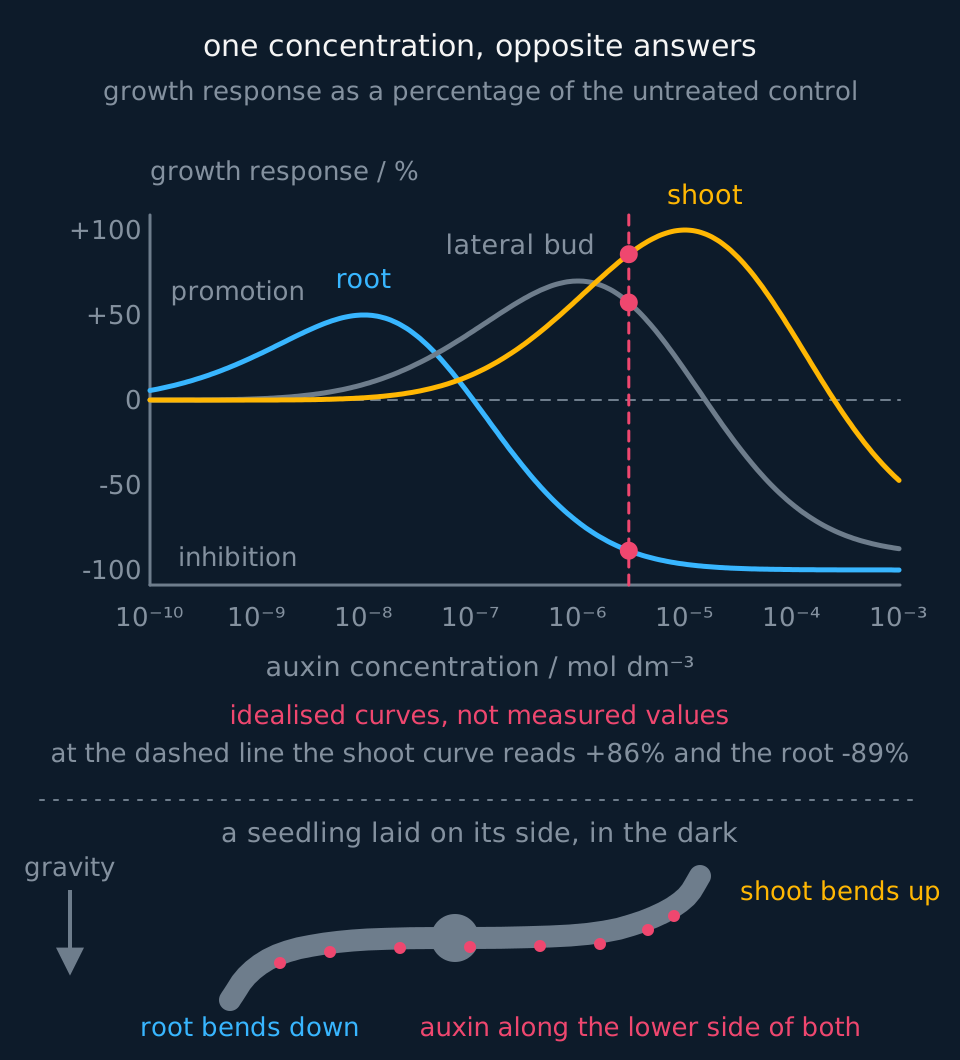
Describe the drawing
A graph of growth response, as a percentage of untreated growth, against auxin concentration on a logarithmic axis from ten to the minus ten up to ten to the minus three moles per cubic decimetre. Three idealised curves each rise to an optimum and then fall below zero into inhibition: the root peaks near ten to the minus eight, the lateral bud near ten to the minus six and the shoot near ten to the minus five, so the shoot's optimum is a thousand times the root's. A vertical line marks the concentration reached on the lower side of an organ laid on its side, and where it cuts the curves the shoot is promoted and the root inhibited. Below, a seedling on its side with auxin drawn along its lower flank, the shoot curving upwards and the root curving downwards.
Apical dominance
Auxin has a second effect in the shoot. A lateral bud lies in the angle between each leaf and the stem, and in a plant growing straight upwards nearly all of them remain dormant while the bud at the tip, the apical bud, grows. That suppression is apical dominance.
Removing the apical bud changes the shape of the plant within days. The lateral buds nearest the cut grow out into side shoots and the plant becomes bushy rather than tall. Pinching out a growing tip or clipping a hedge uses this effect, and the conical shape of a conifer results from the same suppression running down a trunk whose tip is intact.
To tie the effect to auxin, cut the apical bud off and smear the cut end with a lanolin paste containing indole-3-acetic acid, and the lateral buds stay dormant as though the tip were still there. Use plain lanolin with no auxin in it and they grow out. So it is a chemical made in the apical bud and transported down the stem that holds the lateral buds shut, and supplying that chemical artificially reproduces the effect of the bud.
Auxin produced in the shoot apex moves down the stem and contributes to inhibition of lateral-bud growth. Removing the apical bud reduces this influence and lateral buds grow. Current models also involve cytokinins and strigolactones, so apical dominance is controlled by interactions among several signals rather than by auxin acting alone inside each bud.
Auxin does not accumulate in the buds it inhibits, which is evidence against a direct inhibitory action within the bud. Cytokinin applied directly to a dormant lateral bud on an intact plant causes it to grow out while the apical bud is still in place, which supports control by the balance of signals rather than by auxin concentration alone.
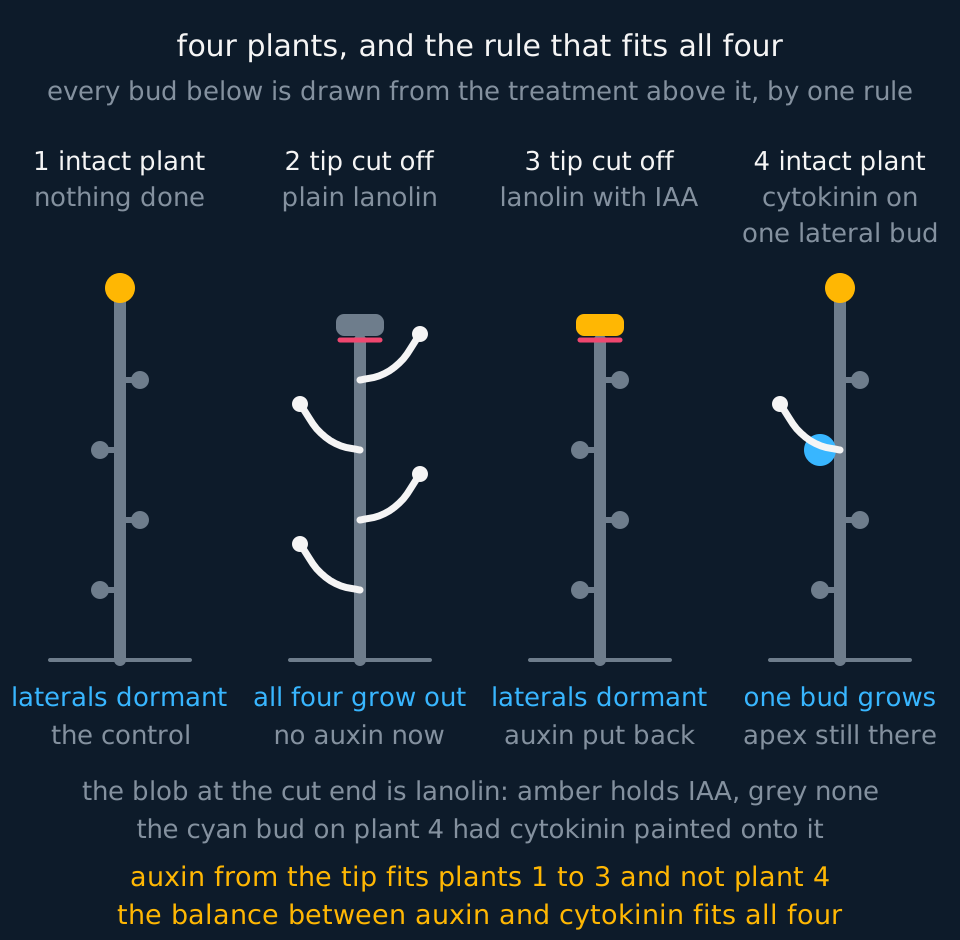
Describe the drawing
Four young plants in a row, each with an apical bud position and four lateral buds, drawn dormant as small knobs or grown out as side shoots. The first plant is intact and all its lateral buds are dormant. The second has had its tip cut off and plain lanolin put on the cut, and all four laterals have grown out. The third has had its tip cut off and lanolin containing IAA put on, and its laterals are dormant again, as though the tip were still there. The fourth is intact, with cytokinin painted onto one lateral bud, and that one bud alone has grown out while the apex is still in place.
Apical dominance has a stated advantage for the plant. Resources directed to a single growing point produce greater height growth than the same resources divided among several lateral shoots, which favours a seedling competing for light. When the apex is lost to grazing or cutting, the lateral buds are released and branching resumes.
Gibberellins, abscisic acid, and what they are used for
Exam-board note: AQA examines auxin; OCR A, Cambridge International 9700 and Pearson Edexcel B examine further growth substances. Two of them are set out below.
Gibberellins promote stem elongation by stimulating cell division and cell elongation between the nodes, and dwarf varieties of plants such as maize and peas are often dwarf because they cannot make them. Their other examined role is in germination, and it is a clean example of gene expression being controlled by a chemical signal. In a barley grain taking up water, the embryo secretes gibberellin, which diffuses to the aleurone layer surrounding the starchy endosperm. There it causes the transcription of the gene for amylase, the amylase hydrolyses the stored starch to maltose, and the maltose is absorbed by the embryo and respired. A grain whose embryo has been removed makes no amylase; add gibberellin to it and it does.
Abscisic acid has largely opposite effects. It maintains dormancy in seeds and buds, opposing gibberellin in the aleurone layer so that less amylase is made, and closes stomata under water stress. Released when a plant begins to lose more water than it can take up, abscisic acid causes solutes to leave the guard cells, so their water potential rises, water follows out by osmosis, the guard cells become flaccid and the stoma closes. Transpiration falls, and so does the rate of photosynthesis, because carbon dioxide uptake falls with it.
Ethene, a gas, ripens fruit and promotes leaf fall, and cytokinins promote cell division and delay leaf senescence. Exam-board note: OCR A examines both, Pearson Edexcel B examines cytokinins, and AQA requires neither.
Leaf fall in a deciduous tree is controlled by auxin and ethene together. As the days shorten in autumn the leaf makes less auxin, and the cells at the base of its stalk become more sensitive to ethene. Ethene stimulates cells in this abscission zone to make cellulase, which digests their walls, and the leaf breaks away, leaving a scar sealed with suberin. Without leaves the tree loses little water in winter, when water in cold or frozen soil is hard to take up, and it keeps no leaves for frost to damage.
| Use | Substance | How it works |
|---|---|---|
| Selective weedkiller | Synthetic auxin, such as 2,4-D | Broad-leaved weeds are far more sensitive and grow themselves to death; grasses tolerate it. Leaf shape and uptake are one part of a selectivity that also depends on how each plant moves and breaks the auxin down |
| Rooting powder for cuttings | Auxin | Stimulates root growth at the cut end, so cuttings establish |
| Seedless fruit | Auxin or gibberellin | Fruit develops without fertilisation, so no seeds form |
| Larger, looser grape bunches | Gibberellin | Elongates the stalks and the fruits themselves |
| Malting barley | Gibberellin | Speeds and evens out amylase production, so starch is converted to sugars sooner |
| Ripening fruit after transport | Ethene | Fruit picked unripe travels undamaged, then is ripened on arrival |
| Tissue culture of plants | Cytokinin with auxin | The ratio of the two decides whether the tissue forms shoots or roots |
TRY IT: Designing the control that decides it
A student claims that gibberellin causes amylase production in germinating barley grains. Describe an experiment using barley grains, some with the embryo removed, that would test the claim, and say what result would support it.
Check your answer
Set up three groups of grains. Group A is intact grains. Group B has the embryo cut away. Group C has the embryo cut away and is supplied with a gibberellin solution. All three are cut in half, sterilised to prevent microbial amylase, and placed on agar plates containing starch, then left at the same temperature for the same time.
Amylase activity is detected by flooding each plate with iodine solution afterwards. Starch that has been hydrolysed gives a clear zone around the grain; starch still present stains blue-black, and the diameter of the clear zone is a measure of how much amylase was produced.
The claim is supported if group A gives clear zones, group B gives none or almost none, and group C gives zones comparable with group A. That pattern shows the embryo is needed for amylase production and that gibberellin alone can replace it.
Group C is the group that does the work, and a plan without it proves nothing: A against B shows only that something in the embryo is required. Two more controls are worth stating: grains with the embryo removed and supplied with water alone, to show the solvent does nothing, and sterilisation of every grain, so that a clear zone cannot be the work of a fungus.
Phytochrome: detecting red and far-red light
Exam-board note: phytochrome is examined by Pearson Edexcel A (8.6) and Pearson Edexcel B (9.3 iv). AQA, OCR A and Cambridge International do not name it.
A tropism responds to the direction of light. Many other responses depend on whether there is light at all, on how long it lasts each day and on its colour, and the receptor for these is phytochrome: a protein with a light-absorbing pigment group attached, present in small amounts in most of the plant's tissues.
Phytochrome exists in two forms that convert into each other. Pr absorbs red light, most strongly at about 660 nm, and absorbing it converts the molecule into Pfr. Pfr absorbs far-red light, most strongly at about 730 nm, and absorbing it converts the molecule back into Pr. Both conversions by light are fast. In darkness Pfr also reverts to Pr, but slowly, over hours, and some Pfr is broken down instead.
Pfr is the active form. The responses phytochrome controls depend on how much of a cell's phytochrome is Pfr, and Pr is treated as inactive. Sunlight contains both wavelengths but more red than far-red, so in daylight Pr is converted to Pfr faster than Pfr is converted back, and Pfr accumulates. At night no Pfr is made and the amount falls as it reverts. The amount left at dawn therefore depends on how long the night was, which is how a plant is able to measure day length.
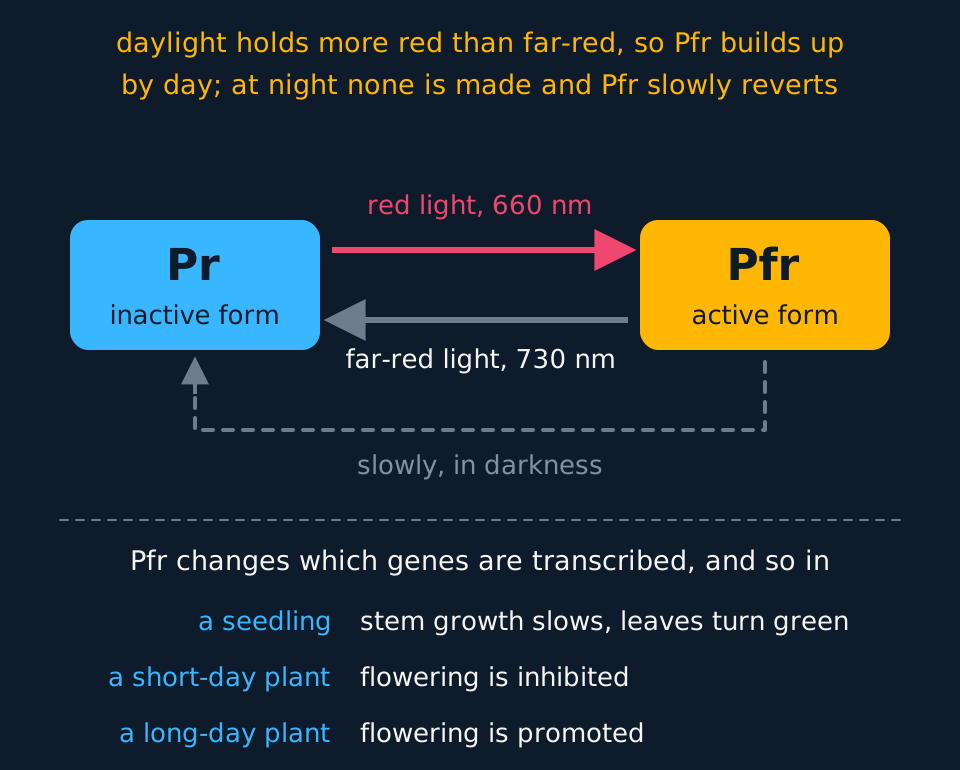
Describe the drawing
Two boxes, Pr on the left labelled inactive and Pfr on the right labelled active. An arrow from Pr to Pfr is marked red light, 660 nanometres; an arrow back from Pfr to Pr is marked far-red light, 730 nanometres; and a dashed arrow from Pfr round to Pr is marked slowly, in darkness. Beneath, Pfr's effects: in a seedling, stem growth slows and leaves turn green; in a short-day plant flowering is inhibited; in a long-day plant flowering is promoted.
The colour of the light matters as well as its presence. Light that has passed through leaves, or been reflected from them, has lost most of its red to chlorophyll but kept its far-red. A seedling under a canopy therefore holds less of its phytochrome as Pfr than one in the open. Pfr inhibits stem elongation, so the shaded seedling elongates faster, which tends to carry its leaves up out of the shade.
The evidence that one pigment with two interconvertible forms is at work comes from seeds. Some small seeds, including some lettuce varieties, germinate only after exposure to light. A brief flash of red light lets them germinate; far-red light given straight afterwards stops them; and after a series of alternating red and far-red flashes, the colour of the last flash decides whether they germinate. Only a pigment being switched back and forth between two states accounts for a result that depends on the last flash alone.
- Phytochrome
- A photoreceptor protein in plants that exists in two interconvertible forms, Pr and Pfr, and controls responses to the presence, duration and colour of light.
- Pr
- The form of phytochrome that absorbs red light, about 660 nm, and is converted by it into Pfr.
- Pfr
- The active form of phytochrome, which absorbs far-red light, about 730 nm, and is converted by it, and slowly in darkness, into Pr.
Etiolation and photomorphogenesis
A seed that germinates under the soil, or a seedling grown in a dark cupboard, grows in a characteristic way called etiolation. The stem elongates rapidly with long internodes and is thin and weak, the leaves stay small, folded and yellow because no chlorophyll is made, and in many dicotyledons the top of the stem is bent into a hook that protects the shoot tip as it is pushed up through the soil. The seed's food reserves are spent on length rather than on leaves, which gives the shoot the best chance of reaching light before the reserves run out.
Photomorphogenesis is the control of a plant's form and development by light, and the change at the soil surface is its clearest example. When the seedling first meets light, Pr is converted to Pfr and the seedling de-etiolates within hours: stem elongation slows, the hook straightens, the leaves expand, chlorophyll is made and the plastids develop into working chloroplasts. Each of those changes needs proteins the seedling was not making in the dark, which is why phytochrome's effects come down to the transcription of genes, set out in the last section of this lesson.
- Etiolation
- The growth of a plant in darkness, with long, thin internodes and small, folded leaves that lack chlorophyll.
- Photomorphogenesis
- The control of a plant's growth and development by light, such as the de-etiolation of a seedling that reaches light.
Day length and flowering
Many plants flower at the same time every year, and the cue most of them use is day length, a response called photoperiodism. Day length changes in the same way every year at a given place, where temperature does not, and flowering at the same time lets the plants of a species cross-pollinate.
Long-day plants flower when days are longer than a critical length, which in Britain means late spring and summer; spinach, wheat and barley are examples. Short-day plants flower when days are shorter than a critical length, in late summer, autumn or winter; chrysanthemum, poinsettia and soya bean are examples. Day-neutral plants, such as tomato, flower whatever the day length.
The names are misleading. Experiments in which the light and dark periods were varied separately showed that what the plant measures is the length of the uninterrupted dark period. A short-day plant flowers only when the night is longer than its critical night length, and a long-day plant only when the night is shorter.
The test that settles it is a night break. Interrupt a long night with a few minutes of light in the middle and a short-day plant fails to flower while a long-day plant flowers, as though the night had been short. A spell of darkness in the middle of a long day has no comparable effect.
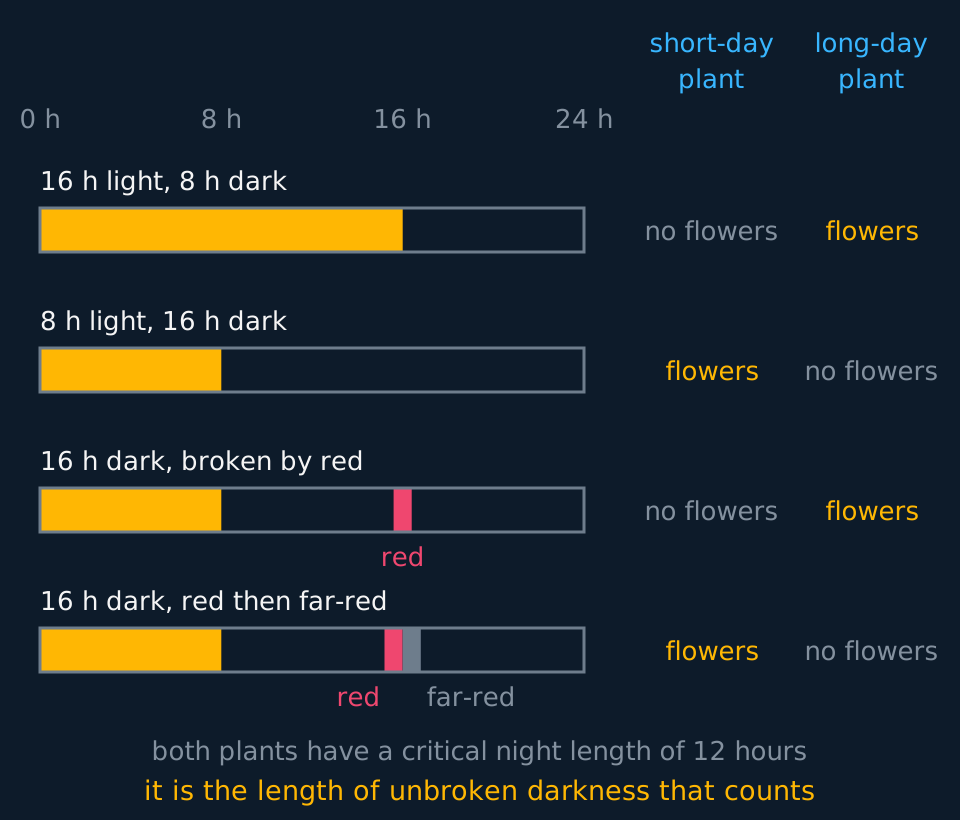
Describe the drawing
Four 24-hour cycles drawn as bars, light filled in amber and dark left empty, with the result for a short-day and a long-day plant beside each. With 16 hours of light and 8 of dark, the long-day plant flowers and the short-day plant does not. With 8 hours of light and 16 of dark, the short-day plant flowers and the long-day plant does not. When that long night is broken in the middle by a brief flash of red light, the results reverse, as though the night were short. When the red flash is followed at once by far-red, the results return to those of the unbroken long night.
The colour of the night break identifies the pigment. Red light is the most effective colour, and far-red given straight after the red cancels it. The model used in A-level answers is therefore written in terms of Pfr. During a long night Pfr reverts to Pr for long enough that little remains by dawn, while after a short night much of it is left.
In a short-day plant, Pfr inhibits flowering. A long night removes the Pfr and the plant flowers; a red flash in the middle of the night converts Pr back to Pfr, and flowering is prevented.
In a long-day plant, Pfr promotes flowering. Short nights leave enough Pfr for the plant to flower, and so does a red flash in the middle of a long night.
Real plants also time the night with an internal circadian clock, because reversion alone is too slow and variable, but the Pfr model predicts every result in the figure and is the one examined.
Day length is detected by the leaves, not by the buds that become flowers. If only the leaves of a chrysanthemum are given long nights while its shoot tip is kept on short nights, the plant flowers; reverse the treatment and it does not. A signal, long called florigen, therefore travels in the phloem from the leaves to the shoot apex. It is now known to be mainly a small protein, FT, described in the last section.
Growers use this. Chrysanthemums are brought into flower for sale at any time of year by covering them with blackout sheeting to give long nights, and kept from flowering by lighting them for a short time in the middle of the night.
- Photoperiodism
- The response of a plant to the relative lengths of day and night, such as the timing of flowering.
- Short-day plant
- A plant that flowers only when the night is longer than its critical night length.
- Long-day plant
- A plant that flowers only when the night is shorter than its critical night length.
- Critical night length
- The length of uninterrupted darkness that decides whether a photoperiodic plant flowers.
TRY IT: Predicting flowering from the length of the night
A short-day plant has a critical night length of 10 hours. Predict whether it flowers on each of these daily cycles, and explain each prediction. (a) 12 hours light, 12 hours dark. (b) 10 hours light, 14 hours dark, with five minutes of red light 7 hours into the dark period. (c) As (b), but the red light is followed at once by five minutes of far-red. (d) 10 hours light, 14 hours dark, with five minutes of far-red light alone 7 hours into the dark period.
Check your answer
(a) The night is 12 hours, longer than the critical 10 hours, so Pfr falls low by dawn and stops inhibiting flowering. The plant flowers.
(b) The red flash converts Pr to Pfr in the middle of the night. The longest unbroken dark period is now about 7 hours, shorter than the critical length, and Pfr is present at dawn. The plant does not flower.
(c) The far-red converts the Pfr made by the red flash straight back to Pr, so the night behaves as an unbroken 14 hours. The plant flowers.
(d) Far-red alone converts any Pfr still present into Pr and makes none, so it does not break the night. The plant flowers. The rule to apply is that the last colour of a flash decides whether the night has been broken.
How IAA and phytochrome change transcription
Exam-board note: Pearson Edexcel A (8.6) asks for the effects of IAA and phytochrome on transcription.
The proton pumping described earlier in this lesson begins within minutes of auxin arriving. Growth that continues for hours, and nearly everything phytochrome does, also depends on a change in which genes are transcribed. Both substances work in the same general way, by causing a regulatory protein in the nucleus to be broken down, which changes the activity of transcription factors.
IAA. In a cell with little auxin, transcription factors called auxin response factors are already bound to the promoters of auxin-responsive genes, but they are held inactive by repressor proteins bound to them, the Aux/IAA proteins. IAA entering the nucleus binds to a receptor protein, and the receptor with IAA bound attaches to the repressor proteins and marks them for breakdown.
With the repressors gone, the auxin response factors activate transcription, RNA polymerase transcribes the genes, and the mRNA is translated. Among the proteins made are expansins and others involved in loosening the wall and in growth, so the elongation that acidification starts is sustained.
Phytochrome. Pr stays in the cytoplasm. When it absorbs red light, the Pfr formed moves into the nucleus. There it binds to transcription factors called phytochrome-interacting factors, which in darkness promote the transcription of genes for etiolated growth and repress genes for photosynthesis. Pfr binding leads to their breakdown. Transcription of genes for chloroplast proteins, such as the light-harvesting proteins of the photosystems and the small subunit of rubisco, rises, and stem elongation slows. That change in gene expression is de-etiolation.
Flowering is controlled by transcription at one remove. When the night length is right, cells in the leaves transcribe the gene for FT. The FT protein is carried in the phloem to the shoot apex, where it acts with a transcription factor already there to switch on the genes for flower development.
| Feature | IAA | Phytochrome |
|---|---|---|
| Environmental cue | Direction of light and of gravity | Presence, duration and colour of light |
| What it is | A plant growth substance made in shoot tips and transported to the cells that respond | A photoreceptor protein in the cells that detect the light |
| Active form | IAA bound to its receptor in the nucleus | Pfr, which moves into the nucleus |
| Effect on transcription | Repressor proteins are broken down, so auxin response factors switch on auxin-responsive genes | Phytochrome-interacting factors are broken down, so genes for light-grown development are switched on |
| Example response | Elongation on the shaded side of a shoot | De-etiolation, and flowering in long-day and short-day plants |
- Auxin response factor
- A transcription factor that activates auxin-responsive genes once IAA has caused the repressor proteins bound to it to be broken down.
Core practical 14: gibberellin and amylase, measured on starch agar
optional
Pearson Edexcel Biology B (9BI0) sets Core Practical 14 under statement 9.3 i: Investigate the effect of gibberellin on the production of amylase in germinating cereals using a starch agar assay. The biology is in the gibberellin section above: the embryo of a germinating grain secretes gibberellin, which causes the aleurone layer to make amylase.
A starch agar assay detects the amylase. Half grains are laid cut face down on agar containing starch. Amylase made in the grain diffuses out and hydrolyses the starch around it. When the plate is later flooded with iodine solution, the agar stains blue-black wherever starch remains and stays clear where it has been hydrolysed, so the size of the clear zone measures how much amylase was made. Cutting off the half with the embryo removes the grain's own source of gibberellin, so any amylase made by the other half depends on the gibberellin supplied.
The apparatus: barley or wheat grains that have not been treated with a fungicide; a scalpel and a cutting tile; a surface sterilant and sterile distilled water; a dilution series of gibberellic acid (GA3) solutions, with distilled water as zero; sterile Petri dishes of starch agar poured to the same depth from one batch; sterile forceps; tape; an incubator; iodine in potassium iodide solution; and a ruler.
| Step | What to do | Why |
|---|---|---|
| 1 | Cut each grain across the middle and keep the half without the embryo. Keep some embryo halves for a separate plate | The embryo half makes its own gibberellin, so it is a positive control, not part of the series |
| 2 | Soak the half grains in the surface sterilant for the time the school's method gives, then rinse them in sterile water | Bacteria and fungi on the grain make amylase of their own |
| 3 | Soak equal numbers of half grains in each gibberellin solution, and in distilled water, for the same length of time | Each group differs only in the gibberellin it received |
| 4 | With sterile forceps, place the same number of half grains, cut face down and well spaced, on each starch agar plate. Label, tape and incubate all plates at the same temperature, below body temperature as the risk assessment sets, for one to two days | Spacing stops neighbouring clear zones merging |
| 5 | Check each plate through the lid first: one with colonies of bacteria or fungi is not opened. Remove the grains, flood each plate with iodine solution, pour it off after a minute, and measure the diameter of each clear zone twice, at right angles | Zones are rarely perfect circles, so the mean of two diameters is used |
| 6 | Calculate the mean diameter for each concentration, then the area of the clear zone as πr² | Area reflects the amount of starch hydrolysed better than diameter does |
The independent variable is the concentration of gibberellin. The dependent variable is the area of the clear zone. Control the variety and batch of grain and the size of the half grains, the soaking time, the number of half grains per plate, the depth and starch content of the agar, the incubation temperature and time, and the time the iodine is left on. The half grains soaked in water are the negative control: they show that without gibberellin little or no amylase is made. The embryo halves are the positive control: they show that the aleurone works and the assay detects amylase.
Clear zones against gibberellin concentration
These results are invented to show the processing. The mean diameter of the clear zone was 0 mm for half grains soaked in water, 4 mm at 10⁻⁸ mol dm⁻³ gibberellic acid, 10 mm at 10⁻⁷, 16 mm at 10⁻⁶ and 18 mm at 10⁻⁵ mol dm⁻³. Embryo halves gave 17 mm. Calculate the area of each zone and describe the pattern.
Show the working
Area = π × (diameter ÷ 2)²: 0 mm² in water; π × 2² = 12.6 mm² at 10⁻⁸; π × 5² = 78.5 mm² at 10⁻⁷; π × 8² = 201 mm² at 10⁻⁶; π × 9² = 254 mm² at 10⁻⁵ mol dm⁻³.
With no gibberellin there is no clear zone, so the aleurone makes no amylase without it. Each tenfold rise in concentration up to 10⁻⁶ mol dm⁻³ gives a much larger zone, and the rise then levels off, so at the highest concentrations something other than gibberellin limits the amylase made, such as the amount of aleurone in a half grain.
Embryo halves fell within the same range as the highest concentrations, so the gibberellin supplied can replace the embryo's own. Because the concentrations go up in tenfold steps, plot area against log10 concentration.
| Source of error | Effect | Improvement |
|---|---|---|
| Microorganisms on the grains or plates make amylase | Clear zones not caused by the aleurone | Surface-sterilise the grains, use sterile forceps and plates, and discard any plate with visible colonies |
| Half grains differ in size | Zones vary within a concentration | Choose grains of similar size and use several per plate and several plates |
| Zones are irregular | One diameter misrepresents the zone | Measure two diameters at right angles and take the mean |
| Zones merge | Areas cannot be measured | Space the half grains well apart |
| The iodine colour spreads or fades | Zone edges blur | Measure all plates at the same time after staining |
Risk assessment. Cut grains on a tile with the blade moving away from your hand. The surface sterilant and the iodine solution can irritate the skin and eyes and the iodine stains, and gibberellic acid has its own Hazcard: check the CLEAPSS Hazcard for each and your school's risk assessment, wear eye protection, and wash your hands afterwards. Grain sold for sowing may be coated with fungicide, so use untreated grain. A plate showing growth of bacteria or fungi is not opened; it goes to the teacher. Every plate, opened or not, is autoclaved or pressure-cooked before disposal.
- Starch agar assay
- A test for amylase in which tissue is placed on agar containing starch; after iodine is added, the size of the clear zone where the starch has been hydrolysed measures the amylase produced.
- Aleurone layer
- The layer of living cells around the starchy endosperm of a cereal grain, which makes amylase when gibberellin reaches it during germination.
In the exam
- A tropism is a growth response whose direction is set by the direction of the stimulus. The plant does not move towards the stimulus; growth is unequal on the two sides.
- Attribute each experiment to what it showed. Darwin's shows the tip detects light; Boysen-Jensen's shows a diffusible chemical is involved; Went's shows the chemical alone causes bending in the dark.
- Say that auxin is redistributed to the shaded side, not that light destroys it. The evidence is that the total quantity is unchanged.
- For elongation, name the steps: proton pumps, low pH in the wall, expansins, wall loosened, water in by osmosis, cell elongates. That auxin makes cells grow states the outcome rather than the mechanism.
- In gravitropism, state that roots and shoots respond differently to the same concentration, inhibited in one and stimulated in the other.
- For apical dominance, the evidence is the pair of treatments: removing the tip releases the lateral buds, and auxin paste on the cut stump keeps them shut. Quote both, because one on its own proves nothing.
- For gibberellin and germination, state that it causes transcription of the amylase gene in the aleurone layer. Gibberellin does not hydrolyse the starch itself.
- In the starch agar assay, the clear zone is where starch has gone, so a larger clear zone means more amylase was made.
- Red light converts Pr into Pfr; far-red light and darkness convert Pfr into Pr. Pfr, the form named after the far-red it absorbs, is the active one.
- In photoperiodism, write about the length of the night. A short-day plant flowers after a night longer than its critical length, because by dawn the Pfr that inhibits its flowering has fallen.
- For an effect on transcription, name the protein that is broken down and the genes that are then transcribed. Saying that IAA or Pfr switches genes on does not explain how.
Check yourself
A coleoptile is illuminated from the left. A student proposes two hypotheses: that light destroys auxin on the lit side, and that auxin moves across to the shaded side. Design an experiment using agar blocks that would distinguish between them, and state the result each hypothesis predicts.
Answer
Cut the tips from a number of coleoptiles and stand each tip on a pair of agar blocks separated by a thin impermeable barrier that rises just into the base of the tip, so that auxin diffusing from the lit half and from the shaded half of the base is collected separately while the tip above stays intact. Illuminate from one side, and keep a second set of tips in complete darkness as a control.
Measure the auxin in each block by the standard bioassay: place the block on one side of a decapitated stump in the dark and measure the angle of curvature, which is proportional to the quantity of auxin present.
If light destroys auxin, the total collected from the two blocks of an illuminated tip will be less than the total from a tip kept in darkness, and the shortfall will be on the lit side. If auxin moves across instead, the total will be the same as in darkness, but more will be in the shaded block and less in the lit one.
The experiment as actually done gave the second result, so redistribution is supported and destruction is not. Extending the barrier up through the whole tip makes the design decisive in another way: with the halves fully separated no sideways movement is possible, and the asymmetry between the blocks disappears. Redistribution predicts exactly that; destruction cannot explain it, because light falling on the lit side would leave a shortfall there whether or not sideways movement were blocked.
Questions
Question 15 marks
A student claims that the classic decapitation-and-auxin-paste experiment proves that auxin acting alone in the lateral bud is what keeps it dormant. Evaluate this claim, using the further evidence described in this lesson.
Mark scheme
- B1 in support: the paired result is genuine evidence for auxin's involvement, since removing the tip releases the buds and replacing the auxin with a paste on the cut stump keeps them dormant again, with a plain, auxin-free paste as the control that fails to do so
- B1 in support: because only the auxin supply differs between the treated and control stumps, the result does rule out the paste itself, or the act of cutting, as the cause
- B1 against: auxin does not accumulate inside the buds it inhibits, which would be expected if it acted there directly, so the evidence does not establish that auxin acts within the bud itself
- B1 against: cytokinin applied directly to a dormant lateral bud on an otherwise intact plant, with the apical bud left in place, causes that bud to grow out, showing a bud can be released from dormancy without any change in the auxin reaching it
- B1 judgement: the experiment shows convincingly that auxin from the apical bud contributes to keeping lateral buds dormant, but not that it is the sole cause or that it acts directly inside each bud; a balance of several signals, including cytokinins and strigolactones, is a more accurate account
Question 24 marks
The tips of oat coleoptiles were cut off and replaced, with a thin layer separating each tip from its stump, and the coleoptiles were lit from one side. With a layer of gelatine, through which water and dissolved substances can diffuse, the coleoptiles bent towards the light. With a layer of mica, through which nothing can diffuse, they did not bend. In a further experiment, a thin plate of mica pushed part-way into one side of an intact coleoptile, just below the tip, stopped bending when it was on the shaded side but not when it was on the lit side. Explain what these results show about the signal that passes from the tip to the region that bends.
Mark scheme
- B1 the signal crosses a gap of non-living gelatine, so it does not need a continuous line of living cells or a mechanical link from the tip
- B1 it is stopped by mica, which nothing can diffuse through, so it is most likely a chemical that diffuses from the tip; wet gelatine also conducts ions, so these results alone do not rule out an electrical signal
- B1 blocking the shaded side stops bending while blocking the lit side does not, so the substance travels down the shaded side
- B1 the shaded side therefore elongates faster than the lit side, so the coleoptile bends towards the light; the experiments do not identify the substance
Question 34 marks
Explain how auxin arriving at a cell in the growing region of a shoot causes that cell to become longer.
Mark scheme
- B1 auxin binds to receptors in the cell and stimulates the proton pumps in the cell surface membrane
- B1 the pumps actively transport hydrogen ions out into the cell wall, so the pH of the wall falls to about 5
- B1 at that pH proteins called expansins become active and loosen the bonds between the cellulose microfibrils, so the wall becomes more plastic
- A1 the turgor pressure already present can then stretch the loosened wall, water enters by osmosis, and the cell lengthens along its axis
Question 44 marks
A germinating seedling is laid on its side in complete darkness. Explain why its shoot grows upwards and its root grows downwards, even though auxin collects on the lower side of both.
Mark scheme
- B1 gravity is detected by statoliths, dense starch-filled organelles that sediment to the lower side of particular cells, such as the columella cells of the root cap
- B1 auxin is then redistributed to the lower side of both the shoot and the root
- B1 in the shoot that concentration stimulates elongation, so the lower cells elongate more than the upper ones and the shoot curves upwards, which is negative gravitropism
- A1 root cells are inhibited at concentrations that stimulate a shoot, so the lower cells of the root elongate less than the upper ones and the root curves downwards, which is positive gravitropism
Question 54 marks
A gardener removes the growing tip from a young shrub and it becomes bushy within a fortnight. Explain this result, and explain what would happen if the cut end were smeared with a paste containing auxin.
Mark scheme
- B1 auxin made in the apical bud is transported down the stem and keeps the lateral buds below it dormant, which is apical dominance
- B1 removing the tip removes the source of that auxin, so the lateral buds are released and grow out into side shoots, and the shrub becomes bushy rather than tall
- B1 a paste containing auxin on the cut end replaces the supply the apical bud provided, so the lateral buds stay dormant and the shrub does not become bushy
- A1 the pair of treatments together is the evidence that auxin causes the inhibition; plain paste with no auxin in it is the control, and the buds grow out
Question 64 marks
Tips were cut from oat coleoptiles and stood on small blocks of agar in the dark for some hours, then removed. Each block was placed on one side of the cut surface of a coleoptile whose own tip had been removed, and the coleoptiles were kept in the dark. Each stump curved away from the side carrying the block. A block that had never touched a tip caused no curvature, and blocks that had carried more tips caused greater curvature. Explain what these results show.
Mark scheme
- B1 a substance passed out of the tips into the agar, since a block that had never touched a tip had no effect, so the agar itself is not the cause
- B1 the side beneath the block grew faster, so the substance stimulates elongation on the side it reaches, which makes the stump curve away from that side
- B1 the bending happened in darkness and with no tip present, so the substance alone is enough to cause curvature and light is not needed for it to act
- B1 greater curvature with more tips shows that the response depends on the amount of substance, so the angle of curvature can be used to measure how much substance a block contains
Question 74 marks
Explain how abscisic acid causes a stoma to close when a plant is short of water.
Mark scheme
- B1 abscisic acid is released when a plant begins to lose more water than it is taking up
- B1 it causes solutes to leave the guard cells, so the water potential of the guard cells rises, becoming less negative
- B1 water then leaves the guard cells by osmosis down that water potential gradient, and the cells become flaccid
- A1 flaccid guard cells can no longer hold the stoma open, so it closes, which reduces transpiration but also reduces the rate of photosynthesis because less carbon dioxide can enter
Question 84 marks
Compare the effects of gibberellin with the effects of abscisic acid on seed dormancy and on germination.
Mark scheme
- B1 gibberellin promotes germination, diffusing to the aleurone layer and causing transcription of the amylase gene, whereas abscisic acid maintains dormancy and prevents germination from starting
- B1 in a seed about to germinate, gibberellin overcomes the dormancy abscisic acid had been maintaining, so the relative concentrations of the two substances decide whether germination proceeds
- B1 gibberellin's effect here is on gene expression in the aleurone, producing an enzyme, whereas abscisic acid opposes this in the aleurone, suppressing amylase production
- A1 the two substances are broadly antagonistic here: one promotes growth and germination, and the other suppresses them, in the way that many pairs of plant growth substances balance each other
Question 94 marks
Groups of a short-day plant were given the daily light and dark periods in the table, and whether each group flowered was recorded. The results are constructed to show the classic pattern. Explain the results of groups 2, 3 and 4, using what happens to phytochrome.
| Group | Light / h | Dark / h | Treatment in the middle of the dark period | Flowered |
|---|---|---|---|---|
| 1 | 16 | 8 | none | no |
| 2 | 8 | 16 | none | yes |
| 3 | 8 | 16 | 5 minutes of red light | no |
| 4 | 8 | 16 | 5 minutes of red, then 5 minutes of far-red | yes |
Mark scheme
- B1 in group 2 the night is longer than the critical night length, so Pfr reverts to Pr for long enough that little is left by dawn
- B1 Pfr inhibits flowering in a short-day plant, so with little Pfr the plant flowers
- B1 in group 3 the red light converts Pr to Pfr in the middle of the night, so neither part of the night is longer than the critical length and Pfr inhibits flowering
- B1 in group 4 the far-red converts the Pfr made by the red light straight back to Pr, so the night acts as one unbroken long night and the plant flowers
Question 104 marks
Describe the appearance of a bean seedling that has grown in complete darkness, and describe how phytochrome brings about the changes when the seedling is moved into light.
Mark scheme
- B1 the stem is long and thin with long internodes, often with a hook at the top
- B1 the leaves are small, folded and yellow because no chlorophyll has been made; this is etiolation
- B1 in light, red light converts Pr into Pfr, the active form, which changes the transcription of genes
- B1 stem elongation slows, the hook straightens, the leaves expand and chlorophyll is made, which is photomorphogenesis
Question 114 marks
Explain how IAA arriving at a cell in the growing region of a shoot changes the transcription of genes in that cell.
Mark scheme
- B1 without IAA, transcription factors called auxin response factors are bound to the auxin-responsive genes but held inactive by repressor proteins
- B1 IAA binds to a receptor protein in the nucleus, and the receptor with IAA bound causes the repressor proteins to be broken down
- B1 the freed auxin response factors activate transcription, so RNA polymerase transcribes the auxin-responsive genes
- B1 the mRNA is translated into proteins, such as expansins, that loosen the cell wall and sustain elongation
Question 123 marks
Explain how a synthetic auxin sprayed over a field can kill broad-leaved weeds without seriously harming the cereal crop growing among them.
Mark scheme
- B1 broad-leaved weeds absorb and transport more of the synthetic auxin than the cereal, which intercepts less spray on its narrow upright leaves and breaks down more of what it absorbs; credit either the uptake or the breakdown point
- B1 the high concentration inside the weed causes rapid and uncontrolled elongation and growth
- A1 the weed cannot supply the water and nutrients that growth demands and it dies, while the concentration in the cereal's tissues stays too low to have that effect
Question 133 marks
Maltsters soak barley grains in water and add gibberellin to the steeping tank. Suggest why this makes the starch in the grains turn into sugars sooner and more evenly across the batch.
Mark scheme
- B1 gibberellin diffuses to the aleurone layer surrounding the starchy endosperm and causes transcription of the gene for amylase
- B1 the amylase produced hydrolyses the stored starch to maltose, so sugars become available sooner than if the maltster waited for each embryo to secrete its own gibberellin
- A1 every grain receives gibberellin at the same time and in the same amount, so grains that would otherwise germinate at different rates produce amylase together and the batch is more uniform
Question 143 marks
Suggest why a gardener treats the cut end of a stem cutting with a rooting powder containing auxin, and suggest what result they would expect if they used a paste with no auxin in it instead, as a comparison.
Mark scheme
- B1 auxin stimulates cell elongation and division in the tissue at the cut end, which is needed for new roots to form there, so a treated cutting roots sooner and more reliably than an untreated one
- B1 an auxin-free paste applied to a comparison group of cuttings acts as a control, showing what proportion of cuttings would root without any auxin being supplied at all
- A1 if far fewer of the untreated cuttings produced roots, or produced them much later, that difference would be the evidence that the auxin itself, rather than something else about the paste, caused the improvement
Question 153 marks
Fruit is often picked while unripe, transported long distances, and then exposed to ethene gas just before it reaches the shop. Suggest why picking the fruit unripe is useful, and suggest why the ethene is applied only near the end of the journey rather than at the start.
Mark scheme
- B1 unripe fruit is firmer and less easily damaged than ripe fruit, so it survives the mechanical stress of transport far better
- B1 ethene promotes ripening, so exposing the fruit to it converts the firm, unripe fruit into ripe fruit ready for sale
- A1 applying the ethene only near the end of the journey means the fruit stays firm and undamaged for as much of the transport as possible, ripening just before it is needed
Question 163 marks
Chrysanthemums are short-day plants that naturally flower in autumn. Suggest how a grower could produce flowering chrysanthemums for sale in June, and how they could stop plants flowering in autumn until they are wanted.
Mark scheme
- B1 in June, cover the plants with blackout sheeting for part of each day so that the night is longer than the critical night length
- B1 during the long night Pfr reverts to Pr, so little of the Pfr that inhibits flowering is left and the plants flower
- B1 in autumn, light the plants briefly in the middle of each night, which converts Pr to Pfr and breaks the long night, so they do not flower
Question 173 marks
Seedlings growing beneath the leaves of taller plants have longer stems than seedlings of the same species growing in the open. Explain this difference using phytochrome.
Mark scheme
- B1 chlorophyll in the leaves above absorbs most of the red light but little of the far-red, so the light reaching the shaded seedlings is rich in far-red
- B1 far-red light converts Pfr into Pr, so a smaller proportion of the shaded seedlings' phytochrome is in the active Pfr form
- B1 less Pfr means less inhibition of stem elongation, so the shaded seedlings elongate faster, which tends to lift their leaves out of the shade
Question 183 marks
In a starch agar assay, half barley grains without embryos were soaked in two concentrations of gibberellic acid. The mean diameter of the clear zones was 9.0 mm at the lower concentration and 15.0 mm at the higher; the results are invented for this question. Calculate the percentage increase in the area of the clear zone between the two concentrations.
Mark scheme
- M1 radii 4.5 mm and 7.5 mm, so areas π × 4.5² = 63.6 mm² and π × 7.5² = 176.7 mm²
- M1 (176.7 − 63.6) ÷ 63.6 × 100
- A1 178%; accept 177% to 178%
Question 193 marks
In an investigation of the effect of gibberellin on amylase production, explain why the embryo is cut off each barley grain, why the half grains are surface-sterilised, and why one group of half grains is soaked in distilled water only.
Mark scheme
- B1 the embryo is the grain's source of gibberellin, so removing it means any amylase made depends on the gibberellin supplied
- B1 bacteria and fungi on the grain surface make amylase, which would hydrolyse starch and give clear zones not caused by the aleurone layer
- B1 the water-only group is a control showing how much amylase is made with no gibberellin, so any increase can be put down to the gibberellin
Question 202 marks
Give the name of the tropism shown by a shoot growing towards light from one side, and give the name of the plant growth substance responsible for the bending.
Mark scheme
- B1 it is positive phototropism, because growth is towards the stimulus
- B1 the substance is auxin, in practice indole-3-acetic acid
Question 212 marks
Charles and Francis Darwin lit grass seedlings from one side. Seedlings with an opaque cap over the tip of the coleoptile did not bend. Seedlings with the tip uncovered but the region below it shielded from light bent towards the light, and the bend formed in the shielded region. Explain what these results show about where light is detected and where the response happens.
Mark scheme
- B1 covering only the tip stops bending, while shading the region below it does not, so light is detected at the tip
- B1 the bend forms below the tip, in a region that was itself in shade, so a signal must pass from the tip to the region that bends; these results do not show what that signal is
Question 222 marks
Name the tropism shown by a root growing towards water, and name the tropism shown by a pollen tube growing down a style towards chemicals released by the ovule.
Mark scheme
- B1 it is positive hydrotropism
- B1 it is positive chemotropism
Question 232 marks
State the colour of light that converts Pr into Pfr, and state what happens to Pfr when a plant is kept in darkness.
Mark scheme
- B1 red light, with a peak at about 660 nm, converts Pr into Pfr
- B1 in darkness Pfr slowly reverts to Pr, and some of it is broken down
Worth remembering
- A tropism is unequal growth whose direction is set by the direction of the stimulus.
- Tip detects, chemical diffuses, chemical alone bends in the dark: one experiment each, and no more.
- Auxin is redistributed to the shaded side; the total does not fall.
- Elongation is proton pumps, an acid wall, expansins, and water entering by osmosis.
- The same concentration stimulates a shoot and inhibits a root, which is why they bend opposite ways.
- Auxin from the apical bud contributes to keeping lateral buds dormant; remove the tip and they grow, unless auxin is applied in its place. Cytokinins and strigolactones are also involved.
- Red light makes Pfr, far-red light and darkness remove it, and Pfr is the active form.
- A plant times the night: Pfr inhibits flowering in a short-day plant and promotes it in a long-day plant.
- IAA and Pfr each cause a regulatory protein in the nucleus to be broken down, which changes the genes transcribed.
CHECK YOUR PROGRESS
Rate how confident you are with each objective for this lesson. Ratings are saved in this browser, on this device, unless you sign in.
- Define a tropism and name the common ones with their stimulus and direction.
- State what Darwin's, Boysen-Jensen's and Went's experiments each establish, and what they do not.
- Explain how auxin causes a cell to elongate, using the cell wall.
- Explain why the same auxin distribution bends a shoot upwards and a root downwards.
- Describe apical dominance and the evidence that auxin from the apical bud causes it.
- Describe the effects of gibberellins and of abscisic acid.
- Give a commercial use of a plant growth substance and explain how it works.
- Describe the two forms of phytochrome and how red light, far-red light and darkness convert one into the other.
- Describe etiolation and explain how phytochrome brings about photomorphogenesis when a seedling reaches light.
- Explain how phytochrome controls flowering in long-day and short-day plants, using the results of night-break experiments.
- Explain how IAA and phytochrome each change the transcription of genes.
- Investigate the effect of gibberellin on amylase production in cereal grains with a starch agar assay, and process the clear zones into areas.
Open the full revision checklist to see every objective in the curriculum in one place.
Practise this lesson
WORKBOOK
The written questions from this topic, on paper with room to work, and a separate book of mark schemes. The question that is set on a diagram stays on this page, where the diagram can be drawn. Free to use; please do not redistribute or sell.
Used later in Cloning in plants and animals