Biology › Classification, biodiversity and conservation › Conservation in situ and ex situ
Conservation in situ and ex situ
In situ conservation protects a species in its natural habitat; ex situ conservation maintains it outside that habitat, in a zoo, botanic garden, seed bank or cryobank. Each addresses threats the other cannot. The economic, ecological, ethical and aesthetic arguments for conservation, and two case histories, are covered here.
Before this Species diversity and genetic diversity · Genetic bottlenecks and the founder effect · Succession and habitat management
COMMON MISCONCEPTION
If a species is in trouble, breed it in a zoo and put it back.
Small captive populations lose alleles through genetic drift and inbreeding. Managed pedigrees, exchange between collections and stored gametes can slow the loss. Successful release also requires suitable habitat and, where necessary, learned survival behaviours.
What you should be able to do
- Define in situ and ex situ conservation and give examples of each.
- Explain the advantages and the limitations of each approach, and why most programmes use both.
- Describe how a seed bank collects, dries, stores and tests seed, and explain which species it cannot store.
- Outline what CITES and the Convention on Biological Diversity each do.
- Set out the economic, ecological, ethical and aesthetic cases for conservation, and the objection each one meets.
- Discuss a case where conservation succeeded and one where the outcome is genuinely disputed.
- Name the assisted reproduction methods used in captive breeding, and explain what a frozen zoo stores and what it cannot do.
In situ and ex situ conservation defined
Conservation is the protection and management of species and habitats so that they persist. It differs from preservation, which means leaving an area unaltered; many British habitats are maintained by continued cutting, grazing or burning.
Populations and species become extinct when deaths outnumber births for long enough, and Cambridge International names four causes. Habitat degradation and loss leave too little food, shelter or breeding space, and split what remains into fragments too small to persist. Hunting by humans removes animals faster than they are replaced, which hits large, slow-breeding species hardest. Competition, often from an introduced species, takes resources a native species depends on. Climate change shifts conditions faster than many species can move or adapt, and a species already confined to a mountain top has nowhere cooler to go.
- In situ conservation
- Conserving a species in its natural habitat, so that the community and the conditions it is adapted to are conserved with it.
- Ex situ conservation
- Conserving a species outside its natural habitat, in a zoo, a botanic garden, a seed bank or a captive breeding centre.
- Endangered species
- A species at very high risk of extinction in the wild, as assessed against criteria such as the IUCN Red List's.
- Extinct in the wild
- A species surviving only in cultivation, captivity or as a population well outside its past range.
Describe the drawing
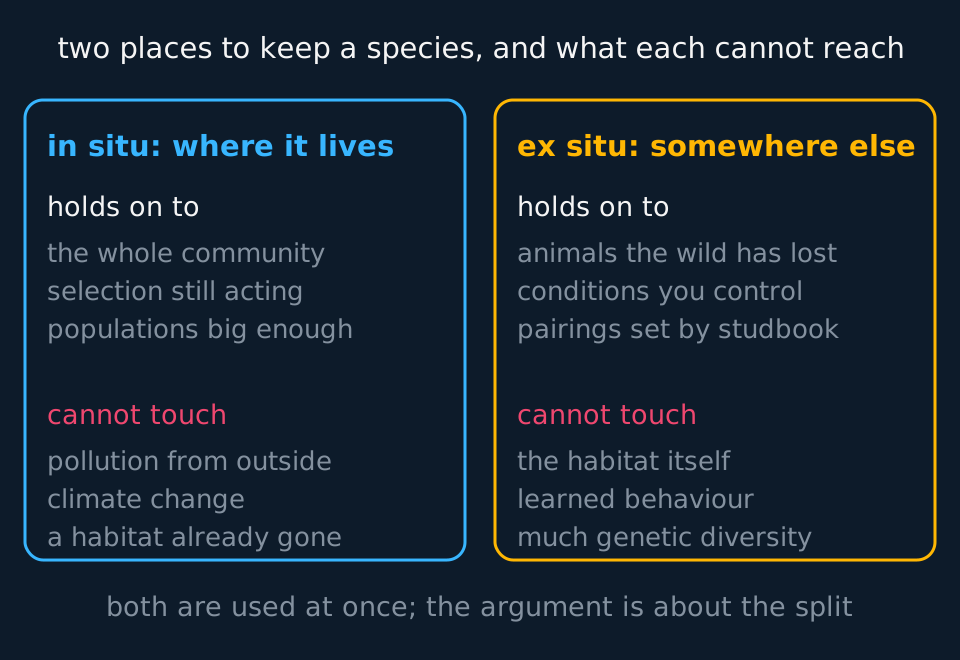
Two large outlined cards side by side. The left card, in situ conservation, lists what conserving a species where it lives holds on to (the whole community, natural selection still operating, populations large enough to matter), and beneath it what that approach cannot touch: pollution from outside, climate change and a habitat that has already been destroyed. The right card does the same for ex situ conservation, from controlled conditions and planned matings down to the habitat itself, learned behaviour and genetic diversity.
In situ conservation
Conserving a species in its habitat conserves the community and conditions around it. National parks, nature reserves, Sites of Special Scientific Interest and marine conservation zones protect an area rather than a species, so unstudied species in the area are protected as well. Selection continues to act, so the population remains adapted to conditions that are themselves changing. Populations can be large, which slows the loss of genetic diversity. Per species conserved, the cost is much lower than captive breeding.
In situ conservation usually requires active management. A chalk grassland left unmanaged develops into scrub and then woodland within a few decades, and the orchids and butterflies it was designated for are lost. Reserves are therefore grazed, coppiced, mown or burned on rotation, holding succession at the stage that suits the species being conserved.
The limitations are the pressures a boundary does not exclude. Poaching continues inside reserves, and in some places a designation concentrates the animals and makes them easier to locate. Invasive species colonise reserves. Pollution and climatic change originate outside them. Reserves are often too small, or too isolated from one another, to hold a viable population of a wide-ranging animal, which is the reason for wildlife corridors linking fragments. And a reserve on land previously farmed or logged imposes a cost on the people who live there, so enforcement is difficult where local communities receive no benefit from it.
Invasive alien species are species moved by people outside their natural range that spread and harm the native community. They are controlled because they compete with native species for food and space, prey on species that evolved without them, carry disease and hybridise with close relatives: the grey squirrel outcompetes the red squirrel and carries squirrelpox, and rats introduced to seabird islands eat the eggs and chicks.
The IUCN, the International Union for Conservation of Nature, assesses species against standard criteria and publishes the Red List, which places each assessed species in a category from Least Concern through Near Threatened, Vulnerable, Endangered and Critically Endangered to Extinct in the Wild and Extinct. Governments and conservation bodies use those assessments to decide which species most need protection.
Two international agreements are named on the specifications. CITES, the Convention on International Trade in Endangered Species, has been in force since 1975 and regulates cross-border trade: species in Appendix I may not be traded commercially at all, those in Appendix II only under permit. It controls trade and nothing else, so it does not touch habitat loss, and it depends entirely on member states enforcing it at their own borders. The Convention on Biological Diversity, agreed at the Rio Earth Summit in 1992, is broader and less prescriptive: signatories commit to conserving biodiversity, using it sustainably, and sharing the benefits arising from genetic resources fairly with the countries of origin. It sets targets rather than prohibitions, and successive sets of targets have not been met in full.
Ex situ conservation
A zoo, a botanic garden or a captive breeding centre offers control that a reserve cannot. Temperature, diet and disease exposure are managed. Veterinary care is available. Breeding can be assisted with artificial insemination, embryo transfer or surrogacy, and matings can be selected. Captive breeding uses a studbook: a record of every individual's ancestry, used to pair the least related animals available and slow the loss of alleles. Animals can be moved between institutions for that purpose. For a species already extinct in the wild there is no alternative.
The main limitation is population size. A captive population is founded by a handful of individuals and held at a few hundred at most, so it passes through a bottleneck by construction, and alleles that were not in the founders are simply not there. Inbreeding raises the frequency of homozygous recessive genotypes, and with it the incidence of inherited disease and of reduced fertility. Captivity also selects: over generations, the animals that breed best in enclosures are not necessarily the ones that would survive outside them.
Behaviour is a second limitation. Hunting, predator avoidance, migration routes and, in many birds and mammals, the details of courtship are learned from other individuals. A hand-reared animal may not acquire them, so release programmes use puppet feeding, mentor birds, pre-release training pens and soft releases with continued support. These measures are expensive and release success rates remain low for many species.
Four assisted-reproduction methods are named on the specifications. Artificial insemination moves semen to a female without moving the male, which matters when the two animals are on different continents or when a pair will not mate. In vitro fertilisation, usually shortened to IVF, takes eggs from the female, fertilises them with collected semen in the laboratory, and grows the embryos far enough to be assessed before any of them is used. Embryo transfer then places an embryo into a female that did not produce the egg, so a single genetically valuable female can be the mother of many more offspring than she could carry herself. Where no female of the species is available to carry a pregnancy, a female of a closely related species can act as a surrogate, which has been done for wild cattle and for wild horses.
Those techniques are what make a frozen zoo, or cryobank, usable. Cryobanks store gametes, embryos or tissue at very low temperature. Samples taken from several individuals can preserve alleles without maintaining the same number of live animals. Material collected before further population decline may later reintroduce stored alleles, but it cannot recover alleles that were lost before sampling and requires suitable reproductive technology or surrogate animals.
In practice the material is held in liquid nitrogen at around minus one hundred and ninety six degrees Celsius, at which temperature metabolism is arrested and the cells remain viable for decades. Semen collected from a bull thirty years ago can be used on a living cow today, returning alleles to a population that has drifted since. Stored tissue also supports work unrelated to breeding, such as sequencing the genome of a species after it has become extinct.
The limitations belong in an evaluation. Freezing and thawing damage cells, and the protocols that work for cattle sperm do not simply transfer to a rhinoceros, so success rates for wild species are low and vary enormously between them. Eggs and embryos are much harder to freeze than sperm because they hold more water. A frozen sample can only be used where living animals are available to receive it, so a store with no surviving population and no suitable surrogate species functions as an archive rather than as a route to reintroduction. And cryobanking does not address the cause of endangerment, which is most often habitat loss.
Cost is a further consideration. Keeping a large mammal in a zoo costs more per animal per year than protecting a comparable area of habitat, which raises the allocation question directly: given a fixed budget, how much should be spent on captive populations and how much on land? Zoos hold that they also carry out research, breeding science and public education that returns funding and support to field work. Critics hold that a species whose habitat is not protected is being maintained as an exhibit.
Seed banks
For plants, ex situ conservation stores far more individuals per unit of space. Seeds are small and are already a dormant stage, and a single collection can hold tens of thousands of seeds from hundreds of separate parent plants, so a seed bank can store allelic variation from a large sample of a population within a building.
Describe the drawing
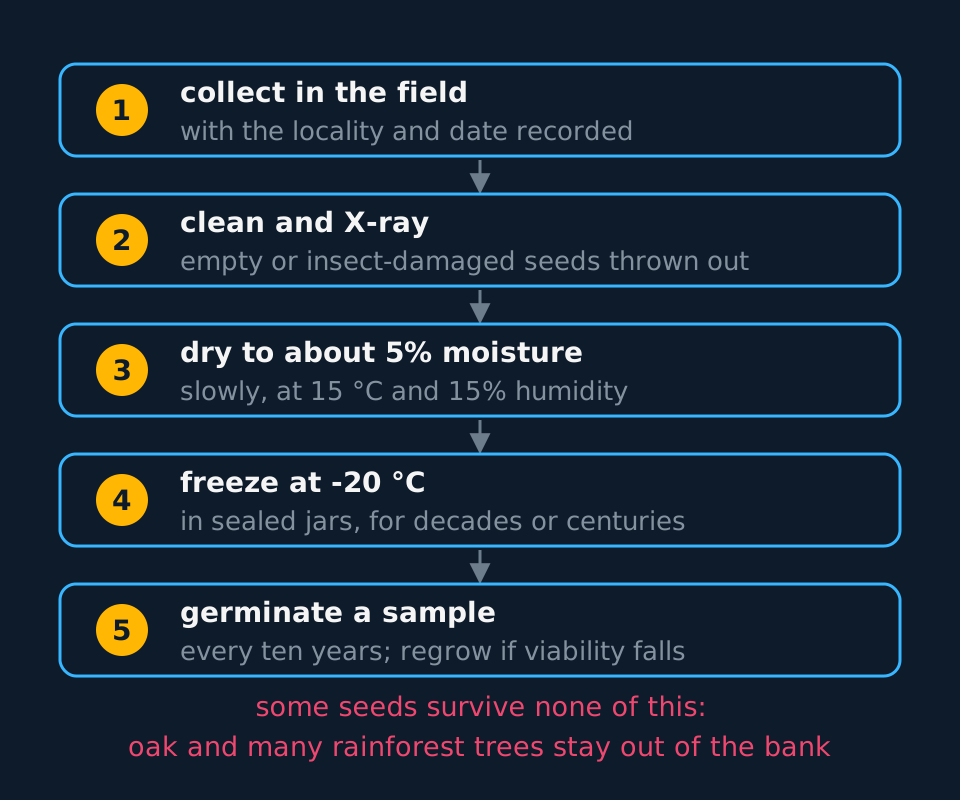
Five numbered cards stacked one above another with arrows running downward between them, setting out what happens to a seed in a seed bank: collection in the field with its locality and date, cleaning and X-ray screening to discard empty seeds, slow drying to about five per cent moisture, freezing at minus twenty degrees in sealed jars, and a germination test on a sample every ten years. A note underneath records that some seeds cannot be dried or frozen at all.
Seed is collected in the wild, from many individuals across a population, with the locality, date and habitat recorded, because an accession without that information cannot be put back anywhere in particular. It is cleaned and X-rayed so that empty or insect-damaged seeds are discarded. It is then dried slowly, typically at around 15 °C and 15 per cent relative humidity, down to roughly 5 per cent moisture content. Only then is it frozen, conventionally at −20 °C, in sealed containers. Drying first is not optional: water left in the seed forms ice crystals that rupture the cell membranes.
Low temperature and low water content slow metabolism almost to a stop, so respiration barely proceeds, reserves are not used up and enzymes do little damage. Seeds of many species stay viable for decades or centuries this way. But viability does fall, so a sample from each accession is germinated at intervals, of which every ten years is a common cycle, and if the germination percentage has dropped too far, seed is grown on to produce a fresh batch.
The Millennium Seed Bank at Wakehurst in Sussex, run by Kew, holds seed from tens of thousands of species with a particular emphasis on wild plants rather than crops; the Svalbard Global Seed Vault, cut into permafrost inside an Arctic mountain, exists as a backup copy of the world's crop collections. The advantages over conserving the plants themselves are less space, less labour, lower risk from fire or a disease outbreak in a living collection, and the storage of many more individuals and therefore many more alleles. Storage risk is reduced rather than eliminated: freezer failure, flooding and funding loss have all affected collections, which is why duplicate accessions are held at separate sites.
One limitation restricts which species can be stored. Seeds that tolerate drying and freezing are called orthodox; a substantial minority, the recalcitrant seeds, do not. Acorns, horse chestnuts, avocados, mangoes, cocoa and a large proportion of tropical rainforest trees have seeds that are shed with a high water content and die if dried. They must be kept as living collections, or by freezing extracted embryos in liquid nitrogen, or in tissue culture, all of which are more expensive and less secure. The habitats richest in species are the ones whose seeds a seed bank finds hardest to take.
Four arguments for maintaining biodiversity
Reasons for maintaining biodiversity are conventionally grouped under four headings. Each heading is a position that is argued for, and each has a standard objection; an evaluation should give both.
Describe the drawing
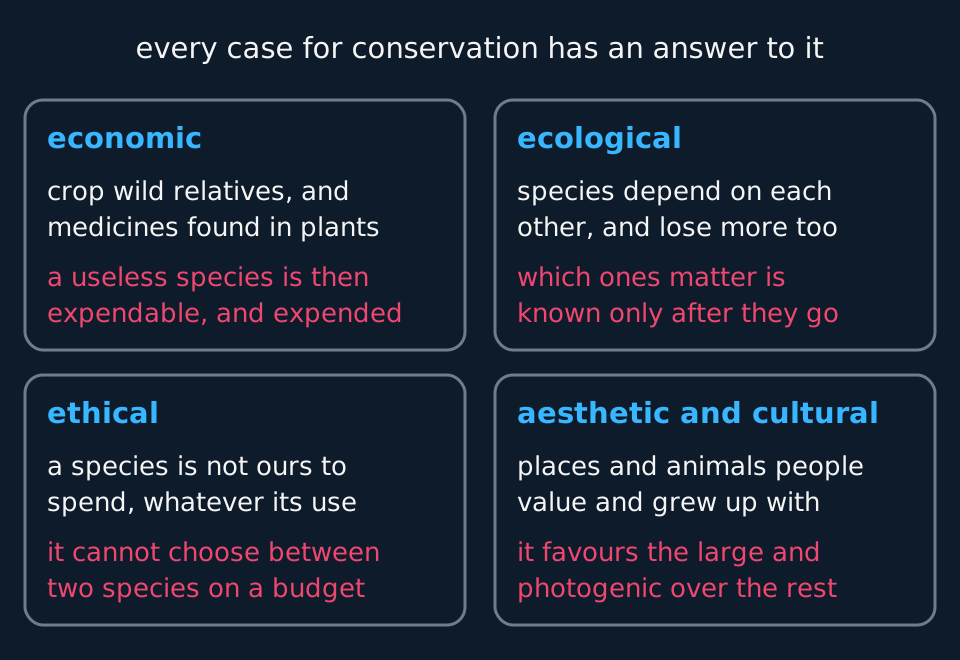
Four cards in a two by two arrangement, one for each kind of case made for conserving biodiversity: economic, ecological, ethical, and aesthetic and cultural. Each card carries the claim in pale text and, beneath it in coral, the standard objection that case runs into: that a species with no known use becomes expendable, that the important species are identified too late, that intrinsic value cannot rank two species against each other, and that beauty favours large and photogenic animals.
The economic case. Wild species are a stock of useful material. Vincristine and vinblastine, still used against childhood leukaemia and Hodgkin lymphoma, came from the Madagascar periwinkle; paclitaxel came from the bark of the Pacific yew. Wild relatives of crops carry disease resistance that breeders need. A wild rice from India supplied the resistance to grassy stunt virus that was bred into cultivated varieties. Habitats also do work for nothing, known as ecosystem services: wetlands hold flood water, forests hold soil, insects pollinate crops. Variety in the crops themselves pays too: growing the same crop on the same land year after year, continuous monoculture, depletes the soil of the nutrients that crop draws on, which a rotation of different crops avoids. The objection is that the argument applies in both directions. If a species is worth conserving because it may prove useful, a species shown to have no use has no claim under this argument, and most species will never be assessed for usefulness at all.
The ecological case. Species are connected, and removing one can lead to the loss of others. Some species have effects out of proportion to their abundance, of which sea otters limiting sea urchin numbers in kelp forests is the standard example, and a community that loses species loses the functional redundancy that allows it to absorb a disturbance. The objection is practical: which species have these effects is generally not known in advance, and often becomes apparent only after the species has been lost. The argument therefore supports precaution generally rather than a method of prioritising funding.
The ethical case. This case holds that a species is the outcome of a very long evolutionary history and should not be ended by human action irrespective of its usefulness, and that present generations have obligations to future ones. The argument does not depend on the species being useful or conspicuous. The objection is that it provides no basis for choosing. Budgets are finite, and an argument that every species has an equal and absolute claim cannot decide between two species when only one can be funded.
The aesthetic and cultural case. People value landscapes and animals, travel to see them, write about them and build identities around them; ecotourism turns that into income that can pay for protection. The objection is that this valuation is measurably uneven. It favours large mammals and birds over invertebrates, fungi and plants, which is close to the reverse of where most species diversity lies, and it makes funding dependent on public interest.
The four arguments do not converge on a single ranking and they conflict in practice. An evaluation should state which argument it relies on, and why, rather than listing all four.
Two case histories
optional
The large blue butterfly: identifying the limiting factor before protecting the site. The large blue, Phengaris arion, declined through the twentieth century in Britain despite its remaining sites being protected, and was declared extinct here in 1979. Protection of the sites had not conserved the species because its habitat requirement was not then known. Jeremy Thomas established that the caterpillar leaves its food plant of wild thyme after a few weeks, drops to the ground and is carried into the nest of a single ant species, Myrmica sabuleti, where it spends ten months eating ant grubs. That ant needs short, warm turf. When myxomatosis destroyed the rabbit population in the 1950s and grazing stopped, the turf grew longer, the soil cooled by a couple of degrees, the ant was replaced by a related species unsuitable as a host, and the butterfly starved inside the wrong nests.
The response was to restore the grazing, with sheep, cattle and returning rabbits, and to re-establish the sward at the height the ant needs, then reintroduce the butterfly from a Swedish population from 1983 onwards. It now flies at dozens of sites in the west of England in numbers larger than for many decades. The effective conservation action was management of the ant's habitat rather than protection of the butterfly itself. The red kite, reintroduced to England and Scotland from 1989 using birds from Spain and Sweden and now breeding in thousands of pairs, follows the same pattern: the cause of the decline, in that case persecution and poisoning, was addressed before reintroduction.
The California condor: a population dependent on continued intervention. By 1982 there were 22 California condors alive anywhere. The decision taken in 1987 was contested: every remaining wild bird was caught, and the species existed only in two zoos. Captive breeding worked better than expected. Double clutching, in which the first egg is removed so the pair lays another, roughly doubled the output, and releases began in 1992. The total population passed five hundred in recent years, with more than half of those birds flying free.
Measured by population size that is a substantial recovery. The cause of the original decline, however, remains. Condors are scavengers, and carcases shot with lead ammunition contain lead fragments; lead poisoning remains the leading cause of death in free-flying birds. So the released population is monitored intensively, birds are trapped and blood-tested, and those with high lead levels are treated with chelation therapy. An outbreak of highly pathogenic avian influenza in 2023 killed a substantial part of one flock and prompted an emergency vaccination programme. Without continued releases, trapping and treatment, the free-flying population would decline. It is not, in the technical sense, self-sustaining.
Whether the condor programme counts as a success depends on the criterion applied. Against the criterion that the species should still exist, it succeeded, and the alternative in 1987 was extinction within a few years. Against the criterion of a wild population living without veterinary support, it has not yet succeeded, and the remaining obstacle is the regulation of lead ammunition rather than a biological constraint. The giant panda raises the same question from the other end: the IUCN moved it from Endangered to Vulnerable in 2016 on the strength of a rising count and an enormous reserve network, China's own authorities disagreed with the downlisting at the time, and the wild population remains split into many small groups separated by roads and farmland, several of which are too small to persist independently. Whether that counts as a recovery depends on whether the measure is the total number of animals or the viability of individual populations.
TRY IT: Choosing an approach, and defending it
A tropical island holds an endemic tree that grows nowhere else. Fewer than 200 mature individuals remain, in three fragments of forest separated by plantations. The tree is pollinated by a bat that is itself declining, and its seeds are large, fleshy and die within days of falling. A conservation body has funding for one main programme.
Evaluate in situ and ex situ options for this species, and recommend one, giving the biological reasons.
Check your answer
Start with what the seeds rule out. Large, fleshy seeds that die quickly are almost certainly recalcitrant: they cannot be dried to 5 per cent moisture and frozen at −20 °C, so a conventional seed bank is not available. The ex situ options are therefore a living collection in a botanic garden, cryopreservation of excised embryos, or tissue culture: all more expensive, all holding far fewer individuals and therefore far fewer alleles.
Now the pollinator. The tree depends on a declining bat, and no botanic garden collection will conserve that relationship. Plants grown ex situ would need hand pollination indefinitely, and a population that has been hand pollinated for decades provides no evidence about whether it can still reproduce in the wild. Conserving the tree without the bat conserves only one part of the pollination system.
The fragmentation is an in situ problem. Fewer than 200 individuals in three separated groups means gene flow between them is limited or absent, and diversity is being lost to drift and inbreeding in each fragment independently.
Recommendation: in situ, focused on the fragments and the gaps between them. Protect the three areas legally, manage them for regeneration, and plant corridors of native forest between them so that bats can move and pollen can flow, which conserves the bat at the same time. Hand-pollinate between fragments in the short term to restore gene flow while the corridors grow.
Alongside it, not instead of it: establish a small living collection in a botanic garden, propagated from as many different parent trees as possible, as insurance against a hurricane or disease taking one of the fragments. The reason this is secondary is that it cannot conserve the pollination system, cannot hold enough individuals to preserve the alleles, and does not address why the tree is declining.
State the assumption: the recommendation depends on the plantations between the fragments being available for purchase or negotiation. If they are not, the ex situ option becomes the only one available.
In the exam
- Define in situ and ex situ before using them: 'in its natural habitat' and 'outside its natural habitat'. Naming zoos and reserves is an example rather than a definition.
- Attach a consequence to each advantage. 'In situ is better for genetic diversity' states the outcome; 'in situ supports a much larger population, so fewer alleles are lost by drift and inbreeding' gives the mechanism.
- For seed banks, give the order and the values: collect with locality data, clean and X-ray, dry to about 5 per cent moisture, freeze at −20 °C, germination-test a sample periodically. Recalcitrant seeds are the standard limitation.
- CITES regulates trade; the Convention on Biological Diversity sets broader commitments on conservation, sustainable use and benefit sharing. Habitat protection is not within the scope of CITES.
- Answer 'discuss' and 'evaluate' commands on both sides. An answer listing only benefits addresses one side of the question.
- Name the example and give a detail specific to it. 'Captive breeding has saved species' names no case; 'the large blue was reintroduced from Sweden after grazing was restored to shorten the sward the host ant requires' does.
Check yourself
A national park protects an area of savannah containing a population of about 400 black rhinoceros. Poaching has risen and 30 animals were killed last year. A donor offers enough money either to double the number of rangers patrolling the park, or to establish a captive breeding herd of 40 animals in a fenced sanctuary elsewhere. Discuss the biological arguments on each side.
Answer
The case for the rangers, in situ. The 400 animals in the park are a far larger gene pool than any captive herd could be, so keeping them alive conserves genetic diversity that cannot be recreated once it is gone. They are in the habitat they are adapted to, with the plants they browse and the community they belong to, and natural selection continues to act. Protecting the park protects everything else living in it at no extra cost. The threat here is poaching, which is precisely the threat more rangers address; the habitat itself is intact, so nothing else is currently limiting the population.
The case for the sanctuary, ex situ. Forty animals behind a fence are far easier to protect, and a catastrophe in the park, whether an escalation in poaching, a disease outbreak or a drought, would not take them with it. Breeding can be managed with a studbook so that the least related animals are paired, and reproduction can be assisted. Rhinoceros are large, slow-breeding and easy to find, which makes them poor candidates for protection by patrol alone.
Against the sanctuary. Forty founders is a bottleneck: alleles present only in the other 360 animals are lost to the herd at the moment of selection, and inbreeding will raise homozygosity in the herd within a few generations. It costs a great deal per animal. It does nothing whatever about the poaching, so the wild population continues to fall while the herd is established, and any future release goes back into the same danger.
Against the rangers. Patrolling treats the symptom. If the demand for horn and the poverty that supplies poachers are untouched, adding rangers raises the cost of poaching without ending it, and the money runs out eventually.
A defensible conclusion. Spend it on the rangers. The habitat is intact and the population is large, so the only thing currently reducing it is killing, and the intervention that stops killing conserves 400 animals and their alleles rather than 40. The sanctuary would be the right answer if the habitat itself were being lost, or if the population had already fallen so low that protection in place could not be relied on. Either answer can earn full marks if it argues from population size, genetic diversity and the nature of the threat rather than from preference.
Questions
Question 15 marks
A captive breeding programme has raised a large scavenging bird from 22 individuals to more than 500, over half of them flying free, but released birds are trapped and blood-tested for lead every year and treated when concentrations are high. Evaluate the claim that the programme has been a success.
Mark scheme
- B1 for: the species still exists, and the alternative when the last wild birds were taken into captivity was extinction within a few years, so on any count of individuals the outcome is a success
- B1 for: the captive breeding worked better than expected. Removing the first egg so that a pair lays another roughly doubled the output, and more than half the birds now fly free rather than being held in enclosures
- B1 against: the cause of the decline has not gone, since carcases shot with lead ammunition remain the leading source of poisoning, so without continued releases, trapping and treatment the free-flying population would fall again
- B1 against: the population is therefore not self-sustaining in the technical sense, and a disease outbreak in one flock can still remove a substantial part of it, so the programme is a permanent commitment rather than a finished task
- B1 judgement: whether this counts as success depends on the goal. It plainly succeeded in keeping the species in existence, and it has not produced a wild population living without veterinary support, with the remaining obstacle being a rule about ammunition rather than anything biological
Question 24 marks
Describe how seed is collected, prepared and stored in a seed bank, and describe how the collection is checked for viability.
Mark scheme
- B1 seed is collected in the wild from many individuals across the population, with locality, date and habitat recorded, then cleaned and X-rayed so that empty or insect-damaged seeds are discarded
- B1 it is dried slowly, typically at about 15 °C and 15 per cent relative humidity, down to roughly 5 per cent moisture content
- B1 it is then sealed in containers and frozen, conventionally at −20 °C, and the drying has to come first because water left in the seed forms ice crystals that rupture the cell membranes
- B1 a sample from each accession is germinated at intervals, commonly every ten years, and if the germination percentage has fallen too far, seed is grown on to produce a fresh batch
Question 34 marks
Explain why a captive breeding population loses genetic diversity, and explain what is done to slow that loss.
Mark scheme
- B1 a captive population is founded by a handful of individuals and held at a few hundred at most, so it passes through a bottleneck by construction and alleles that were not in the founders are simply absent
- B1 in a small population the alleles passed on each generation are a small sample of those present, so frequencies drift by chance and alleles are lost altogether, and only mutation or migration restores them
- B1 inbreeding raises the frequency of homozygous recessive genotypes, so inherited disease and reduced fertility become commoner in the herd
- B1 a studbook records every individual's ancestry so that the least related animals available can be paired, and animals are moved between institutions to widen the choice of mates
Question 44 marks
Compare in situ with ex situ conservation, referring to genetic diversity, to the rest of the community and to the problems each approach cannot solve.
Mark scheme
- B1 in situ keeps the species where it lives, so the whole community and the conditions it is adapted to are conserved with it, whereas ex situ conserves the species alone and cannot conserve its habitat or the species it depends on
- B1 in situ can support a far larger population, so far fewer alleles are lost to drift and inbreeding, whereas an ex situ population is founded by a handful of individuals and passes through a bottleneck
- B1 selection continues to act in situ, so the population stays adapted to conditions that are themselves changing, whereas captivity selects for animals that breed well in enclosures and learned behaviour such as hunting or predator avoidance may never be acquired
- B1 ex situ offers controlled conditions, veterinary care, assisted breeding and chosen matings, and is the only option for a species already gone from the wild, whereas a boundary on a map does not stop poaching, invasive species, pollution or a changing climate
Question 54 marks
Evaluate the claim that a frozen zoo makes the extinction of a mammal species reversible.
Mark scheme
- B1 in support: the store holds gametes and embryos carrying alleles that are otherwise gone, and in vitro fertilisation, embryo transfer and surrogacy give a route from stored material to living animals
- B1 against: freezing and thawing damage cells and the protocols differ between species, so success rates for wild mammals are low, and eggs and embryos are much harder to store than sperm
- B1 against: a stored embryo needs a female of the species or a suitable related surrogate to carry it, and a population rebuilt from a handful of samples would have very little genetic diversity and no learned behaviour
- B1 a judgement: a frozen zoo can slow the loss of alleles and support a population that still exists, but it does not restore the habitat the species was lost from, so it is a supplement to in situ conservation rather than a replacement for it
Question 64 marks
Compare CITES with the Convention on Biological Diversity, referring to what each one regulates and how binding each one's provisions are.
Mark scheme
- B1 CITES regulates cross-border trade in endangered species, banning commercial trade in species listed in Appendix I entirely and requiring a permit for those in Appendix II, whereas the Convention on Biological Diversity is broader, covering conservation, sustainable use and the fair sharing of benefits from genetic resources
- B1 CITES controls trade specifically and does nothing about habitat loss, whereas the Convention on Biological Diversity addresses biodiversity loss more generally but through targets rather than trade rules
- B1 CITES depends on member states enforcing it at their own borders, whereas the Convention on Biological Diversity sets targets rather than prohibitions, and successive sets of its targets have not been met in full
- B1 both are international agreements that individual countries choose to join and must then implement through their own domestic law, so neither compels a non-signatory country to comply
Question 74 marks
A conservation charity raises most of its funds by appealing to public support for large, visually appealing mammals such as tigers and pandas. Evaluate this as a strategy for funding conservation broadly.
Mark scheme
- B1 for: people value and are willing to pay to see and protect landscapes and charismatic animals, and ecotourism and public donations turn that valuation into real income that can pay directly for protection
- B1 for: a well-known species can act as a flagship that draws in funding and attention which then also supports conservation of the habitat, and of the many less visible species that share it
- B1 against: public valuation of species is measurably uneven, favouring large mammals and birds over invertebrates, fungi and plants, which is close to the reverse of where most of the planet's species diversity actually lies
- B1 judgement: funding driven mainly by public appeal will systematically under-fund the groups that hold most of the diversity, so it is a genuine source of income for conservation but a poor basis for deciding which species most need it
Question 84 marks
The caterpillar of the large blue butterfly feeds on wild thyme for about three weeks, then is carried by one particular species of red ant into its nest, where it eats the ant grubs for about ten months before pupating. That ant thrives only in short turf, where the sun warms the soil; in taller turf the soil is cooler and a related ant, which does not rear the caterpillars, replaces it. Grazing rabbits kept the turf short until myxomatosis killed most of Britain's rabbits in the 1950s. The butterfly's sites were protected from development and collectors, but it became extinct in Britain in 1979. Explain why protecting the sites did not prevent the extinction, and suggest what had to be done before the butterfly could be reintroduced.
Mark scheme
- B1 the butterfly depends on the one ant species for most of its larval life, so it cannot survive where that ant is absent, however much thyme there is
- B1 without grazing the turf grew taller and the soil cooler, so the host ant declined and was replaced by the related species that does not rear the caterpillars
- B1 protection kept people from damaging the sites but did nothing to keep the turf short, so the conditions the ant needs were lost on protected land
- B1 the turf had to be kept short again, by grazing with livestock or by cutting, until the host ant was common, and only then could butterflies be reintroduced
Question 94 marks
Explain what artificial insemination, in vitro fertilisation and embryo transfer each contribute to captive breeding, and explain when a surrogate mother is used instead.
Mark scheme
- B1 artificial insemination moves semen to a female without moving the male, which matters where the two animals are kept on different continents or where a pair will not mate naturally
- B1 in vitro fertilisation takes eggs from a female and fertilises them with collected semen in the laboratory, allowing the resulting embryos to be assessed before any is used
- B1 embryo transfer places an embryo into a female that did not produce the egg, so that a single genetically valuable female can become the mother of far more offspring than she could carry herself
- B1 a surrogate, a female of a closely related species, is used to carry a pregnancy where no female of the endangered species itself is available to do so
Question 104 marks
A student says that if a species is in trouble, the answer is to breed it in a zoo and put it back. Discuss whether this is generally an adequate conservation strategy.
Mark scheme
- B1 what is right: captive breeding has restored some species that would otherwise have gone extinct, and it is the only option remaining once a species is already extinct in the wild
- B1 against: a captive population is founded by a handful of individuals and held at a few hundred at most, so it loses genetic diversity to a bottleneck and to inbreeding, and captivity can select for behaviour unsuited to survival outside it
- B1 against: releasing bred animals does nothing about the cause of the original decline; if that cause, such as habitat loss, poaching or lead poisoning, is still present, a released population will simply decline again or require permanent, continued intervention such as trapping and treatment, as with the California condor
- B1 judgement: breeding and releasing a species can rescue it from extinction, but 'put it back' understates what is needed; a self-sustaining wild population usually also requires the original cause of decline to be addressed, which captive breeding on its own does not do
Question 113 marks
The seeds of many tropical rainforest trees are shed with a high water content and die if they are dried. Suggest why such species cannot be held in a conventional seed bank, and suggest two other ways of conserving them outside their habitat.
Mark scheme
- B1 the seed cannot be dried to about 5 per cent moisture, and freezing it while wet would form ice crystals that rupture the cell membranes, so the method depends on a step these seeds do not survive
- B1 they can be kept as a living collection of plants in a botanic garden, which takes far more space and labour and holds far fewer individuals, and therefore far fewer alleles
- B1 embryos can be excised and frozen in liquid nitrogen, or the plants maintained in tissue culture, both of which are more expensive and less secure than a seed store
Question 123 marks
Describe what a frozen zoo stores and explain one advantage it has over keeping the same species as living animals in a zoo.
Mark scheme
- B1 it stores gametes, embryos and tissue samples from endangered animals in liquid nitrogen at about minus one hundred and ninety six degrees Celsius
- B1 at that temperature metabolism stops, so the material keeps for decades without ageing or being selected on
- B1 it holds far more genetic variation in far less space and at far lower cost, and semen stored decades ago can put alleles back into a population that has since lost them
Question 133 marks
Explain the economic case for maintaining biodiversity, giving a named example, and explain the standard objection made to this argument.
Mark scheme
- B1 wild species are a stock of potentially useful material; for example, vincristine and vinblastine, still used to treat childhood leukaemia and Hodgkin lymphoma, were derived from the Madagascar periwinkle
- B1 wild relatives of crop species can also carry disease resistance that plant breeders need, such as the wild rice from India that supplied resistance to grassy stunt virus bred into cultivated rice
- B1 the objection is that the argument applies in both directions: if a species is worth conserving because it may prove useful, a species assessed as having no use has no claim under this argument, and the great majority of species will never be assessed for usefulness at all
Question 143 marks
Explain the ethical case for maintaining biodiversity, and explain the standard objection made to it.
Mark scheme
- B1 a species is the product of a very long evolutionary history, and the ethical case holds that it should not be ended by human action regardless of whether it is useful, with an obligation owed by the present generation to future ones
- B1 this argument does not depend on a species being useful or conspicuous, unlike the economic or aesthetic cases
- B1 the objection is that it gives no basis for choosing between species when a fixed budget cannot fund every one: an argument that every species has an equal and absolute claim cannot say which of two species should be funded when only one can be
Question 152 marks
State what is meant by in situ conservation and what is meant by ex situ conservation.
Mark scheme
- B1 in situ: conserving a species in its natural habitat, so that the community and the conditions it is adapted to are conserved along with it
- B1 ex situ: conserving a species outside its natural habitat, in a zoo, a botanic garden, a seed bank or a captive breeding centre
Worth remembering
- In situ means in the natural habitat; ex situ means outside it. Most programmes use both.
- In situ conserves the community and a big enough population to keep alleles; it cannot stop pollution or climate change that start outside a reserve, or restore a habitat that has already gone.
- Ex situ gives control and can hold a species that is gone from the wild; it cannot hold much genetic diversity, learned behaviour or the habitat.
- Seed banks: dry to about 5 per cent moisture, freeze at −20 °C, germinate a sample periodically. Recalcitrant seeds cannot be stored this way.
- The economic, ecological, ethical and aesthetic cases are four positions with four objections, not four ticks on a list.
- Assisted reproduction in captive breeding means artificial insemination, in vitro fertilisation, embryo transfer and surrogacy.
- A frozen zoo stores gametes, embryos and tissue in liquid nitrogen. It preserves alleles, but it needs living animals to put them back into.
CHECK YOUR PROGRESS
Rate how confident you are with each objective for this lesson. Ratings are saved in this browser, on this device, unless you sign in.
- Define in situ and ex situ conservation and give examples of each.
- Explain the advantages and the limitations of each approach, and why most programmes use both.
- Describe how a seed bank collects, dries, stores and tests seed, and explain which species it cannot store.
- Outline what CITES and the Convention on Biological Diversity each do.
- Set out the economic, ecological, ethical and aesthetic cases for conservation, and the objection each one meets.
- Discuss a case where conservation succeeded and one where the outcome is genuinely disputed.
- Name the assisted reproduction methods used in captive breeding, and explain what a frozen zoo stores and what it cannot do.
Open the full revision checklist to see every objective in the curriculum in one place.
Practise this lesson
Practise conservation in situ and ex situ with 15 original questions and point-by-point mark schemes
WORKBOOK
The questions from this topic, on paper with room to work, and a separate book of mark schemes. Free to use; please do not redistribute or sell.
Used later in Managing ecosystems sustainably