Biology › Evolution and speciation › Natural selection: variation, selection and allele frequency
Natural selection: variation, selection and allele frequency
Natural selection acts on variation that already exists, through differences in phenotype that affect reproductive success, and changes the allele frequencies of the population over generations. The sources of that variation, selection pressure and fitness, and the three modes of selection are covered here.
Before this Meiosis and the origin of variation · Population genetics and the Hardy-Weinberg principle · The genetic code and mutation · Averages, spread and the null hypothesis
COMMON MISCONCEPTION
Evolution is survival of the fittest, and the fittest are the strongest, fastest and biggest.
Fitness in biology is not athletic. It is the number of offspring an individual leaves that themselves survive to breed, relative to everyone else. A small unimpressive organism raising eleven surviving young is fitter than a magnificent one raising none.
What you should be able to do
- Name the sources of genetic variation and say which of them produces an allele that did not exist before.
- Distinguish variation that can be selected on from variation that cannot be inherited.
- Define fitness and selection pressure precisely.
- Recognise stabilising, directional and disruptive selection from a distribution and from a description.
- Explain why selection acts on phenotype while evolution is measured as a change in allele frequency.
- Write about selection without using language that implies organisms change on purpose.
The sources of genetic variation
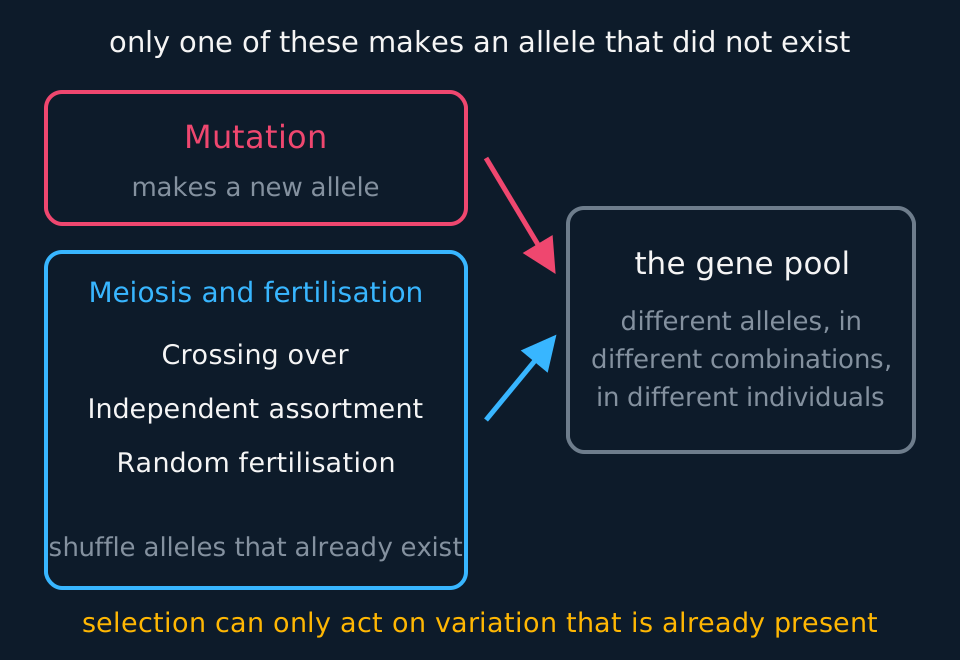
Mutation creates new alleles. Gene flow can introduce alleles from another population. During meiosis, crossing over and independent assortment create new allele combinations, and random fertilisation combines gametes. Natural selection acts through differences in phenotype that affect reproductive success; over generations, this changes allele frequencies in the population.
Those processes are not equivalent. Mutation is a change in the base sequence of DNA, and it is the only one that produces an allele which has not existed before anywhere; the others rearrange existing alleles, and gene flow moves them between populations. Crossing over in prophase I puts maternal and paternal alleles onto the same chromatid, and independent assortment at metaphase I gives a human 2²³ chromosome combinations before crossing over is counted. Random fertilisation then pairs any one of those gametes with any one of the other parent's.
Describe the drawing
A diagram in two halves feeding one gene pool. On the left, a coral box holds mutation, marked as the only process that makes an allele which did not exist before, and a cyan box holds crossing over, independent assortment and random fertilisation, marked as processes that shuffle alleles already present. Two arrows carry both into a box on the right labelled the gene pool, holding different alleles in different combinations in different individuals.
A population with no genetic variation cannot evolve in response to a new selection pressure, however severe it is. Individual organisms may still adjust within their own lifetimes, through physiological or developmental plasticity, but nothing heritable changes, which is why a monoculture of genetically identical crop plants can be destroyed by one new strain of fungus.
Mutations occur whether or not they would be advantageous, and an environment does not induce a specific mutation. Selection acts among mutations that had already occurred, most of which were neutral or harmful when they arose. Mutation is random with respect to fitness. That is a narrower claim than calling it random, since mutation rates vary along a chromosome, but it is the claim that matters here.
- Mutation
- A change in the base sequence of DNA. Mutation creates new alleles.
- Genetic variation
- Differences between individuals in a population that are caused by differences in their alleles, and can therefore be inherited.
- Environmental variation
- Differences in phenotype between organisms caused by the conditions they grew in rather than by their alleles, and therefore not passed to offspring.
- Gene pool
- All the alleles of all the genes in a population at a given time.
Environmental variation is not heritable. A plant grown in shade is taller and paler than the same clone grown in sun, and one grown in darkness becomes long, spindly and yellow, a response called etiolation; a weightlifter's children are not born stronger. Selection can act on an environmentally produced phenotype, since a small plant is shaded out whatever made it small, but if the difference has no genetic basis, nothing is passed on and no evolution occurs. Most characteristics fall between the two: height, yield and birth mass are polygenic and also responsive to conditions, which is why they show continuous variation, a smooth range with a peak in the middle rather than a few distinct classes.
Selection pressure and fitness
A selection pressure is any environmental factor that causes individuals with different phenotypes to survive and reproduce at different rates: predators, parasites, drought, cold, competition for food or for mates, an antibiotic, a pesticide. The pressure does nothing to any individual's genotype. It changes only how many copies of that genotype reach the next generation.
Fitness has a narrower meaning in biology than in everyday use. An individual's fitness is its contribution to the gene pool of the next generation relative to other individuals in the same population. It is counted as surviving fertile offspring, and it is always relative: a fitness of 0.8 means only that this genotype leaves 80% as many surviving offspring as the best one, in that environment, at that time.
- Selection pressure
- An environmental factor that causes individuals with certain phenotypes to survive and reproduce more successfully than others.
- Fitness
- The contribution an individual makes to the gene pool of the next generation, relative to other individuals in the population, usually counted as offspring that themselves survive to reproduce.
- Adaptation
- A characteristic that increases an organism's chance of surviving and reproducing in its environment. Adaptations may be anatomical, physiological or behavioural.
- Natural selection
- The process by which individuals with phenotypes better suited to the environment reproduce more successfully, so the alleles responsible become more frequent.
Defined this way, fitness is environment-specific: a pesticide resistance allele is usually mildly costly when the pesticide is absent, which is why resistance often declines after spraying stops. Fitness is population-specific, so a rare male colour form can do well precisely because it is rare. And fitness is about reproduction, so a peacock's tail is favoured if it wins enough matings to outweigh the risk it carries.
Three statements about fitness are therefore incorrect. It is not a property of a species, so 'humans are the fittest species' has no defined meaning; it is not something an individual gains by effort or training, as 'getting fitter' suggests; and it is not a prediction, because the environment that defines it changes.
Adaptations are usually sorted into three kinds. Anatomical adaptations are features of structure: marram grass has rolled leaves with sunken stomata, which trap humid air and cut water loss. Physiological adaptations are features of how the body works: a kangaroo rat's long loops of Henle let it make very concentrated urine, so it needs almost no drinking water. Behavioural adaptations are things the organism does: woodlice move faster and turn more in dry air and slow down in damp places, so they collect where they lose less water.
Three modes of selection and their effect on a distribution
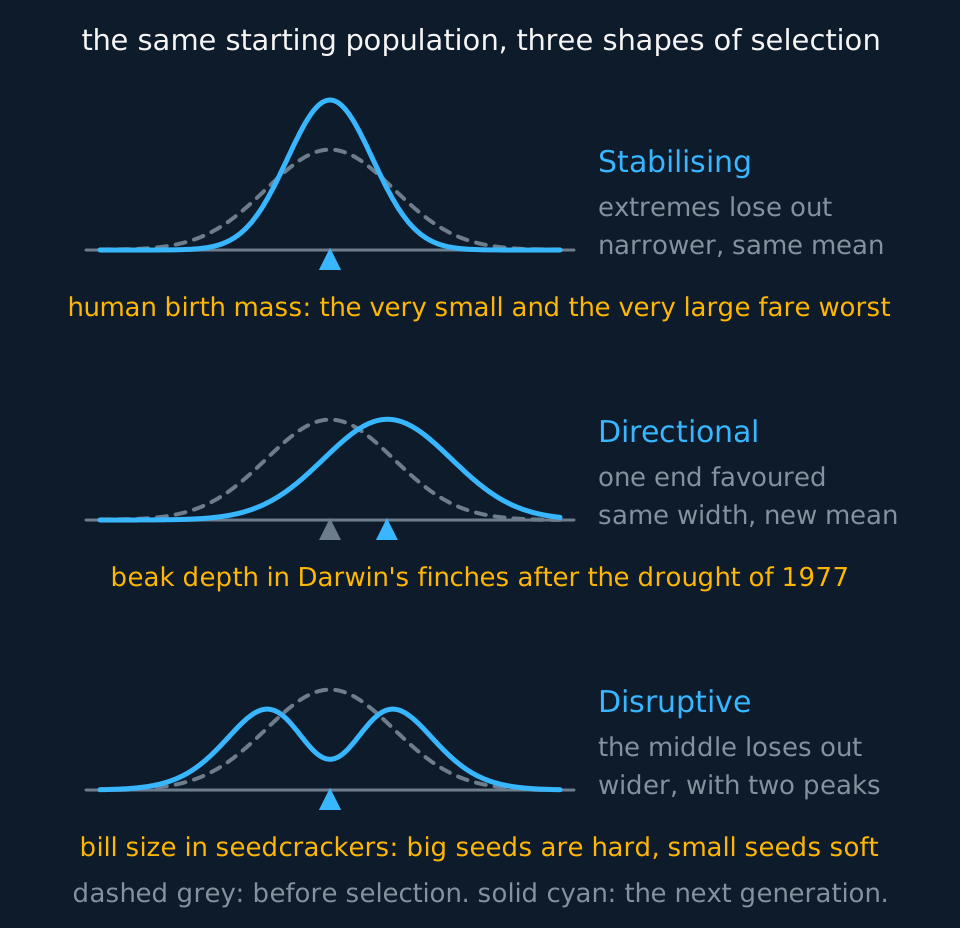
For a characteristic showing continuous variation, a plot of the number of individuals against the value of the characteristic gives a distribution, usually approximately normal. Selection can change it in three ways, depending on which part of the range is favoured.
Describe the drawing
Three graphs stacked vertically, each showing a phenotype distribution before selection as a dashed grey bell curve and the distribution after as a solid cyan curve, with a triangle on the axis marking each mean. In the top graph the cyan curve is taller and narrower with the mean unmoved; in the middle graph it has the same width but its whole peak has slid to the right; in the bottom graph it has split into two peaks with a dip between them where the old peak was.
Stabilising selection favours the middle of the range and acts against both extremes. The mean stays where it is and the variance falls, so the curve becomes taller and narrower. This is the commonest mode in a population living in a stable environment, and it removes variation rather than creating change. Human birth mass is the standard example: in Karn and Penrose's 1951 data, infant mortality was lowest at around 3.6 kg and rose steeply either side of it. Modern obstetric care has substantially weakened the effect, so quote the example with its date rather than as a current measurement.
Directional selection favours one end of the range. Individuals at that end leave more offspring, the whole distribution moves that way, and the mean shifts. This is the mode that produces visible evolutionary change, and it is what happens when an environment alters. Peter and Rosemary Grant watched it on Daphne Major in the Galápagos in 1977, when a drought left mainly large hard seeds. Ground finches with deeper, stronger beaks could crack them and most of the rest starved. The survivors' beaks averaged around 5% deeper than the pre-drought population, and their offspring inherited most of that difference.

Describe the drawing
An animation of a phenotype distribution moving under directional selection across five generations. Each frame shows a cyan bell curve of beak depth in millimetres above an axis, with the region of the curve that survives and breeds shaded amber on the right-hand side, a triangle marking the current mean, and a dashed grey line held at the starting mean of nine point four millimetres. Frame by frame the whole curve slides to the right of the dashed line while keeping its shape, and the printed mean rises past ten millimetres.
Disruptive selection is the least common of the three. It acts against the middle of the range and favours both extremes. Variance increases and the single peak splits into two. Thomas Bates Smith's work on the black-bellied seedcracker in Cameroon is a documented example: the finches feed on two sedges, one with hard seeds and one with soft, and birds have either large bills or small ones with almost no intermediates, even though the two forms interbreed freely. Disruptive selection is one of the few mechanisms by which a population can begin to diverge without geographical separation, a route the speciation lesson takes up.
| Stabilising | Directional | Disruptive | |
|---|---|---|---|
| Favoured | The mean phenotype | One extreme | Both extremes |
| Selected against | Both extremes | The other extreme | The mean |
| Effect on the mean | Unchanged | Moves towards the favoured extreme | May not move at all |
| Effect on variation | Reduced | Roughly unchanged | Increased |
| Curve after selection | Taller and narrower | Shifted sideways | Two peaks with a trough between |
| Typical situation | A stable environment | An environment that has changed | Two distinct resources, nothing in between |
| Example | Human birth mass | Beak depth in ground finches after drought | Bill size in the black-bellied seedcracker |
Exam-board note. AQA's specification names stabilising and directional selection at AS (3.4.4) and adds disruptive selection at A-level (3.7.3); Cambridge International and Edexcel Biology B also name disruptive selection, while OCR Biology A lists only stabilising and directional selection.
Selection acts on phenotype; evolution is measured in allele frequencies
Prerequisite: population genetics and the Hardy-Weinberg principle. A predator, a drought and an antibiotic act on the phenotype, on how fast the animal runs, how deep the beak is and whether the cell wall survives; none of them acts on a genotype directly. What persists into the next generation is not the phenotype but the alleles that contributed to it. Selection therefore operates at one level and its effect is measured at another, and the definition of evolution is written at the second: a change in the allele frequencies of a population over time.
That two-level structure accounts for several observed patterns. A recessive allele in a heterozygote has no effect on the phenotype, so selection through that phenotype does not act on it. Selection against a harmful recessive therefore becomes less effective as the allele gets rarer, because a larger fraction of the copies is carried by heterozygotes. The allele is still not immune to loss: in a finite population chance can remove the remaining copies, and selection acts on them whenever a recessive homozygote occurs. A dominant harmful allele is expressed in every carrier, so selection acts on every copy. It is removed quickly only if it reduces reproductive success before reproduction occurs, which is why late-acting dominant conditions such as Huntington's disease persist.
evolution = a change in allele frequency in a gene poolHardy-Weinberg gives the null: with no selection, no mutation, no migration, random mating and a large population, the frequencies do not change at all. A measured change is therefore evidence that at least one of those conditions is being broken.
Following one generation of selection through the arithmetic
A dominant allele A gives resistance to a fungal disease, and in a large randomly mating population its frequency is 0.10. The disease arrives. The resistant phenotype has a relative fitness of 1.0 and homozygous recessive individuals 0.5. Calculate the frequency of A in the next generation. Idealised figures, chosen to keep the arithmetic clean.
Show the working
Start from the genotype frequencies before selection, using Hardy-Weinberg with p = 0.10 and q = 0.90: p² = 0.01 for AA, 2pq = 0.18 for Aa, q² = 0.81 for aa.
Weight each genotype by its fitness. AA and Aa both show the resistant phenotype, so they are unchanged at 0.01 and 0.18; the aa class is halved to 0.405.
These no longer add to 1, because part of the population has been removed. The total is 0.01 + 0.18 + 0.405 = 0.595, so divide each by it: AA = 0.0168, Aa = 0.3025, aa = 0.6807.
Allele frequency is counted over alleles, so every AA individual contributes two copies of A and every Aa one: p′ = 0.0168 + ½ × 0.3025 = 0.168.
A has risen from 0.100 to 0.168 in a single generation, because selection acted on the phenotype of the aa individuals. No allele changed into another and no new allele arose.
q has fallen only from 0.900 to 0.832, although half the aa individuals were removed, because most copies of the recessive allele were in heterozygotes and were not exposed to selection through this phenotype.
TRY IT: Reading a distribution rather than describing it
An annual plant is measured for stem height in 1990 and again in 2010. In 1990 the distribution is symmetrical, mean 42 cm, standard deviation 9 cm. In 2010 the mean is 41 cm and the standard deviation is 4 cm. Grazing animals were excluded throughout and the climate did not change.
Name the type of selection acting, and explain how the two statistics support your answer.
Check your answer
Stabilising selection.
The mean is essentially unchanged, going from 42 cm to 41 cm, so the population has not moved towards either extreme, which rules out directional selection.
The standard deviation has fallen from 9 cm to 4 cm, so variation around the mean has been more than halved. Plants much taller and much shorter than the mean contributed fewer offspring than plants near it, so the alleles producing extreme heights became less frequent.
The stable environment stated in the question is the expected setting for stabilising selection: the phenotype already best suited remains so.
Support the answer with the two statistics. A statement that the plants adapted to stay the same height describes neither the change in mean nor the change in spread.
Wording that misdescribes the mechanism
Several convenient shorthands imply a mechanism that does not exist. Each row below gives the wording, the reason it is inaccurate, and a statement of what actually happens.
| Do not write | Why it is wrong | Write instead |
|---|---|---|
| The organism adapted to the cold | An individual cannot change its alleles during its lifetime. Populations become adapted; individuals do not adapt. | Individuals with alleles for thicker fur survived the cold better and left more offspring, so those alleles became more frequent |
| A mutation arose because the population needed it | Mutation is random with respect to fitness. Need does not cause mutation. | A mutation had already occurred by chance; when conditions changed it happened to be advantageous |
| The fittest survived | Circular unless fitness is defined, and survival alone changes nothing without reproduction. | Individuals with the advantageous phenotype survived and reproduced more successfully than the others |
| The species evolved a deeper beak so it could crack the seeds | Puts the purpose before the variation. Nothing is produced in order to be useful. | Beak depth varied; birds with deeper beaks could crack the available seeds and left more offspring |
| The bacteria became resistant when the antibiotic was applied | Implies the antibiotic caused the change. It selected among variation already present. | A few bacteria already carried a resistance allele; the antibiotic killed the rest, so the resistant ones came to dominate the population |
One check on a written answer is the direction of causation around the word 'so'. 'Deeper beaks meant more seeds could be cracked, so those birds left more offspring' runs from cause to consequence. 'The birds needed to crack more seeds, so they evolved deeper beaks' places the outcome before the variation and describes inheritance of acquired characteristics rather than natural selection.
A complete explanation of how natural selection produced a characteristic has four steps in this order. Genetic variation exists in the population, caused by mutation. A selection pressure is named. Individuals with a specified phenotype survive and reproduce more successfully. The alleles responsible are passed on, so their frequency increases over generations. Without the first step the account is Lamarckian; without the last it describes one generation of survival rather than evolution.
In the exam
- Open a natural-selection answer by stating that genetic variation caused by mutation was already present before the selection pressure acted.
- Name the selection pressure given in the question. 'The environment changed' does not name one; 'the antibiotic', 'the drought' and 'the predator' do.
- Define fitness as reproductive contribution relative to others in the same population, rather than as strength or as survival alone.
- For a distribution question, quote the mean and the spread separately. Stabilising keeps the mean and cuts the spread; directional moves the mean; disruptive raises the spread and splits the peak.
- Finish on allele frequency. An answer that stops at 'the resistant ones survived' describes selection but not evolution.
- Avoid writing that an organism adapts, wants, needs or tries. Populations become adapted; alleles become more frequent.
Check yourself
A species of moth rests on tree trunks. In an industrial area the trunks are darkened by soot, and over fifty years the proportion of dark moths in the population rises from 2% to over 90%. Explain this change, and then explain why the same alleles were present in the population before the trunks darkened.
Answer
Mutation had already produced an allele for dark colouring, so both phenotypes were present before the soot arrived. Mutation happens whether or not the allele is useful.
Darkened trunks are the selection pressure. Against a dark background, pale moths are more conspicuous to birds hunting by sight and are eaten more often; dark moths are better camouflaged.
Dark moths therefore reproduce in greater numbers and pass on the allele. Over many generations its frequency in the gene pool rises, so the proportion of dark moths rises. That change in allele frequency is the evolution.
Before the trunks darkened the dark allele was present but rare, because against pale lichen-covered bark the dark phenotype was the conspicuous one: held at low frequency by selection, not absent. This is Biston betularia, and the detail is unusually well documented: the carbonaria form went from under 2% in Manchester in 1848 to about 98% by 1895, and the mutation has been identified as a transposable element in the cortex gene, dated to around 1819.
State that the soot selected among variation already present rather than causing the mutation.
Questions
Question 15 marks
Evaluate the claim that natural selection is accurately summed up by the phrase 'survival of the fittest'.
Mark scheme
- B1 for the phrase: it does capture that some individuals leave more descendants than others because of differences in their phenotype, which is the core of natural selection
- B1 against the phrase: 'fittest' is circular unless fitness is defined independently of survival, and without a definition the phrase says only that whoever survives, survives
- B1 against the phrase: survival alone changes nothing; an individual that lives a long time but never reproduces contributes nothing to the next generation's gene pool, so 'survival' is the wrong word for what matters
- B1 against the phrase: fitness is relative to a particular population in a particular environment at a particular time, so a fixed idea of 'the fittest' does not exist independently of the conditions
- B1 a judgement: the phrase is a poor summary of natural selection, since it omits reproduction and invites circularity; 'differential reproduction of heritable variation' is a more accurate, if less memorable, description
Question 24 marks
A field of crops is sprayed with a new insecticide every year, and after ten years most of the insects in that field survive the spray. Explain how this change came about.
Mark scheme
- B1 genetic variation was already present in the population, produced by random mutation, so a few insects carried an allele giving resistance before the insecticide was ever used
- B1 the insecticide is the selection pressure: insects without the allele are killed, while those carrying it survive
- B1 the survivors reproduce and pass the allele to their offspring, so a greater proportion of the next generation carries it
- B1 repeated over many generations the frequency of the resistance allele in the gene pool rises, and that change in allele frequency is the evolution
Question 34 marks
Compare stabilising selection with disruptive selection, referring to which phenotypes are favoured and to what happens to the mean and to the variation.
Mark scheme
- B1 stabilising selection favours the mean phenotype and acts against both extremes, whereas disruptive selection acts against the mean and favours both extremes
- B1 under stabilising selection the mean is unchanged, and under disruptive selection the mean may not move either, so the mean alone does not distinguish them
- B1 stabilising selection reduces the variation, so the curve becomes taller and narrower, whereas disruptive selection increases it and the single peak splits into two with a trough between
- B1 stabilising selection is the usual mode in a stable environment, whereas disruptive selection needs two distinct resources with nothing in between, as for a finch feeding on hard seeds and on soft ones
Question 44 marks
A recessive allele causes a metabolic condition, and 1 person in every 2500 is born with it. Assuming the Hardy-Weinberg conditions hold, calculate the frequency of the recessive allele and calculate the percentage of the population who are heterozygous carriers.
Mark scheme
- M1 the homozygous recessive genotype has frequency q2, so q2 = 1 ÷ 2500 = 0.0004; the square root is taken of that genotype frequency, not of 2500
- A1 q = the square root of 0.0004 = 0.02
- M1 p = 1 − q = 0.98, and the frequency of heterozygotes is 2pq = 2 × 0.98 × 0.02
- A1 0.0392, so 3.92 per cent of the population are carriers
Question 54 marks
Before a drought, Galápagos ground finches on Daphne Major have a range of beak depths with no strong advantage to any particular depth. A severe drought leaves mainly large, hard seeds, and most small-beaked birds starve. Describe the change in the distribution of beak depth that follows, and describe how the next generation compares with the survivors.
Mark scheme
- B1 before the drought the population shows a range of beak depths with a single peak around the mean, and no particular depth is strongly favoured
- B1 during the drought, birds with shallow beaks cannot crack the large hard seeds that remain and mostly starve, while birds with deep, strong beaks survive
- B1 the survivors' distribution of beak depth is shifted towards greater depth compared with the pre-drought population, since it is drawn only from the deep-beaked part of it
- B1 the offspring of the survivors show most of that same shift, because beak depth is heritable, so the mean beak depth of the next generation is deeper than the mean of the population before the drought
Question 64 marks
A textbook sentence reads: 'peppered moths adapted to soot-darkened trees by evolving darker colouring.' Explain what is wrong with the word 'adapted' in this sentence, and explain what actually happened in the peppered moth population.
Mark scheme
- B1 no individual moth can change its own colour or its own alleles during its lifetime, so 'adapted' wrongly implies that individual moths changed in response to the soot
- B1 the allele for dark colouring already existed in the population at low frequency before the trees darkened, produced by mutation rather than created in response to the soot
- B1 against a soot-darkened background, dark moths were better camouflaged from predatory birds than pale moths, so they survived and reproduced more successfully
- B1 it is the population, not any individual, that becomes adapted, through a rise in the frequency of the dark allele over many generations
Question 74 marks
A recessive allele a is lethal in the homozygous state before reproduction, so aa individuals leave no offspring; AA and Aa individuals are unaffected. In a large, randomly mating population the frequency of a is 0.5. Calculate the genotype frequencies before selection, and calculate the frequency of a in the next generation after selection.
Mark scheme
- M1 before selection, Hardy-Weinberg with p = q = 0.5 gives p2 = 0.25 AA, 2pq = 0.5 Aa and q2 = 0.25 aa
- A1 aa individuals leave no offspring, so among survivors the genotypes are in the ratio 0.25 AA : 0.5 Aa (aa removed entirely), which renormalises to 1⁄3 AA and 2⁄3 Aa
- M1 allele frequency is counted over alleles: every AA contributes two copies of A and every Aa contributes one copy of A and one of a, so q′ comes only from the Aa survivors, as ½ × 2⁄3
- A1 q′ = 1⁄3 ≈ 0.33, so the allele frequency falls from 0.5 to about 0.33 in one generation but is not eliminated, because copies carried by heterozygotes are not exposed to selection
Question 84 marks
Outline, in the correct order, the four steps of a complete explanation of how natural selection increases the frequency of an advantageous allele in a population.
Mark scheme
- B1 genetic variation, caused by mutation, already exists in the population before the selection pressure acts
- B1 a selection pressure is identified and named, such as a predator, a drought or an antibiotic
- B1 individuals with the advantageous phenotype survive and reproduce more successfully than individuals without it
- B1 the alleles responsible are passed on to offspring, so their frequency in the population's gene pool increases over generations
Question 93 marks
An allele giving resistance to a pesticide reaches a frequency of 0.6 in a field where the pesticide is used every season. Spraying then stops, and over the following years the frequency of the allele falls. Suggest why.
Mark scheme
- B1 with no pesticide present the allele confers no advantage, so it is no longer favoured and the individuals lacking it are no longer killed
- B1 resistance usually carries a cost, such as a protein that does its normal job less well or energy spent running a mechanism the insect does not need, so carriers leave slightly fewer surviving offspring than the rest
- B1 the frequency of the allele in the gene pool therefore falls generation by generation
Question 103 marks
A peacock with a larger, more colourful tail wins more matings, but the tail also makes him more visible to predators and costly to grow, and peacocks with large tails tend to live shorter lives on average. Suggest why a large tail could still be favoured by natural selection.
Mark scheme
- B1 fitness is measured by an individual's reproductive contribution to the next generation relative to others, not by how long it survives, so a trait that shortens life can still raise fitness if it increases mating success enough
- B1 a male with a larger tail may be chosen by females more often, so he fathers more offspring across his shorter life than a male with a smaller tail fathers across a longer one
- B1 the relevant evidence would be the number of offspring each male actually produces over his lifetime, not how long he survives
Question 112 marks
Name the only process that produces an allele that has never existed anywhere before, and name two processes that produce new combinations of alleles that already exist.
Mark scheme
- B1 mutation, a change in the base sequence of DNA
- B1 crossing over in prophase I and independent assortment at metaphase I of meiosis, with random fertilisation combining any gamete of one parent with any of the other's
Question 122 marks
State what is meant by the fitness of an individual, and state why survival on its own does not raise it.
Mark scheme
- B1 an individual's contribution to the gene pool of the next generation relative to other individuals in the same population, counted as offspring that themselves survive to reproduce
- B1 an individual that lives a long time and never reproduces contributes nothing to the next generation's gene pool, so survival counts only in so far as it leads to reproduction
Question 132 marks
State what is meant by a selection pressure, and state one named example of a selection pressure other than an antibiotic or a pesticide.
Mark scheme
- B1 a selection pressure is an environmental factor that causes individuals with different phenotypes to survive and reproduce at different rates
- B1 a named example such as a predator, a parasite, drought, cold, or competition for food or for mates
Question 142 marks
Give two differences between genetic variation and environmental variation in a population.
Mark scheme
- B1 genetic variation arises from differences in alleles and can be inherited by offspring, whereas environmental variation arises from differences in the conditions individuals experience and is not inherited
- B1 only genetic variation provides the raw material selection can act on to change a population over generations, so a population that varies only environmentally cannot evolve in response to a new selection pressure, however severe it is
Question 152 marks
A moth population's wing-pattern score is measured before and after a change in the environment. Before the change the population has one peak in wing-pattern score, at the mean. After the change there are two peaks, one at each end of the range, and very few moths show the intermediate pattern that used to be commonest. Identify the type of selection shown, and identify one feature of the new distribution that supports your answer.
Mark scheme
- B1 the type shown is disruptive selection
- B1 the single peak has split into two peaks with a trough between them, showing that the intermediate phenotype, once commonest, is now selected against rather than favoured
Worth remembering
- Mutation creates new alleles. Gene flow can introduce alleles that already exist in another population, while meiosis and fertilisation produce new combinations of existing alleles.
- Mutation is random with respect to fitness. An environment selects among existing variation and does not induce a specific mutation.
- Fitness is relative reproductive contribution, counted in surviving fertile offspring.
- Stabilising narrows the distribution, directional moves it, disruptive splits it. AQA A-level, Cambridge International and Edexcel B name disruptive selection; OCR A names only stabilising and directional.
- Selection acts on the phenotype; evolution is measured as the change in allele frequency it leaves behind.
- Selection against a recessive allele becomes less effective as the allele becomes rare because most copies are in heterozygotes. In a finite population, chance and selection can both affect the remaining copies.
CHECK YOUR PROGRESS
Rate how confident you are with each objective for this lesson. Ratings are saved in this browser, on this device, unless you sign in.
- Name the sources of genetic variation and say which of them produces an allele that did not exist before.
- Distinguish variation that can be selected on from variation that cannot be inherited.
- Define fitness and selection pressure precisely.
- Recognise stabilising, directional and disruptive selection from a distribution and from a description.
- Explain why selection acts on phenotype while evolution is measured as a change in allele frequency.
- Write about selection without using language that implies organisms change on purpose.
Open the full revision checklist to see every objective in the curriculum in one place.
Practise this lesson
WORKBOOK
The questions from this topic, on paper with room to work, and a separate book of mark schemes. Free to use; please do not redistribute or sell.
Used later in Classification, phylogeny and molecular evidence · Speciation and reproductive isolation · Continuous and discontinuous variation · Artificial selection and selective breeding