Biology › Ecology, populations and environmental change › Managing ecosystems sustainably
Managing ecosystems sustainably
A sustainable yield is a harvest that does not cause a long-term decline in the population under the conditions considered. In the simple logistic model, replacement growth is greatest at about half the carrying capacity, but real carrying capacity and recruitment vary. Timber and fishery management, aquaculture and the distribution of costs are covered here.
Before this Populations and their limits · Succession and environmental change · Conservation
COMMON MISCONCEPTION
The way to get the most fish out of a stock for ever is to leave the population as large as possible.
In the simple logistic model, net growth is zero at carrying capacity and greatest at about half of it. Harvesting moves a population below carrying capacity, where replacement growth is positive, and a sustainable catch must not exceed that growth at the current size.
What you should be able to do
- Define sustainable yield and explain, using the growth curve, why it is greatest at about half the carrying capacity.
- Describe coppicing, pollarding, rotational management and selective felling, and say what each is for.
- Explain how quotas, mesh sizes, closed seasons and no-take zones each protect a fish stock.
- Evaluate aquaculture as an answer to overfishing.
- Discuss the conflict between managing an ecosystem for conservation and the needs of the people who use it.
Sustainable yield and the logistic model
A sustainable yield is a harvest that does not cause a long-term decline in the population under the conditions considered. In the simple logistic model, replacement growth is greatest at about half the carrying capacity, but real carrying capacity and recruitment vary. Managers therefore use stock monitoring, precautionary limits and several complementary controls rather than treating the modelled maximum as a guaranteed quota.
Anything harvested from a wild population, whether timber, fish or game, is taken from a population that replaces itself. The sustainable yield is the amount that can be removed in a given period without reducing the size of the population, so that the same amount can be removed again in the next period. A smaller harvest allows the population to grow; a larger one reduces it, and repeated harvests above the sustainable yield reduce it further each period.
The growth curve gives the size at which the sustainable yield is largest. Prerequisite: populations and their limits. In the simple logistic model, net population growth is zero at carrying capacity, because births and deaths are equal, so a population left at that size produces no surplus to take. A population reduced almost to nothing is not growing much either, because there are too few individuals to reproduce. In between is the steep part of the sigmoid curve, where there are plenty of individuals and resources are not yet limiting, and that is where the population adds the most each year: net growth is greatest at about half the carrying capacity. Harvesting moves a population below its carrying capacity, into that range, and a sustainable harvest must not exceed the population's replacement growth at its current size. The half-K maximum applies only under the assumptions of that model.
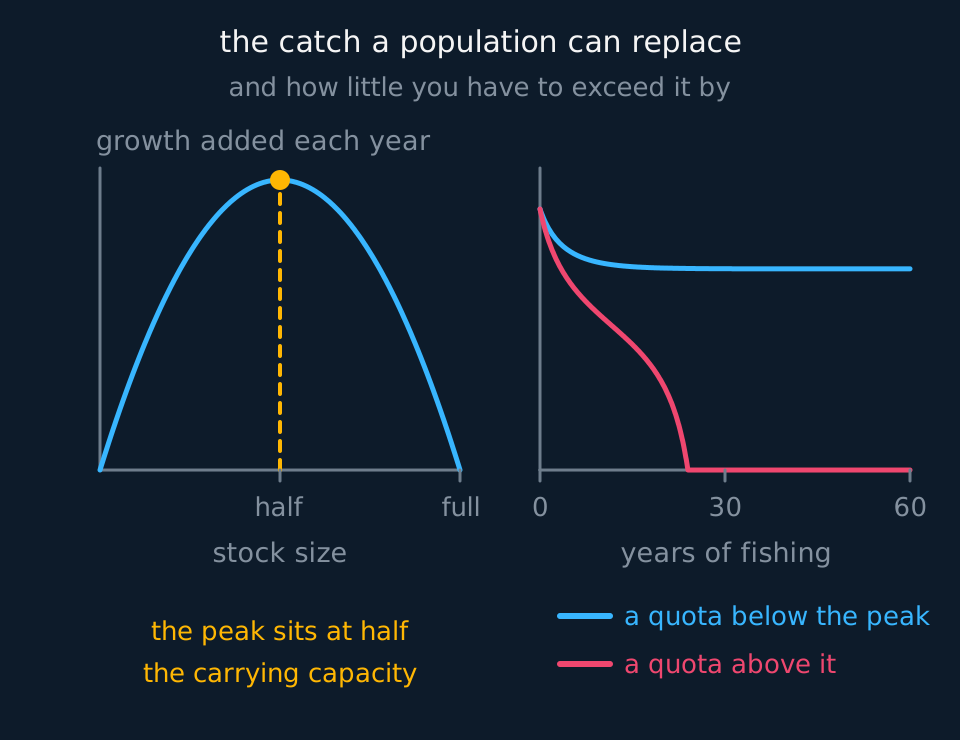
That is why a fixed quota above the maximum sustainable yield does not produce a proportionate overshoot. In the model, a catch above the peak exceeds the replacement growth available at any population size, so the population falls each year and the same quota takes a larger share of what remains. Managers therefore set limits below the modelled maximum, both for that reason and because the carrying capacity is estimated rather than measured and varies with conditions.
- Sustainable yield
- The amount that can be harvested from a population in a given period without reducing the size of that population, so the same harvest can be repeated indefinitely.
- Maximum sustainable yield
- The largest sustainable yield available from a population. In the simple logistic model it occurs at about half the carrying capacity, where net growth is greatest; that position depends on the model's assumptions.
- Sustainable management
- Using an ecosystem so that its resources are still available to future generations, and the ecosystem itself is not degraded.
Timber management
Four named techniques manage woodland for a repeatable timber yield.
Coppicing is cutting a broadleaved tree down to a stump, called a stool, close to the ground. Hazel, ash, willow, sweet chestnut and lime all respond by sending up many new shoots from the stool, which grow far faster than a seedling would because they are supplied by a root system that is already established. After a rotation of somewhere between seven and twenty years, depending on the species and on what the poles are wanted for, the shoots are cut again. The tree is not killed; coppice stools are among the oldest living things in Britain, and some have been cut on a cycle for many centuries.
Rotational coppicing is what turns that into a steady supply. The wood is divided into compartments and one compartment is cut each year, so that after a full rotation the first compartment is ready again. The wood as a whole therefore holds the same standing crop every year, the yield is the same every year, and at any moment the wood contains patches at every stage of regrowth.
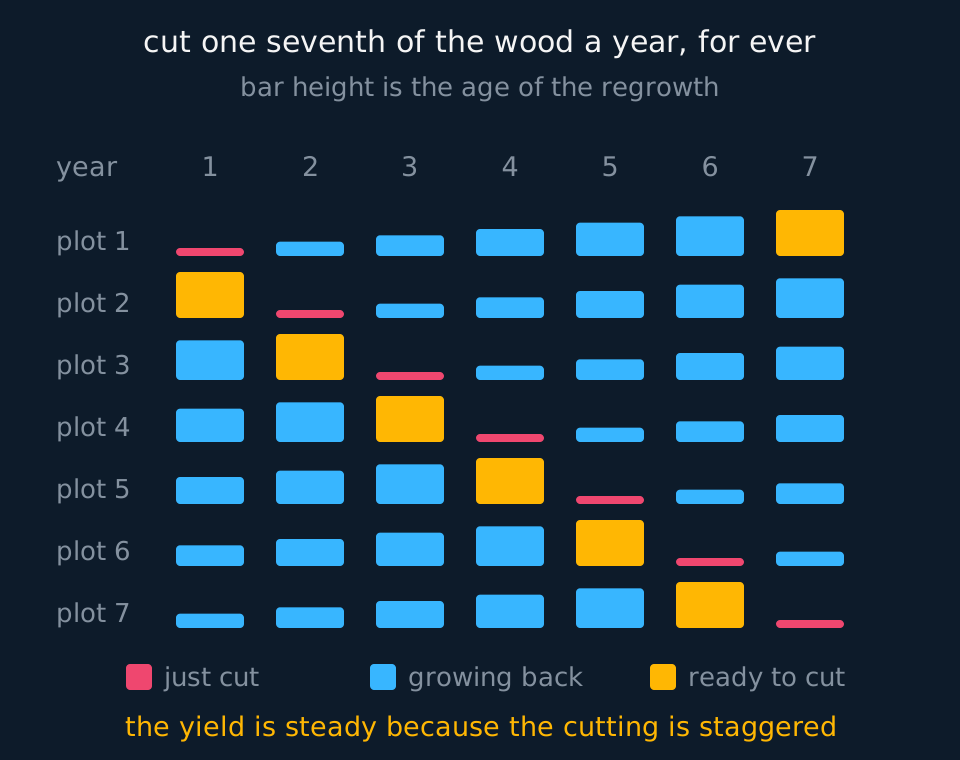
The resulting patchwork has a conservation value alongside the timber. A recently cut compartment is open and sunlit, and the woodland flowers that respond to it, primroses, bluebells and violets, bring in the butterflies that feed on them. An older compartment is shady and suits different species. A wood managed on a rotation therefore holds more habitat diversity, and in surveys of British coppice more species, than a comparable unmanaged or clear-felled wood; the comparison depends on the woodland type and on what is measured. This is deflected succession applied to management, and it is why conservation bodies fund coppicing in woods where the poles have no market.
Pollarding is the same operation carried out about two metres up, so that the new shoots grow out of reach of deer, cattle and sheep. It is what you see on old parkland and along roadsides, and it is used wherever the wood cannot be fenced against grazing animals.
Selective felling belongs to bigger timber. Rather than clearing an area, individual mature trees are identified and removed, leaving the canopy and the structure of the forest essentially intact. Compared with clear felling it keeps the habitat, leaves the soil covered so it is not eroded or leached, keeps the forest fixing carbon, and lets the gaps fill from the surrounding trees. It yields less per hectare per visit and costs more per tree extracted, which is why it is not universal.
Two supporting practices come up in the same questions. Trees are replanted, at least one for each removed and usually more, and planting native species suited to the site matters more than the number. And trees are given room, since a plantation grown too dense produces many thin poles rather than the fewer thick trunks that timber requires, which is why plantations are thinned as they grow.
Fishery management
A fishery presents four difficulties a wood does not. The stock cannot be observed directly, it moves across international boundaries, it is a common resource that many parties take from, and fishing effort has increased faster than the stocks are replaced. Several North Atlantic stocks have been fished to collapse, of which the Grand Banks cod fishery off Newfoundland, closed in 1992 after the stock fell to about one per cent of its former biomass and has not recovered to its former level, is the standard example.
The management measures are separate controls, each with its own effect and its own limitation.
| Measure | How it works | What limits it |
|---|---|---|
| Quotas | A total allowable catch is set from stock surveys and shared out, so the catch is held below the sustainable yield | The stock estimate may be wrong, and fish caught over quota are thrown back dead unless a landing obligation applies |
| Mesh size | A larger mesh lets young fish escape, so they survive to breed at least once before they can be caught | Does nothing about how many boats are fishing, and is easily defeated by fishing where the young fish are |
| Closed seasons | Fishing is banned during the spawning period, so the fish breed before they are taken | Effort simply moves to the open season unless the total catch is also limited |
| No-take zones | An area is closed to fishing entirely, so the stock inside recovers and spills over into the fished areas around it | Needs to be large enough and policed, and displaces effort onto the areas that remain open |
| Limits on effort | Days at sea, engine power or the number of licensed boats are capped | Boats become more efficient, so the same nominal effort catches more |
The measures are complementary rather than alternatives. A mesh size protects the young fish but not the total taken; a quota limits the total taken but says nothing about which fish; a closed season protects spawning but not the rest of the year. Fisheries that have recovered, such as North Sea herring after its 1977 closure or Icelandic cod under strict quota management, have generally used several at once and enforced them.
Aquaculture is offered as the way out, and it now supplies about half the fish people eat. It has real advantages: the stock is enclosed so nothing is caught by accident, food conversion can be managed, harvesting does not damage the sea bed as trawling does, and pressure on the wild stock is reduced. It also has four documented problems, which belong in an evaluation. Carnivorous farmed species such as salmon are fed on fishmeal made from wild-caught fish, so the pressure is moved rather than removed. Dense stocking spreads parasites such as sea lice and diseases into wild populations swimming past. Uneaten food and faeces enrich the water beneath the cages, which is eutrophication in miniature. And escaped farmed fish interbreed with wild ones, diluting the local adaptations of a wild stock with alleles selected for a cage.
Distributional effects and governance
Each measure above imposes a present cost in order to protect a future yield, and the distribution of those costs is contested. A quota that saves a stock over twenty years may put a fishing community out of work this year, and a family whose income has gone does not get it back when the stock recovers. The Newfoundland closure put tens of thousands of people out of work in one announcement.
The same conflict occurs in land management, between protected areas and the people whose livelihoods depend on the land. A national park in which grazing is restricted protects a habitat and reduces a herder's income. A logging ban protects a forest and removes the only cash a village has. Rules written by people who do not depend on the resource, and enforced on people who do, are less well complied with, which is why successful schemes tend to share three features: local people are involved in setting the rules, they get a share of the benefit, whether from tourism, licensed harvesting or payment for managing the land, and the rules are simple enough to be checked.
Sustainable management therefore combines a biological quantity with an economic decision. The biology gives an estimated sustainable yield, and a stock harvested above it declines regardless of what has been agreed. The decisions are about who takes that yield, over what period the costs are borne, and who compensates those asked to take less in the short term.
TRY IT: Advising on a fishery
A fish stock has a carrying capacity estimated at 400 000 tonnes. Surveys put the current biomass at 90 000 tonnes and falling, and the catch last year was 40 000 tonnes. The fleet has asked for the quota to be kept at 40 000 tonnes on the grounds that the fishery supports 3000 jobs.
Advise the manager, using the growth curve, and say what else you would put in place besides a quota.
Check your answer
The stock is at about 22 per cent of its carrying capacity, which is well below the half at which growth is fastest. A population this far down the curve is adding less each year than it would at half the carrying capacity, so its sustainable yield now is below the maximum.
The stock is falling while 40 000 tonnes are being taken, which is direct evidence that the catch is above the sustainable yield at the current biomass. Keeping the quota where it is therefore guarantees further decline, and as the stock falls the same quota takes a larger and larger share of it.
The advice is to cut the quota well below the current catch, and to keep it there until the biomass has climbed back towards half the carrying capacity, at which point the sustainable yield itself is at its largest in the model. The argument to the fleet is that a reduced catch now gives a larger sustained catch later.
Besides the quota: increase the mesh size so young fish escape and breed at least once; close the spawning season; and establish no-take zones from which the recovering stock can spill over. Each does something the quota does not.
Address the employment argument rather than setting it aside. Without a cut the fishery may collapse and all 3000 jobs be lost permanently, as at the Grand Banks. Support during the recovery, decommissioning of some vessels, and involving the fleet in setting and policing the rules are what make the cut hold.
In the exam
- Define sustainable yield as a harvest taken 'without reducing the size of the population'. 'Not taking too many' does not state the criterion.
- In the simple logistic model the maximum sustainable yield is at about half the carrying capacity, because net growth is greatest there. Give the reason and name the model as well as the position.
- Describe coppicing with the stool and the rotation: cut to near ground level, many shoots regrow from the established root system, and compartments are cut in turn so the yield is steady.
- For fisheries, name a measure and state what it does. Mesh size protects immature fish, closed seasons protect spawning, quotas cap the total, and no-take zones allow a stock to recover and spill over.
- Give both sides in an evaluation of aquaculture: reduced pressure on wild stocks and controlled production against fishmeal demand, disease, pollution and escapes.
Check yourself
A wood of 70 hectares has been clear felled every thirty years, taking the whole wood at once. The owner is advised to change to rotational coppicing instead. Explain what rotational coppicing involves, and explain two advantages it has over clear felling, one for the timber yield and one for biodiversity.
Answer
Rotational coppicing means cutting broadleaved trees down to a stump near ground level, called a stool, from which many new shoots grow, and dividing the wood into compartments so that one compartment is cut each year.
The rotation is chosen to suit the species and the product, typically between seven and twenty years, and after a full rotation the first compartment has regrown and is ready to be cut again. The trees are not killed, because the root system survives and supplies the regrowth, which is why coppice regrows far faster than a planted seedling.
Advantage for yield. Cutting one compartment a year gives a harvest every year, of the same size, rather than one very large harvest followed by thirty years of nothing. The standing crop of the wood as a whole stays constant, so the income is steady and the wood is never left without trees.
Advantage for biodiversity. At any moment the wood holds compartments at every stage of regrowth, so it contains open sunlit ground, dense young growth and shaded older growth all at once. That is far more habitat diversity than either a clear-felled site or a uniform mature wood, and the woodland flowers of the newly cut compartments support insects that a closed canopy would not.
Clear felling also removes the canopy and the root systems from a whole area at once, exposing the soil to erosion and leaching and stopping the wood fixing carbon until the replanting has grown, none of which happens under a rotation.
Questions
Question 15 marks
The graph shows the mass a fish stock adds each year at each biomass. Give the carrying capacity of the stock and the maximum sustainable yield, and calculate the change in the biomass of the stock over a year that begins with 300 thousand tonnes in the water and in which 45 thousand tonnes are caught.
Mark scheme
- B1 the carrying capacity is 400 thousand tonnes, read from where the curve returns to zero, since a stock at its carrying capacity adds nothing
- B1 the maximum sustainable yield is 40 thousand tonnes a year, at the peak of the curve, and the peak sits at a biomass of 200 thousand tonnes, half the carrying capacity
- M1 reads the mass added at a biomass of 300 thousand tonnes off the curve as 30 thousand tonnes a year
- M1 change over the year = mass added − mass caught = 30 − 45
- A1 the biomass falls by 15 thousand tonnes, to 285 thousand tonnes; a catch of 45 thousand tonnes is above the peak of the curve, so it cannot be replaced at any biomass and the stock goes on falling
Question 25 marks
A campaigner argues that the way to get the largest catch from a fish stock, year after year, is to leave the population as large as possible by taking very little from it. Evaluate this claim, using the logistic growth model.
Mark scheme
- B1 for: a very large population is far from extinction, and taking very little from it clearly avoids the collapse that a much smaller population close to zero would risk
- B1 for: the half-capacity maximum is a model's figure, and the carrying capacity is estimated rather than measured and varies from year to year, so a stock kept large and fished lightly is protected against an overestimate or a poor breeding year, which is why managers set limits below the modelled maximum
- B1 against: in the simple logistic model, net population growth, and so the largest catch that can be taken and replaced, is greatest at about half the carrying capacity rather than at the carrying capacity itself
- B1 against: at the carrying capacity itself, births and deaths are equal and net growth is zero, so a population left at its largest possible size actually produces no surplus at all to harvest sustainably
- B1 judgement: the claim confuses population size with sustainable yield; the largest repeatable catch comes from holding the stock at about half its carrying capacity, not from leaving it as large as possible, though the stock must still be kept well clear of the very low levels where recruitment collapses
Question 34 marks
Describe how a hazel wood is managed by rotational coppicing, and describe the effect this has on the number of habitats in the wood.
Mark scheme
- B1 the trees are cut down to a stump close to the ground, called a stool, and many new shoots grow from it, supplied by the established root system
- B1 the wood is divided into compartments and one compartment is cut each year, on a rotation of roughly seven to twenty years
- B1 after a full rotation the first compartment has regrown and is cut again, so the yield and the standing crop of the wood stay the same year after year
- B1 at any moment the wood contains compartments at every stage of regrowth, from open sunlit ground to shaded older growth, so habitat diversity and species diversity are both higher than in an unmanaged or clear-felled wood
Question 44 marks
Evaluate the use of aquaculture, the farming of fish in cages, as a way of reducing pressure on wild fish stocks.
Mark scheme
- B1 in support: farmed fish are enclosed, so nothing is taken from the wild stock to supply them to consumers, no unwanted species are caught by accident and the sea bed is not damaged as it is by trawling
- B1 against: carnivorous farmed species such as salmon are fed on fishmeal made from wild-caught fish, so the pressure on wild stocks is moved rather than removed
- B1 against: dense stocking spreads parasites such as sea lice and diseases to wild fish passing the cages, uneaten food and faeces enrich the water beneath them, and escaped farmed fish interbreed with wild ones and dilute their local adaptations
- B1 a judgement: aquaculture reduces pressure on the stocks used directly for food, but it is only a net gain where the species farmed is not fed on wild fish and where waste, disease and escapes are controlled
Question 54 marks
A government proposes to cut the quota for a declining fish stock by half. Discuss the arguments for and against the proposal.
Mark scheme
- B1 for: the stock is declining, so the present catch is above the sustainable yield, and every year that continues the population falls further and the same quota takes a larger share of it
- B1 for: allowing the biomass to climb back towards half the carrying capacity raises the sustainable yield itself, so the long-term catch is larger than it would otherwise be
- B1 against: the loss of income and of jobs falls on the fishing communities immediately, while the benefit arrives years later and may be taken by somebody else, and stock estimates carry real uncertainty
- B1 a judgement: the cut is justified because a collapse costs every job permanently, as at the Grand Banks, but it should come with support during the recovery and with the fleet involved in setting and policing the rules, or it will not hold
Question 64 marks
Compare selective felling with clear felling as ways of taking timber from a forest.
Mark scheme
- B1 selective felling identifies individual mature trees and removes them, leaving the canopy and the structure of the forest around them standing, whereas clear felling takes every tree in an area at one time
- B1 under selective felling the soil stays covered and held by the roots of the trees left behind, so it is not eroded or leached, whereas a clear-felled area is left bare and loses soil and mineral ions
- B1 the forest goes on fixing carbon and remains a habitat under selective felling, and the gaps are filled by seed from the trees around them, whereas clear felling removes the habitat and the carbon fixation together and the area has to be replanted
- B1 clear felling yields far more timber per hectare per visit and costs less per tree extracted, whereas selective felling yields less and costs more, which is why it is not used everywhere
Question 74 marks
A no-take zone is set up over the spawning ground of a heavily fished stock, and fishing goes on everywhere outside it. Suggest why the catch taken from the water around the zone may rise after several years, and suggest one reason the zone might fail to help.
Mark scheme
- B1 nothing is removed inside the zone, so individuals survive to spawn more than once and the biomass inside climbs back towards the carrying capacity
- B1 a large old female produces far more eggs than a small one, so a recovered stock releases eggs and larvae out of all proportion to the area of the zone, and those larvae drift out into the water that is fished
- B1 as the density inside rises, adults and juveniles move out across the boundary, so the fished stock outside is supplied from inside and catches near the boundary rise
- B1 it may fail if the zone is smaller than the area a fish moves over, if it is not policed, or if the same fleet simply fishes the water that is left open, so the same total is taken from a smaller area
Question 84 marks
A government proposes to ban logging inside a tropical forest reserve that borders several villages whose only cash income comes from timber cut there. Discuss how the reserve might be managed so that the rules are actually followed.
Mark scheme
- B1 for a strict ban: the forest is protected in full only if no logging happens at all, since any legal cutting sets a precedent that is hard to police or to limit once it is allowed
- B1 against a strict ban with no alternative: rules that remove a community's only cash income without support are poorly complied with, since the people enforcing the ban do not depend on the resource while the people who do have every reason to keep logging
- B1 an alternative: successful schemes usually involve local people in setting the rules, give them a share of the benefit, for example from licensed harvesting, tourism or payment for managing the land, and keep the rules simple enough to be checked
- B1 judgement: a ban imposed without local involvement or an alternative income is likely to be broken or resented, so a managed, locally-involved scheme is more likely to protect the reserve in the long run than an unsupported ban, even though it permits some harvesting
Question 93 marks
Explain why the maximum sustainable yield from a fish stock is obtained when the population is held at about half its carrying capacity.
Mark scheme
- B1 at the carrying capacity births and deaths are equal, so the population adds nothing each year and there is no surplus to harvest
- B1 at a very low population size there are too few individuals reproducing, so the number added each year is also small
- B1 at about half the carrying capacity the population is on the steepest part of the sigmoid curve, with many reproducing individuals and resources not yet limiting, so it adds the greatest number each year and that surplus is the largest catch that can be replaced
Question 103 marks
Explain how increasing the mesh size of a fishing net and closing a fishery during the spawning season each help a fish stock to recover.
Mark scheme
- B1 a larger mesh allows smaller, immature fish to escape from the net
- B1 those fish survive to reach reproductive age and breed at least once before they can be caught, so recruitment to the stock continues
- B1 a closed season prevents adults from being taken while they are spawning, so the eggs are laid before any of those fish are removed from the population
Question 113 marks
Describe pollarding, and describe why it is used instead of coppicing where grazing animals such as deer or cattle have access to the wood.
Mark scheme
- B1 pollarding is the same cutting operation as coppicing, encouraging new shoots to grow from the cut, but carried out about two metres above ground rather than at ground level
- B1 the new shoots then grow out at that height, above the reach of grazing animals such as deer, cattle or sheep
- B1 a stool cut near the ground would have its new shoots eaten as they grew, so pollarding is used instead wherever the wood cannot be fenced against grazing
Question 123 marks
Explain two reasons a quota, on its own, may fail to keep a fish stock at a sustainable level.
Mark scheme
- B1 the total allowable catch is set from a survey estimate of the stock, and if that estimate is wrong the quota set from it may be higher than the stock can actually sustain
- B1 fish caught in excess of a boat's quota are often thrown back dead rather than landed, unless a landing obligation applies, so fish are still removed from the stock without being limited by the quota
- B1 a quota limits the total mass taken but does nothing about which fish are taken, so young, immature fish can still be caught and removed before they have had a chance to breed even once
Question 133 marks
Explain how limiting fishing effort, for example by capping the number of days a boat may spend at sea, is intended to protect a fish stock, and explain why this measure can still fail to reduce the catch.
Mark scheme
- B1 capping days at sea, engine power or the number of licensed boats is intended to limit how much fishing pressure is applied to the stock, on the assumption that less time or fewer boats fishing means a smaller catch
- B1 boats become more efficient over time, for example through better sonar or larger nets, so the same nominal effort, the same number of days or boats, is able to catch more fish than before
- B1 if efficiency rises fast enough, a capped effort can still take a catch above the sustainable yield, so limiting effort alone does not guarantee the limit on catch that was intended
Question 143 marks
A plantation of young trees is left unthinned and grows far more densely than a natural woodland would. Suggest what effect this has on the trees produced, and suggest why the owner should thin the plantation.
Mark scheme
- B1 at high density each tree competes intensely with its close neighbours for light, water and nutrients, so individual trees grow more slowly and the plantation produces many thin poles rather than fewer thick trunks
- B1 timber production usually requires fewer, thicker trunks rather than many thin poles, so an unthinned plantation yields a lower-value crop even though the total number of trees standing is high
- B1 thinning removes some trees, usually the smaller or poorer ones, reducing competition and letting the remaining trees grow larger and thicker, giving a more valuable crop by the time of felling
Question 152 marks
State what is meant by a sustainable yield, and state what is meant by the maximum sustainable yield.
Mark scheme
- B1 a sustainable yield is the amount that can be harvested from a population in a given period without reducing the size of that population, so the same harvest can be taken again
- B1 the maximum sustainable yield is the largest such harvest available from the population, which in the simple logistic model occurs at about half the carrying capacity
Worth remembering
- Sustainable yield is what can be taken without reducing the population, so the same amount can be taken again.
- In the simple logistic model the maximum sustainable yield comes at about half the carrying capacity, where net growth is fastest, and exceeding it has no stable outcome.
- Coppicing cuts to a stool near the ground and pollarding cuts higher up, out of reach of grazing animals.
- Cutting one compartment of a wood each year gives a steady yield and a patchwork of habitats.
- Selective felling removes individual mature trees and leaves the forest structure, unlike clear felling.
- Quotas cap the catch, mesh sizes spare immature fish, closed seasons protect spawning, and no-take zones let stocks recover and spill over.
- Aquaculture reduces pressure on wild stocks but brings fishmeal demand, disease, pollution and escapes with it.
CHECK YOUR PROGRESS
Rate how confident you are with each objective for this lesson. Ratings are saved in this browser, on this device, unless you sign in.
- Define sustainable yield and explain, using the growth curve, why it is greatest at about half the carrying capacity.
- Describe coppicing, pollarding, rotational management and selective felling, and say what each is for.
- Explain how quotas, mesh sizes, closed seasons and no-take zones each protect a fish stock.
- Evaluate aquaculture as an answer to overfishing.
- Discuss the conflict between managing an ecosystem for conservation and the needs of the people who use it.
Open the full revision checklist to see every objective in the curriculum in one place.
Practise this lesson
WORKBOOK
The written questions from this topic, on paper with room to work, and a separate book of mark schemes. The question that is set on a diagram stays on this page, where the diagram can be drawn. Free to use; please do not redistribute or sell.