Biology › Enzymes and metabolic control › Cofactors, coenzymes and where enzymes work
Cofactors, coenzymes and where enzymes work
Many enzymes require a non-protein component before the active site is catalytically active. Those components are classified as cofactor ions, coenzymes and prosthetic groups. Enzymes are also classified by where they act, and Km is used to compare the apparent affinity of different enzymes for the same substrate.
Before this The active site and the enzyme-substrate complex · Vmax and Km, as used to diagnose inhibitors · Haemoglobin as a protein with a non-protein haem group
COMMON MISCONCEPTION
An enzyme is a protein and nothing else, so the polypeptide chain must carry everything the catalysis needs.
Plenty of enzymes need help. A cofactor ion such as the chloride in amylase, a coenzyme such as NAD that carries something away and returns, or a prosthetic group such as the haem fixed in catalase: without its partner the polypeptide folds correctly and still does nothing.
What you should be able to do
- Describe how a coenzyme works, and distinguish a cofactor ion, a coenzyme and a prosthetic group with a named example of each.
- Explain why a vitamin shortage slows enzyme-controlled reactions, using NAD and coenzyme A as the examples.
- Classify enzymes as intracellular or extracellular, placing catalase, amylase and trypsin correctly.
- Explain why the digestion of food has to be carried out by secreted, extracellular enzymes.
- Use Km to compare the affinity of two enzymes for the same substrate, and predict which one matters when the substrate is scarce.
What a coenzyme does
A coenzyme is a small organic molecule that an enzyme needs alongside its substrate. It binds to the enzyme, is chemically changed by the reaction that enzyme catalyses, and leaves carrying whatever the reaction removed: a pair of hydrogen atoms, a phosphate group, an acetyl group. It then binds a second enzyme elsewhere in the cell, gives that group up, and returns to the form it started in. A coenzyme is therefore a carrier between enzymes, recycled rather than used up, which is why a cell holds only a small quantity of one.
NAD is the example to work from. In glycolysis and the Krebs cycle a dehydrogenase removes two hydrogen atoms from its substrate; NAD accepts them and leaves the enzyme as reduced NAD. It carries them to the electron transport chain of the inner mitochondrial membrane, releases them there, and the oxidised form returns to accept another pair. Coenzyme A does the same with a different cargo, collecting the two-carbon acetate group made from pyruvate and delivering it into the Krebs cycle, and NADP carries hydrogen this way in photosynthesis. One molecule of a coenzyme therefore serves many reactions in succession.
A coenzyme is not a substrate, and the difference is worth stating precisely. A substrate is the molecule an enzyme exists to convert: it is complementary to that enzyme's active site, and it is consumed as product accumulates. A coenzyme is used by many different enzymes, is restored to its original form at one of them, and is not consumed, so the quantity a cell holds stays roughly constant while the pathway runs.
Four terms are used for the non-protein partners an enzyme may need, and the distinction to get right is whether the partner stays bound to the enzyme or binds, acts and leaves.
| Term | What it means | Bound to the enzyme | Example |
|---|---|---|---|
| Cofactor | The general term: any non-protein component an enzyme requires for activity | Either | Any of the three rows below |
| Inorganic cofactor | An ion rather than an organic molecule | Usually temporarily | Chloride ion, required by salivary amylase |
| Coenzyme | An organic cofactor, changed by the reaction and carrying a group to another enzyme | Temporarily | NAD and coenzyme A, both made from B vitamins |
| Prosthetic group | A cofactor held permanently and treated as part of the protein | Permanently | Haem in catalase; the zinc ion of carbonic anhydrase |
Apply the permanence test rather than the chemistry, because chemical type does not decide the category. The haem group of catalase is organic and permanently bound; the zinc ion of carbonic anhydrase is inorganic and permanently bound. Both are prosthetic groups.
Cofactors, coenzymes and prosthetic groups
Some enzymes require a non-protein component, called a cofactor, for catalytic activity. Chloride ions, for example, are required for full activity of salivary amylase. Organic cofactors are called coenzymes; NAD and coenzyme A are examples derived from B vitamins. A cofactor that remains tightly bound to a protein is called a prosthetic group; haem in catalase is an example.
Binding strength and chemical type are separate properties. A prosthetic group may be organic or inorganic, and some organic cofactors remain tightly bound. Where an examination specification defines coenzyme more narrowly as a temporary carrier, use that board's definition in the answer.
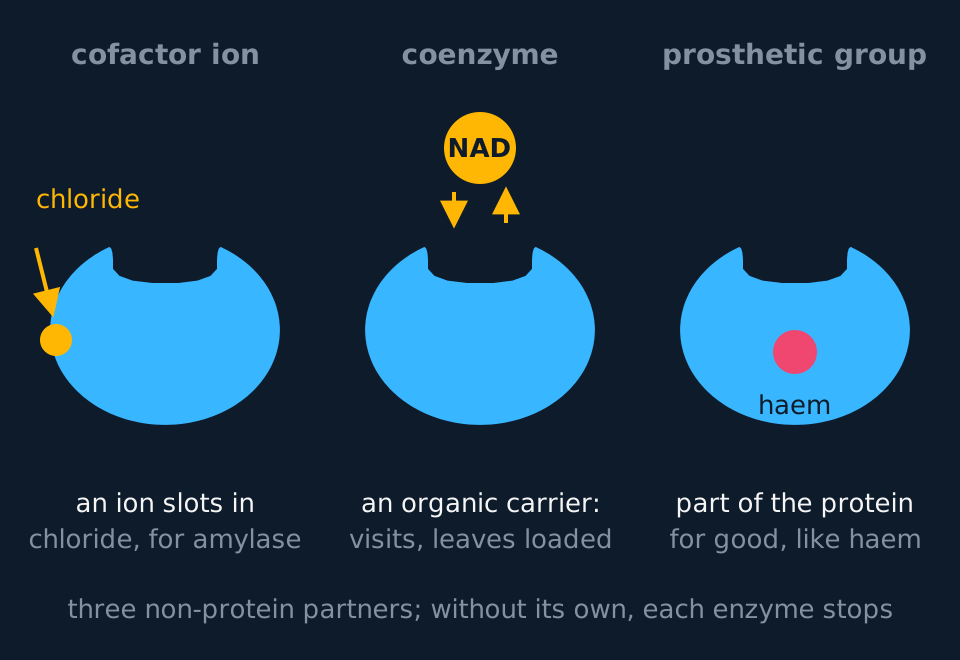
That grouping gives the three categories A-level questions ask for. Some cofactors are inorganic ions, such as the chloride required by amylase: the ion sits close to the active site and its charge helps the site take, or hold, the shape that is complementary to the substrate. Some are small organic molecules that bind and are released again, carrying a chemical group with them; these are the coenzymes of the usual convention. And some are non-protein groups bound tightly enough to be treated as part of the protein: prosthetic groups.
Prerequisite: haemoglobin as a conjugated protein. The haem group of haemoglobin, an iron-containing ring that is not made of amino acids, is a prosthetic group, and haemoglobin is called a conjugated protein because of it. Catalase also contains haem, and the iron in it catalyses the decomposition of hydrogen peroxide, a reaction no amino acid side chain catalyses on its own. Carbonic anhydrase, the enzyme in red blood cells that interconverts carbon dioxide and hydrogencarbonate, holds a single zinc ion in its active site permanently: an inorganic partner, but a prosthetic group rather than a visiting cofactor, because it never leaves.
- Cofactor
- A non-protein substance that an enzyme requires in order to function, such as the chloride ion required by amylase.
- Coenzyme
- An organic cofactor. In the usual A-level convention it binds to an enzyme, carries chemical groups or hydrogen between reactions and is released again; many are made from vitamins.
- Prosthetic group
- A cofactor tightly bound to an enzyme or other protein, and which may be organic, such as the haem group of catalase, or inorganic, such as the zinc ion of carbonic anhydrase.
Coenzymes and vitamins
In the usual A-level convention a coenzyme is a carrier. It binds to an enzyme alongside the substrate, accepts a group released by the reaction, such as a pair of hydrogen atoms or an acetate group, carries it to a different enzyme, and is returned to its original form when it gives that group up. It is recycled repeatedly, so a cell requires only a small quantity, but that quantity is not zero.
Two coenzymes are named in this unit, and both act in respiration. NAD collects hydrogen from the oxidation reactions of glycolysis and the Krebs cycle and delivers it to the electron transport chain, where the energy it carries is used to make ATP. Coenzyme A picks up the two-carbon acetate made from pyruvate and delivers it into the Krebs cycle. Both are coenzymes and both are derived from B vitamins. Next topic for the reactions themselves: glycolysis, the link reaction and the Krebs cycle.
| Partner | Kind | Made from | What it does |
|---|---|---|---|
| Chloride ion | Cofactor (inorganic ion) | The diet, as a mineral | Allows the active site of amylase to take its working shape |
| NAD | Coenzyme | Nicotinamide (vitamin B3) | Carries hydrogen from respiration's oxidation steps to the electron transport chain |
| Coenzyme A | Coenzyme | Pantothenic acid (vitamin B5) | Carries acetate from the link reaction into the Krebs cycle |
| Haem | Prosthetic group | Synthesised in the cell, around iron | Gives catalase the iron centre that decomposes hydrogen peroxide |
| Zinc ion | Prosthetic group | The diet, as a mineral | The permanent working centre of carbonic anhydrase |
The 'made from' column explains why vitamins are examinable here. A cell cannot synthesise nicotinamide or pantothenic acid: both are obtained in food as vitamins and converted into NAD and coenzyme A inside the cell. A diet lacking vitamin B3 therefore limits NAD supply in every cell, and the deficiency disease pellagra, which affects the skin, digestive system and nervous system, results from that shortage in tissues with a high respiratory rate.
Several other B vitamins are coenzymes or precursors of coenzymes, which is why the group is treated together. Only a small dietary quantity is required, because coenzymes are recycled rather than consumed.
Intracellular and extracellular enzymes
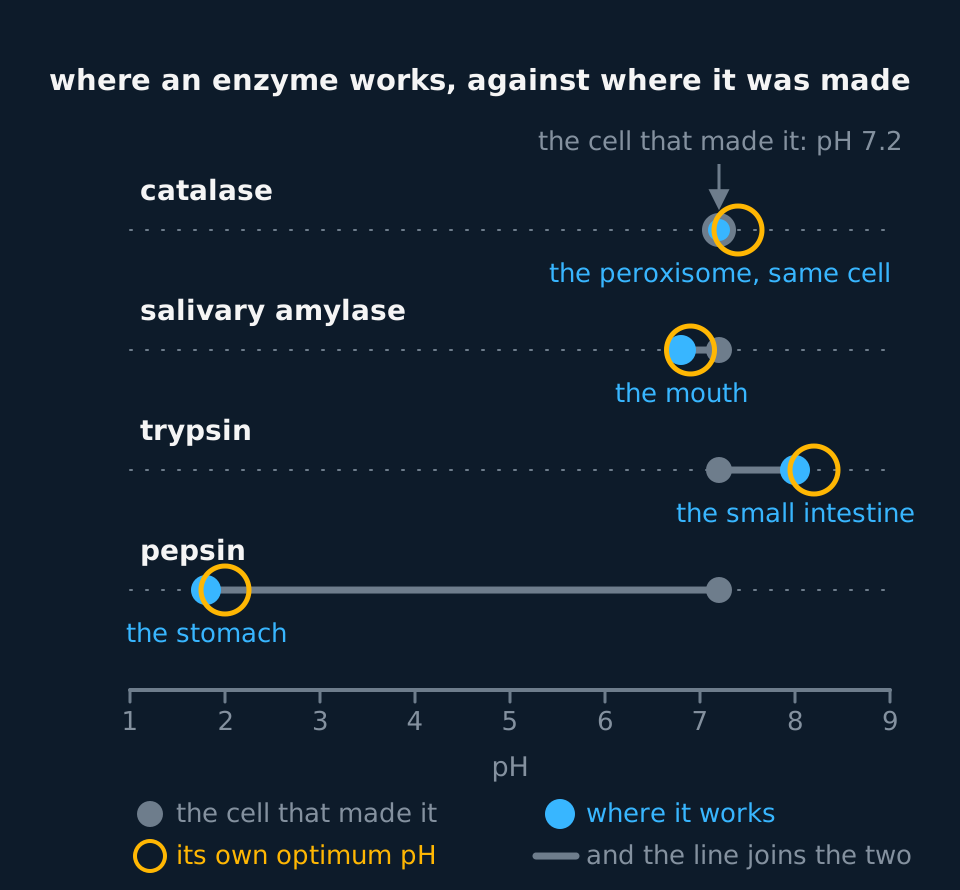
Enzymes are also classified by where they act, and both terms below are examinable. An intracellular enzyme is made and used within the same cell. Catalase is the standard example: it sits inside peroxisomes, small organelles bounded by a single membrane, and breaks down the hydrogen peroxide that the cell's own metabolism produces, before that peroxide oxidises other cell components. The enzymes of glycolysis, dissolved in the cytoplasm, are intracellular too, and so is DNA polymerase in the nucleus.
An extracellular enzyme is secreted from the cell that made it, by exocytosis, and does its work outside. Digestion is the reason this category has to exist. Starch, proteins and triglycerides are far too large to cross a cell surface membrane, so no cell can take them in and hydrolyse them internally; the enzymes are secreted to act on the food. Salivary amylase is secreted into the mouth and begins starch on its way to maltose; trypsin is made in the pancreas and secreted into the small intestine, where it hydrolyses proteins it never shares a cell with. Only the small, soluble products of that external digestion, glucose, amino acids and the rest, are absorbed. Fungi take the same idea further: a mould secretes its digestive enzymes onto the food it grows across and absorbs what they release.
| Enzyme | Made in | Works in | Class |
|---|---|---|---|
| Catalase | Most cells | Peroxisomes of the same cell | Intracellular |
| Salivary amylase | Salivary glands | The mouth | Extracellular |
| Trypsin | The pancreas | The small intestine | Extracellular |
| DNA polymerase | Every dividing cell | The nucleus of the same cell | Intracellular |
The classification has a practical consequence. An extracellular enzyme must remain active in conditions the secreting cell never experiences, which is why pepsin's optimum is at the pH of the stomach rather than the pH of the cell that secreted it. The pancreas secretes some proteases in an inactive form that is activated only in the gut, which prevents them hydrolysing pancreatic tissue.
- Intracellular enzyme
- An enzyme that catalyses reactions inside the cell that made it, such as catalase in peroxisomes.
- Extracellular enzyme
- An enzyme secreted from the cell that made it and catalysing reactions outside it, such as amylase and trypsin in digestion.
Km and apparent affinity
Prerequisite: Km as used to distinguish competitive from non-competitive inhibitors. Km, the substrate concentration at which an enzyme works at half its maximum rate, is also used to compare different enzymes acting on the same substrate.
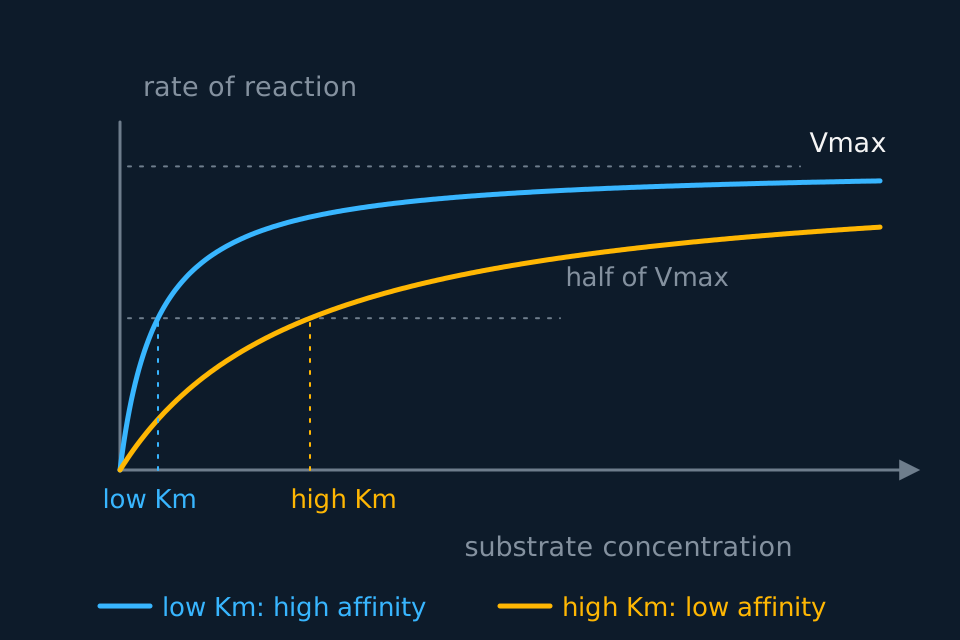
In the simple Michaelis-Menten comparisons used at A level, an enzyme that reaches half of Vmax at a low substrate concentration is described as having a higher apparent affinity for its substrate. An enzyme requiring a much higher substrate concentration to reach half its maximum rate has a lower apparent affinity. The relationship is inverse: an enzyme with a very large Km works well below half its maximum rate at physiological substrate concentrations.
Hexokinase and glucokinase both catalyse the same reaction, the phosphorylation of glucose at the start of glycolysis. Hexokinase, found in nearly all tissues, has a Km far below the normal concentration of glucose in blood, so it operates near its maximum rate continuously, and tissues such as the brain maintain glycolysis at a steady rate regardless of the last meal. Glucokinase, the liver isoform, has a Km roughly a hundred times higher, in the range of glucose concentrations reached after a meal. The liver enzyme therefore works well below its maximum rate between meals and its rate rises steeply when blood glucose rises, which is when the liver stores glucose as glycogen.
TRY IT: Ranking three enzymes by a number
Three enzymes act on the same substrate and have similar Vmax values. Enzyme A has a Km of 0.1 mmol dm⁻³, enzyme B a Km of 2 mmol dm⁻³ and enzyme C a Km of 15 mmol dm⁻³. Rank them by affinity, and state which enzyme converts most substrate when the substrate concentration is 0.2 mmol dm⁻³.
Check your answer
Apparent affinity is inversely related to Km, so the ranking is A highest, then B, then C lowest. A reaches half of its maximum rate at a concentration one hundred and fifty times lower than C requires.
At 0.2 mmol dm⁻³ enzyme A is above its Km, so it is working at more than half of Vmax. B is at a tenth of its Km and C at less than a seventieth of its own, so both are working well below half their maximum rate. With similar Vmax values, A converts most substrate.
State the comparison as well as the values: 'A has the highest apparent affinity because it reaches half of Vmax at the lowest substrate concentration'.
In the exam
- Keep the three words apart as the A-level convention does: a cofactor ion or a coenzyme binds and is released, while a prosthetic group stays tightly bound to the protein and may be organic or inorganic. An answer that calls haem a coenzyme has put it in the wrong category.
- A coenzyme is not a substrate. Where a question asks for the difference, state that the coenzyme is changed by the reaction and then restored at another enzyme, so it is recycled rather than consumed as the substrate is.
- Include the vitamin link in coenzyme answers: NAD is made from vitamin B3 and coenzyme A from vitamin B5, so a dietary shortage of either vitamin reduces the rate of respiration.
- Intracellular and extracellular are the examinable names. Catalase inside peroxisomes is the intracellular example; amylase and trypsin, secreted into the gut, are the extracellular ones.
- Explain the secretion of digestive enzymes by stating that food molecules are too large to cross the cell surface membrane, so hydrolysis occurs outside the cell and only the products are absorbed.
- For the simple Michaelis-Menten comparisons used at A level, a lower Km means that half Vmax is reached at a lower substrate concentration and is treated as evidence of higher apparent affinity. Km is not a direct binding constant in every mechanism.
Check yourself
Liver cells contain two enzymes that phosphorylate glucose: one with a Km of about 0.1 mmol dm⁻³ and one with a Km of about 10 mmol dm⁻³. Blood glucose is normally about 5 mmol dm⁻³ and rises towards 10 mmol dm⁻³ after a meal. Explain which enzyme has the higher affinity for glucose, how each enzyme behaves before and after a meal, and why having both is useful to the liver.
Answer
The enzyme with the Km of 0.1 mmol dm⁻³ has the higher apparent affinity: it reaches half of its maximum rate at a glucose concentration fifty times below the normal blood level, so it binds glucose readily even when glucose is scarce.
That enzyme is already close to saturated at 5 mmol dm⁻³, far above its Km, so its rate barely changes when blood glucose rises after a meal. It supplies the cell's own steady, baseline glycolysis whatever the diet is doing.
The enzyme with the Km of 10 mmol dm⁻³ is working well below half speed at normal blood glucose. After a meal the concentration climbs towards its Km, so its rate rises steeply, roughly in proportion to the glucose arriving.
Having both enzymes gives the liver a constant supply of phosphorylated glucose for its own respiration and, separately, additional phosphorylation only when blood glucose is high enough for the surplus to be stored as glycogen. Different Km values in different tissues therefore suit each tissue's function.
Questions
Question 14 marks
A prolonged dietary shortage of vitamin B3 damages tissues that respire heavily, such as skin and the nervous system. Suggest why.
Mark scheme
- B1 vitamin B3 (nicotinamide) is the raw material from which cells make the coenzyme NAD
- B1 NAD carries hydrogen from the oxidation reactions of respiration to the electron transport chain
- B1 with too little NAD those reactions slow, so less ATP is made by respiration
- B1 tissues with a high demand for ATP are affected first, because active transport, synthesis and impulse transmission all depend on it
Question 24 marks
Compare an intracellular enzyme with an extracellular enzyme, giving a named example of each and comparing the conditions each must tolerate.
Mark scheme
- B1 an intracellular enzyme catalyses reactions inside the cell that made it, such as catalase acting in peroxisomes, whereas an extracellular enzyme is secreted from the cell that made it and acts outside it, such as trypsin acting in the small intestine
- B1 an intracellular enzyme need only tolerate the conditions inside its own cell, whereas an extracellular enzyme must remain active in conditions the secreting cell never itself experiences, such as the strongly acidic stomach
- B1 intracellular enzymes are not released by exocytosis, whereas extracellular enzymes are
- B1 both classes are made by ribosomes inside a cell; what differs is only where each subsequently acts
Question 34 marks
A patient's diet is severely deficient in vitamin B5. Suggest the effect this has on the Krebs cycle, and suggest why a wide range of tissues would be affected rather than just one.
Mark scheme
- B1 vitamin B5 is the raw material from which cells make coenzyme A, so a deficiency would limit the supply of coenzyme A available
- B1 coenzyme A carries the two-carbon acetate group from the link reaction into the Krebs cycle, so with too little of it fewer acetate groups could be delivered and the Krebs cycle would slow
- B1 a slower Krebs cycle would reduce the ATP a cell can make by aerobic respiration
- B1 because every respiring cell in the body needs coenzyme A for this step, a wide range of tissues, not just one, would be affected, especially those with the highest demand for ATP
Question 43 marks
Compare a coenzyme with a prosthetic group, giving a named example of each.
Mark scheme
- B1 both are non-protein partners that an enzyme needs in order to function
- B1 a coenzyme binds and is released and recycled, whereas a prosthetic group is tightly bound to the protein and may be organic or inorganic
- B1 NAD or coenzyme A as the coenzyme, against the haem group of catalase or the zinc ion of carbonic anhydrase as the prosthetic group
Question 53 marks
A purified sample of amylase hydrolyses starch only when chloride ions are present in the solution. Explain this observation.
Mark scheme
- B1 the chloride ion is a cofactor that amylase requires in order to function
- B1 without the ion the active site does not take, or hold, the shape complementary to starch, so few enzyme-substrate complexes form
- B1 the ion is not the substrate and is not used up: it binds near the active site and allows the reaction to be catalysed
Question 63 marks
Explain why the enzymes that digest food in the gut must be extracellular, and name two such enzymes.
Mark scheme
- B1 food molecules such as starch and proteins are too large to cross the cell surface membrane, so they cannot be digested inside a cell
- B1 the enzymes are therefore secreted, by exocytosis, and hydrolyse the food outside the cells, so only the small soluble products are absorbed
- B1 salivary amylase and trypsin, or another correct pair of secreted digestive enzymes
Question 73 marks
Two enzymes, P and Q, act on the same substrate and have similar Vmax values. Enzyme P has a Km of 0.2 mmol dm⁻³ and enzyme Q a Km of 4.0 mmol dm⁻³. Explain which enzyme has the higher affinity for the substrate, and which converts more substrate when the substrate concentration is low.
Mark scheme
- B1 enzyme P has the higher affinity, because affinity runs opposite to Km
- B1 a low Km means the enzyme reaches half of its maximum rate while the substrate is still scarce, which is only possible if it binds the substrate readily
- B1 at low substrate concentration P works at a far higher fraction of Vmax than Q, so with similar Vmax values P converts more substrate
Question 83 marks
Name the vitamin from which coenzyme A is made, name the coenzyme it forms, and name the pathway it carries acetate into.
Mark scheme
- B1 pantothenic acid, vitamin B5
- B1 coenzyme A, the coenzyme formed
- B1 the Krebs cycle, which it feeds acetate into
Question 93 marks
Explain why carbonic anhydrase's zinc ion is classed as a prosthetic group rather than as a cofactor that visits and leaves, even though it is a single inorganic ion.
Mark scheme
- B1 the distinction between a visiting cofactor and a prosthetic group is about how tightly and permanently it is bound, not about whether it is organic or inorganic
- B1 the zinc ion in carbonic anhydrase never leaves the active site once the enzyme has folded around it, unlike a coenzyme, which binds and is released repeatedly
- B1 because it remains permanently bound, it is classed as a prosthetic group, in the same category as the organic haem group of catalase, despite being an inorganic ion
Question 103 marks
Describe the role of NAD in aerobic respiration, and describe what happens to the coenzyme once it has delivered its hydrogen.
Mark scheme
- B1 NAD collects hydrogen released during the oxidation reactions of glycolysis and the Krebs cycle
- B1 it delivers that hydrogen to the electron transport chain, where the energy carried is used to make ATP
- B1 having released its hydrogen, NAD is free to collect more from a further oxidation reaction, which is why only a small quantity is needed despite being used repeatedly
Question 113 marks
Explain why a cofactor is not shown as one of the products of a reaction it makes possible, even though the reaction could not proceed without it.
Mark scheme
- B1 a cofactor is not a substrate: it is not chemically changed into a product by the reaction it enables
- B1 it may be required simply to be present, as the chloride ion is for amylase, or it may bind, leave carrying what the reaction removed, and be restored to its original form at another enzyme, as a coenzyme does
- B1 because it is regenerated or unaffected rather than consumed, only a small quantity of a cofactor is needed relative to the amount of substrate the enzyme processes
Question 123 marks
Hexokinase has a Km far below the normal blood glucose concentration. Explain what this tells us about how close to Vmax hexokinase is working under normal conditions, and explain why its rate barely changes when blood glucose rises after a meal.
Mark scheme
- B1 a Km far below the normal blood glucose concentration means the enzyme is already working close to its maximum rate under normal conditions, since Km is the concentration needed to reach only half of Vmax
- B1 because glucose concentration is already well above the level needed to saturate hexokinase, only a small proportion of active sites are ever free at any moment
- B1 raising glucose concentration further after a meal makes little difference, because there is little room for the rate to rise: hexokinase is already close to its ceiling
Question 132 marks
State what is meant by a coenzyme, and name the vitamin from which the coenzyme NAD is made.
Mark scheme
- B1 a coenzyme is an organic cofactor: a small non-protein organic molecule that binds to an enzyme, carries hydrogen or chemical groups between reactions and is released again
- B1 NAD is made from nicotinamide, which is vitamin B3
Question 142 marks
State what is meant by a prosthetic group, and state one named example of one.
Mark scheme
- B1 a prosthetic group is a cofactor that is tightly bound to a protein, and may be organic or inorganic
- B1 haem in catalase, or the zinc ion of carbonic anhydrase
Question 152 marks
Name the organelle in which catalase acts, and name the class, intracellular or extracellular, that this makes catalase.
Mark scheme
- B1 the peroxisome, inside the cell
- B1 intracellular, acting in the same cell
Worth remembering
- A cofactor is a non-protein component an enzyme requires for activity; chloride for amylase is the named inorganic example.
- An organic cofactor is a coenzyme. In the usual A-level convention it binds temporarily and carries hydrogen or chemical groups between enzymes; NAD and coenzyme A are made from B vitamins.
- A prosthetic group is a cofactor tightly bound to the protein, and may be organic, like the haem of catalase, or inorganic, like the zinc of carbonic anhydrase.
- Intracellular enzymes act in the cell that made them, such as catalase; extracellular enzymes are secreted to act outside it, such as amylase and trypsin, because food molecules cannot cross a membrane undigested.
- Km is inversely related to apparent affinity in the simple Michaelis-Menten model: a lower Km means half Vmax is reached at a lower substrate concentration.
CHECK YOUR PROGRESS
Rate how confident you are with each objective for this lesson. Ratings are saved in this browser, on this device, unless you sign in.
- Describe how a coenzyme works, and distinguish a cofactor ion, a coenzyme and a prosthetic group with a named example of each.
- Explain why a vitamin shortage slows enzyme-controlled reactions, using NAD and coenzyme A as the examples.
- Classify enzymes as intracellular or extracellular, placing catalase, amylase and trypsin correctly.
- Explain why the digestion of food has to be carried out by secreted, extracellular enzymes.
- Use Km to compare the affinity of two enzymes for the same substrate, and predict which one matters when the substrate is scarce.
Open the full revision checklist to see every objective in the curriculum in one place.
Practise this lesson
WORKBOOK
The same questions as the player, on paper with room to work, and a separate book of mark schemes. Free to use; please do not redistribute or sell.