Biology › Enzymes and metabolic control › Enzyme inhibition and metabolic control
Enzyme inhibition and metabolic control
Competitive and non-competitive inhibitors slow the same enzyme by different routes, and a rate graph shows which is which. The same two mechanisms explain how penicillin kills a bacterium, how a statin lowers cholesterol, and how end-product inhibition stops a cell making something it already has enough of.
Before this The active site and induced fit · Substrate concentration and saturation
COMMON MISCONCEPTION
An enzyme inhibitor is always a foreign poison, not a molecule the cell makes to control its own pathways.
End-product inhibition regulates metabolic pathways. When the final product accumulates, it binds to a regulatory site on an enzyme controlling an early committed step and reduces pathway activity. As product concentration falls, inhibition decreases.
What you should be able to do
- Distinguish competitive from non-competitive inhibition by where the inhibitor binds and what it does to the active site.
- State the effect of each type on Vmax and on Km, and explain both effects in words rather than by quoting the graph.
- Explain why raising the substrate concentration relieves one kind of inhibition and not the other.
- Describe end-product inhibition and say why acting on the enzyme catalysing the first committed step of a pathway is the efficient choice.
- Give the advantages of immobilising an enzyme for an industrial process, and one disadvantage.
Competitive and non-competitive inhibition
An inhibitor is any molecule that reduces the rate of an enzyme-catalysed reaction. Two mechanisms are examined at A level, and they are distinguished by where the inhibitor binds.
Describe the drawing
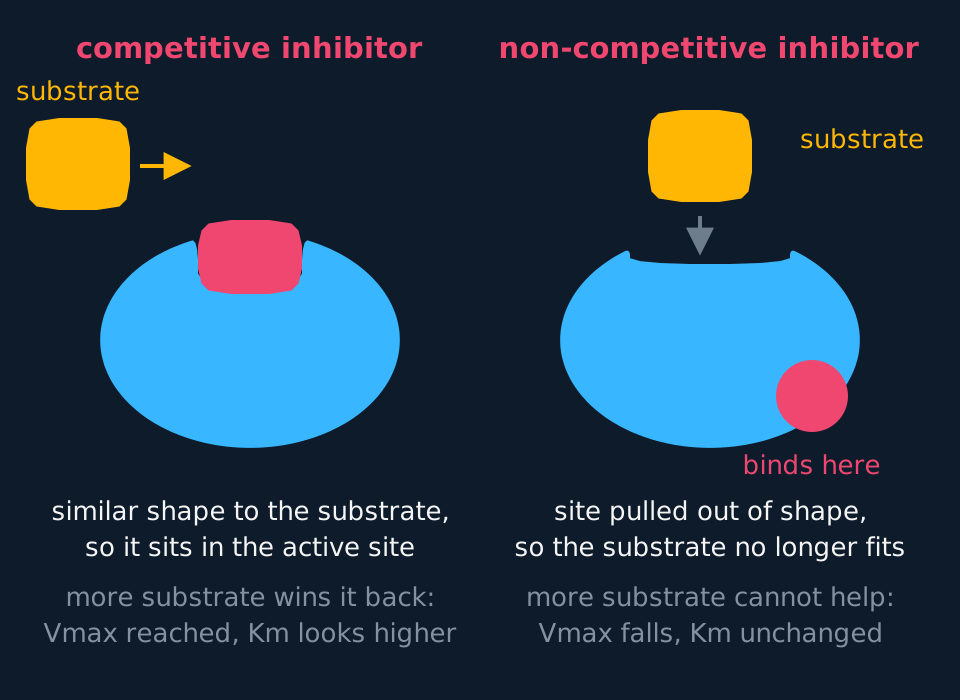
Two enzymes drawn side by side. On the left a competitive inhibitor, similar in shape to the substrate, is sitting in the active site while the substrate waits outside unable to enter. On the right an inhibitor is attached to a site well away from the active site, low on the side of the enzyme, and the active site above has been pulled into a wide shallow shape that the substrate no longer fits.
A competitive inhibitor has a shape similar enough to the substrate's that it fits the active site. While it occupies the site the substrate cannot bind, so fewer enzyme-substrate complexes form and the rate falls. The enzyme is not damaged; the proportion of sites occupied by each molecule depends on their relative concentrations.
A non-competitive inhibitor binds somewhere else entirely, at what is often called the allosteric site. Binding there changes the tertiary structure of the whole protein, and the active site, being a product of that structure, changes shape with it, so the substrate is no longer complementary. The two molecules do not compete for the same site, so raising the substrate concentration does not relieve the inhibition.
- Competitive inhibitor
- A molecule with a shape similar to the substrate that binds to the active site, preventing the substrate from binding.
- Non-competitive inhibitor
- A molecule that binds to a site other than the active site, altering the enzyme's tertiary structure so that the active site is no longer complementary to the substrate.
- Allosteric site
- A binding site on an enzyme away from the active site, at which a regulatory molecule binds.
Interpreting the rate curves
Both types lower the rate, so a single measurement does not distinguish them. Varying the substrate concentration does.
Describe the drawing
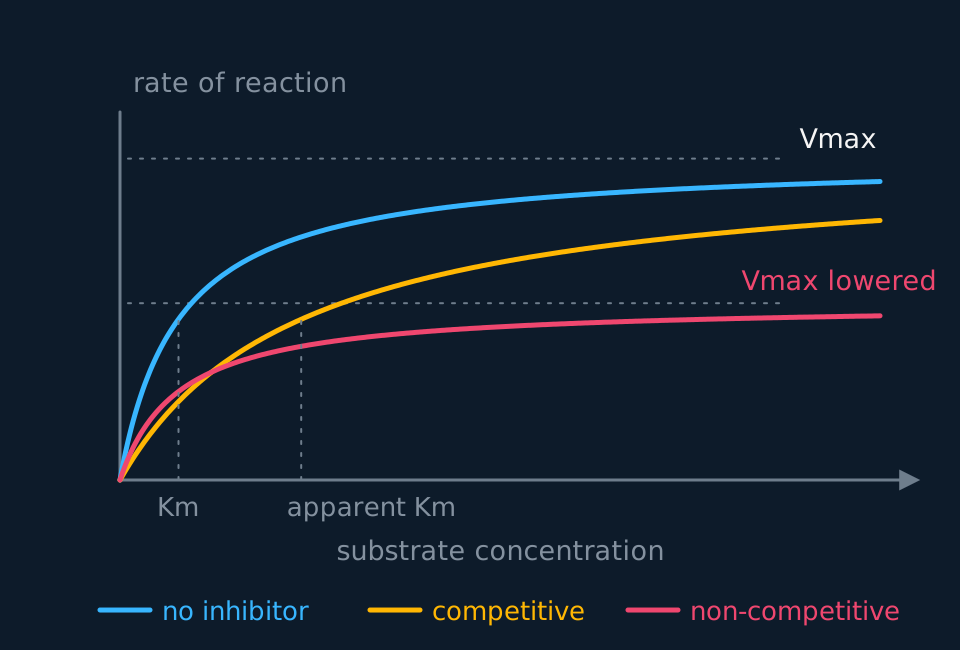
Rate of reaction plotted against substrate concentration with three curves. The cyan control curve rises and levels off at the maximum rate. The amber competitive curve rises more slowly but climbs towards the same maximum, reaching half of it at a much higher substrate concentration. The coral non-competitive curve levels off against a lower dashed maximum, reaching half of that lower value at the same substrate concentration as the control.
With a competitive inhibitor present, the rate at any given substrate concentration is lower, but the curve still approaches the same maximum. At high substrate concentration, substrate molecules occupy the great majority of active sites, so Vmax is reached. What changes is the substrate concentration required, so Km, the substrate concentration giving half the maximum rate, is apparently larger. State it as 'Vmax is unchanged and still reachable, but a higher substrate concentration is needed, so the apparent Km increases'.
With a non-competitive inhibitor present, a fixed proportion of the enzyme molecules are inactive however much substrate is added, so the maximum rate itself is lower: Vmax falls. The unaffected molecules have normal active sites and bind substrate as before, so the concentration needed to reach half of the new maximum is unchanged: Km is unchanged. Include that second statement as well as the first.
That pair describes the ideal, purely non-competitive case examined at A level. Real allosteric and mixed inhibitors often shift Km as well, so treat 'Km unchanged' as the model used in assessment rather than a general rule.
The concentration of the inhibitor is itself a factor. At a fixed substrate concentration, raising the concentration of either type of inhibitor lowers the rate, because at any moment more active sites are occupied by a competitive inhibitor, or more enzyme molecules are distorted by a non-competitive one. The rate falls steeply at first and then more and more gradually towards zero. With a competitive inhibitor the size of the effect depends on how much substrate is competing with it, so the same inhibitor concentration has less effect at a higher substrate concentration; with a non-competitive inhibitor the substrate concentration makes no difference to the fraction of activity lost.
| Competitive | Non-competitive | |
|---|---|---|
| Where it binds | The active site | A site elsewhere on the enzyme |
| Shape | Similar to the substrate | Unrelated to the substrate |
| Effect on the active site | Blocks it | Changes its shape |
| Effect of adding more substrate | Inhibition is overcome | No effect |
| Vmax | Unchanged, still reachable | Lowered |
| Km | Increased (apparent) | Unchanged |
Identifying an inhibitor from three numbers
Without inhibitor, an enzyme has Vmax = 80 μmol min⁻¹ and Km = 0.5 mmol dm⁻³. With inhibitor X, Vmax = 80 and Km = 2.0. With inhibitor Y, Vmax = 44 and Km = 0.5. Identify each inhibitor and justify your answer.
Show the working
Take X first. Vmax is unchanged, so given enough substrate the enzyme still reaches full speed. Km has quadrupled, so it takes four times as much substrate to get halfway there. Both fit a molecule occupying the active site part of the time and being displaced by substrate: X is competitive.
Y is the mirror image. Km is untouched, so the sites that are working bind substrate exactly as they always did; Vmax has fallen by 45%, so some of the enzyme is out of action no matter how much substrate is supplied. That is non-competitive.
Distinguish the two by binding location, not binding strength. Y could be held weakly and reversibly and still lower Vmax, because raising the substrate concentration cannot restore the distorted active sites.
Reversible and irreversible inhibitors
Inhibitors can also be classified by whether the binding is reversible.
Reversible inhibitors are held by hydrogen bonds, ionic bonds and hydrophobic interactions, the same weak forces that hold a substrate. They dissociate and the enzyme recovers activity. Most competitive inhibitors act this way, and so does almost all metabolic regulation within a cell, where the rate must be adjustable in both directions.
Irreversible inhibitors form a covalent bond with the enzyme. That enzyme molecule remains inactive, and activity is restored only by synthesising a replacement. Mercury and silver ions act this way, binding the sulfur of cysteine side chains; that disrupts disulfide bridges and the other interactions holding the tertiary structure, so the fold collapses and takes the active site with it.
Penicillin is the standard named example. Bacteria cross-link the strands of their peptidoglycan wall using a transpeptidase, and penicillin resembles the peptidoglycan fragment that enzyme normally binds closely enough to enter the active site, where it then reacts, forming a covalent bond that does not break. The bacterium continues to grow, cannot strengthen its wall, and bursts as water enters by osmosis. Human cells have no peptidoglycan and no transpeptidase, so penicillin has no equivalent target in them.
Statins are the reversible counterpart: competitive inhibitors of HMG-CoA reductase, the enzyme controlling the rate-limiting step of cholesterol synthesis in the liver, which bind because their shape is similar to that of the substrate. Reversibility is useful in a drug taken daily: when the drug is stopped, enzyme activity returns. Reversibility is not always preferable, however. Penicillin is irreversible and is among the most widely used antibiotics; the requirement depends on the clinical purpose of the drug.
End-product inhibition
Cellular products are rarely made in one step. Glucose is converted to pyruvate in ten reactions, each with its own enzyme, and many such pathways operate simultaneously in one cell. End-product inhibition is the mechanism that matches the rate of a pathway to demand.
Describe the drawing
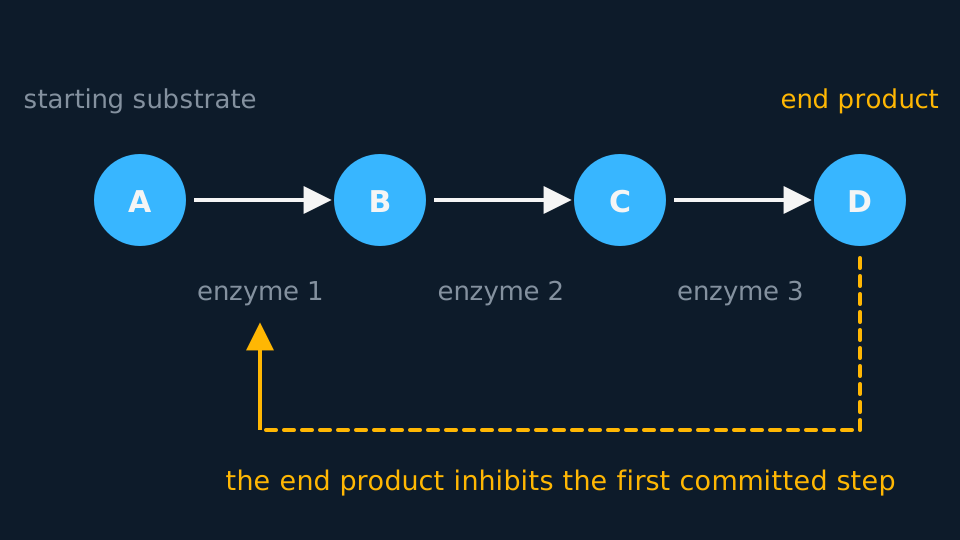
A four-step pathway drawn left to right: four circles labelled A, B, C and D joined by arrows, with the enzyme for each step named beneath its arrow. A dashed line leaves the end product D, runs down and back along under the pathway, and arrows upwards onto enzyme 1, showing the end product switching off the first committed step of the sequence.
In end-product inhibition, the final product of the pathway acts as a non-competitive inhibitor of the enzyme catalysing the first committed step of the pathway, which is an early regulatory step rather than necessarily the first chemical one. It binds at an allosteric site. As product accumulates, more of that enzyme is inhibited and the pathway slows; as product is used, the inhibitor dissociates and the pathway accelerates again.
Inhibiting the last enzyme instead would leave the earlier steps running, so intermediates would accumulate in the cell after substrate and ATP had been spent making them. The target is the first committed step, the first reaction that serves only this pathway, so earlier steps shared with other pathways continue to operate.
The named example is ATP acting on phosphofructokinase in glycolysis. Phosphofructokinase catalyses an early committed step, and ATP, the eventual product of the pathway, binds it at an allosteric site and inhibits it. A high ATP concentration therefore reduces the rate of glucose breakdown, and a falling ATP concentration relieves the inhibition. ATP is also a substrate at that enzyme's active site, which demonstrates that the two sites are distinct.
- End-product inhibition
- The inhibition of an enzyme early in a metabolic pathway by the final product of that pathway, so that the rate of the pathway matches demand.
Immobilised enzymes in industry
An enzyme dissolved in its own product creates two problems. It must be separated out before the product can be sold, and it leaves with the batch, so the next batch requires fresh enzyme. Enzymes are expensive.
Immobilising the enzyme solves both. It is attached to something that does not move: adsorbed onto a clay or resin, covalently bonded to a support such as cellulose, trapped in a gel, of which alginate beads are the school version, or held behind a partially permeable membrane while substrate diffuses through to it.
| Advantage | Why it follows |
|---|---|
| Recovered and reused | It stays on the support as product flows past |
| Product free of enzyme | No separation step, so lower cost and no protein in the product |
| More stable to heat and pH | The support holds the tertiary structure, so a hotter, faster process is possible |
| Runs continuously | Substrate is pumped through a packed column instead of mixed in batches |
| Easy to stop | Stop the flow and the two are no longer in contact |
The disadvantage is a loss of activity. Fixing an enzyme to a support can block part of the active site or hold it slightly strained, and the substrate must diffuse to a site that cannot move towards it, so an immobilised enzyme usually works more slowly than the same enzyme free in solution. Set-up costs are also higher, and both are offset by reuse.
In the school version of this comparison, the enzyme is mixed with sodium alginate solution and dripped into calcium chloride solution, where each drop sets into a bead of calcium alginate with the enzyme trapped inside. The rinsed beads are packed into a syringe barrel and substrate is run through them, while the same volume of substrate is mixed with the same quantity of free enzyme. With lactase and milk, glucose test strips show how quickly product appears in each. The free enzyme usually gives the higher initial rate, but the beads can be rinsed and used again and the product contains no enzyme.
Name a specific example. Lactase immobilised on beads makes lactose-free milk, the milk passing through a column and the enzyme never entering the carton. Glucose isomerase converts glucose syrup into the sweeter fructose syrup used across the food industry. And penicillin acylase removes a side chain from natural penicillin so that semi-synthetic antibiotics can be built on what remains.
TRY IT: Choosing a temperature for a column
A dairy passes milk through a column of immobilised lactase. The free enzyme has an optimum of 48 °C but denatures noticeably within an hour at it. Immobilised, it runs at 50 °C for weeks. Suggest why immobilisation makes the higher temperature possible, and give one reason the dairy might still run the column cooler.
Check your answer
Immobilisation restricts how much the polypeptide can move. Attachment to the support, or entrapment in a gel, holds parts of the chain in place, so the vibration that would otherwise break hydrogen and ionic bonds is less able to unfold the tertiary structure. The active site keeps its shape at a temperature that would have destroyed the free enzyme, and rate rises with temperature, so the dairy gets more product per hour as well.
Reasons to run cooler are practical rather than enzymic: warm milk supports bacterial growth, heating costs energy, and prolonged warming affects taste.
In the exam
- Distinguish the two by binding location. A competitive inhibitor binds the active site; a non-competitive one binds elsewhere and changes the shape of the active site. Binding strength is not the distinction.
- State the Vmax and Km effects as two sentences: competitive means Vmax unchanged and still reachable with a higher apparent Km; non-competitive means Vmax lower and Km unchanged.
- Adding more substrate relieves competitive inhibition and has no effect on non-competitive inhibition. State the reason as well as the outcome.
- For end-product inhibition, state that the product acts on the enzyme catalysing the first committed step and that it binds at a site other than the active site. Where a question asks for an advantage, add that it prevents substrate and ATP being spent on unused intermediates.
- For immobilised enzymes, give advantages tied to the industrial process: reuse, no contamination of the product, continuous operation and a higher working temperature. Give the loss of activity as the disadvantage in an evaluation.
Check yourself
A company has two candidate molecules that both slow the same enzyme in cultured cells. When the substrate concentration in the culture is raised tenfold, molecule A stops having any measurable effect while molecule B works exactly as well as before. Identify each type of inhibition, and advise the company on which molecule is the better starting point for a drug that must work in a tissue where substrate concentration rises and falls sharply after meals.
Answer
Molecule A is a competitive inhibitor. Its effect disappears at high substrate concentration because it binds the active site and is displaced once substrate molecules greatly outnumber it, so Vmax is reached in spite of the inhibitor being present.
Molecule B is a non-competitive inhibitor. It binds away from the active site and alters the enzyme's tertiary structure, so the site is no longer complementary to the substrate. Substrate cannot compete for a place it does not occupy, and the maximum rate is lower however much is available.
For the tissue described, B is the better starting point: a drug based on A would lose its effect exactly when substrate concentration peaked after a meal, so the dose would in effect vary with what the patient had eaten. The advice needs a caveat, though. Non-competitive inhibition cannot be reversed by raising the substrate concentration, so an overdose is harder to counteract, and a molecule that binds one allosteric site may bind others. Check B's specificity across related enzymes, and confirm its binding is reversible, before committing.
Questions
Question 14 marks
Compare a competitive inhibitor with a non-competitive inhibitor, referring to where each one binds and what each does to the enzyme.
Mark scheme
- B1 a competitive inhibitor binds to the active site, whereas a non-competitive inhibitor binds elsewhere, at an allosteric site
- B1 a competitive inhibitor has a shape similar to the substrate, whereas a non-competitive inhibitor has a shape unrelated to it
- B1 a competitive inhibitor blocks the site, whereas a non-competitive inhibitor alters the tertiary structure so the site is no longer complementary to the substrate
- B1 raising the substrate concentration overcomes competitive inhibition, but has no effect at all on non-competitive inhibition
Question 24 marks
Explain how end-product inhibition controls the rate of a metabolic pathway, and explain why inhibiting an early committed step prevents substrate and ATP being spent on intermediates the cell does not need.
Mark scheme
- B1 the final product of the pathway acts as a non-competitive inhibitor of the enzyme catalysing the first committed step, binding at an allosteric site
- B1 as product accumulates more of that enzyme is inhibited, so the pathway slows
- B1 as product is used up the inhibitor comes off again, so the pathway speeds up and its rate matches demand
- B1 inhibiting a later enzyme instead would leave the earlier steps running, so substrate and ATP would be spent building intermediates the cell has no use for
Question 34 marks
A dairy producing lactose-free milk must decide whether to immobilise its lactase on a column or to add the free enzyme to each batch. Evaluate the case for immobilising it.
Mark scheme
- B1 the immobilised enzyme stays on its support as the milk flows past, so it is recovered and reused instead of being lost with every batch
- B1 no enzyme leaves with the product, so no separation step is needed and the milk contains none of the enzyme protein
- B1 the support holds the tertiary structure, so the column tolerates a higher temperature and can be run continuously rather than in batches
- B1 against this, an immobilised enzyme works more slowly because part of the active site may be blocked and substrate must diffuse to it, and set-up costs are higher; for continuous large-scale production the savings from reuse outweigh these, so immobilising is the better choice
Question 44 marks
Compare a reversible inhibitor with an irreversible inhibitor, referring to the type of bond formed and to whether activity can be restored.
Mark scheme
- B1 a reversible inhibitor is held by weak interactions, such as hydrogen bonds, ionic bonds and hydrophobic interactions, the same kind of forces that hold a substrate
- B1 an irreversible inhibitor forms a covalent bond with the enzyme
- B1 a reversible inhibitor can dissociate, so the enzyme regains activity once the inhibitor's concentration falls, whereas an irreversible inhibitor leaves that enzyme molecule permanently inactive
- B1 activity lost to an irreversible inhibitor is restored only by the cell synthesising new enzyme molecules, not by removing the inhibitor
Question 54 marks
Explain how a statin lowers the rate of cholesterol synthesis in the liver, and explain why its effect wears off once a patient stops taking it.
Mark scheme
- B1 a statin has a shape similar to the substrate of HMG-CoA reductase, the enzyme controlling the rate-limiting step of cholesterol synthesis
- B1 it competes with the natural substrate for the active site, so fewer enzyme-substrate complexes form and the rate of that step, and so of the whole pathway, falls
- B1 a statin is a reversible, competitive inhibitor, held by weak interactions rather than a covalent bond
- B1 once the drug is stopped its concentration in the liver falls, so it dissociates from the enzyme and normal enzyme activity, and cholesterol synthesis, returns
Question 64 marks
Without inhibitor, an enzyme has Vmax = 60 μmol min⁻¹ and Km = 1.0 mmol dm⁻³. With inhibitor P present, Vmax = 30 and Km = 1.0. With inhibitor Q present, Vmax = 60 and Km = 4.0. Identify the type of each inhibitor, and identify the evidence that rules out the other type in each case.
Mark scheme
- B1 P is a non-competitive inhibitor, because Vmax has fallen, from 60 to 30, while Km is unchanged
- B1 a competitive inhibitor is ruled out for P because the unchanged Km shows the sites still working bind substrate exactly as before, and raising substrate concentration could not restore the lost Vmax
- B1 Q is a competitive inhibitor, because Vmax is unchanged, still 60 and reachable given enough substrate, while Km has increased, from 1.0 to 4.0
- B1 a non-competitive inhibitor is ruled out for Q because a fixed loss of active sites would lower Vmax however much substrate was added, which is not observed here
Question 74 marks
A new pesticide binds permanently and covalently to an insect enzyme essential for nerve function, at a site away from its active site. Suggest the type of inhibitor this pesticide is, giving your reasoning, and suggest why washing an exposed insect in water would not restore the enzyme's activity.
Mark scheme
- B1 it is a non-competitive inhibitor: it binds away from the active site, so it does not compete with the substrate, and it alters the enzyme's tertiary structure so the active site changes shape
- B1 the covalent bond it forms makes it irreversible, unlike the weak interactions that hold a reversible inhibitor in place
- B1 washing removes only what is not chemically bonded to the enzyme, and a covalent bond does not break under those conditions
- B1 activity in the affected insect would return only once new enzyme molecules were synthesised, not because the existing ones recovered
Question 83 marks
Explain why penicillin kills growing bacteria but does no harm to human cells.
Mark scheme
- B1 penicillin resembles the piece of peptidoglycan that the bacterial transpeptidase normally grips, closely enough to enter that enzyme's active site
- B1 it then forms a covalent bond with the enzyme, so the inhibition is irreversible, the growing bacterium cannot cross-link its wall, and it bursts as water enters by osmosis
- B1 human cells have no peptidoglycan wall and therefore no transpeptidase, so there is nothing for penicillin to inhibit
Question 93 marks
Mercury ions inhibit many enzymes, and washing the mercury away does not restore activity. Suggest how mercury ions inhibit an enzyme, and suggest why the effect cannot be reversed.
Mark scheme
- B1 mercury ions bind to the sulfur in cysteine side chains
- B1 the disulfide bridges those cysteines would have formed cannot form, so the tertiary structure collapses and the active site loses its shape
- B1 the bond the mercury forms is covalent, so it does not come off, and the only recovery available is to synthesise a fresh enzyme molecule
Question 103 marks
Describe two advantages of immobilising an enzyme for an industrial process, other than the ability to reuse it.
Mark scheme
- B1 the product contains none of the enzyme, because the enzyme stays on its support rather than mixing with the product, so no separation step is needed
- B1 the support holds the tertiary structure in place, so the immobilised enzyme tolerates higher temperatures than the same enzyme free in solution, allowing a faster, hotter process
- B1 the process can be run continuously, with substrate pumped through a packed column, rather than in separate batches
Question 113 marks
Name the enzyme immobilised to produce lactose-free milk, name the enzyme used to convert glucose syrup into a sweeter fructose syrup, and name the enzyme used to remove a side chain from natural penicillin.
Mark scheme
- B1 lactase, immobilised on beads
- B1 glucose isomerase, for fructose syrup
- B1 penicillin acylase, for semi-synthetics
Question 123 marks
Explain why raising the substrate concentration relieves competitive inhibition but has no effect on non-competitive inhibition.
Mark scheme
- B1 a competitive inhibitor competes with the substrate for the same active site, so raising the substrate concentration increases the chance that a substrate molecule occupies a site before the inhibitor does
- B1 a non-competitive inhibitor binds at a separate allosteric site, not the active site, so it does not compete with substrate molecules for a place
- B1 with the active sites of the affected enzyme molecules already distorted, adding more substrate gives them nothing to bind to, so the inhibition is not relieved
Question 132 marks
State the effect a non-competitive inhibitor has on the Vmax of an enzyme, and state its effect on the Km.
Mark scheme
- B1 Vmax is lowered by a non-competitive inhibitor
- B1 Km is unchanged by a non-competitive inhibitor
Question 142 marks
State the effect a competitive inhibitor has on the Vmax of an enzyme-catalysed reaction, and state its effect on the apparent Km.
Mark scheme
- B1 Vmax is unchanged by a competitive inhibitor, and is still reached given enough substrate
- B1 the apparent Km is increased, because a higher substrate concentration is needed to reach half of Vmax
Question 152 marks
Phosphofructokinase catalyses an early step in glycolysis, using ATP as one of its substrates. A high concentration of ATP also inhibits the enzyme by binding to a second site, away from the active site, which changes the shape of the active site. State whether ATP acts here as a competitive or a non-competitive inhibitor, and explain how this inhibition matches the rate of glycolysis to the cell's demand for ATP.
Mark scheme
- B1 non-competitive, because it binds at a site other than the active site and changes the active site's shape, so fewer enzyme-substrate complexes form
- B1 when ATP is plentiful the enzyme is inhibited and glycolysis slows, so glucose is not used to make ATP that is not needed; as ATP is used and its concentration falls, the inhibition is released and glycolysis speeds up again
Worth remembering
- Competitive inhibitors bind the active site; non-competitive inhibitors bind elsewhere and change its shape.
- More substrate overcomes competitive inhibition and does nothing for non-competitive inhibition.
- Competitive: Vmax unchanged, apparent Km raised. Non-competitive: Vmax lowered, Km unchanged.
- Reversible inhibitors are held by weak interactions; irreversible ones form a covalent bond, as penicillin does with the transpeptidase that builds a bacterial wall.
- End-product inhibition acts on the enzyme catalysing the first committed step of a pathway, so no substrate and no ATP is spent making intermediates the cell does not need.
CHECK YOUR PROGRESS
Rate how confident you are with each objective for this lesson. Ratings are saved in this browser, on this device, unless you sign in.
- Distinguish competitive from non-competitive inhibition by where the inhibitor binds and what it does to the active site.
- State the effect of each type on Vmax and on Km, and explain both effects in words rather than by quoting the graph.
- Explain why raising the substrate concentration relieves one kind of inhibition and not the other.
- Describe end-product inhibition and say why acting on the enzyme catalysing the first committed step of a pathway is the efficient choice.
- Give the advantages of immobilising an enzyme for an industrial process, and one disadvantage.
Open the full revision checklist to see every objective in the curriculum in one place.
Practise this lesson
WORKBOOK
The questions from this topic, on paper with room to work, and a separate book of mark schemes. Free to use; please do not redistribute or sell.
Used later in Industrial biotechnology and fermentation