Biology › Gene regulation, genomics and biotechnology › Pharming, recombinant medicines and synthetic biology
Pharming, recombinant medicines and synthetic biology
Large therapeutic proteins are usually produced in living cells because correct folding and post-translational modification can be difficult to achieve by chemical synthesis. The required processing determines the expression system. Pharming uses genetically modified plants or animals to produce pharmaceutical substances; synthetic biology assembles characterised genetic components and pathways for defined functions.
Before this Recombinant DNA: vectors, transformation and markers · Post-translational modification in the Golgi apparatus · Promoters and tissue-specific gene expression · Somatic and germ line gene therapy
COMMON MISCONCEPTION
Once the human gene is in, any cell will do: a protein is a protein whoever manufactures it.
The expression host must provide the processing required by the protein. E. coli can produce insulin, which needs limited post-translational modification; factor VIII requires eukaryotic folding and glycosylation, so it is produced in mammalian cells or another suitable eukaryotic system.
What you should be able to do
- Name factor VIII and adenosine deaminase as recombinant medicines, state what each treats, and explain what recombinant production replaced.
- Explain why some human proteins must be made in eukaryotic cells rather than in bacteria.
- Describe how a transgenic animal is engineered to secrete a human protein in its milk, and explain the role of the mammary-specific promoter.
- Set out the welfare and regulatory arguments around pharming on both sides.
- Describe what synthetic biology adds to genetic engineering, using standard parts, genome synthesis and the artemisinin pathway as the named examples.
- Argue the biosecurity and ownership questions synthetic biology raises, from both directions.
Medicines that are proteins
Large or extensively modified therapeutic proteins are usually produced in living cells because correct folding and post-translational processing are difficult to reproduce by chemical synthesis. The required processing determines whether bacterial, yeast or mammalian cells are suitable. Some short peptides are synthesised chemically, and cell-free expression systems exist, so cellular production is a practical requirement for large glycoproteins rather than an absolute rule for all protein drugs.
Before recombinant DNA technology, protein medicines were extracted from an organism that already made them, and the two named examples on the specification show the consequences of that.
Factor VIII is the clotting factor missing in the commonest severe haemophilia. For decades it was concentrated from donated blood plasma, pooled from thousands of donors per batch, and in the early 1980s that pooling proved catastrophic: plasma from a single infected donor contaminated whole batches, and a large fraction of the people treated for haemophilia in that era were infected with HIV, hepatitis C or both. Recombinant factor VIII, made since the 1990s by cultured mammalian cells carrying the human gene, removed the donor pool, and with it that route of infection, entirely.
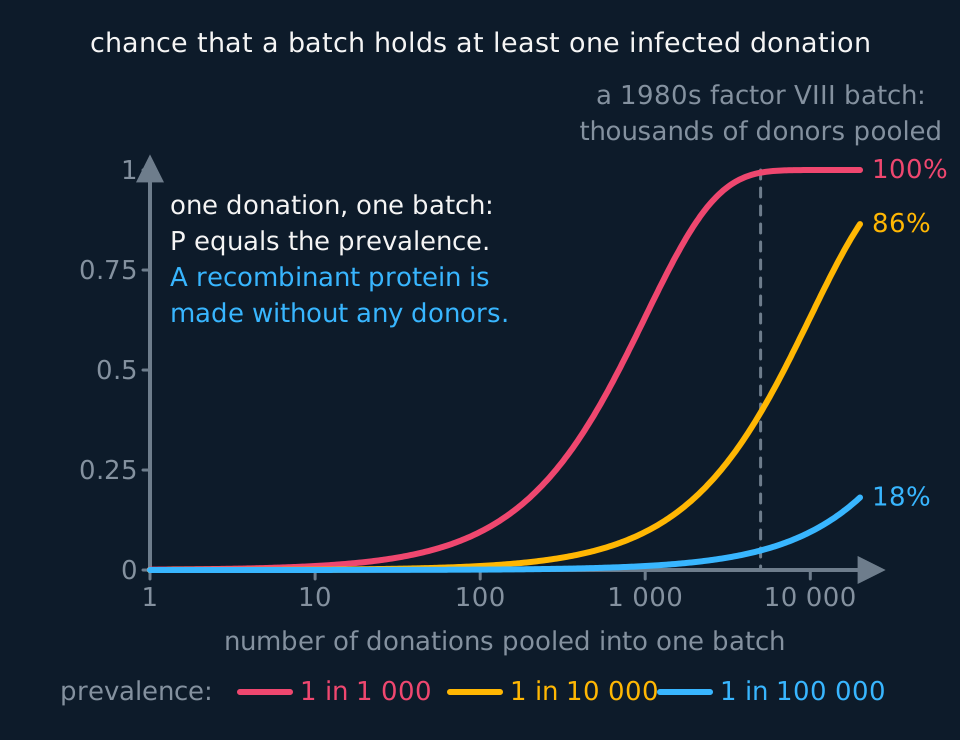
Adenosine deaminase (ADA) is the enzyme whose absence causes one form of severe combined immunodeficiency, the condition you met in the gene therapy lesson. Before gene therapy, and still alongside it, patients are treated with injections of the enzyme itself, produced recombinantly and chemically stabilised so it survives in the blood. The same condition therefore has two recombinant treatments: supplying the protein, or supplying the gene.
Mammalian cells are used in preference to a cheaper bacterial fermenter because E. coli transcribes and translates a human gene without carrying out the subsequent processing. Factor VIII requires chaperoned folding, disulfide bridges at specific positions, and sugar chains added in a Golgi apparatus; a bacterium has none of those, so it yields a polypeptide with the correct primary structure and without the required folding or glycosylation. Insulin is small and requires little post-translational modification, so it can be produced in bacteria. The required processing determines the expression host.
- Recombinant medicine
- A protein drug produced by cells carrying an introduced copy of the human gene, rather than extracted from blood or tissue.
- Factor VIII
- The clotting protein deficient in haemophilia A, produced recombinantly in mammalian cell culture since the 1990s.
- Adenosine deaminase
- The enzyme missing in ADA-deficient severe combined immunodeficiency, supplied to patients as a recombinant protein.
Pharming: expression in milk
Pharming uses genetically modified organisms, including plants and animals, to produce pharmaceutical substances. A tissue-specific promoter can direct expression in milk, but yield depends on the construct and species.
Mammalian cell culture is effective and expensive: the cells grow slowly, require a rich sterile medium, and typically yield milligrams per litre. A lactating transgenic animal secretes the protein into milk, which is collected by milking and is a simpler starting material to purify than cell culture medium or plasma. Reported yields vary widely between constructs and species, from milligrams to several grams per litre, so quote a figure with its source rather than a general rate.
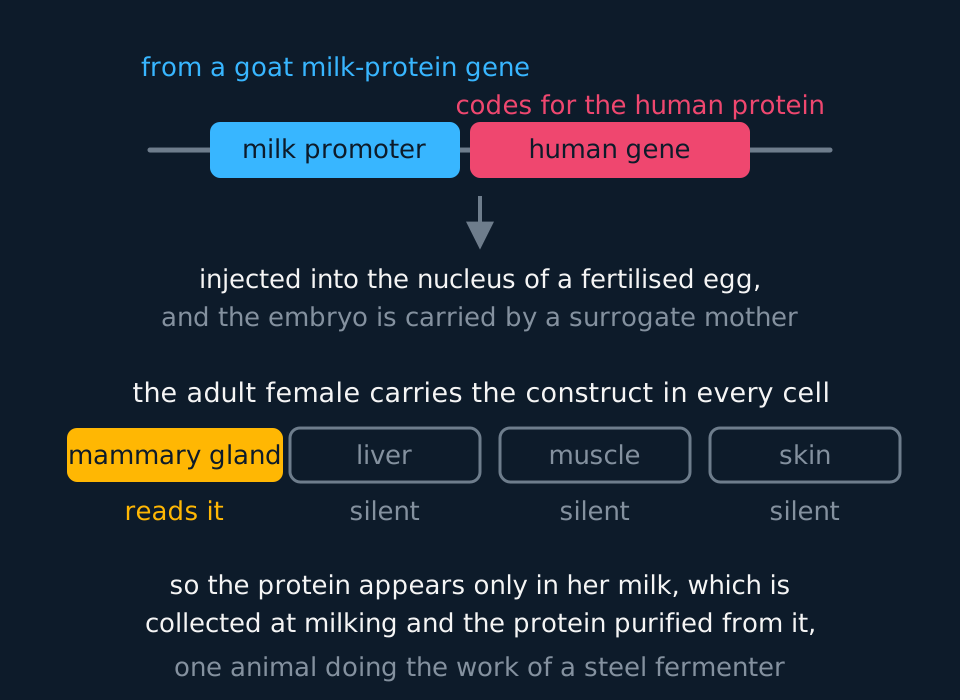
The construct is the part to describe precisely. The human gene is joined downstream of the promoter of a milk protein gene, such as β-lactoglobulin, so the transcription factors that switch that promoter on exist only in mammary gland cells during lactation. The construct is microinjected into the nucleus of a fertilised egg, or introduced into cultured cells from which an embryo is then cloned by nuclear transfer, and the embryo is implanted into a surrogate. Microinjection can produce mosaic founders, in which only some cells carry the insert, so animals must be screened and a confirmed line established before production begins. A female of that established line carries the gene in every cell and expresses it in one tissue: her milk carries the human protein, her blood and other tissues carry very little, and purification starts from milk.
Antithrombin is the licensed example: an anticoagulant protein produced in the milk of a herd of transgenic goats and approved as a drug in Europe in 2006, the first medicine from a transgenic animal to be licensed. A herd of goats can supply quantities that would otherwise require very large numbers of blood donations.
- Pharming
- The use of genetically modified organisms, including plants and animals, to produce pharmaceutical substances; in livestock, classically in milk.
- Mammary-specific promoter
- The promoter of a milk protein gene, placed in front of an introduced gene so that the gene is transcribed only in mammary gland cells during lactation.
Welfare and regulatory considerations
The arguments about pharming are set out below on each side, with the evidence for each.
Welfare, against. Making a founder animal is inefficient: microinjection succeeds in a small percentage of eggs, so producing one transgenic goat means many surrogate pregnancies, failed implantations and discarded embryos, and where cloning is used it brings its own losses, since a large fraction of cloned pregnancies fail late or produce unhealthy offspring. Critics add a deeper objection: that redesigning an animal's genome to serve as production equipment treats a sentient creature as an instrument, whatever its day-to-day conditions.
Welfare, for. Once the founder exists, the producing herd is bred normally and kept as a dairy herd; milking does not harm the animal, and the commercial requirement for clean, consistent milk means the animals are housed and fed to a high standard. Supporters also compare the alternatives: the protein would otherwise come from pooled human plasma, with the safety record described above, or from cell culture at a cost some health systems will not meet.
Regulation. A drug from a living animal poses questions a steel fermenter does not. Milk composition varies with the animal, the season and the feed, so every batch must be purified and tested to prove it identical to the last; the herd must be certified free of infections, and of prion disease in particular, that could pass into the product; and the animals themselves must be contained, because a transgenic goat that bred into an ordinary herd would spread a pharmaceutical gene that could never be recalled. Regulators answered with closed, certified herds, animals identified and tracked individually, and approval processes that took years. The animals are also patented, which is one instance of the ownership question treated below.
Synthetic biology: parts, genomes and pathways
Recombinant DNA technology introduces one gene at a time into an organism that is otherwise unchanged. Synthetic biology assembles characterised genetic components and pathways for defined functions, treating DNA as an engineering material that is specified, synthesised to order, and assembled into circuits and pathways not found in any organism.
It has three levels. Standard parts: promoters, ribosome binding sites, genes and terminators catalogued with defined, measured behaviour, designed so that any part joins to any other, the way electronic components share standard connections. An engineer picks parts from the registry and assembles a device instead of hunting each sequence from scratch. Genome synthesis: whole genomes built chemically from their sequence data. A bacterial genome of about a million base pairs was synthesised and installed in a recipient cell in 2010, and the cell ran on it; stripped-down versions since have asked what the minimum set of genes for life actually is. Engineered pathways: several genes, from several organisms, assembled so that a cell runs a metabolic production line it never had.
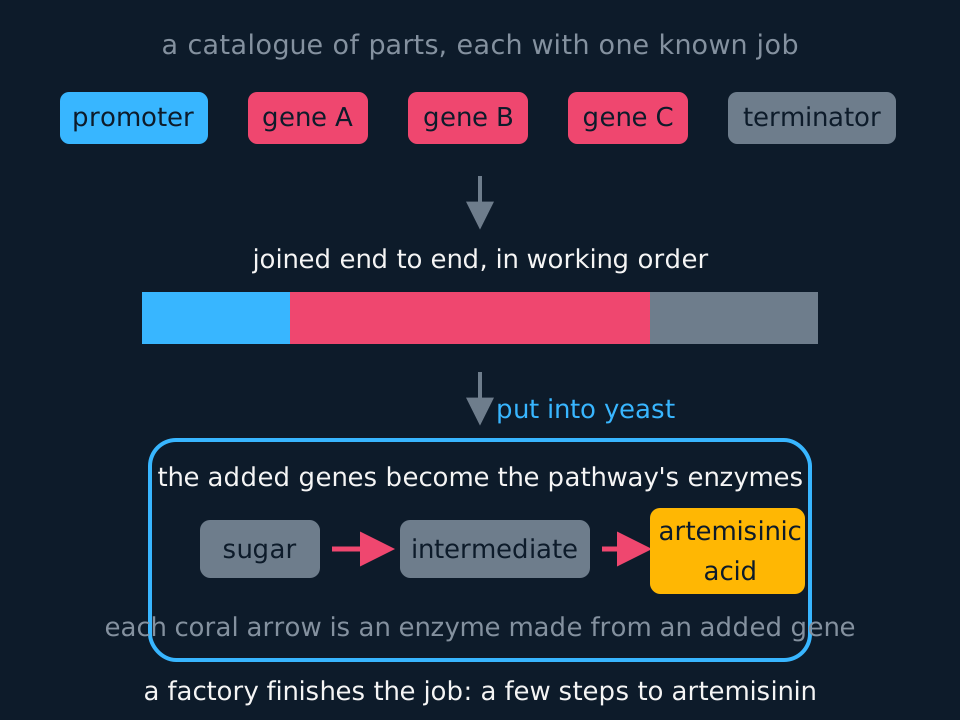
The named pathway example is artemisinin, the antimalarial used in combination therapy worldwide. It is extracted from sweet wormwood, a crop whose yield and price varied substantially between years. A pathway of enzymes, some from the plant and some derived from yeast's own metabolism, was assembled in brewer's yeast, so that the yeast converts sugar into artemisinic acid, which industrial chemical steps then convert into artemisinin. Production began at scale in 2013, providing a supply that does not depend solely on the harvest.
- Synthetic biology
- The design and construction of new biological parts, devices and pathways, and the redesign of existing organisms, treating DNA as a specifiable engineering material.
- Standard part
- A DNA sequence with a defined function, catalogued and designed to be assembled with any other standard part.
Biosecurity and ownership
The same capability, DNA synthesised to order, underlies both the applications and the risks of synthetic biology. The specifications require the arguments on each side, which are paired below.
Biosecurity. Poliovirus was assembled from mail-ordered DNA fragments and published in 2002, and an extinct relative of smallpox was synthesised in 2017 for around one hundred thousand dollars, so the barrier to recreating a dangerous pathogen is money and published sequence, not rare skill. Against that: the same openness lets any public-health laboratory synthesise a new pathogen's genes within days of its sequence appearing, which is how vaccine development now starts, and the response to the risk has been screening rather than secrecy, with synthesis companies checking orders against databases of dangerous sequences and flagging the customers who place them. Screening is voluntary and coverage differs between suppliers, and whether voluntary screening is sufficient is the point at issue. Date any claim about screening practice or regulation, since both change.
Ownership. Engineered organisms and standard parts can be patented, and the case for is the usual case for patents: development costs run to hundreds of millions, and no company recovers that without a period of exclusivity, so patents are what pay for the goats, the yeast and the trials. The case against has two layers. One is access: a patented medicine is priced by its owner, and the diseases synthetic biology could treat most cheaply are concentrated where patients are poorest. The other is displacement, and artemisinin is the worked case: fermenter production stabilises the drug supply and also competes with the smallholder farmers who grow wormwood, so the same process reduces supply risk for health systems and reduces income for those growers. A boundary question is also unresolved in law: patenting one gene is established practice, and whether the design of an entire organism can be owned is not settled.
TRY IT: Evaluating a synthetic biology proposal
A company announces it will synthesise and sell, to research laboratories only, DNA fragments of any sequence up to 10 000 base pairs, arguing that fast synthesis accelerates vaccine research. A critic replies that the same service could assemble a dangerous virus. Evaluate both claims and suggest one safeguard the company could adopt.
Check your answer
The company's claim is sound as far as it goes. Vaccine work now begins from published sequence, and synthesising a pathogen's surface protein genes in days, rather than waiting for samples of the organism to be shipped and cultured, genuinely shortens development; the 2002 poliovirus work and everything since show synthesis at this scale is practical.
The critic's claim is also sound, and for the same reason: several dangerous viruses have genomes small enough to assemble from fragments of the size offered, and the poliovirus and horsepox syntheses demonstrate that publication plus purchasable DNA can equal a live pathogen. The two claims do not contradict each other; they describe the same capability pointed in different directions.
A defensible judgement retains the service with a safeguard: screen every order against the sequences of known dangerous pathogens, verify the customer's identity, and refuse or report matches. That is the safeguard the major synthesis companies operate. State its limitation: screening is voluntary and coverage differs between suppliers.
In the exam
- Name the two recombinant medicines with their conditions: factor VIII for haemophilia A, adenosine deaminase for ADA-deficient severe combined immunodeficiency.
- Give the mechanism behind the change to recombinant factor VIII: pooled plasma transmitted HIV and hepatitis viruses, and cultured cells carrying the gene do not.
- Give post-translational modification as the reason for using a mammalian cell rather than a bacterium: folding, disulfide bridges and glycosylation occur in eukaryotic cells, and E. coli has no Golgi apparatus.
- For pharming, give the function of the promoter: a milk-protein promoter is active in mammary gland cells during lactation, so the whole animal carries the gene and the protein is secreted into milk.
- Give both sides with reasons in welfare and regulation questions: inefficient founder production and the treatment of animals as production systems against a well-kept herd replacing pooled plasma; batch variation and escape against closed, certified, tracked herds.
- Give the three levels of synthetic biology: standard parts, genome synthesis, and an engineered pathway, with artemisinic acid from yeast as the pathway example.
- Answer biosecurity and ownership on both sides: state the strongest version of each, then give a judgement.
Check yourself
A biotechnology company must choose between producing human factor VIII in genetically modified E. coli grown in fermenters, or in the milk of transgenic goats. Explain why the bacterial option is unlikely to yield a usable medicine, describe how the goat option would be set up, and give one welfare and one regulatory issue the company should expect.
Answer
The bacterial option fails at the protein, not the gene. E. coli will transcribe and translate a human factor VIII gene supplied with a bacterial promoter, but factor VIII is a large glycoprotein: it needs chaperoned folding, disulfide bridges formed correctly, and sugar chains added in the Golgi apparatus. A prokaryote has no endoplasmic reticulum and no Golgi, so what accumulates is a polypeptide with the right primary structure and the wrong tertiary structure and no glycosylation: inactive, and liable to provoke an immune reaction if injected.
The goat option: join the human factor VIII gene downstream of the promoter of a goat milk protein gene, so that only mammary gland cells during lactation transcribe it. Introduce the construct by microinjection into the nucleus of a fertilised egg, or into cultured cells used for nuclear transfer; implant the embryo in a surrogate; screen the offspring for the transgene, since microinjection can produce mosaic founders, and establish a confirmed line. A transgenic female of that line then carries the gene in every cell, expresses it only in her mammary gland, and secretes factor VIII into her milk, from which it is purified. Goats' cells are eukaryotic, so the folding and modification the bacterium could not do are done as the protein is secreted.
Welfare: founding the line is inefficient, so the company should expect many failed embryo transfers and surrogate pregnancies for each transgenic kid, and should be ready to defend that cost publicly. Regulatory: the product comes from a living animal, so every batch must be shown consistent and free of animal pathogens, the herd must be closed, certified and tracked, and the animals contained so the transgene cannot enter ordinary goat populations. The precedent is antithrombin from transgenic goats, which met these requirements and was approved in 2006.
Questions
Question 15 marks
A company will synthesise DNA of any sequence to order and sell it to research laboratories, and has patented the engineered yeast it uses in its own drug production. Evaluate the biosecurity and ownership concerns raised by work of this kind.
Mark scheme
- B1 the biosecurity worry is concrete: poliovirus was assembled from mail-ordered DNA fragments in 2002 and an extinct relative of smallpox was synthesised in 2017 for around one hundred thousand dollars, so recreating a dangerous pathogen needs money and a published sequence rather than rare skill
- B1 against that, the same openness lets a public-health laboratory synthesise a new pathogen's genes within days of its sequence appearing, which is how vaccine development now begins
- B1 the case for patents is that development costs run to hundreds of millions, and a period of exclusivity is what pays for the engineering, the animals and the trials
- B1 the case against is access and displacement: a patented medicine is priced by its owner and the diseases involved are concentrated where patients are poorest, and a fermenter making artemisinic acid competes with the smallholders who grow wormwood for the same drug
- B1 a judgement supported by those points, for example that the service should continue with every order screened against the sequences of known dangerous pathogens and the customer verified, while noting that such screening is voluntary and a fence some suppliers do not build
Question 24 marks
Describe how a goat is engineered to secrete a human protein into its milk, and describe why the protein appears there and nowhere else in the animal.
Mark scheme
- B1 the human gene is joined downstream of the promoter of a milk protein gene, such as the promoter of β-lactoglobulin
- B1 the construct is microinjected into the nucleus of a fertilised egg, or introduced into cultured cells from which an embryo is cloned by nuclear transfer
- B1 the embryo is implanted into a surrogate, and the offspring are tested for the transgene; a transgenic female carries the gene in every cell of her body
- B1 the transcription factors that switch that promoter on are present only in mammary gland cells during lactation, so only those cells transcribe the gene and the protein is purified from milk rather than from blood
Question 34 marks
Discuss the welfare arguments for and against producing medicines in the milk of transgenic livestock.
Mark scheme
- B1 against: founding the line is inefficient, because microinjection succeeds in only a small percentage of eggs, so each transgenic animal costs many surrogate pregnancies, failed implantations and discarded embryos, and cloning adds its own late pregnancy failures
- B1 against: redesigning an animal's genome so that it serves as production equipment treats a sentient creature as an instrument, whatever its day-to-day conditions
- B1 for: once the founder exists the producing herd is bred normally and milking does not harm the animal, and the commercial need for clean, consistent milk means the animals are housed and fed to a high standard
- B1 for: the alternative sources are pooled human plasma, with the infection record that caused, or mammalian cell culture at a price some health systems will not pay, so the welfare cost has to be weighed against the patients who would otherwise go untreated
Question 44 marks
Compare producing a human protein in mammalian cell culture with producing the same protein in the milk of a transgenic goat, referring to typical yield and to the starting material that has to be purified.
Mark scheme
- B1 mammalian cell culture is effective but expensive, requiring the cells to be grown slowly in a rich sterile medium, and typically yielding only milligrams of protein per litre
- B1 a lactating transgenic animal can secrete the protein into its milk at reported yields that vary widely between constructs and species, from milligrams up to several grams per litre
- B1 milk is a simpler starting material to purify than cell culture medium, since routine collection by milking replaces the sterile, continuous maintenance a cell culture demands
- B1 whichever route is used, a claimed yield should be quoted with its source rather than as a general figure, because it varies so widely between different constructs and species
Question 54 marks
Describe how the artemisinin supply chain changed once an engineered yeast pathway became available, referring to what the yeast is engineered to produce and to what happens to that product afterwards.
Mark scheme
- B1 before the engineered pathway, artemisinin was extracted from sweet wormwood, a crop whose yield and price varied substantially between years depending on the harvest
- B1 a pathway of enzymes, some from the plant and some derived from yeast's own metabolism, was assembled in brewer's yeast
- B1 the engineered yeast converts sugar into artemisinic acid rather than the finished drug itself
- B1 industrial chemical steps then convert the artemisinic acid into artemisinin, and production at this scale began in 2013, providing a supply that does not depend solely on the harvest
Question 64 marks
Discuss the argument that patenting an engineered organism or a standard genetic part slows down, rather than speeds up, the wider benefit of synthetic biology.
Mark scheme
- B1 for slowing benefit: a patented medicine or process is priced by its owner, and the diseases synthetic biology could treat most cheaply are often concentrated where patients are poorest
- B1 for slowing benefit: fermenter production of a compound such as artemisinic acid competes with existing small-scale producers, such as the farmers who grow wormwood, displacing an established supply rather than only adding a new one
- B1 against, for speeding benefit: patents are the usual justification for development costs running to hundreds of millions, and without a period of exclusivity a company has less reason to fund the engineering, the animals and the trials at all
- B1 the boundary is not fully settled in law either: patenting a single gene is established practice, but whether the overall design of an entire organism can be owned in the same way remains an open question
Question 73 marks
State the condition treated with recombinant factor VIII, state the condition treated with recombinant adenosine deaminase, and state what recombinant factor VIII replaced.
Mark scheme
- B1 factor VIII is the clotting protein deficient in haemophilia A, the commonest severe haemophilia
- B1 adenosine deaminase is the enzyme missing in ADA-deficient severe combined immunodeficiency
- B1 recombinant factor VIII replaced factor VIII concentrated from donated blood plasma, pooled from thousands of donors per batch, which transmitted HIV and hepatitis C to a large fraction of the people treated in the early 1980s
Question 83 marks
Insulin is manufactured in genetically modified bacteria, but factor VIII is made in cultured mammalian cells. Explain why factor VIII cannot be produced usefully in Escherichia coli.
Mark scheme
- B1 factor VIII is a large glycoprotein: it must be folded with help, have its disulfide bridges formed in the right places, and have sugar chains added in the Golgi apparatus
- B1 a prokaryote can transcribe and translate the human gene but has no endoplasmic reticulum and no Golgi apparatus, so it cannot carry out that post-translational modification
- B1 what accumulates has the right primary structure and the wrong tertiary structure and no glycosylation, so it is inactive, whereas insulin is small enough to need almost none of that modification
Question 93 marks
A transgenic goat secretes antithrombin at 2.5 g per dm³ of milk and yields 800 dm³ of milk in a year. A mammalian cell culture yields 50 mg of the same protein per dm³ of medium. Calculate the mass of antithrombin one goat supplies in a year, and calculate the volume of culture medium needed to match it.
Mark scheme
- M1 mass from the goat is the concentration multiplied by the volume of milk, so 2.5 × 800
- A1 2000 g, which is 2.0 kg of antithrombin a year
- A1 the culture yields 0.050 g per dm³, so 2000 ÷ 0.050 = 40 000 dm³ of medium would be needed
Question 103 marks
Outline what synthetic biology adds to genetic engineering, referring to standard parts, genome synthesis and engineered pathways.
Mark scheme
- B1 standard parts are promoters, ribosome binding sites, genes and terminators catalogued with defined, measured behaviour and designed so that any part joins to any other, so a device is assembled from a registry rather than hunted for one sequence at a time
- B1 genome synthesis means whole genomes built chemically from sequence data: a bacterial genome of about a million base pairs was synthesised and installed in a recipient cell in 2010, and the cell ran on it
- B1 an engineered pathway assembles several genes from several organisms so that a cell runs a production line it never had, as in the yeast that ferments sugar into artemisinic acid, a few chemical steps short of the antimalarial artemisinin
Question 113 marks
Describe why founder transgenic animals must be screened for mosaicism before a production line is established.
Mark scheme
- B1 microinjection of the DNA construct into a fertilised egg can produce a mosaic founder, in which only some of the animal's cells carry the inserted gene
- B1 an animal that is mosaic in the cells relevant to expression, such as the mammary gland, may secrete little or none of the protein even though the construct was successfully introduced
- B1 offspring are therefore tested individually for the transgene, and a confirmed line, descended from an animal shown to express the gene reliably, is established before large-scale production begins
Question 123 marks
A regulator requires every batch of a drug produced in the milk of a transgenic herd to be tested, and requires the herd itself to be certified free of particular infections. Explain the reason for each requirement.
Mark scheme
- B1 milk composition varies with the individual animal, the season and the feed, so a batch collected at one time is not guaranteed to be identical to the last, and each must be purified and tested to prove that it is
- B1 an animal-derived product can carry pathogens the animal itself is infected with, so the herd must be certified free of infections, and of prion disease in particular, that could pass into the product
- B1 both requirements exist because a drug from a living animal poses risks that a batch produced by a sterile industrial process from defined chemical starting materials does not pose in the same way
Question 133 marks
Explain why the goats used to produce a licensed drug in their milk must be kept in a closed, contained herd rather than allowed to breed with ordinary goat populations.
Mark scheme
- B1 a transgenic goat carries the human gene in every cell of its body and could pass it on to any offspring it breeds with
- B1 if a transgenic animal bred into an ordinary herd, the gene would spread into a population from which it could never be recalled or removed
- B1 containment, keeping the herd closed and its animals tracked individually, prevents that spread while the drug continues to be produced from the certified line
Question 143 marks
A synthesis company screens every DNA order against a database of known dangerous pathogen sequences before manufacturing it. Suggest what this screening is intended to prevent, and suggest one limitation of relying on it.
Mark scheme
- B1 the screening is intended to stop a customer using the service to obtain the DNA needed to assemble a dangerous pathogen, such as poliovirus or an extinct relative of smallpox, both of which have been assembled from synthesised DNA fragments
- B1 screening only catches an order if the sequence matches something already in the database, so a novel or disguised dangerous sequence could still be missed
- B1 screening is voluntary and coverage differs between suppliers, so a customer refused by one company could in principle approach a supplier that does not screen orders
Question 152 marks
State what is meant by pharming, and state one advantage milk has as a starting material for purification compared with mammalian cell culture medium.
Mark scheme
- B1 pharming is the use of genetically modified organisms, including plants and animals, to produce pharmaceutical substances
- B1 milk is a simpler starting material to purify than cell culture medium, and is collected non-invasively by the routine act of milking
Worth remembering
- Factor VIII for haemophilia and adenosine deaminase for severe combined immunodeficiency are the named recombinant medicines, and both replaced extraction from donated human material.
- Proteins requiring chaperoned folding, disulfide bridges and glycosylation are produced in eukaryotic cells; bacteria are used for proteins needing little post-translational modification, such as insulin.
- Pharming: human gene behind a milk-protein promoter, introduced into a fertilised egg; founders are screened for mosaicism and a confirmed line established, and the transgenic female secretes the protein in her milk.
- Argue pharming on both sides: inefficient founder production and the treatment of animals as production systems against safe supply and a well-kept herd; regulators require batch consistency, pathogen-free certification and containment.
- Synthetic biology comprises standard parts, synthesised genomes and engineered pathways; yeast producing artemisinic acid is the pathway example.
- Biosecurity and ownership are argued rather than settled: sequence screening against synthesis misuse, which is voluntary and unevenly applied, and patents that fund development while also affecting price and displacing existing producers.
CHECK YOUR PROGRESS
Rate how confident you are with each objective for this lesson. Ratings are saved in this browser, on this device, unless you sign in.
- Name factor VIII and adenosine deaminase as recombinant medicines, state what each treats, and explain what recombinant production replaced.
- Explain why some human proteins must be made in eukaryotic cells rather than in bacteria.
- Describe how a transgenic animal is engineered to secrete a human protein in its milk, and explain the role of the mammary-specific promoter.
- Set out the welfare and regulatory arguments around pharming on both sides.
- Describe what synthetic biology adds to genetic engineering, using standard parts, genome synthesis and the artemisinin pathway as the named examples.
- Argue the biosecurity and ownership questions synthetic biology raises, from both directions.
Open the full revision checklist to see every objective in the curriculum in one place.
Practise this lesson
WORKBOOK
The same questions as the player, on paper with room to work, and a separate book of mark schemes. Free to use; please do not redistribute or sell.