Biology › Classification, biodiversity and conservation › Classification, phylogeny and molecular evidence
Classification, phylogeny and molecular evidence
Classification organises organisms into nested taxa. Modern classifications aim to reflect evolutionary relationships using evidence from morphology, DNA, RNA and protein sequences. This lesson covers binomial nomenclature, species concepts, homologous and analogous structures, the three domains, molecular clocks and interpretation of cladograms.
Before this Natural selection and variation · DNA base sequence: the genetic code and transcription · Antigens and the antibody response
COMMON MISCONCEPTION
Humans evolved from chimpanzees.
Chimpanzees are not our ancestors but our cousins. The two lineages separated from a shared ancestral population six to eight million years ago, and both have been changing ever since. A phylogeny is a record of splitting, with no direction and no finishing line.
What you should be able to do
- Write the eight taxonomic ranks in order and name a group at each rank for a named organism.
- Write a binomial correctly and say what each part of it means.
- State the biological species concept and give two situations it cannot handle.
- Distinguish a phenetic from a phylogenetic classification, and explain why convergent evolution defeats the first.
- Describe the evidence from ribosomal RNA that split the prokaryotes into two domains.
- Explain how DNA sequences, amino acid sequences and immunological comparisons are used to estimate how closely two species are related.
- Read a cladogram: say what it asserts, and say what it does not.
Binomial nomenclature and the taxonomic hierarchy
Common names are local and unstable, and the same name can refer to different species in different places. A robin in Surrey is a small brown bird that will follow a spade around a garden; a robin in Ohio is a thrush the size of a blackbird. A buzzard in Britain is a hawk; a buzzard in Arizona is a vulture. Biology therefore uses an internationally agreed name that belongs to one species only.
The system is binomial nomenclature, set out by Linnaeus in the eighteenth century, before the reason organisms fall into groups was known. Every species has two words. The first is the genus, shared with the other species placed in that genus; the second is the specific name, and it is unique within that genus. Homo sapiens. Panthera leo. Quercus robur. The genus takes a capital letter and the specific name never does, both are printed in italics, and both are underlined in handwriting. After the first mention you may abbreviate the genus to its initial: H. sapiens.
The conventions are part of the name. homo Sapiens reverses both of them and is not a correctly written binomial.
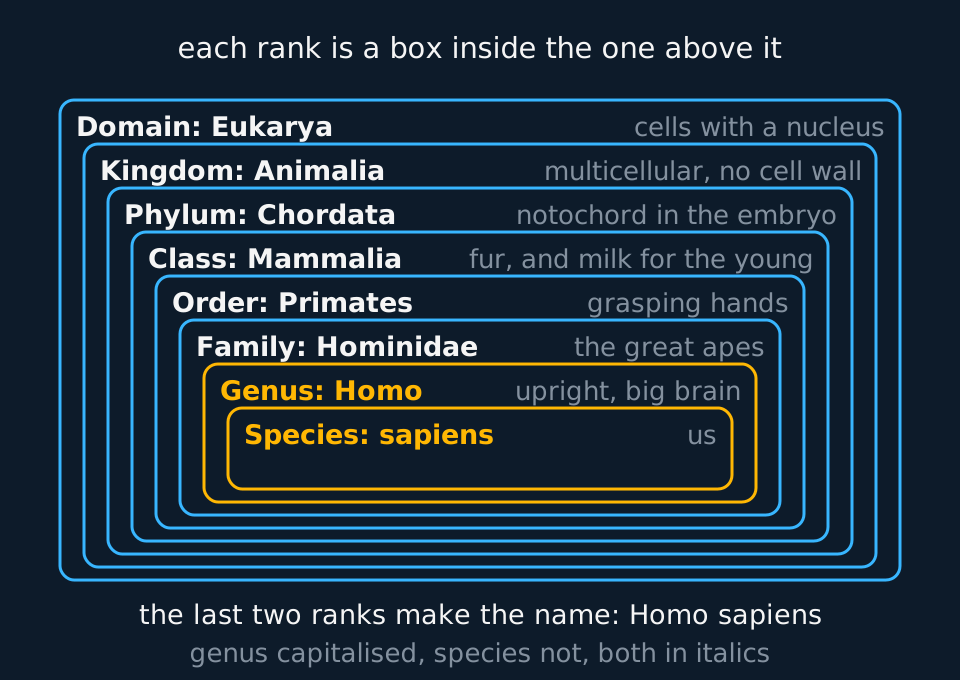
Describe the drawing
Eight rectangles drawn one inside another, each labelled with a taxonomic rank and the group a human belongs to at that rank: domain Eukarya, kingdom Animalia, phylum Chordata, class Mammalia, order Primates, family Hominidae, genus Homo, species sapiens. A short note beside each rank gives the feature that rank picks out, and the two innermost boxes are highlighted as the binomial.
A species does not sit on its own. It is placed in a genus, the genus in a family, and so on up through eight ranks: domain, kingdom, phylum, class, order, family, genus, species. Botanists usually use division where zoologists use phylum.
Two features define the hierarchy. It is nested: every mammal is a chordate, every chordate is an animal, and there is no organism that belongs half to one class and half to another. And it has no overlap at a rank: nothing is in two orders. Both features follow from building groups by descent, because a lineage that has split does not rejoin.
- Taxonomy
- The naming and classifying of organisms into a hierarchy of groups.
- Taxon
- Any one group in the taxonomic hierarchy: Mammalia, Primates and Homo are all taxa.
- Binomial
- The two-part international name of a species: genus then specific name, italicised, genus capitalised.
- Phylogeny
- The evolutionary history of a group: which lineages split from which, and in what order.
Species concepts
The species is the only rank in the hierarchy that has been defined from first principles, and several definitions are in use. The one stated by AQA, Cambridge International and Pearson Edexcel Biology B, and assumed by the other mapped specifications, is the biological species concept: a group of organisms with similar characteristics whose members can breed with each other to produce fertile offspring.
The word fertile is doing the work. A horse and a donkey will breed and produce a mule, and the mule is almost always sterile, so horses and donkeys stay two species. Textbooks often add that members of a species occupy the same ecological niche; treat that as a common observation about species rather than part of the definition, which turns on interbreeding. In animals there is usually also a specific courtship behaviour, whether a display, a call, a scent or a dance, that lets a male and a female recognise a member of their own species, of the opposite sex, and in breeding condition. Courtship is one of the mechanisms that maintains reproductive isolation, and AQA examines it directly.
The concept has four limitations. It cannot be applied to organisms that do not reproduce sexually, which excludes bacteria and archaea and many protoctists and plants; prokaryote species are delimited instead by genome similarity, using thresholds that differ between groups and between methods rather than a single universal cut-off. It cannot be applied to fossils, which cannot be bred. It cannot resolve cases where populations form a chain around a barrier and neighbours interbreed while the two ends do not. And a substantial number of species hybridise successfully in the wild: polar and brown bears do, as do many flowering plants, in which new species have arisen from hybrids doubling their chromosomes.
The concept remains the standard definition. A question asking for a limitation is asking for one of the four situations above, and which populations count as one species can depend on the operational concept applied.
Phenetic and phylogenetic classification
A classification can be built by grouping organisms by how much they resemble one another, counting the features they share and placing the most similar together. That is a phenetic classification, and it is what Linnaeus was doing. It requires no theory of ancestry, and it has one systematic weakness.
A dolphin is streamlined, has a dorsal fin and flippers, and lives its whole life in the sea, exactly like a shark. A bat has wings and flies, exactly like a swift. A cactus and a euphorbia are both fat, spiny, green-stemmed desert plants that look almost identical, and they belong to families that are not closely related. In each case the resemblance is convergent evolution: unrelated lineages under the same selection pressure arriving at similar structures. Grouping by resemblance places the dolphin with the shark.
- Phenetic classification
- Grouping organisms by observable similarity, without regard to how they are related.
- Phylogenetic classification
- Grouping organisms so that each group contains a common ancestor and all of its descendants.
- Homologous structures
- Structures with the same underlying plan, inherited from a common ancestor, whatever they are now used for.
- Analogous structures
- Structures with the same function and different origins, produced by convergent evolution.
The resolution is to compare the underlying structure rather than the overall resemblance. A dolphin's flipper contains one upper arm bone, two forearm bones, a set of wrist bones and five digits: the pentadactyl limb, the same plan as a bat's wing, a horse's leg and your hand. A shark's fin has nothing of the kind. The flipper and the wing are homologous; the flipper and the shark fin are analogous. Homology is evidence of common ancestry; analogy is evidence of similar selection pressures.
A phylogenetic classification uses homology and excludes analogy. Each group it recognises is a complete section of the evolutionary tree: a common ancestor together with every descendant of that ancestor, and nothing else. On that criterion 'reptiles' is not a valid group. The ancestor of crocodiles and lizards also gave rise to birds, so a group containing the reptiles but excluding the birds omits part of the ancestor's descendants.
The three domains
For most of the twentieth century the top-level division was between prokaryotes and eukaryotes: cells without a nucleus, and cells with one. The five-kingdom scheme that grew out of Whittaker's 1969 proposal, with Prokaryotae (his Monera), Protoctista, Fungi, Plantae and Animalia, placed every organism without a nucleus in a single kingdom, on the evidence then available from microscopy.
Comparisons of small-subunit ribosomal RNA helped establish Bacteria, Archaea and Eukarya as three distinct domains. Domains and kingdoms are both taxonomic groupings informed by evolutionary relationships; the traditional kingdom Prokaryotae spans organisms now placed in two domains.
From the 1970s Carl Woese compared the base sequence of the RNA in the small subunit of the ribosome, 16S rRNA in prokaryotes and 18S in eukaryotes, across a wide range of organisms. The comparison separated the prokaryotes into two groups whose rRNA sequences differed substantially from each other. In 1990 Woese, Kandler and Wheelis proposed a rank above kingdom, the domain, and three of them: Bacteria, Archaea and Eukarya.
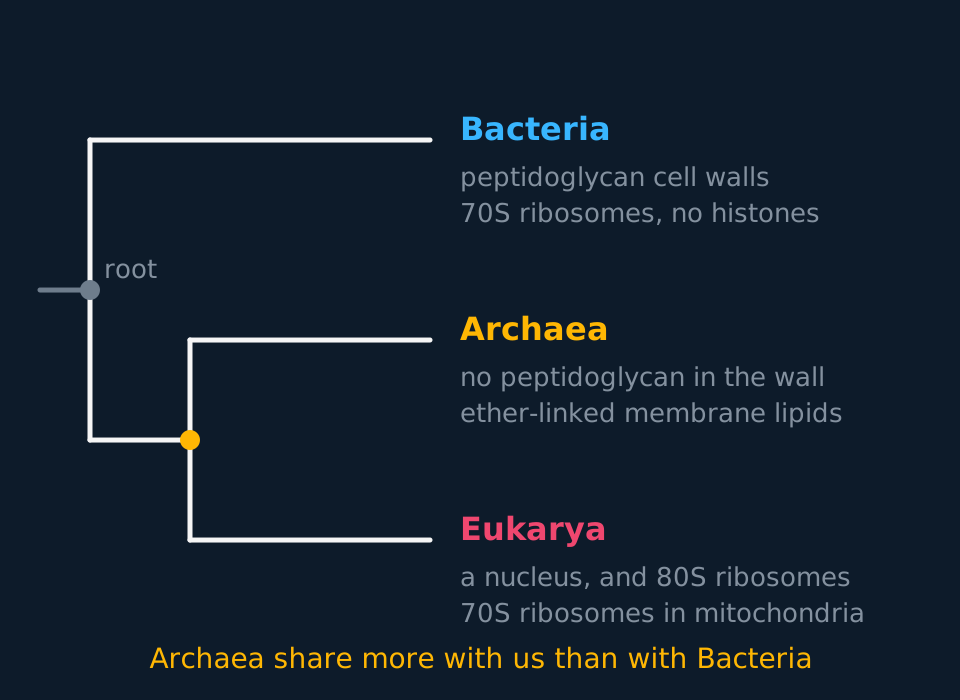
Describe the drawing
A rooted branching tree with three tips. The root divides first into the bacterial branch and second into a node, marked in amber, from which Archaea and Eukarya branch as a pair. Beside each tip are two lines of cell features: peptidoglycan walls and small ribosomes for Bacteria, ether-linked membrane lipids and histone-like proteins for Archaea, a nucleus and large ribosomes for Eukarya.
Ribosomal RNA was chosen for four reasons. Every cellular organism sequenced has ribosomes, so the same molecule can be compared across all cellular life. Its function, holding the ribosome together and positioning the tRNAs, is the same everywhere, so equivalent positions can be lined up against each other. Most of its sequence changes very slowly, because almost any change breaks a working ribosome, so it still carries a readable signal across billions of years. And it is long enough that the similarities are not coincidence.
Cell biology supports the split. Archaea are not a subgroup of bacteria; on several molecular features they resemble eukaryotes more closely than they resemble Bacteria.
| Bacteria | Archaea | Eukarya | |
|---|---|---|---|
| Cell wall | Peptidoglycan (murein) | No peptidoglycan; protein or pseudomurein | Cellulose or chitin where present; none in animals |
| Membrane lipids | Ester bonds, unbranched chains | Ether bonds, branched chains | Ester bonds, unbranched chains |
| Ribosomes | 70S | 70S | 80S, with 70S inside mitochondria and chloroplasts |
| DNA packaging | No histones | Histone-like proteins in most | Histones |
| RNA polymerase | One, few subunits | One, many subunits, resembling the eukaryotic enzymes | Three, many subunits |
| Introns | Very rare | Present in some genes | Common |
| Antibiotics such as streptomycin | Growth inhibited | Not inhibited | Not inhibited |
Exam-board note. AQA names domain as the top rank of its hierarchy but states that recall of the three-domain and five-kingdom systems will not be required. OCR Biology A lists the five kingdoms and the three-domain revision, and can require a comparison of them. Cambridge International 9700 lists three domains with the eukaryotic kingdoms beneath them. In each case a classification is a hypothesis about ancestry, and new evidence can revise it.
Woese's proposal also shows how a new classification comes to be accepted, which both Pearson Edexcel specifications examine. His sequence comparisons were published in scientific journals after peer review, in which other specialists check the methods and the reasoning before a paper appears. Publication let other laboratories test the claim, and the three domains were argued over at scientific conferences, where some prominent biologists rejected them. The model became the accepted view because independent groups, comparing other genes and proteins, kept finding the same three-way split.
Viruses sit outside the whole arrangement. They are not cells, they have no ribosomes and therefore no ribosomal RNA to compare, and they carry out no metabolism of their own, so the molecule that built the tree cannot place them on it. They are classified by their own scheme, based on the kind of nucleic acid they carry and how they replicate it.
Molecular evidence of relatedness
Anatomical comparison has limits: prokaryotes offer few distinguishing structures, and whether a structure is homologous can be disputed. Molecules provide sequences of discrete units that can be counted, so relatedness can be quantified.
DNA base sequence. The direct comparison. Align the same gene from two species and count the positions where the bases differ. Fewer differences means less time has passed since the two lineages separated, because mutations accumulate steadily once two populations stop exchanging genes. Whole-genome comparison is now routine and has rearranged several parts of the tree.
DNA hybridisation. The older technique, still examined. Heat DNA from two species so the strands separate, mix them, and let hybrid double strands form. The more similar the sequences, the more hydrogen bonds hold the hybrid together, and the higher the temperature needed to separate it again.
Amino acid sequence. Compare the same protein, of which cytochrome c and the haemoglobin chains are the standard examples, and count the positions that differ. This is a slightly blunter tool than DNA comparison, because the genetic code is degenerate: a base can change without changing the amino acid, so some differences are invisible at the protein level.
Gel electrophoresis. The same gene, or the same stretch of DNA, from several species is cut with the same restriction enzyme and the fragments are separated by length on a gel, as in DNA profiling. A difference in base sequence can remove a restriction site or create one, so each species gives its own pattern of bands. Species whose patterns share more bands have more similar sequences and are more closely related, and a sample whose pattern matches none of the known species may belong to a separate one.
Immunological comparison. Inject a rabbit with human blood serum. The rabbit makes antibodies against the human proteins, and the serum containing those antibodies is collected. Now add that antiserum to serum from another species: the antibodies bind wherever the other species' proteins are similar enough to human ones, and the amount of precipitate formed measures how similar they are. More precipitate means a closer relative. The numbers below are idealised to show the pattern rather than taken from a particular study.
| Serum tested against anti-human antiserum | Precipitate, as a percentage of the human result |
|---|---|
| Human | 100 |
| Chimpanzee | 95 |
| Gorilla | 92 |
| Baboon | 78 |
| Lemur | 45 |
| Pig | 10 |
Molecular clocks. If substitutions accumulate at a roughly steady rate in a given molecule, then the number of differences between two species is a measure of the time since they diverged. Calibrate the rate against a split whose date is known from the fossil record, and the same molecule will date splits that left no useful fossils.
Dating a split with a molecular clock
Two mammals, P and Q, are known from the fossil record to have diverged 30 million years ago. A protein 120 amino acids long differs at 6 positions between them. The same protein differs at 9 positions between two other mammals, X and Y. Estimate when X and Y diverged, and state two assumptions you have made. The counts are idealised.
Show the working
Calibrate first. P and Q have accumulated 6 differences in 30 million years, so the rate is 6 ÷ 30 = 0.2 amino acid differences per million years of divergence.
Apply it. X and Y differ at 9 positions, so the time since they diverged is 9 ÷ 0.2 = 45 million years.
State the assumptions. The calculation assumes that the protein changes at the same rate in all four lineages, and that the rate has been constant over the whole 45 million years. It also assumes that each observed difference represents one substitution. If a position has changed twice, or changed and reverted, the count is an underestimate, and the underestimate increases with the age of the split. Molecular clock estimates are therefore more reliable for recent divergences than for ancient ones.
The calculation estimates elapsed time. It does not rank either species as more or less advanced.
Interpreting a cladogram
A cladogram is a diagram of branching order. Each line is a lineage, each fork is a point where one ancestral population split into two that stopped interbreeding, and each tip is a taxon. A clade is any fork together with everything above it: an ancestor and all of its descendants.

Describe the drawing
A cladogram of five animals (lamprey, salmon, frog, lizard and mouse) built up in five steps. It begins as a single node with five branches leaving it, because no character has been used yet. Adding jaws splits the lamprey off first. Adding four limbs splits the salmon off next. Adding the amniotic egg splits the frog off and leaves lizard and mouse as a pair, which resolves the tree completely. The final step marks each character with an amber dot on the branch where it appears and draws a dashed line through all five tips to show that every one of them is living now, so no tip descends from another.
The tree is built from shared derived characters: features that are new in a group and inherited from that group's common ancestor. Jaws are a shared derived character of everything except the lamprey in that animation; four limbs are a shared derived character of the tetrapods; the amniotic egg, with its membranes that let an egg be laid on dry land, is shared by lizard and mouse. Analogous characters, such as the streamlining of a dolphin and a shark, are excluded.
A cladogram asserts three things. It asserts the order of branching: which lineages separated before which. It asserts common ancestry at every fork. It asserts a set of nested groups.
It does not assert the following. It does not say how long each branch is in years unless the diagram is explicitly drawn to a time scale. It does not say how much change happened along a branch. A lineage may have changed enormously or hardly at all. It does not say that any tip is descended from any other tip; all five animals in that animation are alive now, and none of them is the ancestor of the others. And it carries no direction of improvement. The two branches at any fork can be exchanged without changing what the tree asserts, so the order of the tips along the bottom of the diagram carries no information. One further limitation: the diagram is strictly branching, so it cannot record hybridisation or, in prokaryotes, horizontal gene transfer, both of which reconnect lineages the tree shows as separate.
A cladogram does not rank living species as more or less evolved. Every extant species has a continuous line of ancestors extending back through the same elapsed time. A modern fish is not a human ancestor; humans and modern fish share an ancestral population further back in time.
TRY IT: Four statements about one cladogram
Using the resolved tree in the animation above, with lamprey, salmon, frog, lizard and mouse, decide whether each statement is supported, and say why.
(a) The lizard and the mouse share a more recent common ancestor with each other than either does with the frog.
(b) The mouse evolved from the lizard.
(c) The salmon has changed less since the tetrapods split off than the mouse has.
(d) Lampreys are more primitive than salmon.
Check your answer
(a) Supported. Lizard and mouse meet at a fork above the fork that the frog joins, so their most recent common ancestor is younger than the one they share with the frog. Branching order is what a cladogram asserts.
(b) Not supported. Both are tips. A tip is a living taxon, not an ancestor. Their common ancestor sits at the fork between them and was neither a lizard nor a mouse.
(c) Not supported. The diagram carries no information about amount of change; branch length here is drawn for legibility. Fossil or sequence evidence would be needed to compare rates of change.
(d) Not supported. Lampreys branch off earlier, which states when their lineage separated. They have been evolving for the same elapsed time as every other tip on the diagram and are highly specialised. Use 'branches off earlier', which describes the tree, rather than 'primitive', which does not.
In the exam
- Apply the binomial conventions in every answer: capital for the genus, lower case for the specific name, italics or underlining for both.
- Where a question asks why a classification changed, name the evidence. State that comparison of ribosomal RNA base sequences separated Archaea from Bacteria, rather than referring to 'new technology'.
- For a limitation of the biological species concept, take one situation and explain it: asexual reproduction, fossils, ring species, or fertile hybrids. One explained limitation answers the question; four named and none explained does not.
- Give the assumptions with a molecular clock calculation: a constant rate of substitution, and one observed difference per substitution.
- Avoid 'more evolved', 'higher' and 'more advanced' for a living organism. Use 'branched off earlier' or 'shares a more recent common ancestor with', which state what the tree shows.
- Where a question asks what a cladogram shows, answer with branching order and common ancestry, and do not infer elapsed time or amount of change.
Check yourself
A student writes: 'Whales are more closely related to fish than to cows, because whales and fish both live in water, have streamlined bodies and swim using fins.' Explain what is wrong with the reasoning, and describe two kinds of evidence that would settle the question.
Answer
The reasoning is phenetic: it groups by resemblance without asking where the resemblance came from. Streamlining, fins and an aquatic life are what any large animal that hunts in open water ends up with, whether it started as a fish or as a land mammal. They are analogous features produced by convergent evolution, and analogy is evidence of a shared problem rather than a shared ancestor.
Comparison of the underlying structures reverses the conclusion. A whale's flipper contains the pentadactyl limb, with one upper arm bone, two forearm bones, wrist bones and five digits, which is homologous with the limb of a cow, a bat and a human, and has no counterpart in a fish's fin. Whales also have lungs, a four-chambered heart, hair and mammary glands.
First kind of evidence: compare base sequences. Sequence the same gene, or the whole genome, in a whale, a cow and a fish and count the differences. The whale and the cow come out far closer, and in fact the closest living relatives of whales are hippopotamuses.
Second kind: compare proteins, either by counting differences in the amino acid sequence of a protein such as cytochrome c or haemoglobin, or by an immunological test in which antiserum raised against whale serum proteins gives far more precipitate with cow serum than with fish serum.
Both kinds of evidence count differences in molecules that all three animals possess, so neither is affected by convergent adaptation to an aquatic habitat.
Questions
Question 15 marks
A protein 200 amino acids long is compared between two primate species and found to differ at 3 positions. The same protein is compared between one of those species and a rodent, and differs at 46 positions. Calculate the percentage sequence identity in each comparison, and state what the two percentages suggest about which pair of species is more closely related.
Mark scheme
- M1 percentage identity = (number of positions unchanged ÷ total positions) × 100, using unchanged = total − differences
- A1 primate pair: (200 − 3) ÷ 200 × 100 = 98.5 per cent identical
- M1 rodent comparison: (200 − 46) ÷ 200 × 100
- A1 77 per cent identical
- B1 the primates, with far higher sequence identity, are the more closely related pair, since fewer amino acid differences have accumulated since they last shared a common ancestor
Question 24 marks
Explain why grouping organisms by how similar they look places a dolphin with a shark, and explain how homologous structures avoid that error.
Mark scheme
- B1 a phenetic classification counts observable resemblances without asking where the resemblance came from
- B1 unrelated lineages exposed to the same selective pressure end up with similar features, so a dolphin and a shark are both streamlined with fins because both hunt in open water; that is convergent evolution and the structures are analogous
- B1 a dolphin's flipper contains the pentadactyl limb: one upper arm bone, two forearm bones, wrist bones and five digits. That is the same plan as a bat's wing and a human hand, while a shark's fin has nothing of the kind
- B1 a shared underlying plan is homologous and can only be explained by inheritance from a common ancestor, so a phylogenetic classification uses homology as evidence of ancestry and discards analogy
Question 34 marks
Two bird species are known from the fossil record to have diverged 12 million years ago, and a protein 150 amino acids long differs at 4 positions between them. The same protein differs at 7 positions between two other bird species. Calculate the rate of change and estimate when the second pair diverged. The counts are idealised.
Mark scheme
- M1 calibrate first: rate = number of amino acid differences divided by the time since divergence, using the pair whose date is known
- A1 4 ÷ 12 = 0.33 amino acid differences per million years
- M1 time since divergence = number of differences divided by that rate, kept unrounded: 7 ÷ (4 ÷ 12)
- A1 21 million years; accept 21.2 from a rate rounded to 0.33
Question 44 marks
Compare the cell walls and the membrane lipids of Bacteria and Archaea, and compare how each domain responds to the antibiotic streptomycin.
Mark scheme
- B1 Bacteria have a cell wall containing peptidoglycan, whereas Archaea have no peptidoglycan in their walls, instead having wall material such as protein or pseudomurein
- B1 the membrane lipids of Bacteria are joined to glycerol by ester bonds and form unbranched chains, whereas those of Archaea are joined by ether bonds and form branched chains
- B1 growth of Bacteria is inhibited by streptomycin, whereas growth of Archaea is not inhibited by it
- B1 these differences show that although Bacteria and Archaea are both prokaryotes lacking a nucleus, they differ in fundamental aspects of cell chemistry, which is part of the evidence that they are not close relatives within a single group
Question 54 marks
Describe how the immunological comparison technique is carried out to compare how closely two species are related, using an anti-human antiserum as an example, and describe what a smaller amount of precipitate formed indicates.
Mark scheme
- B1 a rabbit is injected with human blood serum, and the rabbit's immune system makes antibodies against the human proteins in it; that antiserum is then collected
- B1 the anti-human antiserum is added to serum taken from another species, and if that species' proteins are similar enough to the human proteins, the antibodies bind to them and a precipitate forms
- B1 the amount of precipitate formed is measured, for example as a percentage of the precipitate formed when the antiserum is tested against human serum itself
- B1 a smaller amount of precipitate indicates that the tested species' proteins are less similar to the human proteins, and so indicates a more distant evolutionary relationship to humans
Question 64 marks
Explain why a group containing crocodiles and lizards but excluding birds is not a valid group in a phylogenetic classification.
Mark scheme
- B1 a phylogenetic classification requires each group it recognises to contain a common ancestor together with every one of that ancestor's descendants, and nothing else
- B1 the common ancestor of crocodiles and lizards is also the ancestor of birds, since birds branched from within that same lineage
- B1 a group made up of crocodiles and lizards but excluding birds therefore leaves out some of that ancestor's descendants, so it is not a complete section of the evolutionary tree
- B1 such a group is described as paraphyletic rather than as a valid, monophyletic, clade, which is why 'reptiles' defined that way is not used as a formal group in a phylogenetic classification
Question 74 marks
A student says that humans evolved from chimpanzees. Discuss whether a cladogram showing humans and chimpanzees as the two closest living relatives on the tree supports this statement.
Mark scheme
- B1 what the cladogram does support: humans and chimpanzees share a more recent common ancestor with each other than either does with any other living species, so of all living species chimpanzees are humans' closest relatives
- B1 against: both humans and chimpanzees are tips on the tree, meaning both are living species rather than ancestors, and a cladogram never asserts that one tip is descended from another
- B1 against: the actual common ancestor of humans and chimpanzees sat at the fork where the two lineages split, some millions of years ago, and was itself neither a human nor a chimpanzee as either exists today
- B1 judgement: 'humans evolved from chimpanzees' misreads the tree; the accurate statement is that humans and chimpanzees evolved from a shared ancestral population, with each lineage changing over the same elapsed time since the split, rather than one being derived from the other
Question 84 marks
A DNA base sequence comparison between two species finds more differences than an amino acid sequence comparison of the protein that DNA codes for. Suggest why the two methods can give different numbers of differences for what is ultimately the same gene.
Mark scheme
- B1 the genetic code is degenerate, so more than one triplet can specify the same amino acid
- B1 some of the base differences found between the two DNA sequences are therefore silent, changing the triplet but not the amino acid it specifies, so they leave the protein's amino acid sequence unaffected
- B1 the amino acid sequence comparison misses those silent differences, and so records fewer differences overall than a direct comparison of the DNA base sequence does
- B1 amino acid comparison is consequently the blunter of the two tools for measuring relatedness
Question 93 marks
Describe the evidence from ribosomal RNA that led to the prokaryotes being separated into two domains.
Mark scheme
- B1 the base sequence of the RNA in the small subunit of the ribosome was compared across as many organisms as could be obtained
- B1 the prokaryotes fell into two groups whose sequences differed from each other about as much as either differed from those of eukaryotes
- B1 that supported a rank above kingdom, the domain, with Bacteria, Archaea and Eukarya, and with Archaea sharing a more recent common ancestor with Eukarya than with Bacteria
Question 103 marks
Suggest why ribosomal RNA rather than haemoglobin was chosen as the molecule for comparing organisms drawn from all three domains.
Mark scheme
- B1 every organism that has been sequenced has ribosomes, so the same molecule can be compared right across life, whereas haemoglobin is present in only some animals
- B1 its job is the same in every organism, holding the ribosome together and positioning the tRNAs, so equivalent positions in the sequence can be lined up against one another
- B1 most of its sequence changes very slowly, because almost any change breaks a working ribosome, so a readable signal survives across billions of years, and it is long enough that the similarities are not coincidence
Question 113 marks
Explain the role that a specific courtship behaviour plays in keeping two closely related animal species reproductively isolated from each other.
Mark scheme
- B1 many animal species have their own specific courtship behaviour, such as a display, a call, a scent or a dance, that differs from the courtship behaviour of even closely related species
- B1 that behaviour lets an individual recognise a potential mate as being of its own species, of the opposite sex, and in breeding condition, before mating is attempted
- B1 individuals of two different species are therefore much less likely to mate with each other in the first place, which keeps the two gene pools separate even where the two species' ranges overlap
Question 122 marks
State the eight taxonomic ranks in order, beginning with the largest, and state the conventions for writing a binomial.
Mark scheme
- B1 domain, kingdom, phylum, class, order, family, genus, species
- B1 the genus takes a capital letter and the specific name does not, and both are printed in italics or underlined when written by hand
Question 132 marks
Give two situations in which the biological species concept cannot be applied, and give the reason in each case.
Mark scheme
- B1 organisms that do not reproduce sexually, such as bacteria and archaea, never interbreed at all, so the test cannot be carried out and prokaryotes are grouped instead by how similar their genomes are
- B1 fossils cannot be bred, so the interbreeding test cannot be applied to them and the species are assigned from morphology instead
Question 142 marks
State what is meant by describing the taxonomic hierarchy as nested, and state what is meant by saying it has no overlap at a rank.
Mark scheme
- B1 nested means every group at one rank sits inside exactly one group at the rank above, so every organism in a lower taxon belongs wholly to one higher taxon rather than partly to more than one
- B1 no overlap at a rank means no organism belongs to two different groups at the same rank, such as two different orders, at the same time
Question 152 marks
Give two further situations, beyond asexual organisms and fossils, in which the biological species concept is difficult to apply, and give the reason in each case.
Mark scheme
- B1 a ring species: where a chain of populations runs around a geographical barrier and neighbouring populations along the chain can interbreed, but the two ends of the chain meet and cannot, so no single boundary can be drawn between one species and two
- B1 species that hybridise successfully in the wild, such as polar bears and brown bears or many flowering plants, since the concept assumes fertile offspring do not occur between different species
Worth remembering
- Domain, kingdom, phylum, class, order, family, genus, species: nested, with no overlap at any rank.
- Binomial: genus capitalised, specific name not, both italicised or underlined.
- Homologous means same plan, different job, and is evidence of ancestry. Analogous means same job, different plan, and is evidence of convergence.
- The three domains came from comparing small-subunit ribosomal RNA, and Archaea are closer to Eukarya than to Bacteria.
- A cladogram claims branching order and common ancestry. It does not claim time, amount of change, or progress.
CHECK YOUR PROGRESS
Rate how confident you are with each objective for this lesson. Ratings are saved in this browser, on this device, unless you sign in.
- Write the eight taxonomic ranks in order and name a group at each rank for a named organism.
- Write a binomial correctly and say what each part of it means.
- State the biological species concept and give two situations it cannot handle.
- Distinguish a phenetic from a phylogenetic classification, and explain why convergent evolution defeats the first.
- Describe the evidence from ribosomal RNA that split the prokaryotes into two domains.
- Explain how DNA sequences, amino acid sequences and immunological comparisons are used to estimate how closely two species are related.
- Read a cladogram: say what it asserts, and say what it does not.
Open the full revision checklist to see every objective in the curriculum in one place.
Practise this lesson
WORKBOOK
The questions from this topic, on paper with room to work, and a separate book of mark schemes. Free to use; please do not redistribute or sell.