Biology › Gene regulation, genomics and biotechnology › Industrial biotechnology and fermentation
Industrial biotechnology and fermentation
Microorganisms are cultured industrially because they grow rapidly on relatively simple feedstocks and can be selected or modified for high product yield. Microorganisms as human food, the stirred-tank fermenter as a controlled environment, and the choice between batch and continuous culture are covered here.
Before this The closed-culture growth curve: lag, log, stationary, death · Immobilised enzymes and why industry uses them · Aseptic technique when culturing microorganisms · Factors affecting enzyme rate
COMMON MISCONCEPTION
A fermenter is a big brewing vat: tip in the microorganisms and the sugar, seal the lid, and come back when it is done.
A fermenter monitors and controls asepsis, temperature, pH, aeration, mixing and nutrient supply. Cooling removes heat released by respiration, while sterile air and stirring maintain oxygen availability. Loss of control can reduce yield or contaminate the culture.
What you should be able to do
- Give the reasons industry grows microorganisms rather than farming a plant or an animal for the same product.
- Set out the arguments for and against using microorganisms as human food, with mycoprotein as the named example.
- Name the parts of a stirred-tank fermenter and explain why each condition inside it has to be controlled.
- Distinguish batch from continuous fermentation on the closed-culture growth curve, and state which part of the curve each uses.
- Match a product to the method that suits it, using primary and secondary metabolites.
Why industry cultures microorganisms
Microorganisms are used in industrial biotechnology because they grow rapidly, can be cultured at high density, use relatively simple feedstocks and can be selected or genetically modified for a high product yield. Production in a fermenter allows temperature, pH, aeration, mixing, nutrients and contamination risk to be monitored and controlled. It is less dependent on season than agriculture, although energy, water, feedstock and infrastructure still affect cost and performance.
Generation time accounts for the rate. A cow doubles its numbers in years, a fungus in hours, and a bacterium such as E. coli, given warmth and nutrients, in about twenty minutes.
The remaining reasons are distinct from speed and from each other. Microorganisms use low-cost substrates: many grow on by-products of other industries, whey from cheese-making, molasses from sugar refining, straw and paper pulp, which are cheaper than purpose-grown feedstocks and in some cases carry a disposal cost for the producer. Culture conditions are set inside the vessel rather than by the weather, so production does not depend on season, though it does depend on local energy, water and infrastructure. The organisms raise no animal-welfare objections of the kind livestock farming does. And their genomes are small and readily altered, so a strain can be improved by selection over a few weeks, or transformed with a human gene, which is how recombinant insulin is manufactured at scale.
- Biotechnology
- The use of living organisms, usually microorganisms, or of their components such as enzymes, in industrial processes that make useful products.
- Fermentation (industrial)
- The large-scale culture of microorganisms in a fermenter to make a product. The industrial word covers aerobic processes as well as the anaerobic pathway the respiration unit gave the same name.
The word 'fermentation' has two meanings. In respiration, fermentation is the anaerobic regeneration of NAD. In industry, a fermentation is any large-scale culture with a product at the end, and most of them, penicillin and mycoprotein included, are aerated. The industrial term identifies a vessel of microorganisms and does not indicate whether oxygen is involved.
The products span every unit of this course: yoghurt, cheese and bread from traditional fermentations; ethanol for fuel as well as for drink; enzymes such as the proteases in washing powder and the lactase and glucose isomerase you met immobilised; antibiotics; and human proteins from transformed cells. Two of those categories, food and medicines, are treated in the sections below.
Microorganisms as human food
Most industrial biotechnology sells a product made by a microorganism. The microorganism itself is also sold, dried and flavoured, as protein-rich food, called single-cell protein whether or not the producer organism is single-celled.
The example on British shelves is mycoprotein: the hyphae of the fungus Fusarium venenatum, grown continuously on glucose syrup with ammonia as the nitrogen source, harvested, heat-treated and pressed into a food that has been sold since the 1980s. The fibrous hyphae matter as much as the protein: they give a texture close enough to muscle for the product to stand in for meat, which yeast or bacterial cells, being small and round, cannot do.
| For microorganisms as food | Against |
|---|---|
| Protein produced in days, in a small building, all year round | The product has little taste of its own, so flavour and colour must be manufactured into it |
| Grown on low-cost substrates, including by-products of other industries | Consumer acceptance is uneven, and accurate labelling of the organism and substrate can reduce sales |
| High in protein and fibre, low in fat, with no cholesterol | Microbial cells are rich in nucleic acid, which must be reduced during processing because its breakdown product, uric acid, can cause gout |
| No animal is reared or slaughtered, and far less land and water are used per kilogram of protein | The culture must be kept sterile and precisely controlled, so the plant is expensive to build and to run, and a contaminated batch is a food-safety failure rather than a nuisance |
- Single-cell protein
- Protein-rich food produced from cultured microorganisms, eaten by humans or fed to livestock.
- Mycoprotein
- Single-cell protein made from the hyphae of the fungus Fusarium venenatum, grown in continuous culture and textured to resemble meat.
Set the argument out on both sides, and attach each point to a mechanism. 'It is unnatural' names no process; 'the nucleic acid content must be lowered because its breakdown product uric acid can cause gout' does.
The stirred-tank fermenter: a controlled environment
A stirred-tank fermenter is a stainless steel vessel, from bench size up to hundreds of thousands of litres, designed to hold a large volume of nutrient medium at the optimum conditions for one organism's enzymes while excluding other organisms.
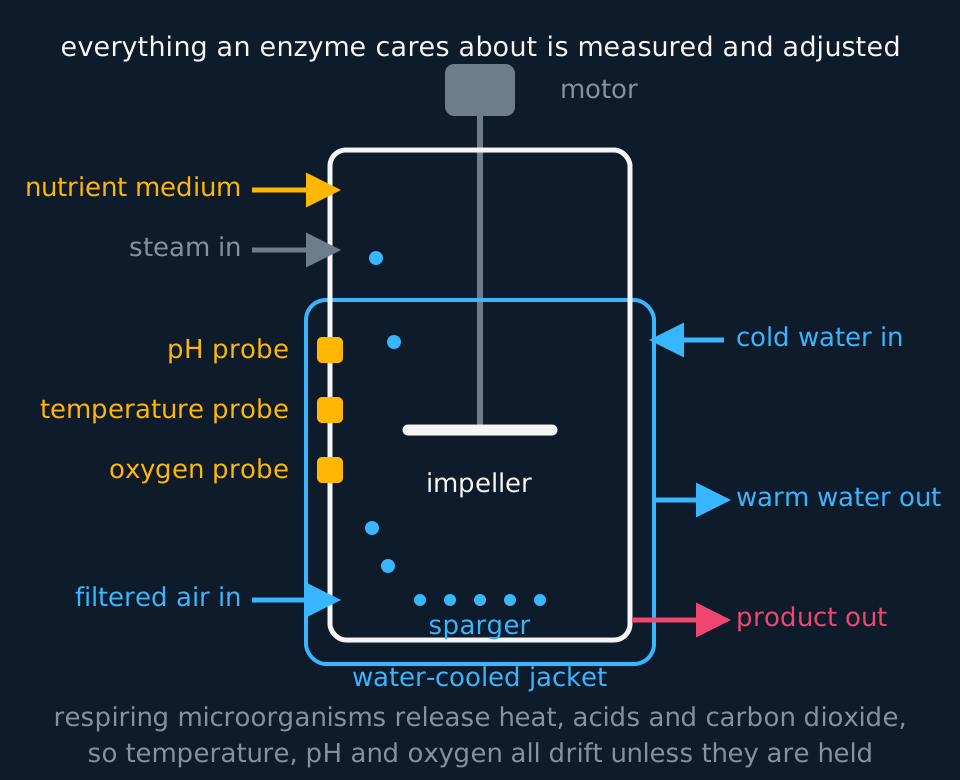
Asepsis first. The vessel is sterilised with pressurised steam between runs, the medium is sterilised before it enters, and the air is passed through filters fine enough to strip bacteria and spores. The reason is competitive: a contaminating organism consumes the substrate, may out-grow the production strain, may degrade the product, and in a food or medicine makes the batch unsellable in any case. Aseptic technique at industrial scale uses the same principles as laboratory practice, with steam sterilisation in place of a flame.
The conditions controlled are those affecting enzyme rate. A dense culture respires rapidly and respiration releases heat, so an uncooled fermenter warms past its own optimum and the enzymes denature: water circulating through the cooling jacket carries that heat away, holding the culture at its optimum temperature. Metabolism also shifts pH, since carbon dioxide and organic acids accumulate, so a pH probe monitors the broth and alkali or acid is metered in to hold the optimum. Aerobic cultures consume oxygen faster than it dissolves, so sterile air is forced in through a sparger, a ring of fine holes near the bottom, and the impeller above it breaks the rising bubbles up and keeps organisms, nutrients, heat and oxygen evenly mixed, so no part of the tank becomes a stagnant corner running anaerobic. Nutrients are added, the exhaust gas escapes through a filter, and probes report continuously so that each variable is corrected as it departs from its set point, which is negative feedback.
- Fermenter
- A vessel in which microorganisms are cultured at large scale under controlled conditions of temperature, pH, oxygen and nutrient supply.
- Aseptic conditions
- Conditions from which unwanted microorganisms are excluded, achieved in a fermenter by steam-sterilising the vessel and medium and filtering the incoming air.
Batch and continuous fermentation
Prerequisite: the closed-culture growth curve, covered in populations and their limits. It has a lag phase while the population adjusts and synthesises the enzymes its new medium requires, an exponential (log) phase of doubling while nothing limits growth, a stationary phase when nutrients run short and wastes accumulate so deaths balance divisions, and a death phase when deaths exceed divisions. The two ways of running a fermenter operate at different points on that curve.
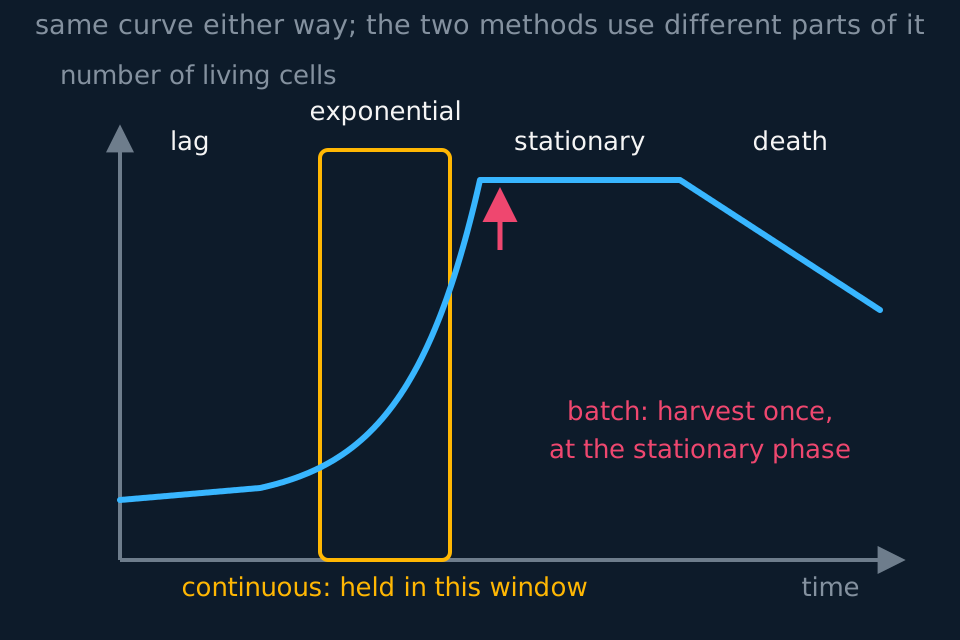
Batch fermentation is a closed culture. The vessel is filled with sterile medium, inoculated, sealed, and left to run through the curve; at the end, usually early in the stationary phase, the whole tank is harvested, emptied, sterilised and set up again. Nothing is added during the run except air and pH correction, so the culture visits every phase the growth curve has.
Continuous fermentation is an open one. In a chemostat, fresh medium enters and culture leaves at the same rate. A limiting nutrient and the dilution rate control growth, allowing a steady state to be maintained without passing through a complete batch growth curve. Nutrient supply and waste removal are balanced against consumption and production rather than being unlimited, and the population grows at a constant rate set by the dilution rate for weeks or months.
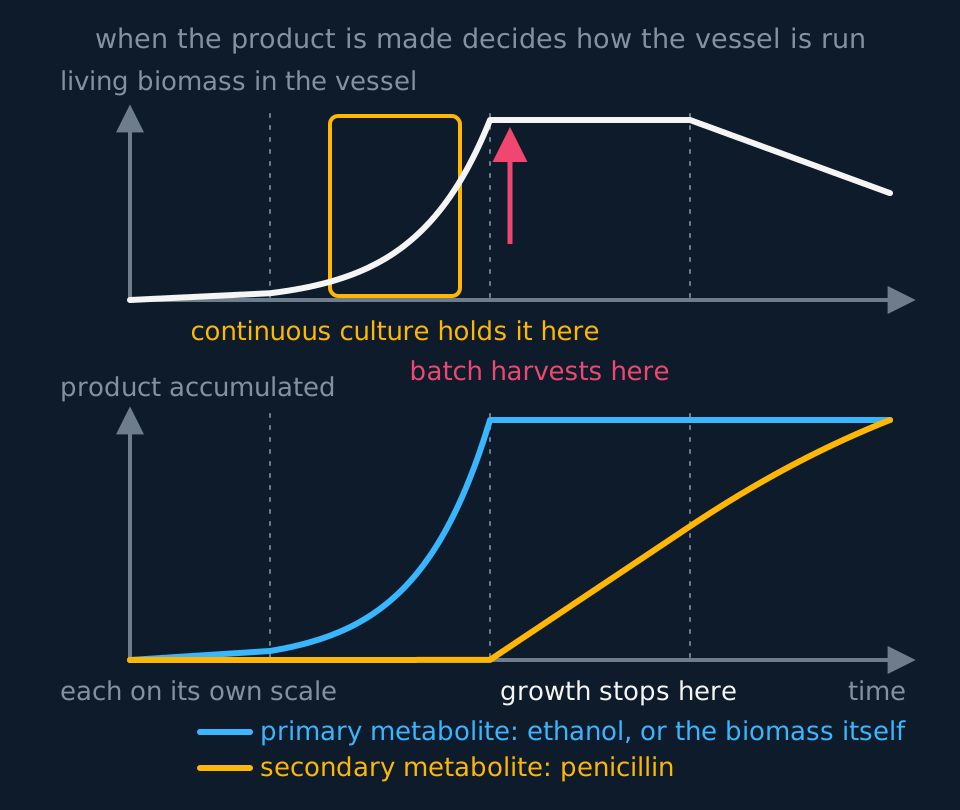
Which to choose turns on when the product is made, and the pair of terms that captures it is examined by name. A primary metabolite is made during normal growth, as part of it: ethanol, biomass itself, most enzymes. A secondary metabolite is made when growth slows, typically as the culture enters the stationary phase; penicillin is the standard example, an antibiotic that inhibits the mould's competitors under crowded, nutrient-limited conditions. A product made during growth suits a continuous process that maintains growth; a product made when growth slows is produced in batch, because a continuous culture in steady state does not reach the stationary phase.
| Batch | Continuous | |
|---|---|---|
| The culture | Closed: nothing added after the start | Open: medium in and culture out at matching rates |
| Phase used | The whole curve, harvested at stationary | Held in the exponential phase |
| Harvest | Once per run, then clean out and restart | Continuous draw-off, for weeks at a time |
| If contamination gets in | One batch is lost | A long production run is lost |
| Rate of production | Lower: the vessel spends time in lag, harvest and cleaning | Higher: the vessel is always at peak output |
| Suits | Secondary metabolites such as penicillin | Biomass and primary metabolites, such as mycoprotein |
Choosing the method from the product
A company makes two products: penicillin, and mycoprotein for food. State, with reasons, which fermentation method suits each.
Show the working
Penicillin is a secondary metabolite: the mould makes very little of it while nutrients are plentiful and growth is fast, and switches to making it as the culture crowds and enters the stationary phase. A continuous culture in steady state does not reach that phase, so it would produce mould biomass and little antibiotic. Penicillin is therefore made in batch: the culture grows, becomes nutrient-limited, the drug is harvested, and the vessel is cleaned and restarted.
Mycoprotein is the opposite case, because the product is the organism. Biomass accumulates fastest while the culture is in exponential growth, so the process should hold it there for as long as engineering allows: continuous culture, with hyphae drawn off at the same rate the fungus replaces them, running for weeks between shutdowns.
The criterion is when the product is made. If it is made during growth, use continuous culture; if it is made as growth slows, use batch culture.
In the exam
- Give distinct reasons for using microorganisms: fast growth, low-cost or by-product substrates, conditions set inside the vessel rather than by season, no animal-welfare issues, and ease of genetic modification.
- Attach a reason to every fermenter feature: the jacket removes the heat respiration releases, the impeller distributes oxygen and nutrients, the sparger supplies oxygen for aerobic respiration, and asepsis excludes competing organisms.
- Give the reason temperature and pH are controlled: each enzyme has an optimum, and departures from it reduce the rate or denature the enzyme.
- Answer batch against continuous on the growth curve: batch harvests at the stationary phase, continuous holds the culture in the exponential phase at a rate set by the dilution rate. Name the phases.
- Penicillin is made in batch because it is a secondary metabolite; mycoprotein is made continuously because the product is the growing biomass.
- In an evaluation of microorganisms as food, argue both ways and give a mechanism for each point: nucleic acid content must be lowered because its breakdown product uric acid can cause gout.
Check yourself
A manager proposes converting the company's penicillin plant from batch to continuous fermentation, arguing that continuous culture produces more product per litre per day and wastes no time on emptying and cleaning. Evaluate the proposal, and state what would happen to penicillin yield if it went ahead.
Answer
The manager's general premise holds and does not apply to this product. Continuous culture does keep a vessel at high output with no downtime, which is why mycoprotein is made that way.
But it is productivity of biomass. Penicillin is a secondary metabolite: the mould synthesises it in quantity only as growth slows, when the culture is crowded and nutrients are running short, at the approach to the stationary phase. A continuous fermenter is operated so that the culture does not reach those conditions: medium is supplied and culture removed at matching rates, and the population is held in exponential growth at the dilution rate.
The converted plant would therefore produce a high yield of mould biomass and very little penicillin.
The recommendation is to reject the proposal for penicillin while retaining the principle behind it. Continuous methods suit products made during growth; batch methods suit products made as growth slows. The criterion is when the product is made.
Questions
Question 14 marks
Describe how the conditions inside a stirred-tank fermenter are held at the optimum for the production organism, naming the part of the fermenter responsible in each case.
Mark scheme
- B1 a dense culture respires hard and respiration releases heat, so water circulating through the cooling jacket carries that heat away and holds the optimum temperature
- B1 metabolism produces carbon dioxide and organic acids, so a pH probe monitors the broth and acid or alkali is metered in to hold the optimum pH
- B1 an aerobic culture uses oxygen faster than it dissolves, so sterile air is forced in through the sparger near the bottom of the vessel
- B1 the impeller breaks up the rising bubbles and keeps organisms, nutrients, heat and oxygen evenly mixed, so no part of the tank becomes a stagnant corner running anaerobic
Question 24 marks
Compare batch fermentation with continuous fermentation, referring to the closed-culture growth curve in your answer.
Mark scheme
- B1 batch culture is closed, with nothing added after inoculation, whereas continuous culture is open, with sterile medium flowing in and culture flowing out at matching rates
- B1 a batch culture passes through the whole curve and is harvested once, usually early in the stationary phase, whereas a continuous culture is held permanently in the exponential phase and never reaches stationary, because nutrients never run out and wastes never accumulate
- B1 batch production is slower overall, because the vessel spends time in lag phase, harvesting and cleaning, whereas a continuous vessel is always at peak output and runs for weeks
- B1 contamination costs a batch process one run, whereas it costs a continuous process a long production run
Question 34 marks
A company cultures a bacterium that secretes a new antibiotic only once the culture stops dividing. It also sells the bacterial biomass itself as animal feed. Suggest which fermentation method suits each product, and suggest why.
Mark scheme
- B1 the antibiotic is a secondary metabolite, made only as growth slows and the culture enters the stationary phase
- B1 it must therefore be made in batch culture, because a continuous culture is held in the exponential phase and never experiences the conditions that switch production on, so it would grow bacteria and make almost no antibiotic
- B1 the biomass is the product of growth itself, a primary product that accumulates fastest while the culture is growing exponentially
- B1 it therefore suits continuous culture, with cells drawn off as fast as they are replaced, so the vessel stays at peak output instead of losing time to harvesting and cleaning
Question 44 marks
A local authority proposes to replace part of the meat served in its school meals with mycoprotein. Evaluate this proposal.
Mark scheme
- B1 in favour: mycoprotein is produced in days in a small building all year round, on cheap substrates, and uses far less land and water per kilogram of protein than livestock, with no animal reared or slaughtered
- B1 in favour: the hyphae of Fusarium venenatum give a fibrous texture close enough to muscle to stand in for meat, and the product is high in protein and fibre, low in fat and free of cholesterol
- B1 against: the product has little taste of its own so flavour and colour must be manufactured into it, the cells are rich in nucleic acid whose breakdown product uric acid can cause gout so this must be reduced during processing, and some people are unwilling to eat a fungus grown on industrial glucose
- B1 a judgement supported by those points, for example that the nutritional and environmental case is strong provided the nucleic acid content is reduced and the food is labelled honestly, while accepting that the sterile, precisely controlled plant is expensive to build and a contaminated batch is a food-safety failure
Question 54 marks
Describe how mycoprotein is produced from Fusarium venenatum, from culture to finished food.
Mark scheme
- B1 the fungus is grown in continuous culture on glucose syrup, with ammonia supplied as the nitrogen source
- B1 the fungal hyphae are harvested continuously as the culture grows
- B1 the harvested biomass is heat-treated, partly to reduce its nucleic acid content
- B1 it is then pressed into a textured food product, the fibrous hyphae giving it a texture close enough to muscle to stand in for meat
Question 64 marks
Describe the four phases of the closed-culture growth curve that a batch fermentation passes through, in order.
Mark scheme
- B1 a lag phase, during which the population adjusts to the new medium and synthesises the enzymes it requires, so numbers barely rise
- B1 an exponential, or log, phase, during which nothing yet limits growth and the population doubles at a constant rate
- B1 a stationary phase, when a nutrient runs short or a waste product accumulates, so the rate of division comes to balance the rate of death and numbers level off
- B1 a death phase, when deaths exceed divisions and the population falls
Question 74 marks
A continuous fermenter has a working volume of 8000 dm³ and is run at a dilution rate of 0.15 per hour. Calculate the flow rate of fresh medium into the fermenter in dm³ per hour, and calculate how long it takes for a volume of medium equal to the whole vessel to pass through.
Mark scheme
- M1 dilution rate = flow rate ÷ culture volume, rearranged to flow rate = dilution rate × volume
- A1 0.15 × 8000 = 1200 dm³ per hour
- M1 time for one working volume to pass through = volume ÷ flow rate
- A1 8000 ÷ 1200 = 6.7 hours, which is about 6 hours 40 minutes
Question 84 marks
A small start-up proposes cutting costs by skipping the steam sterilisation of its fermenter medium, relying only on filtering the incoming air. Evaluate this proposal.
Mark scheme
- B1 for: filtering the incoming air does remove airborne bacteria and spores from that one contamination route, so some protection against contamination would remain
- B1 against: the growth medium itself, and the vessel and pipework, are further routes by which contaminating organisms can enter, and skipping medium sterilisation leaves those routes open
- B1 against: a contaminating organism can compete for the substrate, out-grow or degrade the product, and in a food or medicine renders the whole batch unsellable, so the saving from skipping one step could easily be outweighed by the cost of losing an entire batch
- B1 judgement: the proposal is not defensible as it stands, since the saving is small and the failure mode is a complete batch loss, though validating a shortened rather than an eliminated sterilisation cycle could be worth investigating
Question 93 marks
Explain why a fermenter must be run under aseptic conditions, and explain how those conditions are achieved at industrial scale.
Mark scheme
- B1 a contaminating organism competes for the substrate and may out-grow the production strain or destroy the product, and in a food or a medicine it renders the whole batch unsellable
- B1 the vessel is sterilised with pressurised steam between runs and the medium is sterilised before it enters
- B1 the incoming air is passed through filters fine enough to remove bacteria and spores, and every other inlet is treated as a contamination route and sterilised
Question 103 marks
A fermenter is inoculated with 5.0 × 10⁴ bacteria of a strain whose doubling time under these conditions is 20 minutes. Calculate the number of bacteria present after 4 hours of exponential growth.
Mark scheme
- M1 the number of divisions is the time divided by the doubling time, so 240 ÷ 20 = 12
- M1 the number present is the starting number multiplied by 2 raised to the number of divisions, so 5.0 × 10⁴ × 2¹²
- A1 2¹² is 4096, giving 2.05 × 10⁸ bacteria
Question 113 marks
Explain why microbial cells intended as human food have their nucleic acid content reduced during processing.
Mark scheme
- B1 microbial cells are proportionately much richer in nucleic acid than the cells of a plant or animal food source, because they are small and each one holds a full genome relative to its size
- B1 nucleic acid consumed in the diet is broken down, and one breakdown product is uric acid
- B1 a high intake of uric acid can cause gout, so the nucleic acid content of the harvested biomass must be lowered before it is sold as food
Question 123 marks
Compare the generation time of a bacterium such as Escherichia coli with that of a fungus and with that of a farm animal such as a cow, and compare the consequence each has for industrial production.
Mark scheme
- B1 a bacterium such as Escherichia coli can double its numbers in about twenty minutes given warmth and nutrients, whereas a fungus doubles over hours and a cow doubles its numbers over years
- B1 industrial biotechnology exploits this difference by culturing microorganisms rather than farming plants or animals, since a much larger yield can be obtained from a given starting culture in a much shorter time
- B1 generation time is one of several distinct reasons for using microorganisms, working alongside low-cost substrates, conditions set inside the vessel rather than by season, no animal-welfare objections and ease of genetic modification, rather than being the whole explanation on its own
Question 133 marks
Explain why the temperature and pH probes in a fermenter are described as providing negative feedback.
Mark scheme
- B1 each probe continuously measures a condition, temperature or pH, so that a departure from the optimum set point is detected
- B1 the fermenter's control system responds by correcting the departure, for example running more coolant through the jacket if the temperature rises, or metering in alkali if the pH falls
- B1 the correction acts to return the condition towards its original set point rather than push it further away, which is what makes the control negative feedback
Question 142 marks
Apart from their rapid growth, state two reasons why industry grows microorganisms rather than farming a plant or an animal for the same product.
Mark scheme
- B1 they are cheap to feed, because many grow on waste from other industries such as whey, molasses or straw
- B1 production is independent of climate and season, because the environment is made inside the vessel; or there are no welfare objections; or the genome is small and easily altered, so a strain is quickly improved
Question 152 marks
Name the fungus used to produce mycoprotein, and name the two substances supplied as its main carbon and nitrogen sources during culture.
Mark scheme
- A1 the fungus Fusarium venenatum
- A1 glucose syrup as the carbon source and ammonia as the nitrogen source
Worth remembering
- Industry cultures microorganisms because they grow fast on low-cost substrates under conditions set inside the vessel, without animal-welfare objections, and are readily modified.
- Mycoprotein: fungal hyphae grown continuously, protein-rich and meat-textured. Argue the food case on both sides, with mechanisms.
- A fermenter controls temperature, pH, oxygen and nutrients at an organism's optima, under aseptic conditions, with probes feeding back to each control.
- Batch culture runs through the whole growth curve and harvests at the stationary phase; continuous culture holds the exponential phase by matching inflow to draw-off, with growth set by the dilution rate and a limiting nutrient.
- Primary metabolites are made during growth and suit continuous culture; secondary metabolites, including penicillin, are made as growth slows and are produced in batch.
CHECK YOUR PROGRESS
Rate how confident you are with each objective for this lesson. Ratings are saved in this browser, on this device, unless you sign in.
- Give the reasons industry grows microorganisms rather than farming a plant or an animal for the same product.
- Set out the arguments for and against using microorganisms as human food, with mycoprotein as the named example.
- Name the parts of a stirred-tank fermenter and explain why each condition inside it has to be controlled.
- Distinguish batch from continuous fermentation on the closed-culture growth curve, and state which part of the curve each uses.
- Match a product to the method that suits it, using primary and secondary metabolites.
Open the full revision checklist to see every objective in the curriculum in one place.
Practise this lesson
WORKBOOK
The same questions as the player, on paper with room to work, and a separate book of mark schemes. Free to use; please do not redistribute or sell.