Biology › Biological molecules, water and inorganic ions › Water and inorganic ions
Water and inorganic ions
The biological properties of water follow from the polarity of the molecule and the hydrogen bonding it allows: solvent action, high specific heat capacity, high latent heat of vaporisation, cohesion and the lower density of ice. Inorganic ions dissolved in that water each have a named job, such as iron in haemoglobin and phosphate in ATP and DNA.
Before this Covalent bonding and the idea of a charged ion · Condensation and hydrolysis
COMMON MISCONCEPTION
Water is a good solvent because it is a liquid, so things can move about in it.
Being liquid is not enough: shake sugar with cooking oil and nothing dissolves. Water dissolves ionic and polar solutes because its own molecules are polar, so their charged ends surround an ion and hold it away from its neighbours. A lipid carries no charge, so nothing separates it.
What you should be able to do
- Explain why a water molecule is polar, and how a hydrogen bond forms between two of them.
- Derive each property of water from its hydrogen bonding rather than listing the properties.
- Give a biological consequence of each property, naming an organism or a process.
- Explain why ice floats, and what that means for life in a pond in winter.
- State the role of hydrogen, iron, sodium, potassium, phosphate, calcium and nitrate ions, and of ammonium, chloride, hydrogencarbonate and hydroxide.
Polarity and hydrogen bonding
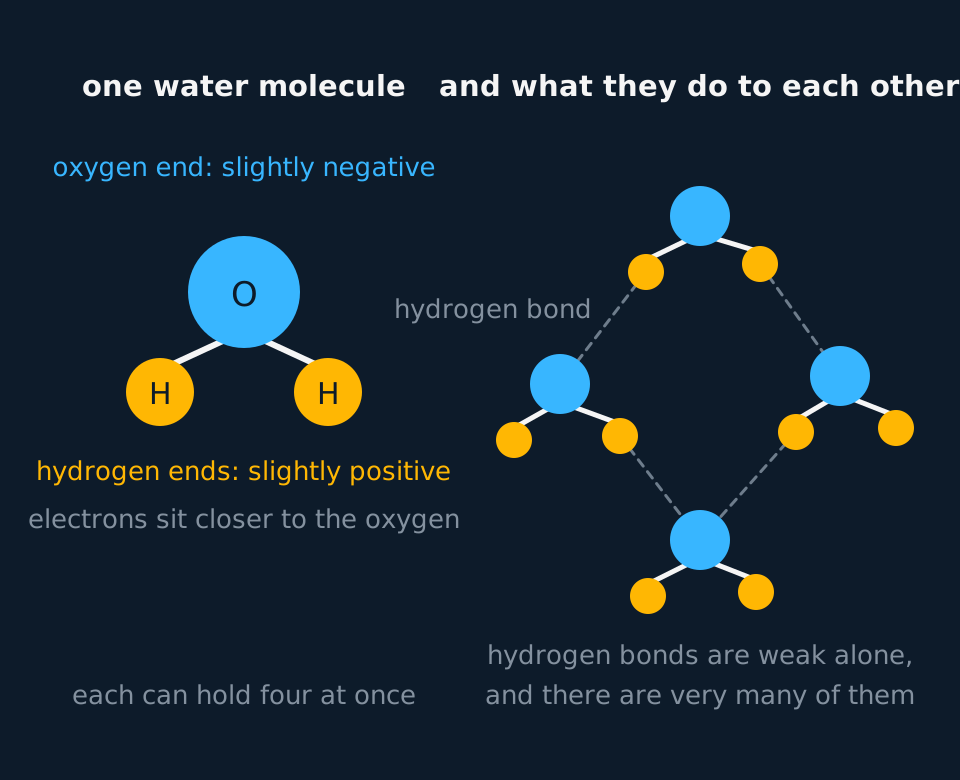
In a water molecule the oxygen atom pulls the shared electrons of each covalent bond closer to itself than the hydrogen atoms do. That leaves the oxygen end with a slight negative charge and each hydrogen with a slight positive one. The molecule is also bent rather than straight, so the two positive ends sit on the same side of it, and the molecule as a whole has a negative end and a positive end. That is what polar means, and the molecule is described as a dipole.
A slightly positive hydrogen of one water molecule is then attracted to the slightly negative oxygen of another. That attraction is a hydrogen bond. One of them is weak, around a twentieth of the strength of the covalent bond inside the molecule, and each water molecule can form four at once. Liquid water contains very large numbers of them, constantly breaking and re-forming, and the properties below all follow from that.
Describe the drawing
On the left, one water molecule drawn large: a big central circle labelled O with two smaller circles labelled H attached below it, both on the same side, so the molecule is bent. The oxygen end is labelled slightly negative and the hydrogen ends slightly positive. On the right, four smaller water molecules arranged in a ring, each drawn the same way, with dashed lines running from a hydrogen of one molecule to the oxygen of another. Those dashed lines are labelled hydrogen bonds, weak individually and very numerous.
- Polar molecule
- A molecule with an uneven distribution of charge, so that one part is slightly negative and another slightly positive.
- Hydrogen bond
- A weak attraction between a slightly positive hydrogen atom and a slightly negative atom such as oxygen or nitrogen, in another molecule or another part of the same molecule.
- Specific heat capacity
- The energy needed to raise the temperature of one kilogram of a substance by one kelvin.
- Latent heat of vaporisation
- The energy needed to change one kilogram of a liquid into a gas without a change in temperature.
Water as a solvent
Put an ionic compound such as sodium chloride into water and the negative ends of water molecules cluster around each sodium ion while the positive ends cluster around each chloride ion. The ions are pulled away from the crystal and stay apart, surrounded by water. Polar molecules such as glucose and amino acids dissolve for the same reason.
Blood plasma, cytoplasm, xylem sap and phloem sap are all aqueous solutions, so glucose, amino acids, ions and urea can be transported. Metabolic reactions occur between dissolved substances, and an enzyme and its substrate must be in solution to collide.
Lipids are non-polar and do not dissolve, which is why the products of fat digestion are carried in micelles and then in lipoproteins, and why the interior of a membrane keeps ions out.
Water and temperature
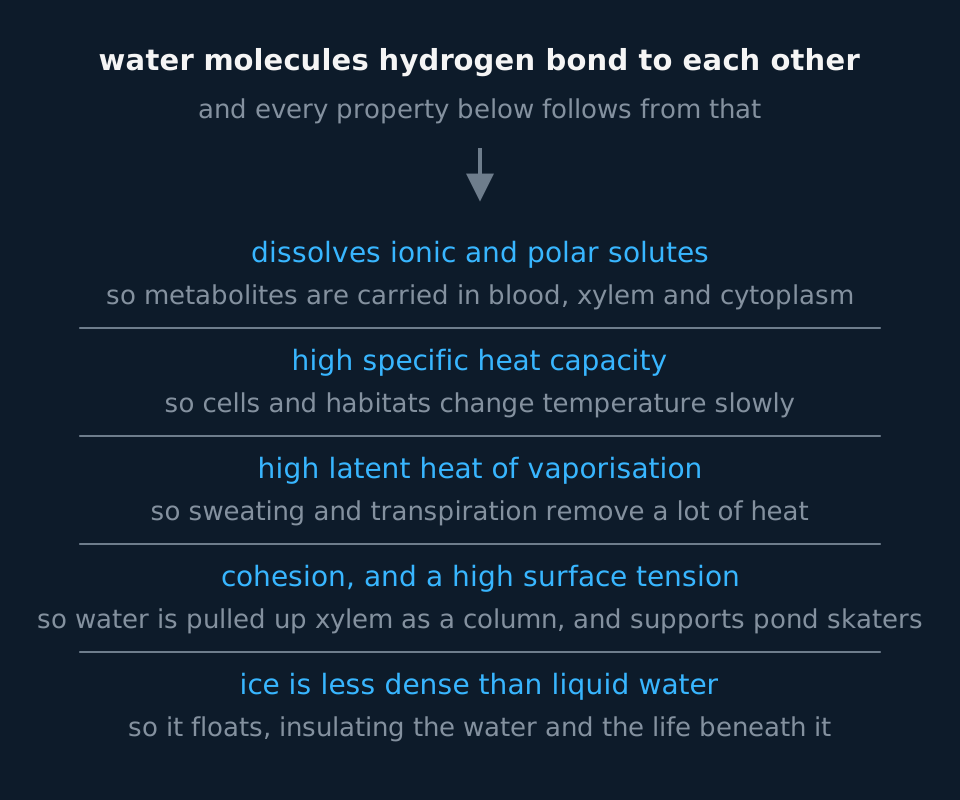
Warming water means making its molecules move faster, and that means breaking hydrogen bonds. A great deal of energy goes into that rather than into raising the temperature, so water has a high specific heat capacity: about 4,200 joules per kilogram per kelvin, higher than that of most other liquids.
The consequence is stability. A cell is mostly water, so its temperature changes slowly, and enzymes are not denatured by every fluctuation outside. A lake or an ocean changes temperature far more slowly than the air above it, which is why aquatic habitats vary less over a day and over a year than terrestrial ones.
Turning liquid water into vapour means breaking those hydrogen bonds completely, so the latent heat of vaporisation is high as well. Evaporating a small mass of water therefore removes a large amount of heat, which is what makes sweating and panting effective in a mammal and what cools a leaf as water evaporates from its mesophyll.
Describe the drawing
A list of five properties of water, each with the use living organisms make of it written underneath. Water dissolves ionic and polar solutes, so metabolites are carried in blood, xylem and cytoplasm. It has a high specific heat capacity, so cells and habitats change temperature slowly. It has a high latent heat of vaporisation, so sweating and transpiration remove a lot of heat. It is cohesive and has a high surface tension, so water is pulled up xylem as a column and pond skaters can rest on the surface. Ice is less dense than liquid water, so it floats and insulates what is underneath. A heading above the list records that all five follow from hydrogen bonding.
Cohesion, surface tension and the density of ice
Because water molecules hydrogen bond to each other they stick together, which is cohesion. A column of water in a xylem vessel is held together by it, so when water evaporates from a leaf the whole column is pulled up behind it rather than breaking. A tree fifty metres tall depends on that.
At the surface, water molecules are pulled sideways and downwards but not upwards, so the surface behaves as though it had a skin. That is surface tension, and it is high enough to support a pond skater and to make a surface film that a great many small organisms live on and under.
Like any liquid, water resists being compressed, so water enclosed by a cell wall or a body wall keeps its volume when it is pressed on. That is what makes a turgid plant cell rigid, and what lets an earthworm use its fluid-filled body cavity as a hydrostatic skeleton.
Water is unusual in one more way. Most substances are denser as solids than as liquids. When water freezes, the hydrogen bonds lock its molecules into an open lattice that holds them further apart than they are in the liquid, so ice is less dense than water and floats. Liquid water is at its densest at 4 °C; cooled below that it expands slightly, but it remains a liquid, not a lattice, until it freezes.
A pond therefore freezes from the top down, the ice insulates the water below it, and fish and invertebrates survive the winter in liquid water underneath.
Water as a reactant and a product
Water is both the medium for reactions and a participant in many of them. Every hydrolysis reaction in digestion and in a cell uses a molecule of water, and every condensation reaction that builds a polymer releases one.
Two named processes can be quoted. In the light-dependent stage of photosynthesis, water is split, providing the electrons that replace those lost from chlorophyll and releasing oxygen as a by-product. In aerobic respiration, water is the product formed at the end of the electron transport chain when oxygen accepts electrons and protons.
Inorganic ions and their roles
An inorganic ion is an ion containing no carbon, apart from carbonate and hydrogencarbonate, present in solution in cytoplasm and in body fluids, sometimes in very small quantities. Specifications name a small set of them and require a role for each, so learn each ion with its role.
Describe the drawing
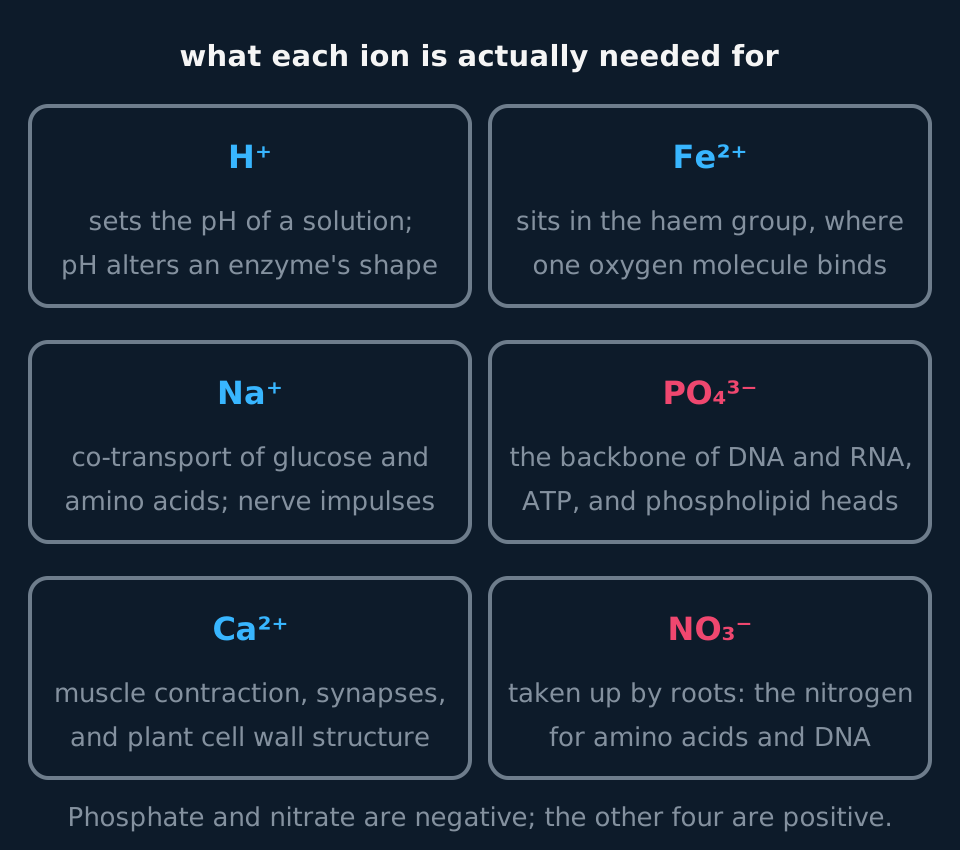
Six boxes arranged in two columns and three rows, one for each ion. Hydrogen ions, written H plus, set the pH of a solution, and pH alters an enzyme's shape. Iron two plus ions sit in the haem group, where one oxygen molecule binds. Sodium ions are used in the co-transport of glucose and amino acids and in nerve impulses. Phosphate ions form the backbone of DNA and RNA, part of ATP and the heads of phospholipids. Calcium ions are used in muscle contraction, at synapses and in plant cell wall structure. Nitrate ions are taken up by roots and supply the nitrogen for amino acids and DNA. The two negative ions are phosphate and nitrate; the other four are positive.
| Ion | Where it is found | What it does |
|---|---|---|
| Hydrogen, H+ | All aqueous solutions | Its concentration sets the pH, and pH affects the bonds holding an enzyme's tertiary structure. Also the gradient across a membrane that drives ATP synthase |
| Iron(II), Fe2+ | The haem group of haemoglobin | Binds one oxygen molecule per haem group, which is how oxygen is transported in the blood |
| Sodium, Na+ | Blood plasma, tissue fluid, cytoplasm | Co-transport of glucose and amino acids across the ileum and kidney epithelium; generation of action potentials with potassium |
| Potassium, K+ | Cytoplasm, neurones, guard cells | Held at a high concentration inside cells by the sodium-potassium pump; its diffusion out of a neurone repolarises the membrane after an action potential; taken up by guard cells, lowering their water potential, so water enters and the stoma opens |
| Phosphate, PO43− | Nucleotides, ATP, phospholipids | Joins one nucleotide to the next in the DNA and RNA backbone; the group transferred when ATP is hydrolysed, the energy coming from the overall reaction rather than from breaking one bond; the hydrophilic head of a phospholipid |
| Calcium, Ca2+ | Bone, muscle, synapses, plant cell walls | Triggers the release of neurotransmitter at a synapse and exposes binding sites in muscle contraction; strengthens the middle lamella between plant cells |
| Nitrate, NO3− | Soil water, taken up by roots | Supplies the nitrogen a plant needs to make amino acids, nucleotides and chlorophyll |
| Ammonium, NH4+ | Soil water; liver cells, where excess amino acids are broken down | The other form in which plants can take up nitrogen, and the form nitrifying bacteria oxidise to nitrite and then nitrate; in animals, the product of deaminating excess amino acids |
| Chloride, Cl− | Blood plasma, red blood cells, gastric juice | Moves into red blood cells to balance the charge as hydrogencarbonate moves out, the chloride shift; a cofactor that amylase needs before its active site works; part of the stomach's hydrochloric acid |
| Hydrogencarbonate, HCO3− | Blood plasma; pancreatic juice | The form in which most of the blood's carbon dioxide is carried, and a buffer against changes in blood pH: it combines with excess hydrogen ions to form carbonic acid, which dissociates again if the blood becomes too alkaline; secreted by the pancreas to neutralise stomach acid so that trypsin can work |
| Hydroxide, OH− | All aqueous solutions | Sets the pH together with hydrogen ions: as one rises the other falls, so where hydroxide outnumbers hydrogen the solution is alkaline, and an alkaline pH can denature an enzyme just as an acidic one can |
- Inorganic ion
- An ion containing no carbon, apart from carbonate and hydrogencarbonate, present in solution in cytoplasm and body fluids, often in very small amounts, and each with a specific role.
The last four ions are introduced here and examined in detail elsewhere. Next topics: the chloride shift and hydrogencarbonate in gas exchange and transport; ammonium in the nitrogen cycle and in the liver's handling of excess amino acids; and the cofactor role of chloride in the enzymes unit. Give every ion a named role rather than a formula alone.
Two of these warrant further comment. Iron is required in very small quantities, and a shortage limits how much haemoglobin can be synthesised, which is one cause of anaemia. Nitrogen is the nutrient in shortest supply in many terrestrial ecosystems, though which nutrient limits growth depends on the ecosystem, and in fresh water it is often phosphate. That shortage is why nitrate is a main component of fertiliser. Next topic for the consequences of nitrate leaching into a river: nutrient cycles and human effects.
In the exam
- Explain each property from polarity and hydrogen bonding. 'Water has a high specific heat capacity' states the property without explaining it.
- Give a named biological consequence: 'the temperature of a lake changes slowly, so aquatic organisms are not exposed to rapid change', rather than 'stable temperature'.
- Latent heat of vaporisation concerns evaporation and cooling; specific heat capacity concerns resistance to a change in temperature. Use the first for sweating and the second for habitat stability.
- Ice floats because it is less dense than liquid water. State the consequence: the ice insulates the water below, so organisms survive beneath it.
- For ions, give the ion and the process in one sentence: 'iron ions are part of the haem group, where oxygen binds'.
Check yourself
A student writes that water is important in biology because it is a liquid that living things can dissolve substances in and cool themselves with. Rewrite that answer so that every claim in it is explained from the structure of the water molecule.
Answer
Water molecules are polar: the oxygen pulls the shared electrons closer than the hydrogens do, so the oxygen end is slightly negative and the hydrogen ends slightly positive, and the molecule is bent so the two positive ends lie on the same side.
Those charges attract the ions of an ionic compound and the charged parts of polar molecules, pulling them apart and holding them in solution. That is why glucose, amino acids and ions are transported in blood, and why non-polar lipids are not.
The same polarity lets each molecule hydrogen bond to four others. Evaporating water means breaking those bonds, which takes a great deal of energy, so a small mass of sweat evaporating removes a large amount of heat.
The same bonding gives water a high specific heat capacity, so the temperature of a cell or a lake changes slowly, which is a separate point from cooling and earns its own mark.
Questions
Question 14 marks
State two properties of water that result from hydrogen bonding between its molecules, and state one biological consequence of each.
Mark scheme
- B1 any one property: high specific heat capacity, high latent heat of vaporisation, cohesion and high surface tension, or ice being less dense than liquid water
- B1 a consequence of that property, for example that the temperature of a cell or a habitat changes slowly
- B1 a second property from the same list
- B1 a consequence of the second property, for example that evaporation of sweat removes a large amount of heat
Question 24 marks
Water is at its densest at 4 °C rather than at its freezing point. Explain what happens to water molecules as the water cools from 4 °C to 0 °C and then freezes, and explain the consequence for organisms in a pond.
Mark scheme
- B1 as liquid water cools further below 4 °C it expands slightly rather than continuing to contract, though it remains a liquid rather than a rigid lattice until it actually freezes
- B1 when it does freeze, the hydrogen bonds lock the molecules into an open lattice that holds them further apart than in the liquid
- B1 ice is therefore less dense than liquid water and floats, so a pond freezes from the surface downwards rather than from the bottom up
- B1 the layer of ice insulates the liquid water beneath it, so fish and invertebrates can survive the winter in liquid water under the ice
Question 33 marks
Describe how a hydrogen bond forms between two water molecules.
Mark scheme
- B1 the oxygen atom attracts the shared electrons of each covalent bond more strongly than the hydrogen atoms do, so the oxygen is slightly negative and the hydrogens are slightly positive
- B1 the molecule is therefore polar
- B1 a slightly positive hydrogen atom of one molecule is attracted to the slightly negative oxygen atom of a neighbouring molecule, and that attraction is the hydrogen bond
Question 43 marks
Explain why the temperature of a large lake changes more slowly during a hot day than the temperature of the air above it.
Mark scheme
- B1 water has a high specific heat capacity, so a large amount of energy is needed to raise the temperature of a given mass of it
- B1 much of the energy absorbed goes into breaking hydrogen bonds between the water molecules rather than into increasing their kinetic energy
- B1 so the temperature of the lake rises slowly, and organisms living in it are not exposed to rapid changes in temperature
Question 53 marks
Explain how sweating cools a mammal, and explain why only a small volume of sweat is needed to remove a large amount of heat.
Mark scheme
- B1 water in sweat evaporates from the surface of the skin, and the energy needed for this is taken from the body
- B1 evaporation requires the hydrogen bonds between water molecules to be broken
- B1 so water has a high latent heat of vaporisation, and a small mass of water removes a large amount of heat as it evaporates
Question 63 marks
In winter a pond freezes at the surface while the water below stays liquid. Suggest how this is explained by the structure of ice, and suggest what it means for the animals living in the pond.
Mark scheme
- B1 when water freezes, the hydrogen bonds lock the molecules into an open lattice that holds them further apart than in the liquid
- B1 so ice is less dense than liquid water and floats, forming a layer at the surface
- B1 the ice insulates the water beneath it, so the water stays liquid and fish and invertebrates survive the winter in it
Question 73 marks
Explain why sodium chloride dissolves readily in water but a triglyceride does not.
Mark scheme
- B1 water molecules are polar, with a slightly negative oxygen end and slightly positive hydrogen ends
- B1 the slightly negative ends are attracted to the sodium ions and the slightly positive ends to the chloride ions, so the ions are separated from the crystal and held in solution
- B1 a triglyceride is non-polar and carries no charge, so no such attraction forms and it is not separated by water
Question 83 marks
Give the role of iron(II) ions, phosphate ions and calcium ions in a named structure or process.
Mark scheme
- B1 iron(II) ions are part of the haem group of haemoglobin, where one oxygen molecule binds to each
- B1 phosphate ions join one nucleotide to the next in the backbone of DNA and RNA; also accepted are their presence in ATP or in the hydrophilic head of a phospholipid
- B1 calcium ions trigger the release of neurotransmitter at a synapse; also accepted are their role in muscle contraction or in the middle lamella between plant cells
Question 93 marks
A crop grown in soil low in nitrate has pale leaves and grows poorly. Explain why a shortage of nitrate ions has these effects.
Mark scheme
- B1 nitrate ions are absorbed by the roots and supply the nitrogen the plant needs
- B1 nitrogen is required to make amino acids, and therefore proteins including enzymes, so growth is reduced
- B1 nitrogen is also required to make chlorophyll, so less is produced and the leaves are pale, which reduces the rate of photosynthesis
Question 103 marks
Describe what happens to a column of water in a xylem vessel as water evaporates from a leaf, and describe the property of water responsible.
Mark scheme
- B1 water molecules hydrogen bond to each other, and that mutual attraction between molecules is cohesion
- B1 as water evaporates from a leaf, the whole column of water in the xylem is pulled upwards behind it rather than the column separating
- B1 without sufficient cohesion the column would break apart under tension instead of being pulled up as one continuous thread
Question 113 marks
State what is meant by surface tension in water, state the property of water molecules responsible for it, and state one organism that depends on it.
Mark scheme
- B1 surface tension is the tendency of the water surface to behave as though covered by a thin skin, resisting being broken
- B1 it results from hydrogen bonding, since surface molecules are pulled sideways and downwards by neighbouring molecules but have none above them pulling upwards
- B1 a pond skater is supported by it, and a great many small organisms live on or immediately under the surface film it creates
Question 123 marks
State the role of water in the light-dependent reactions of photosynthesis, and state the role of water in the final stage of aerobic respiration.
Mark scheme
- B1 in the light-dependent reactions, water is split, providing electrons that replace those lost from chlorophyll, and releasing oxygen as a by-product
- B1 in aerobic respiration, water is formed at the end of the electron transport chain, when oxygen accepts electrons and protons
- B1 water is therefore a reactant in one process and a product of the other
Question 133 marks
Give the role of sodium ions in the co-transport of glucose across the ileum epithelium, and give one other named role of sodium ions in the body.
Mark scheme
- B1 sodium ions are actively pumped out of the epithelial cell into the blood, maintaining a lower sodium concentration inside the cell than in the gut lumen
- B1 sodium ions then diffuse back into the cell down that concentration gradient through a co-transporter protein, which carries glucose or an amino acid into the cell at the same time
- B1 another named role is accepted: sodium ions moving across the axon membrane, alongside potassium ions, to generate an action potential in a neurone
Question 143 marks
Explain how hydrogencarbonate ions in the blood act as a buffer against changes in blood pH.
Mark scheme
- B1 hydrogencarbonate ions can combine with excess hydrogen ions in the blood, removing them from solution and so resisting a fall in pH
- B1 if the blood becomes too alkaline, carbonic acid formed from dissolved carbon dioxide dissociates into hydrogen ions and hydrogencarbonate ions, opposing the rise
- B1 by resisting changes in the concentration of free hydrogen ions, hydrogencarbonate keeps blood pH within the narrow range enzymes in the blood require to function normally
Question 152 marks
Give the role of chloride ions in the chloride shift, and give one other named role of chloride ions.
Mark scheme
- B1 as hydrogencarbonate ions move out of a red blood cell into the plasma, chloride ions move into the red blood cell to balance the charge, and this exchange is the chloride shift
- B1 another named role is accepted: chloride ions are a cofactor amylase requires before its active site works, or chloride ions are part of the hydrochloric acid secreted in gastric juice
Worth remembering
- The oxygen end of a water molecule is slightly negative and the hydrogen ends slightly positive: that is polarity, and hydrogen bonds follow from it.
- In water, a hydrogen bond runs from a hydrogen of one molecule to the oxygen of another, and each molecule can hold four.
- High specific heat capacity resists a change in temperature; high latent heat of vaporisation removes heat when water evaporates.
- Ice is less dense than liquid water, so it floats and insulates what is below it.
- Every ion needs a named role: hydrogen for pH, iron for haemoglobin, sodium for co-transport and impulses, potassium for repolarisation and stomata, phosphate for nucleotides and ATP, calcium for muscle and synapses, nitrate for amino acids.
- The rest of the roster: ammonium for the nitrogen cycle, chloride for the chloride shift and amylase, hydrogencarbonate for carrying carbon dioxide and buffering, hydroxide for setting pH alongside hydrogen.
CHECK YOUR PROGRESS
Rate how confident you are with each objective for this lesson. Ratings are saved in this browser, on this device, unless you sign in.
- Explain why a water molecule is polar, and how a hydrogen bond forms between two of them.
- Derive each property of water from its hydrogen bonding rather than listing the properties.
- Give a biological consequence of each property, naming an organism or a process.
- Explain why ice floats, and what that means for life in a pond in winter.
- State the role of hydrogen, iron, sodium, potassium, phosphate, calcium and nitrate ions, and of ammonium, chloride, hydrogencarbonate and hydroxide.
Open the full revision checklist to see every objective in the curriculum in one place.
Practise this lesson
Practise water and inorganic ions with 15 original questions and point-by-point mark schemes
WORKBOOK
The questions from this topic, on paper with room to work, and a separate book of mark schemes. Free to use; please do not redistribute or sell.
Used later in DNA and RNA structure · Xylem and the transpiration stream