Biology › Plant transport and mineral nutrition › Xylem and the transpiration stream
Xylem and the transpiration stream
The cohesion-tension theory explains how water reaches the top of a hundred-metre tree without a pump: evaporation from the leaves generates the tension, hydrogen bonding holds the water column together so that it can be drawn upwards, and the xylem contents are under tension rather than pressure. The mechanism and the evidence for it are set out here.
Before this Water potential and osmosis in plant cells · Active transport and carrier proteins · Water and inorganic ions
COMMON MISCONCEPTION
Water is pushed up the stem by root pressure.
Root pressure reaches perhaps 100 to 200 kPa, but in practice it pushes sap only a few metres, and it disappears if the roots are chilled. Xylem sap in a tall tree at midday is under tension, not pressure: the column is pulled from the leaf, not pushed from the root.
What you should be able to do
- Describe how a root hair cell is built for absorbing water and mineral ions.
- Trace water across the root cortex by the apoplast and symplast routes, and say where each one has to cross a membrane.
- Explain what the Casparian strip does and why it hands the plant control over what reaches the xylem.
- Account for every feature of a xylem vessel in terms of the job the tissue does.
- State the cohesion-tension theory and name the property of water each step depends on.
- Set up a potometer, and say exactly which quantity the reading is.
- Name the ions a plant takes up and what a shortage of each one looks like.
- Compare sclerenchyma fibres, xylem vessels and phloem in structure, position in the stem and function, and find each one in a stained stem section.
- Investigate a plant mineral deficiency with culture solutions, and explain the symptoms from the ion that is missing.
Getting water out of the soil
A plant needs a transport system for the same reason as any large organism: diffusion is too slow to supply cells more than a fraction of a millimetre from a source. Water and mineral ions enter at the roots and sugar is made mainly in the leaves, often metres apart. A branching shape gives a plant a large surface area to volume ratio, and its metabolic rate is lower than a mammal's, so oxygen and carbon dioxide can reach its cells by diffusion through the air spaces. Water, ions and sugar have to be carried.
A root hair is one epidermal cell drawn out into a projection perhaps a millimetre long. The hair is part of that cell, not a cell of its own, and it does not last a week. Its function is to increase surface area: thousands of hairs on a centimetre of root give a much larger area in contact with the film of water around the soil particles, and they extend between those particles into water an unmodified root surface could not reach.
Water enters by osmosis, so the cell must sit at a lower water potential than the soil solution. In a moist soil that solution is dilute, only a few tens of kPa below zero, while the cytoplasm and vacuole of the root hair cell sit several hundred kPa negative. Water moves in down the gradient without the plant expending ATP on the water movement itself.
Maintaining that gradient does require ATP, which is spent on the active uptake of mineral ions. A root hair cell contains many mitochondria, and carrier proteins in its membrane move nitrate, phosphate, potassium and the rest inwards against their concentration gradients. That active transport has two consequences: the plant obtains the ions it requires, and the solute potential of the cell contents falls, which maintains the water potential gradient into the cell.
- Root hair cell
- An epidermal cell of the root extended into a long narrow projection, giving a large surface area for the absorption of water and mineral ions.
- Apoplast pathway
- Movement of water through the cellulose cell walls and the spaces between them, without entering the cytoplasm of any cell.
- Symplast pathway
- Movement of water through the cytoplasm of the cells, passing from one to the next through plasmodesmata.
- Casparian strip
- A band of suberin in the walls of the endodermal cells that is impermeable to water, so the apoplast route is blocked and water must cross a plasma membrane.
Which ions, and what each one is for, is examined in its own right, and the deficiency symptoms are more logical than they look. Every one of them follows from the molecule the ion is part of.
| Ion | What the plant builds with it | A shortage shows as |
|---|---|---|
| Nitrate, NO3− | Amino acids, proteins, nucleotides, chlorophyll | Stunted growth and yellow older leaves |
| Magnesium, Mg2+ | The ion at the centre of every chlorophyll molecule | Yellowing between the veins, older leaves first |
| Phosphate, PO43− | ATP, DNA, RNA, phospholipids | Poor root growth, leaves dark or purplish |
| Potassium, K+ | Stomatal opening, enzyme activation, osmotic balance | Scorched, curled leaf margins |
| Calcium, Ca2+ | Calcium pectate in the middle lamella between cell walls | Growing tips and youngest leaves die back |
Notice which leaves go first. Nitrogen, magnesium, phosphorus and potassium all travel in phloem, so a plant running short strips them out of its old leaves for the new growth and the damage shows on the old ones. Calcium cannot move in phloem once delivered, so the growing point is what suffers. Handed a photograph of a deficient plant, look at which end of it is dying.
The apoplast and symplast routes across the cortex
Once through the root hair, water crosses the cortex to reach the xylem at the centre. There are two routes, and they differ in whether a membrane is crossed.
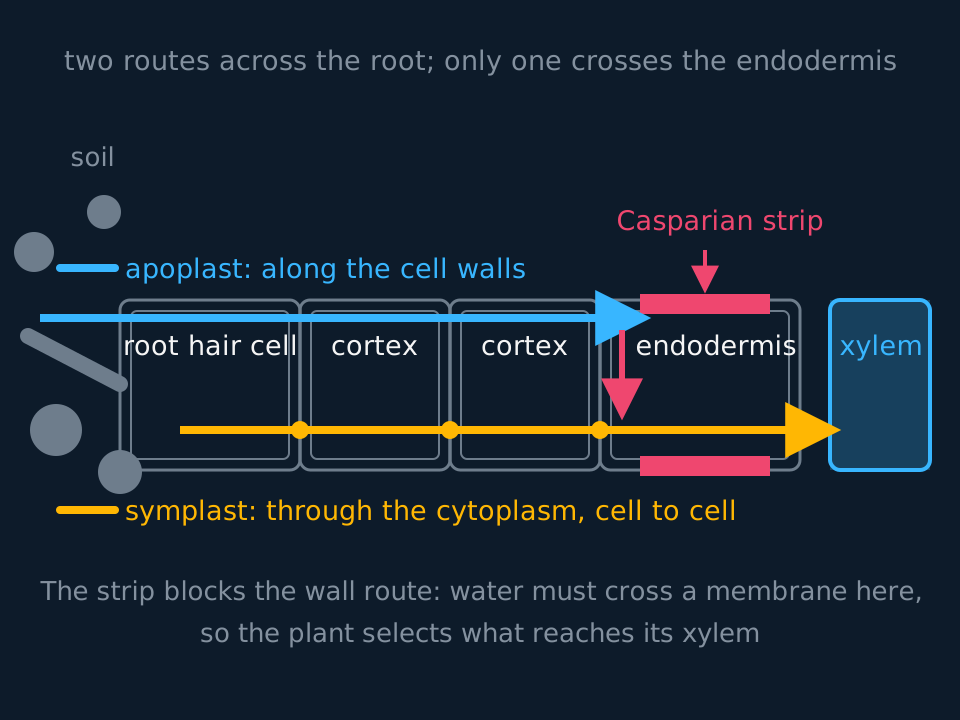
Describe the drawing
A file of root cells drawn in section from the soil on the left to the xylem on the right: a root hair cell reaching out among soil particles, two cortex cells, an endodermis cell and the xylem beyond it. A cyan arrow labelled apoplast runs along the cell walls and stops at the Casparian strip, drawn as coral bands in the endodermal cell's own walls. An amber arrow labelled symplast runs through the cell interiors, passing from cell to cell through plasmodesmata marked as dots between the living cells, and on into the xylem. A coral arrow turns the blocked wall route inwards, across the membrane of the endodermal cell.
The apoplast route runs through the cellulose walls themselves. Cell walls are an open mesh of fibres soaked in water, and they are continuous from cell to cell, so water can travel through them without ever entering a cytoplasm. Nothing is selected, nothing is excluded, and because there is no membrane to cross the resistance is low. Most of the water crossing a root cortex goes this way.
The symplast route goes through the cells. Water crosses a plasma membrane once, at the root hair, then passes from cytoplasm to cytoplasm through the plasmodesmata that thread the pores in adjacent walls, so the living contents of a root are one connected compartment. A third description, the vacuolar route, has water crossing the tonoplast as well, but no board asks for it: OCR A specifies the apoplast and symplast pathways only, CAIE names the same two, and AQA does not examine the route across the root at all.
At the inner edge of the cortex sits a single ring of cells, the endodermis, and their walls carry a band of suberin, a waxy waterproof material, running right round each cell. That is the Casparian strip, and it is the reason the endodermis is worth a name. Water travelling in the walls arrives at the strip and cannot go on. It has to enter the cytoplasm of an endodermal cell, which means crossing a plasma membrane, which means passing whatever that membrane will let through.
That constraint makes the root selective: everything reaching the xylem has crossed a membrane, so toxic ions can be excluded and useful ones concentrated. It also allows the endodermis to transport ions actively into the xylem. The xylem sap's water potential falls, water follows osmotically, and the positive hydrostatic pressure that builds is root pressure, which the strip stops from leaking straight back out along the walls.
Root pressure causes guttation: the beads of liquid water forced out along the leaf margins of grass on a still, humid morning. That is not dew, which condenses onto a surface. Guttation stops if the roots are cooled, flooded so that oxygen is limited, or treated with cyanide, because the active transport driving it has stopped. That dependence on respiration is evidence that root pressure exists; its small magnitude is why it cannot be the main mechanism of water transport.
Xylem vessel structure
Xylem is a tissue, not a cell type, and the part that carries water is the vessel: a file of cells that grew end to end, laid down lignin in their walls, then died and lost their contents. What is left is a hollow tube, sometimes metres long, with nothing inside to obstruct flow.
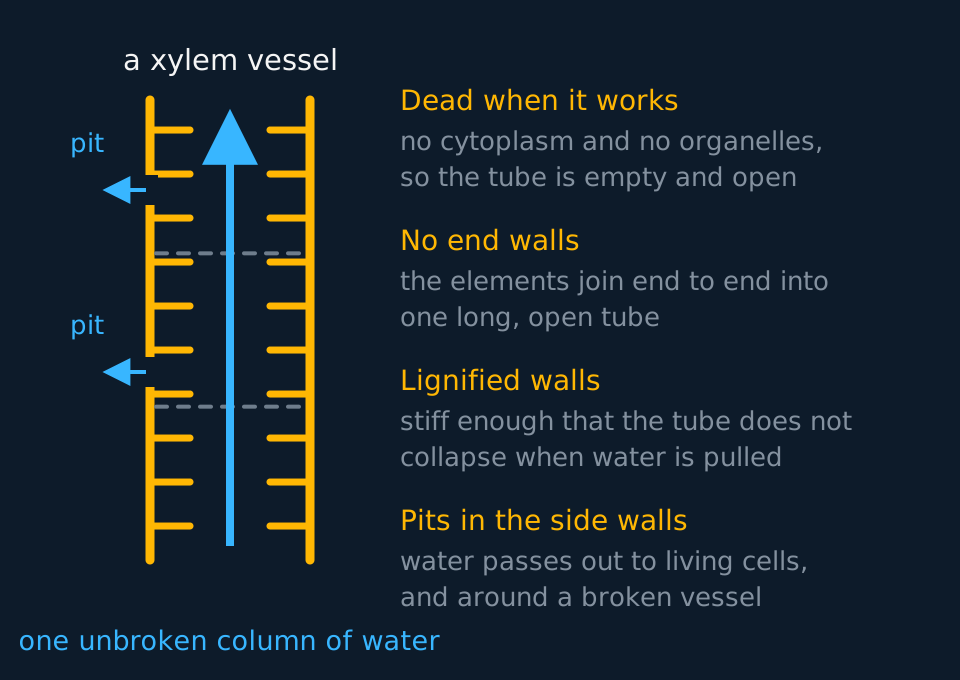
Describe the drawing
A xylem vessel in longitudinal section: two lignified side walls with bands of thickening reaching part way across, two dashed lines marking where the end walls between three elements have broken down, and gaps in the side walls marked as pits with arrows leaving sideways. A cyan arrow runs up the open lumen for the water column. Four labelled notes to the right give the reason for each feature.
The lignin has three functions. A tube carrying water under tension is being squeezed inwards by the atmosphere, and an unreinforced cellulose tube of that diameter would flatten. Laid down in rings, spirals or a pitted mesh, lignin stiffens the wall while leaving a stem flexible enough to bend in wind, waterproofs it so water does not seep out along the whole length, and is strong enough that xylem doubles as the plant's skeleton. Wood is mostly old xylem.
Pits are the gaps where lignin was not laid down, so water can pass sideways to the living cells that need it and from one vessel into its neighbour. That second function is a repair route. If air gets in, the column in that vessel breaks, which is an embolism, and the vessel is usually out of service, though some plants can refill embolised vessels overnight or by root pressure in spring. Meanwhile water detours through the pits into the vessel alongside. Many narrow tubes survive damage that would cripple one wide one.
Most conifers manage without vessels at all. They have only tracheids, narrower cells that keep their tapered end walls and pass water through pits, and a pine still gets water sixty metres up. The vessel's advantage is lower resistance; the tracheid's is that one embolism spreads less easily.
Sclerenchyma fibres, xylem vessels and phloem compared
Pearson Edexcel Biology A (Salters-Nuffield) adds a third tissue to the two that carry things, and asks for all three to be compared and found in a stem. Sclerenchyma fibres carry nothing. Each is a long, narrow cell with tapering ends that overlap the ends of its neighbours. Like a vessel element it lays down a thick lignified wall and then dies, so a mature fibre is a column of wall around a very narrow empty lumen. Its end walls are never removed, so fibres do not join into an open pipe. Their job is support.
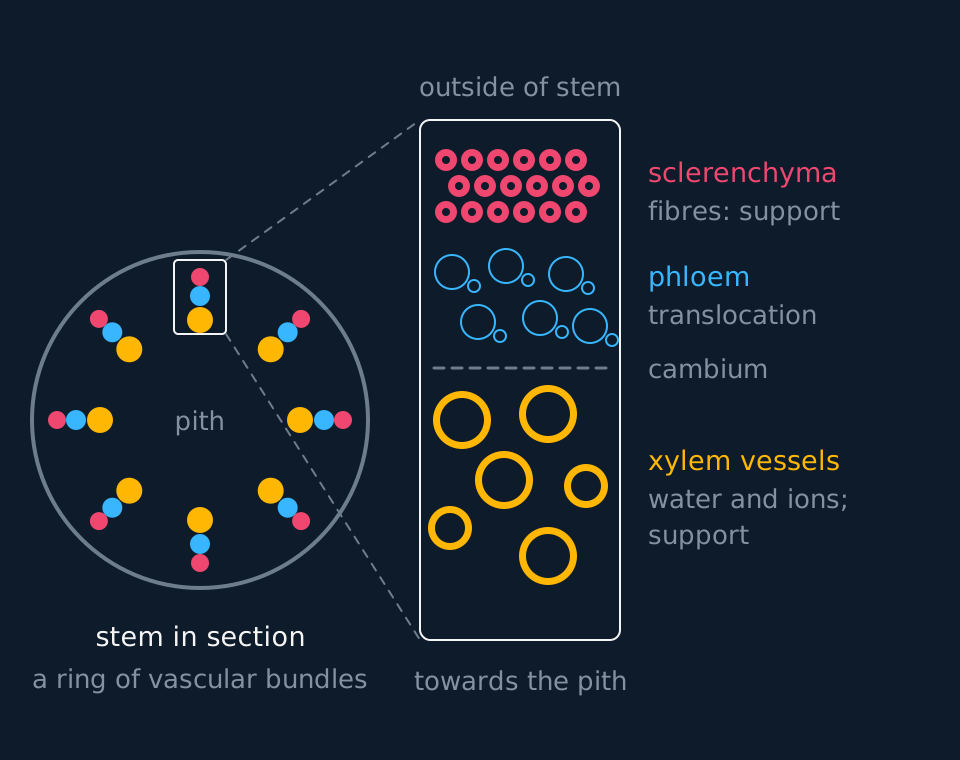
Describe the drawing
On the left, a young stem in transverse section: a circular outline with a ring of eight vascular bundles, each drawn as an amber patch of xylem nearest the central pith, a cyan patch of phloem outside it and a coral cap of sclerenchyma outermost. The bundle at the top is boxed and enlarged on the right, with the outside of the stem at the top. In the enlargement, the sclerenchyma fibres are small cells with very thick coral walls and tiny lumens; beneath them the phloem is large thin-walled cyan sieve tubes, each with a small companion cell beside it; a dashed line marks the cambium; and below that the xylem vessels are wide circles with thick amber walls and open lumens. Labels give each tissue its job: fibres for support, phloem for translocation, xylem vessels for water and ions and for support.
In a young dicotyledonous stem the vascular bundles form a ring near the outside rather than a core down the middle, with soft pith in the centre. Within each bundle the xylem faces inwards towards the pith, the phloem lies outside it, a layer of cambium runs between the two, and the sclerenchyma fibres form a cap on the outer side of the phloem. A stem bent by wind is stretched along one side and compressed along the other, and both effects are largest at the surface, so stiff tissue placed in a ring near the outside resists bending far better than the same amount of tissue at the centre.
| Sclerenchyma fibres | Xylem vessels | Phloem sieve tubes | |
|---|---|---|---|
| Alive when working | No: dead, contents lost | No: dead, contents lost | Yes, but with no nucleus and few organelles |
| Wall | Very thick, lignified secondary wall | Lignified secondary thickening in rings, spirals or a pitted network | Cellulose only, not lignified |
| Ends of the cells | Tapering and overlapping; end walls kept | End walls broken down into a continuous tube | End walls perforated as sieve plates |
| Lumen | Very narrow and empty | Wide and empty | Thin layer of cytoplasm; companion cell alongside |
| Position in a bundle | Outermost, as a cap outside the phloem | Innermost, towards the pith | Between the xylem and the fibre cap |
| Function | Support | Transport of water and mineral ions; support | Translocation of organic solutes such as sucrose and amino acids |
The similarities earn marks too. All three are made of elongated cells lying along the length of the stem in long strands. Fibres and vessels both have lignified secondary walls and are dead when they function, which is why both support the plant. Vessels and sieve tubes both transport, and both are files of cells joined end to end whose end walls have been modified: removed in one, perforated in the other.
The strength sits in the wall, and in the way it is built. A growing cell has only a thin, stretchable primary wall. Once a fibre or a vessel element has reached its full length it lays down a secondary wall on the inside of the primary one, layer by layer. Within each layer the cellulose microfibrils lie parallel to one another, wound round the cell in a helix, and the angle of the helix changes from one layer to the next, so the wall is built like plywood and has no single direction in which it splits easily. Lignin is then deposited between the microfibrils. The microfibrils give the wall its tensile strength, its resistance to being pulled apart; the lignin cements them together, so the wall also resists compression and does not buckle, and it makes the wall waterproof. A fibre's secondary wall is continuous and very thick. In a vessel the same lignified secondary thickening is laid down as the rings, spirals or pitted network described above. Fibre walls built this way are what people take out of the plant for rope, linen or sacking, which the carbohydrates lesson takes further.
Core practical 6 asks for the three tissues to be identified in a stem down a light microscope. Cut thin transverse sections of a young herbaceous stem on a white tile with a sharp blade, cutting away from the fingers, and float them in water so they do not dry out. Stain the thinnest sections with toluidine blue O for about a minute, rinse off the excess in water, and mount each in a drop of water under a coverslip. Lignified walls, in the xylem and the fibres, stain green or blue-green, while unlignified walls, including those of the phloem, stain purple. Check the CLEAPSS Hazcard for the stain you use, wear eye protection and gloves as your school's risk assessment requires, and keep the stain off skin and clothes.
Then read the bundle. The largest, empty, thick-walled openings on the inner side are xylem vessels. The small cells with very thick walls and almost no lumen, in a cap on the outer side, are sclerenchyma fibres. Between them lie the phloem cells, thin-walled and of mixed sizes, the larger sieve tubes each with a much smaller companion cell beside it. A longitudinal section adds the tapering ends of the fibres, the rings and spirals in the vessel walls and, with luck, a sieve plate. Record the distribution as a low-power plan drawing: tissue outlines only, no individual cells, with every region labelled.
- Sclerenchyma fibre
- A long, narrow, dead plant cell with tapering ends and a thick lignified secondary wall around a narrow lumen, whose function is support.
- Vascular bundle
- A strand of xylem and phloem running along a stem, root or leaf; in a young stem the bundles form a ring, each with the xylem on the inner side and a cap of sclerenchyma fibres outside the phloem.
- Secondary thickening
- Extra layers of cell wall laid down inside the primary wall once a cell has stopped growing, made of cellulose microfibrils at different angles in successive layers and usually impregnated with lignin.
Cohesion-tension: the tension originates in the leaf
Suction cannot lift water more than about ten metres, whatever pump is applied: atmospheric pressure is 101 kPa, and 101 kPa supports a column of water 10.3 m high. Water nevertheless reaches the top of a redwood at more than a hundred metres. The water at that height is therefore not supported by pressure from below; it is held under tension generated at the leaves.

Describe the drawing
A plant drawn the same way in five frames, with one link of the water chain highlighted in coral each time. First, arrows rise from the wet walls inside the leaf as water evaporates into the air spaces. Second, arrows leave the underside of the leaf through the stomata. Third, an arrow runs from the top of the stem xylem out into the leaf as the mesophyll pulls water from the vessels. Fourth, a long arrow runs up the xylem the length of the stem, the column moving as one. Fifth, arrows run from the soil into the root hairs and up into the root xylem. A caption under the plant notes that the column is continuous from root to leaf.
Follow the sequence in order. Water evaporates from the wet cellulose walls of the mesophyll cells into the air spaces of the leaf, and diffuses out through the stomata. That cell has now lost water, so its water potential falls, so it draws water osmotically from the cell next to it, and so on back to the xylem in the vein. Water is pulled out of the vessel.
Two properties of water account for the rest. Cohesion, meaning hydrogen bonding between water molecules, prevents the column separating under tension; the column moves as one, so removal of a molecule at the leaf draws one in at the root. Adhesion, meaning hydrogen bonding between water and the wall, holds the column against the lignified surface and assists movement up the narrow tube. Name hydrogen bonding in both cases.
The tension is measurable and it is why the theory has the name it does. Xylem sap in a transpiring tree at midday sits at perhaps −1000 to −2000 kPa. Three observations follow, and all three are used as evidence:
| Observation | What it shows |
|---|---|
| A tree trunk is measurably narrower at midday than at night | The xylem is under tension and pulls its walls inwards; root pressure would push them outwards |
| Cut a stem in a transpiring plant and air is drawn in, not water out | The sap is below atmospheric pressure |
| Let an air bubble into a vessel and water above it stops moving | The mechanism depends on the column being continuous |
Every step of that chain runs downhill in water potential: soil at about −30 kPa, root and stem below it, leaf mesophyll near −1500 kPa, and beyond the stoma an atmosphere lower still. The plant expends no ATP on the movement; the energy comes from solar heating driving evaporation at the leaf surface.
The potometer and what it measures
The standard apparatus for this topic is the potometer, which measures the rate of water uptake rather than the rate of transpiration.
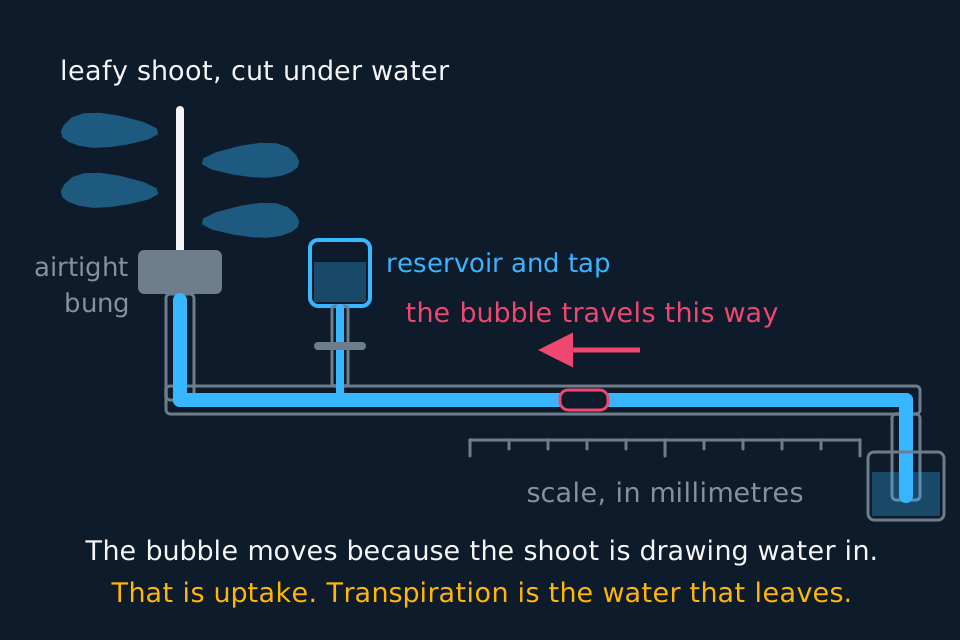
Describe the drawing
A bubble potometer: a leafy shoot sealed by a bung into the top of a water-filled capillary tube, the tube running down and then horizontally to the right past a millimetre scale, its far end dipping into a beaker of water. A reservoir with a tap joins the tube between the shoot and the scale. An air bubble in the horizontal tube is marked, with an arrow showing it travelling towards the shoot; opening the tap pushes it back along the scale.
Setting it up is a sequence of precautions, each with a reason a question can ask for. Cut the shoot under water and assemble it submerged, so no air enters the xylem. Cut the stem at a slant, for a larger surface in contact with the water. Dry the leaves, so that evaporating surface water does not slow transpiration from inside them. Seal every joint with petroleum jelly. Then leave it ten minutes to settle, and take repeats, resetting the bubble from the reservoir between them.
What moves is the air bubble, and it moves because the shoot is drawing water in. That is water uptake. Transpiration is the water leaving through the stomata, and the two are not the same quantity: a small fraction of what the plant takes up is used as a raw material in photosynthesis or held in the cells to keep them turgid as they grow. The fraction is small, usually quoted at around one per cent, so uptake is a good estimate of transpiration. It remains an estimate, so describe the reading as a rate of water uptake rather than a rate of transpiration.
Turning a distance into a volume
The capillary tube of a potometer has an internal diameter of 1.0 mm. The bubble travels 45 mm in 5 minutes. Calculate the rate of water uptake in mm³ min⁻¹.
Show the working
The bubble sweeps out a cylinder of water, so the volume is the cross-sectional area times the distance. The radius is half the diameter: 0.50 mm.
Area = πr² = π × 0.50² = 0.785 mm². Volume = 0.785 × 45 = 35.3 mm³.
Rate = 35.3 ÷ 5 = 7.07 mm³ min⁻¹, or 7.1 to two significant figures.
The tube is quoted by diameter and the formula requires the radius, so halve it before squaring. To compare two shoots, record their leaf areas as well: a larger shoot loses more water for reasons unconnected with the variable being tested.
TRY IT: Saying precisely what was measured
A student writes in her conclusion: 'The potometer showed that the rate of transpiration was 7.1 mm³ min⁻¹.' Explain why that statement is imprecise, and state whether the true rate of transpiration was above or below the figure she recorded.
Check your answer
The potometer measures the rate at which the cut shoot takes water in, not the rate at which it loses it: she should have written 'rate of water uptake'.
Some of that water never leaves the shoot, since a little is a reactant in photosynthesis and some is retained in cells as they expand and stay turgid, so over a run uptake slightly exceeds loss and the true transpiration rate was below 7.1 mm³ min⁻¹. At any single instant the relation can reverse, because a shoot drawing on water stored in its own tissues can briefly lose more than it takes up; give the run-averaged relationship in an answer.
Include one limitation in an evaluation: this is a cut shoot with no roots and no Casparian strip in the pathway.
Core practical 7: investigate plant mineral deficiencies
optional
Pearson Edexcel Biology A (9BN0) prints Core Practical 7, Investigate plant mineral deficiencies, beside statement 4.12 on the importance of water and of nitrate, calcium and magnesium ions. The table of deficiency symptoms earlier in this lesson is the kind of result this investigation produces.
The design is to grow seedlings that are as alike as possible in culture solutions that differ in one ion only. A complete solution contains every mineral ion a plant needs; each of the others lacks one, such as nitrate, magnesium or calcium. A difference from the plants in the complete solution can then be put down to the missing ion. Soil cannot be used, because its ion content is unknown and cannot be controlled.
The apparatus: seedlings of one species, of the same age and size, such as wheat or maize; boiling tubes or small jars, each wrapped in aluminium foil or black paper; a complete culture solution and solutions lacking nitrate, magnesium and calcium, made with distilled water from a kit or the school's recipe; a foam or cotton wool bung to hold each seedling with its roots in the solution; a bank of lights on a timer; a ruler, a balance and an oven. Some schools use duckweed floating on the solutions instead and count the fronds.
| Step | What to do | Why |
|---|---|---|
| 1 | Set up at least five tubes for each solution, filled to the same mark | Seedlings vary, so a mean from several is needed |
| 2 | Wrap each tube so that no light reaches the solution | Algae would grow in a lit solution and take up the ions |
| 3 | Rinse the roots of each seedling in distilled water and allocate seedlings to solutions at random | Rinsing removes ions carried over from where the seedling grew; random allocation stops bigger seedlings going to one solution |
| 4 | Keep every tube under the same lights at the same temperature, and move the tubes round every few days | Light and temperature are then the same for every solution |
| 5 | Top each tube up to the mark with distilled water every few days, and replace the solutions each week | Water lost by transpiration would concentrate the ions, and the plant's uptake would run them down |
| 6 | After three to four weeks, record shoot height, number of leaves, and the colour and position of any yellow or dead tissue; then dry the plants in an oven, reweighing until the mass stops changing | A seed carries its own store of ions, so symptoms take weeks to appear; dry mass is the best single measure of growth |
The independent variable is which ion is missing. The dependent variables are growth, measured as dry mass, height or leaf number, and the symptoms seen. Control the species, age and size of the seedlings, the volume of solution, the light intensity and day length, the temperature and the time allowed. The complete solution is the control: it shows how the seedlings grow when nothing is missing. A tube of distilled water alone adds a second comparison, showing how far a seedling can grow on the reserves in its seed.
Reading a set of deficiency results
These results are invented to show the processing. After 28 days the mean dry mass per plant was 140 mg in the complete solution, 42 mg without nitrate, 91 mg without magnesium, 63 mg without calcium and 30 mg in distilled water. Plants without nitrate were small with pale yellow older leaves; plants without magnesium were yellow between the veins of the older leaves; plants without calcium had distorted young leaves and a dead growing tip. Express each result as a percentage of the complete solution and explain the pattern.
Show the working
Without nitrate: 42 ÷ 140 × 100 = 30%. Without magnesium: 91 ÷ 140 × 100 = 65%. Without calcium: 63 ÷ 140 × 100 = 45%.
Nitrate had the largest effect. Nitrogen is needed for amino acids, and so for every protein including enzymes, and for nucleotides and chlorophyll, so almost all growth depends on it.
Magnesium is at the centre of each chlorophyll molecule. Less chlorophyll means less light absorbed, less photosynthesis and less carbohydrate for growth.
Calcium forms calcium pectate in the middle lamella and cannot be moved in the phloem, so new tissue at the tips suffers first. Nitrogen and magnesium can be moved out of old leaves to young ones, so the old leaves show the symptoms.
Plants in distilled water still reached 30 mg on their seed reserves, which is why a short experiment understates every deficiency.
| Source of error | Effect | Improvement |
|---|---|---|
| Ions stored in the seed | Symptoms are delayed or slight | Run the experiment for longer, or use a species with small seeds |
| Ions from tap water, dirty glassware or the bung | A 'missing' ion is present in small amounts | Use distilled or deionised water and clean glassware, and an inert foam bung |
| Colour judged by eye | Descriptions of yellowing are subjective | Use a leaf colour chart, or extract the chlorophyll and measure it with a colorimeter |
| Only a few seedlings per solution | Natural variation can hide or exaggerate a difference | Use more seedlings and give the mean with its range or standard deviation |
Risk assessment. The solid salts and concentrated stock solutions used to make culture solutions can be harmful or irritant: check the CLEAPSS Hazcard for each salt and your school's risk assessment, wear eye protection when making up solutions, and wash your hands after handling them. Keep the light bank and its cables clear of the tubes and dry. The drying oven and dried samples are hot, so use tongs or heat-resistant gloves. Glass tubes break; stand them in a rack.
- Culture solution
- A solution of mineral ions in distilled water in which plants are grown without soil, so that the ions available can be controlled.
- Chlorosis
- Yellowing of leaves because too little chlorophyll is made, as when nitrate or magnesium ions are in short supply.
In the exam
- Water moves down a water potential gradient, and 'higher' means less negative. Pure water at atmospheric pressure is 0 kPa and no solution at atmospheric pressure has a positive value, so −200 kPa is higher than −900 kPa.
- Name the bonding: 'hydrogen bonds between water molecules', rather than 'the water sticks together'.
- The apoplast route crosses no membrane until the endodermis. State what the Casparian strip makes water do, as well as where it is.
- Root pressure is not the mechanism. Where a question offers it, explain why it is too small and why chilling the roots stops it.
- A potometer measures uptake. Write 'rate of water uptake'.
- For a deficiency, identify which molecule the ion belongs to, then whether it is mobile in phloem, since that determines whether old or new leaves are affected first.
- In a comparison of sclerenchyma, xylem and phloem, name both tissues in every point: 'fibres keep their tapering end walls but vessels lose theirs', rather than 'fibres have end walls'.
- In the mineral deficiency practical, the complete culture solution is the control, and each other solution differs from it in one ion only.
Check yourself
A gardener waters a wilted potted plant thoroughly and it recovers within an hour. A second wilted plant, watered identically, does not recover, and when the pot is tipped out the compost is waterlogged and smells stale. Explain both results in terms of water movement into and through the root.
Answer
In the first plant, watering raises the water potential of the soil solution towards zero, so it is again higher than that inside the root hair cells. Water enters by osmosis, crosses the cortex by the apoplast and symplast routes, passes the endodermis into the xylem, and is carried up by the transpiration pull. The mesophyll cells regain turgor and the leaves stiffen.
In the second plant the compost is waterlogged, so the air spaces between the particles are full of water and the roots are short of oxygen. Aerobic respiration falls, less ATP is available, and the active transport of mineral ions into the root hair cells slows.
With less solute inside, the root cells' water potential rises towards the soil's, the gradient collapses, and uptake slows even though the plant is standing in water. Water uptake is passive, but it depends on an active process to keep the gradient in place, which is why over-watering can kill a plant.
Questions
Question 15 marks
Water reaches the leaves of a fifty-metre tree even though atmospheric pressure could support a column of water only about ten metres high. Explain how, using the cohesion-tension theory.
Mark scheme
- B1 water evaporates from the wet cellulose walls of the mesophyll cells into the leaf air spaces and diffuses out through the stomata
- B1 the water potential of that mesophyll cell falls, so it draws water osmotically from the cell next to it, and so on back to the xylem in the vein
- B1 water is therefore pulled out of the xylem vessel, and the column of water in the vessel is put under tension rather than being pushed from below
- B1 cohesion, from hydrogen bonding between water molecules, stops the column pulling apart, so removing a molecule at the leaf draws one in at the root
- A1 adhesion, from hydrogen bonding between water and the lignified wall, holds the column against the wall of the narrow vessel
Question 24 marks
The capillary tube of a potometer has an internal diameter of 0.80 mm. The air bubble travels 62 mm in 4.0 minutes. Calculate the rate of water uptake by the shoot in mm³ min⁻¹.
Mark scheme
- M1 radius is half the diameter, so r = 0.40 mm
- M1 cross-sectional area = πr² = π × 0.40² = 0.503 mm²
- M1 volume swept out = 0.503 × 62 = 31.2 mm³
- A1 rate = 31.2 ÷ 4.0 = 7.8 mm³ min⁻¹, accepting 7.79 from unrounded working, with the unit given
Question 34 marks
A crop plant grown in nitrate-deficient soil shows stunted growth and yellowing that appears first in its oldest leaves. Explain both symptoms, referring to what nitrate is used to build and to its mobility within the plant.
Mark scheme
- B1 nitrate is needed to build amino acids and proteins, so a shortage limits protein synthesis and therefore growth, giving stunted growth
- B1 nitrate is also needed, through the amino acids and proteins built from it, for chlorophyll synthesis, so a shortage reduces chlorophyll content and causes yellowing
- B1 nitrogen-containing compounds are mobile in the phloem, so when supply is short the plant moves nitrogen out of older leaves to support new growth
- B1 this is why the yellowing shows first in the oldest leaves rather than the youngest
Question 44 marks
Describe four precautions taken when setting up a potometer, and the reason for each.
Mark scheme
- B1 the shoot is cut and assembled under water, so that no air enters the xylem, which would break the water column
- B1 the stem is cut at a slant, giving a larger surface area in contact with the water for uptake
- B1 the leaves are dried, so that evaporation of surface water does not reduce transpiration from inside the leaf and so lower the rate of uptake
- B1 every joint is sealed with petroleum jelly, so that the apparatus is airtight and the bubble's movement reflects only water uptake by the shoot
Question 54 marks
Compare the structure and function of a sclerenchyma fibre with those of a xylem vessel.
Mark scheme
- B1 both have thick walls strengthened with lignin, and both are dead at maturity with no contents
- B1 a sclerenchyma fibre is a single cell with tapering ends that overlap its neighbours, whereas a xylem vessel is a file of cells whose end walls have broken down to form a continuous tube
- B1 a sclerenchyma fibre has a very narrow lumen, whereas a xylem vessel has a wide lumen, with pits in its walls
- B1 both give support, but only the xylem vessel transports water and mineral ions
Question 64 marks
Explain how the arrangement of cellulose microfibrils and the secondary thickening of the cell wall give sclerenchyma fibres and xylem vessels their strength.
Mark scheme
- B1 cellulose molecules are held in microfibrils by many hydrogen bonds between neighbouring chains, giving high tensile strength
- B1 once the cell stops growing, a secondary wall is laid down inside the primary wall in several layers
- B1 the microfibrils in each layer are parallel to each other but lie at a different angle from those in the next layer, so the wall resists forces from more than one direction
- B1 lignin is deposited between the microfibrils, binding them together so the wall resists compression and does not buckle, and making it waterproof
Question 74 marks
Describe how a student could prepare and examine a section of a plant stem to identify the sclerenchyma fibres, the phloem sieve tubes and the xylem vessels using a light microscope.
Mark scheme
- B1 cut a thin transverse section of the stem with a sharp blade, cutting away from the fingers, and keep it in water
- B1 stain it with a stain such as toluidine blue O, so that lignified walls stain a different colour from unlignified ones, and mount it on a slide under a coverslip
- B1 find a vascular bundle at low power: xylem vessels are the large, empty, thick-walled cells on the inner side and the fibres are small cells with very thick walls and almost no lumen on the outer side
- B1 the phloem lies between them as thin-walled, unlignified cells, the sieve tubes with small companion cells beside them
Question 84 marks
Wheat seedlings were grown for four weeks in a complete culture solution or in a solution lacking magnesium ions. The mean dry mass per plant was 120 mg in the complete solution and 78 mg in the solution lacking magnesium; the results are invented for this question. Calculate the percentage decrease in dry mass caused by the lack of magnesium, and explain why the lack of magnesium reduced the dry mass.
Mark scheme
- M1 (120 − 78) ÷ 120 × 100
- A1 a decrease of 35%
- B1 magnesium ions are needed to make chlorophyll, so less chlorophyll is made
- B1 less light is absorbed, so the rate of photosynthesis falls and less carbohydrate is made for growth
Question 93 marks
Describe the apoplast and symplast routes taken by water across the root cortex, including the point on each route at which water has to cross a plasma membrane.
Mark scheme
- B1 on the apoplast route water travels through the cellulose cell walls and the spaces between them, without entering the cytoplasm of any cell
- B1 on the symplast route water travels through the cytoplasm, passing from one cell to the next through plasmodesmata
- A1 the symplast route crosses a plasma membrane at the root hair cell, while the apoplast route crosses none until the Casparian strip forces water into the cytoplasm of an endodermal cell
Question 103 marks
A student records a potometer reading and writes it down as the rate of transpiration. Explain why this will not score, and explain whether the true rate of transpiration was above or below the figure she recorded.
Mark scheme
- B1 the bubble moves because the cut shoot is drawing water in, so the quantity measured is the rate of water uptake
- B1 a small fraction of the water taken up never leaves the shoot: some is a raw material in photosynthesis and some is retained in cells that are expanding or staying turgid
- A1 uptake therefore slightly exceeds loss, so the true rate of transpiration was below the figure she recorded
Question 113 marks
Air enters one xylem vessel of a transpiring tree and the water column in that vessel breaks, yet the leaves above it go on receiving water. Suggest how.
Mark scheme
- B1 the column in that vessel is no longer continuous, so tension cannot be transmitted through it and it stops carrying water
- B1 pits are gaps where lignin was not laid down, so water can pass sideways from one vessel into its neighbour
- A1 water detours through the pits into an intact vessel alongside, which is why many narrow vessels survive damage that would cripple a single wide one
Question 123 marks
Describe the structure of a root hair cell, and describe how this structure increases the surface area available for absorbing water and mineral ions.
Mark scheme
- B1 a root hair cell is an epidermal cell of the root, extended into a long, narrow projection, the root hair
- B1 thousands of these hairs occur per centimetre of root, greatly increasing the surface area of the root in contact with the soil solution
- B1 the hairs extend into the spaces between soil particles, reaching water an unmodified root surface could not reach
Question 133 marks
Compare root pressure with the transpiration pull as mechanisms for moving water up a plant, referring to where each is generated and how far each could move water on its own.
Mark scheme
- B1 root pressure is generated in the root, by the active pumping of ions into the xylem lowering its water potential so water follows by osmosis, whereas the transpiration pull is generated in the leaf, by evaporation from the mesophyll cell walls
- B1 root pressure produces only a modest positive pressure, enough to push water a few metres at most, whereas the tension generated by the transpiration pull is large enough to draw water to the top of a tree many tens of metres tall
- B1 root pressure depends on respiration and active transport and stops if the roots are short of oxygen or poisoned, whereas the cohesion-tension mechanism needs no ATP for the movement of water itself, only cohesion between water molecules
Question 143 marks
Explain three functions of the lignin deposited in the walls of a xylem vessel.
Mark scheme
- B1 it stiffens the wall, so the tube resists collapsing inwards under the atmospheric pressure squeezing a tension-filled vessel
- B1 it waterproofs the wall, so water travelling up the vessel does not leak out sideways along its whole length
- B1 it is mechanically very strong, so lignified xylem also functions as the plant's main supporting tissue, which is why wood is largely old xylem
Question 153 marks
Compare a xylem vessel with a tracheid, referring to their end walls and to how each behaves when an embolism occurs.
Mark scheme
- B1 a vessel's end walls break down completely, forming one continuous open tube, whereas a tracheid keeps its tapered end walls and water must pass through pits between cells
- B1 a vessel offers lower resistance to flow because of its continuous open bore, whereas a tracheid, with end walls in the way, resists flow more
- B1 an embolism in a vessel can disable a long length of tube at once, whereas in a tracheid an embolism spreads less easily, because each cell is a separate short unit connected only through pits
Question 163 marks
A researcher wants to use potometers to estimate the rates of transpiration of two different shoots, one from a sun-loving plant with small leaves and one from a shade plant with large leaves. Suggest why comparing the raw rate of water uptake from each potometer would not by itself show which species transpires faster per unit of leaf area, and suggest what additional measurement would fix this.
Mark scheme
- B1 a shoot with a larger leaf area has more stomata and more surface for evaporation, so it is likely to take up more water simply because it is bigger, regardless of any real difference between the species
- B1 comparing the raw uptake rates therefore confounds species identity with leaf area, so a higher reading for one shoot might reflect its size rather than a real difference between the species
- B1 measuring the leaf area of each shoot and expressing the rate as water uptake per unit leaf area allows a fair comparison between the two species
Question 173 marks
Describe the positions of the xylem, the phloem and the sclerenchyma fibres in a transverse section through a young dicotyledonous stem.
Mark scheme
- B1 the xylem, phloem and fibres lie together in vascular bundles arranged in a ring near the outside of the stem, around a central pith
- B1 in each bundle the xylem is on the inner side, towards the pith, and the phloem lies outside it, with cambium between them
- B1 the sclerenchyma fibres form a cap on the outer side of the phloem, towards the epidermis
Question 183 marks
The table describes three types of cell, A, B and C, seen in sections of a plant stem. Identify each type of cell.
| Cell | Living when working | Wall lignified | Ends of the cell |
|---|---|---|---|
| A | No | Yes | End walls absent; joined into a long open tube |
| B | Yes | No | End walls perforated with pores |
| C | No | Yes | Tapering, overlapping the ends of neighbouring cells |
Mark scheme
- B1 A is a xylem vessel element
- B1 B is a phloem sieve tube element
- B1 C is a sclerenchyma fibre
Question 193 marks
A student investigating plant mineral deficiencies grew seedlings in culture solutions in boiling tubes. Explain why the student wrapped each tube in aluminium foil, made up and topped up every solution with distilled water rather than tap water, and waited four weeks before recording the results.
Mark scheme
- B1 the foil keeps light out of the solution, so algae cannot grow in it and take up the mineral ions
- B1 tap water contains mineral ions, which could supply the ion that a solution is meant to lack
- B1 the seed contains its own store of mineral ions, so deficiency symptoms take weeks to appear
Question 202 marks
A potted plant shows yellowing between the veins of its oldest leaves, while the youngest leaves stay green. Identify the mineral ion most likely to be in short supply, and account for the older leaves being affected first.
Mark scheme
- A1 magnesium ions, which sit at the centre of every chlorophyll molecule
- B1 magnesium travels in the phloem, so a plant running short strips it out of old leaves to supply new growth
Question 212 marks
Describe two pieces of observational evidence, other than the existence of tension itself, that support the cohesion-tension theory of water movement in xylem.
Mark scheme
- B1 any one of: a tree trunk is measurably narrower at midday than at night, showing the xylem is being pulled inward under tension rather than pushed outward as root pressure would; cutting a stem of a transpiring plant draws air in rather than forcing water out, showing the sap is below atmospheric pressure; or letting an air bubble into a vessel stops water above it moving, showing the mechanism depends on a continuous column
- B1 any second, different piece of evidence from the same list
Question 222 marks
In a young herbaceous stem the sclerenchyma fibres lie in a ring near the outside of the stem. Suggest why this position gives more support than the same fibres would give at the centre of the stem.
Mark scheme
- B1 when the stem bends, for example in wind, the tissue near the surface is stretched or compressed the most
- B1 stiff fibres placed in a ring near the outside resist that stretching and compression where it is greatest, so the stem resists bending better
Question 231 mark
Name the band of waterproof material in the walls of the endodermal cells that blocks the apoplast route into the xylem.
Mark scheme
- A1 the Casparian strip, a band of suberin
Worth remembering
- Root hairs give surface area; active uptake of ions keeps the water potential gradient pointing inwards.
- Apoplast through the walls, symplast through the cytoplasm, and the Casparian strip ends the apoplast route at the endodermis.
- A xylem vessel is dead, hollow, lignified and open end to end, and every one of those is an adaptation.
- Evaporation at the leaf creates the pull; cohesion holds the column together; the sap is under tension, not pressure.
- Root pressure is small, needs oxygen, and is not the mechanism.
- A potometer measures uptake, and uptake is slightly more than transpiration.
- Fibre cap outside, phloem, cambium, xylem inside: fibres and vessels are dead and lignified, sieve tubes are alive and are not.
CHECK YOUR PROGRESS
Rate how confident you are with each objective for this lesson. Ratings are saved in this browser, on this device, unless you sign in.
- Describe how a root hair cell is built for absorbing water and mineral ions.
- Trace water across the root cortex by the apoplast and symplast routes, and say where each one has to cross a membrane.
- Explain what the Casparian strip does and why it hands the plant control over what reaches the xylem.
- Account for every feature of a xylem vessel in terms of the job the tissue does.
- State the cohesion-tension theory and name the property of water each step depends on.
- Set up a potometer, and say exactly which quantity the reading is.
- Name the ions a plant takes up and what a shortage of each one looks like.
- Compare sclerenchyma fibres, xylem vessels and phloem in structure, position in the stem and function, and find each one in a stained stem section.
- Investigate a plant mineral deficiency with culture solutions, and explain the symptoms from the ion that is missing.
Open the full revision checklist to see every objective in the curriculum in one place.
Practise this lesson
WORKBOOK
The written questions from this topic, on paper with room to work, and a separate book of mark schemes. The question that is set on a diagram stays on this page, where the diagram can be drawn. Free to use; please do not redistribute or sell.