Biology › Nervous coordination, receptors and muscles › The action potential and its propagation
The action potential and its propagation
A resting neurone maintains a potential difference of about −70 mV across its membrane, which costs a substantial share of the cell's ATP. An impulse is that potential difference reversing and being restored in one short stretch of membrane at a time, propagating along the axon. Its generation by voltage-gated channels, its propagation, the refractory period and the factors affecting conduction speed are set out here.
Before this Receptors, transducers and the generator potential · Facilitated diffusion and active transport
COMMON MISCONCEPTION
The impulse travels along the neurone like electricity down a wire.
An action potential propagates because depolarisation in one region creates local currents that bring the next region to threshold. Individual ions move only short distances; no single charge travels from one end of the axon to the other.
What you should be able to do
- Explain how the sodium-potassium pump and the membrane's permeability produce a resting potential of about −70 mV.
- Describe depolarisation, repolarisation and hyperpolarisation in terms of which gates are open.
- Explain how local currents carry an impulse along an unmyelinated axon.
- State the all-or-nothing principle and say what does vary with stimulus strength.
- Explain the refractory period and give its three consequences.
- Account for conduction speed using myelination, axon diameter and temperature.
- Explain how lidocaine acts as a local anaesthetic by blocking voltage-gated sodium channels.
Holding a charge: the resting potential
An axon that is not conducting an impulse holds its inside at about −70 mV relative to the outside, and maintaining that difference requires continuous active transport.
The work is done by the sodium-potassium pump, a carrier protein that hydrolyses ATP to move three sodium ions out for every two potassium ions in. Both are moved against their concentration gradients, so this is active transport. Notice the arithmetic: three positive charges leave for every two that enter, so each cycle makes the inside slightly more negative.
That alone would only account for a few millivolts. Most of the resting potential comes from the membrane's differential permeability. The membrane has many potassium channels open at rest and very few sodium channels, so it is far more permeable to potassium than to sodium. Potassium therefore leaks back out, down the steep gradient the pump has just built, taking positive charge with it. Sodium cannot leak back in at anything like the same rate. Add the large negatively charged proteins and organic anions trapped inside the axon, which cannot cross at all, and the inside settles at about −70 mV.
- Resting potential
- The potential difference across the membrane of a neurone that is not conducting an impulse, about −70 mV inside relative to outside.
- Polarised
- Describes a membrane with a potential difference across it; at rest the axon membrane is polarised with the inside negative.
- Voltage-gated channel
- A channel protein that opens or closes in response to a change in the potential difference across the membrane.
- Sodium-potassium pump
- A carrier protein in the axon membrane that uses ATP to move three sodium ions out for every two potassium ions in.
An axon at rest therefore holds potential energy in two ion gradients, established at a cost in ATP. The brain accounts for about a fifth of a resting person's energy expenditure, and most of that is used by this pump.
One millisecond, four phases
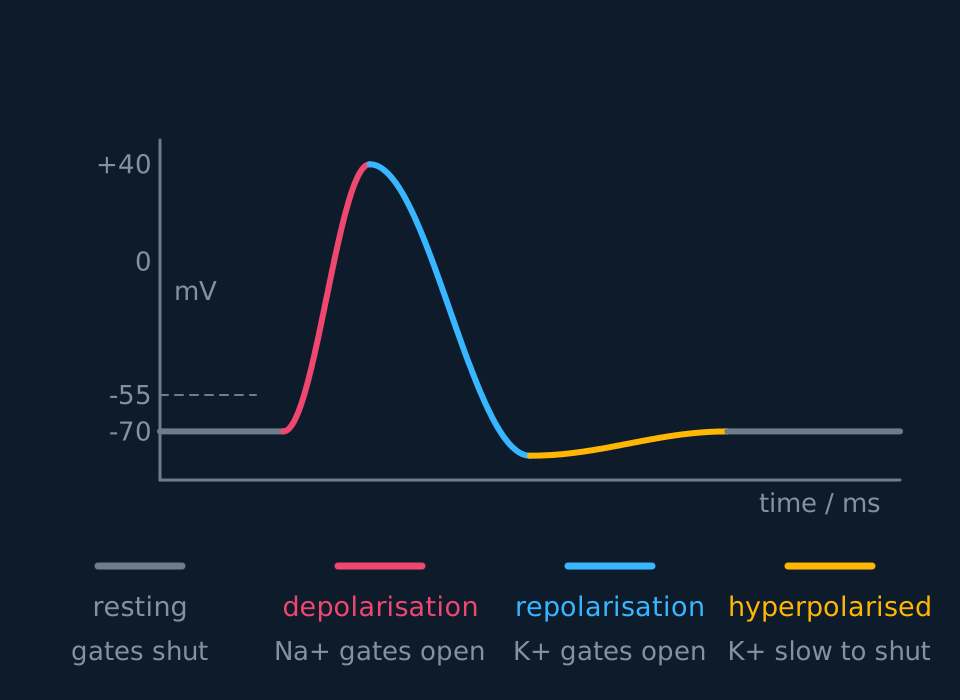
Once the membrane reaches about −55 mV the response is no longer proportional to the stimulus. The voltage-gated sodium channels open, and the remaining phases follow from the states of the sodium and potassium channels.

Describe the drawing
An animation of one action potential in five stages, each showing a patch of axon membrane with a sodium gate, a potassium gate and a sodium-potassium pump, above a graph of membrane potential that builds as the stages advance. Stage one, resting: both voltage-gated channels are shut and the pump moves three sodium ions out for every two potassium ions in, holding the inside at minus seventy millivolts. Stage two, depolarisation: the sodium gates open, sodium floods inwards and the trace climbs to plus forty. Stage three, repolarisation: the sodium gates shut, the potassium gates open and potassium leaving carries the trace back down. Stage four, the relative refractory period: the sodium gates stay shut while potassium is still leaving, so the trace dips below the resting value and only a stronger stimulus than usual could start another impulse. Stage five: the potassium gates close and the leak channels hold the trace at minus seventy again.
| Phase | Voltage-gated sodium channels | Voltage-gated potassium channels | Potential |
|---|---|---|---|
| Resting | Closed | Closed | About −70 mV, set by potassium leak channels |
| Depolarisation | Open | Closed | Rises towards a positive peak |
| Repolarisation | Inactivated | Open | Falls towards the resting value |
| Hyperpolarisation | Closed, recovering from inactivation | Closing slowly | Undershoots to about −80 mV |
Depolarisation. Voltage-gated sodium channels open and sodium ions rush in, down both their concentration gradient and the electrical gradient. The inside becomes less negative, which opens more sodium channels, which lets in more sodium: positive feedback, and the reason the rise is so steep. The potential overshoots zero and reaches a positive peak, quoted at A level as about +40 mV; the exact value depends on the axon and on the ion concentrations across its membrane.
Repolarisation. At the peak the sodium channels close, inactivating automatically after about half a millisecond, and the voltage-gated potassium channels, which are slower to respond, are by now open. Potassium ions leave, carrying positive charge out, and the potential falls back towards its resting value.
Hyperpolarisation. The potassium channels are slow to shut as well as slow to open, so potassium keeps leaving after the resting value has been passed. The inside falls to about −80 mV before the channels finally close and the membrane settles back to the resting potential, set as ever by the resting potassium permeability. The sodium-potassium pump works in the background throughout, maintaining the ion gradients that impulses spend rather than resetting the voltage after each one.
Describe the drawing
A graph of membrane potential in millivolts against time in milliseconds showing one action potential. The line rests at minus seventy, climbs steeply past the marked threshold of minus fifty-five to a peak of plus forty, falls back more slowly to an undershoot below the resting value, then returns to rest. Each part of the curve is coloured and keyed below to the gates responsible: sodium gates opening on the way up, potassium gates on the way down, and potassium gates slow to shut during the undershoot.
The spike itself lasts about a millisecond and the undershoot a few milliseconds more. Only a small fraction of the axon's ions move during one impulse, and a squid axon can fire thousands of times before the gradients fall measurably, so the pump restores the gradients over many impulses rather than after each one.
An impulse moves along an axon because each patch of membrane triggers the next. Sodium ions that have entered at the depolarised patch diffuse along the inside of the axon, and these local currents carry positive charge to the neighbouring membrane, which is still at rest. That membrane is depolarised to threshold, its voltage-gated sodium channels open, and it fires in turn. Along an unmyelinated axon this repeats patch by patch as a wave of depolarisation, and no ion travels more than a tiny distance.
Because each patch must open its own voltage-gated sodium channels, a drug that blocks those channels stops the impulse. Lidocaine, a local anaesthetic, binds to voltage-gated Na+ channels in the axon membrane and stops them letting sodium ions in. The membrane cannot depolarise to threshold, so no action potential is produced and none is passed along. Injected into a small area, such as the gum before dental work, it blocks the sensory neurones there, impulses from the pain receptors do not reach the central nervous system, and the area goes numb while the patient stays fully conscious. The effect wears off as the drug is carried away in the blood.
- Depolarisation
- A change in membrane potential that makes the inside of the cell less negative.
- Repolarisation
- The return of the membrane potential towards the resting value after depolarisation, as potassium ions leave.
- Hyperpolarisation
- A change in membrane potential that makes the inside more negative than the resting potential.
- Local currents
- The movement of ions along the inside of an axon from a depolarised region to the resting membrane next to it.
- Lidocaine
- A local anaesthetic that blocks voltage-gated sodium channels, so no action potentials are produced in the neurones it reaches.
All-or-nothing, and what varies instead
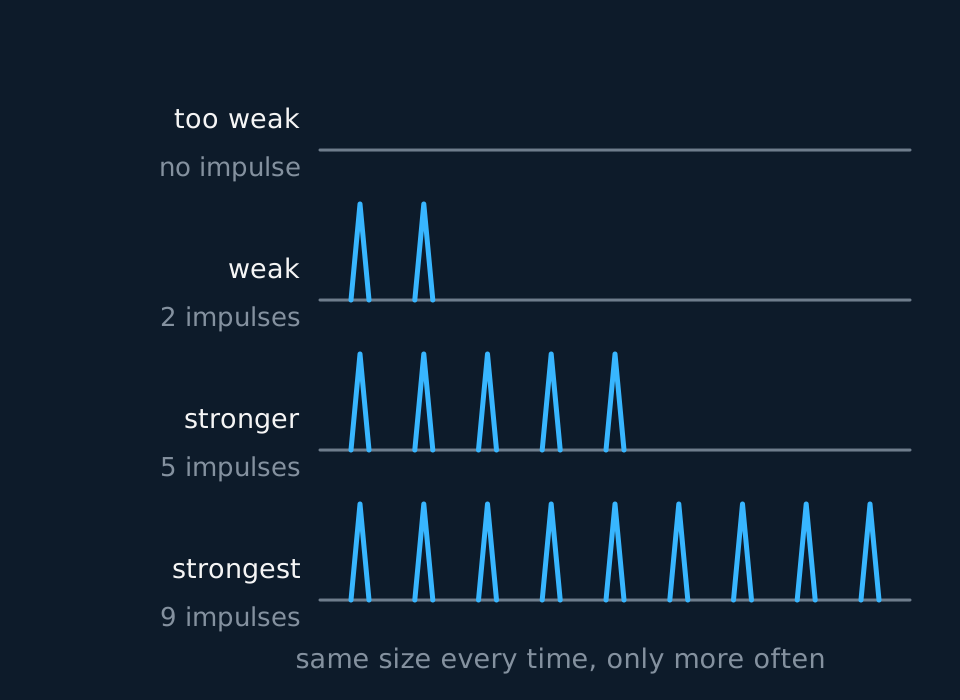
Below threshold, the small depolarisation fades and no impulse is produced. At or above threshold, a full action potential occurs, and in a given axon under fixed conditions its amplitude is the same whatever the stimulus: a stimulus a hundred times threshold produces the same peak as one just over it. This is the all-or-nothing principle, and it follows from the mechanism: once enough sodium channels have opened, the positive feedback runs to completion on its own.
Since every impulse in an axon is the same size, stimulus intensity must be represented some other way.
Describe the drawing
Four rows of axon activity drawn against the same baseline. The top row, from a stimulus too weak to reach threshold, is empty. The three rows below carry two, five and nine identical spikes as the stimulus strengthens, every spike drawn to exactly the same height, so the difference between rows is the number of impulses and not their size.
Stimulus intensity is coded in two ways, and a complete answer gives both. The frequency of impulses along a neurone rises with the strength of the stimulus, and the number of neurones firing rises too, as receptors with higher thresholds are brought in. Nothing about the amplitude changes, ever.
Reading a trace from an experiment
A student records from a single sensory neurone. With a stimulus of 2 units they record 15 impulses in a second; with 6 units they record 45 impulses in a second, each of the same amplitude. A classmate says the second stimulus produced 'three times the signal'. Is that a fair description?
Show the working
The description is correct about the message and incorrect about the mechanism. The frequency has tripled, from 15 Hz to 45 Hz, and frequency is exactly how intensity is coded, so the nervous system does receive a stronger message.
Each impulse is unchanged: same peak, same duration, same shape. Describing the action potentials as larger would contradict the recorded amplitudes.
There is also a ceiling implied by these numbers. The refractory period sets a minimum interval between impulses, so above some stimulus strength the frequency in this one neurone cannot rise further, and any further increase has to be reported by recruiting other neurones.
- All-or-nothing principle
- Once threshold is reached an action potential of full size is produced; below threshold none is produced at all.
The refractory period, and the three things it does
For a short time after an action potential the membrane cannot produce another. During the absolute refractory period the sodium channels are inactivated and no stimulus of any size will do anything; during the relative refractory period that follows, the membrane is hyperpolarised and only an unusually strong stimulus will work. Together they last a millisecond or two.
Three consequences follow from the refractory period.
Impulses stay discrete. One action potential cannot merge into the next, so a train of impulses arrives as separate events that can be counted, which is what makes frequency usable as a code in the first place.
Impulses travel in one direction. The patch of membrane behind the impulse has just fired and is refractory, so it cannot be depolarised again by its neighbour. The only membrane available to depolarise is the patch ahead, and the wave moves forwards.
There is an upper limit on frequency. If the refractory period lasts about 2 ms, the neurone cannot fire more often than about 500 times a second, which caps how intense a stimulus a single neurone can report. Beyond that, the extra information has to come from other neurones joining in.
- Refractory period
- The short time after an action potential during which the membrane cannot produce another, or can do so only with a larger stimulus.
How fast, and what changes it
Conduction speed varies enormously between neurones, from under 1 m s⁻¹ to about 100 m s⁻¹, and three factors account for the range.
A myelinated motor neurone carries impulses from the CNS to an effector. Its cell body, holding the nucleus, lies in the CNS, with short dendrites that collect input from other neurones. A single long axon runs from the cell body to the effector, wrapped along its length by Schwann cells whose layers of membrane form the myelin sheath, and broken at intervals by the nodes of Ranvier. At the effector the axon divides into terminals, each ending at a neuromuscular junction.
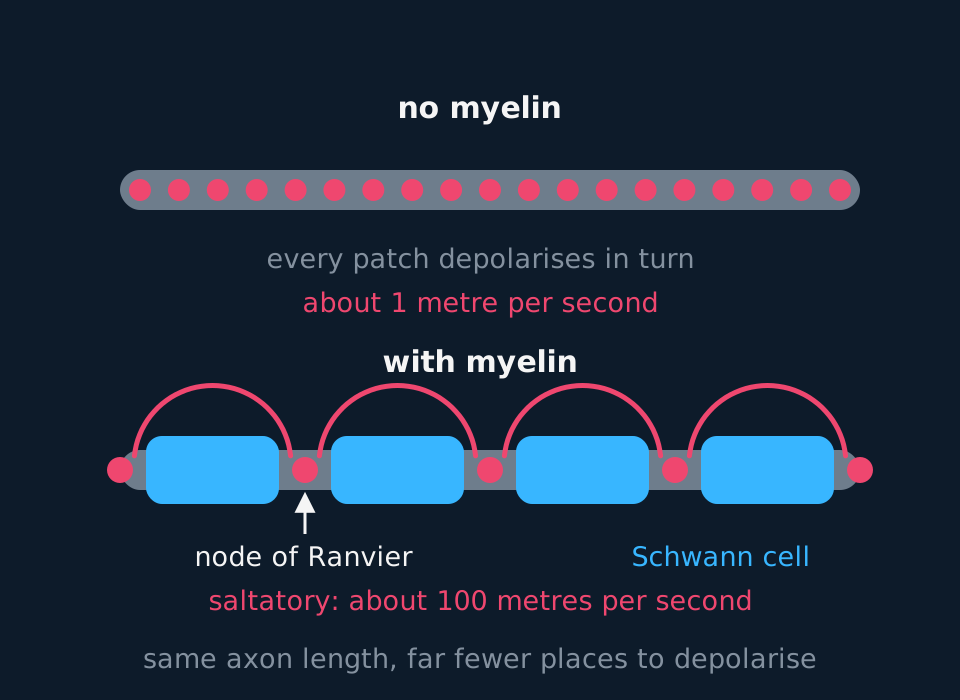
Myelination. Schwann cells wrap themselves round an axon many times, and the layers of membrane act as an electrical insulator. Ions cannot cross where the myelin is, so depolarisation can only happen at the nodes of Ranvier, the gaps between adjacent Schwann cells, spaced every millimetre or so. The local currents therefore flow from node to node and the impulse jumps the insulated stretches between them. This is saltatory conduction, and because far fewer patches of membrane have to be depolarised, it is dramatically faster.
Describe the drawing
Two axons of the same length drawn one above the other. The upper axon is bare, with nineteen evenly spaced dots marking every patch of membrane that has to depolarise in turn, and is labelled about one metre per second. The lower axon is wrapped in Schwann cells with five bare nodes of Ranvier between them, and curved arrows leap from node to node over the myelin, labelled about one hundred metres per second.
Axon diameter. A wider axon offers less resistance to the flow of ions along its length, so local currents spread further and depolarise the membrane ahead more quickly. There is also proportionally less leakage of charge across the membrane. Invertebrates without myelin reach high conduction speeds through diameter alone: the squid's giant axon is about a millimetre across, and it conducts the impulses of a rapid escape response.
Temperature. Ions diffuse faster when warmer, and the pump and channel proteins work faster too, so conduction speeds up as temperature rises through the physiological range. Push far enough above an animal's normal operating temperature and conduction becomes unreliable and eventually fails, at a temperature that varies between species. This is why an ectotherm is sluggish on a cold morning and why experiments on nerve speed always state the temperature.
| Factor | Effect on speed | Why |
|---|---|---|
| Myelination | Up to about 100 m s⁻¹, against about 1 m s⁻¹ without | Depolarisation only at the nodes: saltatory conduction |
| Axon diameter | Wider is faster | Less resistance to ion flow along the axon, less leakage |
| Temperature | Faster when warmer, over the physiological range | Faster diffusion and faster channel and pump proteins; failure well above normal operating temperature |
TRY IT: Explaining a symptom from the biology
In multiple sclerosis the immune system destroys patches of the myelin sheath around axons in the central nervous system. Suggest why this produces slowed and unreliable responses.
Check your answer
Without myelin over a stretch of axon, saltatory conduction is lost there. The impulse can no longer jump from node to node, so every patch of membrane along the damaged stretch has to be depolarised in turn, and conduction along it slows towards the 1 m s⁻¹ of an unmyelinated axon.
Responses that depend on those neurones are therefore delayed, and because the delay differs from axon to axon, signals that should arrive together no longer do, which affects coordination and balance as much as it affects speed.
Where the damage is severe, local currents may not depolarise the next node to threshold at all, and the impulse fails completely. That is why the effects range from mild slowing to loss of function, depending on how much of the sheath has gone.
- Myelin sheath
- Layers of Schwann cell membrane wrapped round an axon, insulating it so that ions cannot cross the membrane beneath.
- Node of Ranvier
- A gap in the myelin sheath between adjacent Schwann cells, where the axon membrane can depolarise.
- Saltatory conduction
- Conduction along a myelinated axon in which depolarisation occurs only at the nodes of Ranvier, so the impulse jumps from node to node.
In the exam
- Name the ion in every statement: which ion moved, in which direction, and through which channel or pump.
- The pump moves three sodium ions out for two potassium ions in, using ATP. Quote the ratio, since it accounts for the sign of the resting potential.
- Depolarisation means the inside becomes less negative; it is not a synonym for the impulse. To describe an action potential, name the channels in order.
- A stronger stimulus does not produce a larger action potential. Intensity is coded by the frequency of impulses and by the number of neurones firing.
- For saltatory conduction, state that depolarisation occurs only at the nodes of Ranvier and that local currents flow between them. That the myelin makes conduction faster is the observation, not the explanation.
- Use any temperature or axon diameter given in the question when accounting for a conduction speed.
Check yourself
A neurone is treated with a drug that blocks voltage-gated potassium channels but leaves the sodium channels and the sodium-potassium pump working. Predict the effect on the shape of an action potential in that neurone, and explain each part of your prediction.
Answer
The rising phase would be unchanged. Depolarisation depends on voltage-gated sodium channels opening and sodium ions entering, and neither is affected, so the membrane would still reach about +40 mV at the same rate.
Repolarisation would be much slower. Normally potassium ions leave through the voltage-gated potassium channels, carrying positive charge out and bringing the potential down quickly. With those channels blocked, the fall would depend on the pump and on whatever leakage remains, both far slower, so the action potential would be prolonged.
The hyperpolarisation would be reduced or absent altogether. The undershoot exists because potassium continues to leave after the resting value is passed, and if that exit is blocked there is nothing to carry the potential below −70 mV.
A prolonged action potential also lengthens the refractory period, so the neurone could not fire as often. Its maximum frequency would fall, and with it the intensity of stimulus it can report.
Questions
Question 14 marks
Explain how the sodium-potassium pump and the permeability of the axon membrane together establish a resting potential of about −70 mV.
Mark scheme
- B1 the pump hydrolyses ATP to move three sodium ions out for every two potassium ions in, both against their concentration gradients
- B1 three positive charges leave for every two that enter, so each cycle of the pump makes the inside slightly more negative
- B1 the membrane has many potassium channels open at rest and very few sodium channels, so it is far more permeable to potassium than to sodium
- A1 potassium therefore leaks back out down the steep gradient the pump has built, carrying positive charge with it, while large negatively charged proteins are trapped inside and cannot leave
Question 24 marks
Describe the changes in membrane potential during an action potential, from threshold to the recovery of the resting value, in terms of which voltage-gated channels are open at each point.
Mark scheme
- B1 at about −55 mV voltage-gated sodium channels open and sodium ions diffuse in, so the inside becomes less negative
- B1 the depolarisation opens more sodium channels, which is positive feedback, and the potential overshoots zero to reach about +40 mV
- B1 at the peak the sodium channels inactivate and the slower voltage-gated potassium channels are now open, so potassium leaves and the potential falls back: repolarisation
- A1 the potassium channels are slow to shut, so potassium keeps leaving past the resting value to about −80 mV, and the resting potential returns as they close, set by the resting potassium permeability
Question 34 marks
Explain what is meant by the all-or-nothing principle, and explain how the nervous system distinguishes a light touch from a heavy blow if every action potential is the same size.
Mark scheme
- B1 below threshold no action potential is produced at all, and the small depolarisation simply fades away
- B1 at or above threshold a full action potential occurs and reaches the same peak of about +40 mV whatever the size of the stimulus, because the positive feedback runs to completion on its own
- B1 a stronger stimulus increases the frequency of impulses along a neurone
- A1 a stronger stimulus also recruits more neurones, as receptors with higher thresholds are brought in, and nothing about the amplitude of any impulse changes
Question 44 marks
Explain what causes the refractory period after an action potential, and explain two consequences it has for the impulses a neurone can carry.
Mark scheme
- B1 during the absolute refractory period the voltage-gated sodium channels are inactivated, so no stimulus of any size can produce another action potential
- B1 during the relative refractory period that follows the membrane is hyperpolarised, so an unusually strong stimulus is needed
- B1 the patch of membrane behind the impulse has just fired and is refractory, so only the membrane ahead can be depolarised and the impulse travels in one direction
- A1 the refractory period sets a minimum interval between impulses, so it keeps them as separate countable events and puts an upper limit on the frequency a single neurone can reach
Question 54 marks
An action potential is recorded 8.4 cm along an axon from the point of stimulation, 1.2 ms after the stimulus was applied. Calculate the conduction velocity of this axon in metres per second, and calculate how long an impulse would take to travel 1.4 m along an unmyelinated axon conducting at 1.0 m s⁻¹.
Mark scheme
- M1 velocity is distance divided by time, with both converted to metres and seconds: 8.4 cm is 0.084 m and 1.2 ms is 1.2 × 10⁻³ s
- A1 0.084 ÷ 0.0012 gives a conduction velocity of 70 m s⁻¹
- M1 time is distance divided by velocity, so 1.4 ÷ 1.0
- A1 1.4 s, which is seventy times the 20 ms the myelinated axon would take over the same distance
Question 64 marks
Lidocaine is injected into the gum before a tooth is filled. Lidocaine blocks voltage-gated sodium ion channels. Explain why the patient feels no pain from the tooth during the treatment, although they remain fully conscious.
Mark scheme
- B1 lidocaine prevents the voltage-gated sodium channels in the membranes of the sensory neurones from opening, so sodium ions cannot diffuse in
- B1 the membrane cannot be depolarised to threshold, so no action potentials are produced
- B1 local currents cannot depolarise the next region of membrane either, so no impulses are propagated along the axons to the central nervous system and the pain is not perceived
- B1 the drug acts only on the neurones in the injected area, so neurones in the brain and elsewhere keep working and the patient stays conscious
Question 74 marks
Describe how myelination increases the conduction velocity of an axon, using the term saltatory conduction in your answer.
Mark scheme
- B1 the layers of membrane wrapped round the axon by Schwann cells act as an electrical insulator, so ions cannot cross the membrane where the myelin is present
- B1 depolarisation can therefore only happen at the nodes of Ranvier, the gaps between adjacent Schwann cells
- B1 local currents flow from node to node, so the impulse appears to jump between them, which is called saltatory conduction
- B1 far fewer patches of membrane have to be depolarised than on a bare axon of the same length, which is why conduction is dramatically faster
Question 84 marks
A patch of myelin around an axon in the spinal cord is destroyed by disease, but the axon itself is undamaged. Suggest what this does to the speed of conduction along the damaged stretch, and suggest why transmission can fail altogether if enough consecutive nodes of Ranvier are affected.
Mark scheme
- B1 without myelin over that stretch, saltatory conduction is lost there, so every patch of membrane along it has to be depolarised in turn rather than the impulse jumping between nodes
- B1 conduction along the damaged stretch slows towards the much lower speed typical of an unmyelinated axon
- B1 local currents decay with distance, and normally still reach the next node large enough to bring it to threshold
- B1 if several exposed nodes lie in a row, the current arriving at the next one may be too weak to reach threshold, so no action potential is generated there and transmission along that axon fails
Question 94 marks
A sensory neurone has an absolute refractory period of 2.0 ms. Calculate the maximum frequency, in impulses per second, at which it could fire, and calculate how many impulses it could send in 5 seconds at that maximum frequency.
Mark scheme
- M1 maximum frequency is the reciprocal of the refractory period, converted to seconds: 1 ÷ 0.0020
- A1 500 impulses per second
- M1 number of impulses in 5 s is frequency multiplied by time: 500 × 5
- A1 2500 impulses in the 5 seconds
Question 103 marks
A local anaesthetic injected at a tooth blocks the voltage-gated sodium channels in the sensory neurones nearby. Suggest why the patient feels no pain from the tooth, and suggest why the sense of touch in the lip on that side is lost as well.
Mark scheme
- B1 with the voltage-gated sodium channels blocked, sodium ions cannot rush into the axon, so the membrane cannot depolarise to +40 mV and no action potential is generated
- B1 no impulses therefore reach the brain from the receptors in the tooth, and pain is only felt when impulses arrive there
- B1 the drug cannot distinguish one neurone from another, so it blocks the channels in every axon it reaches, including those carrying impulses from touch receptors in the lip
Question 113 marks
Give the resting potential and the peak potential from the trace, and calculate the size of the depolarisation in millivolts.
Mark scheme
- B1 the resting potential is −70 mV
- M1 the peak is +40 mV, and the depolarisation is the peak minus the resting potential
- A1 40 − (−70) = 110 mV
Question 123 marks
The trace falls below the resting potential before returning to it. Explain what causes this undershoot, and explain what it means for a second stimulus arriving at that moment.
Mark scheme
- B1 the voltage-gated potassium channels are slow to close, so potassium ions keep leaving after the resting potential has been reached
- B1 the inside of the axon therefore becomes more negative than −70 mV, which is hyperpolarisation
- B1 this is the relative refractory period: a second stimulus has further to depolarise the membrane to reach threshold, so only a larger stimulus produces another action potential and the impulses stay discrete
Question 133 marks
Explain why a wider axon conducts impulses faster than a narrower axon of the same type, even though the size of a single action potential is unaffected by the axon's diameter.
Mark scheme
- B1 a wider axon offers less resistance to the flow of ions along its length, and proportionally less charge leaks away across the membrane as it travels
- B1 local currents therefore spread further along the axon before they die away, and depolarise the membrane ahead to threshold more quickly
- B1 axon diameter affects how fast an existing action potential's local currents spread, not the size of the action potential itself, which is set by the same voltage-gated channels regardless of diameter
Question 143 marks
Compare what happens to conduction velocity when an axon from a frog is warmed from 10 °C to 20 °C with what happens when it is warmed from its normal operating temperature to a temperature well above it.
Mark scheme
- B1 warming from 10 °C to 20 °C, within the physiological range, increases conduction velocity, because ions diffuse faster and the pump and channel proteins work faster, whereas warming well above the normal operating temperature does not continue that rise
- B1 at the higher extreme the proteins responsible for generating and propagating the impulse are disrupted, so conduction instead becomes unreliable and can fail
- B1 together the two results show that raising temperature raises conduction speed only up to a point set by the animal's normal operating range, beyond which the benefit is reversed
Question 153 marks
Explain why the sodium-potassium pump could not, on its own, produce the rapid depolarisation seen during an action potential.
Mark scheme
- B1 the pump moves three sodium ions out for every two potassium ions in, a net loss of positive charge from the axon, so it makes the inside more negative and can never depolarise the membrane
- B1 the pump works continuously by active transport against the ion gradients, whereas depolarisation depends on sodium ions diffusing rapidly down a steep gradient once channels open, which is intrinsically far faster
- B1 depolarisation depends on large numbers of voltage-gated sodium channels opening together, which produces the positive feedback that drives the rapid rise; the pump has no such mechanism
Question 162 marks
State the resting potential of a typical neurone in millivolts, and state the ratio in which the sodium-potassium pump moves the two ions across the membrane.
Mark scheme
- B1 the resting potential is about −70 mV, with the inside negative relative to the outside
- B1 the pump moves three sodium ions out for every two potassium ions in
Worth remembering
- Resting potential is about −70 mV, held by a 3:2 pump and a membrane far more permeable to potassium than to sodium.
- Sodium in for the rise, potassium out for the fall, potassium slow to shut for the undershoot.
- All action potentials in a given axon under fixed conditions are the same size; intensity is coded by frequency and by the number of neurones firing.
- The refractory period keeps impulses discrete, keeps them one-way, and caps their frequency.
- Conduction is faster in myelinated, wide and warm axons and slower in bare, narrow and cold ones.
CHECK YOUR PROGRESS
Rate how confident you are with each objective for this lesson. Ratings are saved in this browser, on this device, unless you sign in.
- Explain how the sodium-potassium pump and the membrane's permeability produce a resting potential of about −70 mV.
- Describe depolarisation, repolarisation and hyperpolarisation in terms of which gates are open.
- Explain how local currents carry an impulse along an unmyelinated axon.
- State the all-or-nothing principle and say what does vary with stimulus strength.
- Explain the refractory period and give its three consequences.
- Account for conduction speed using myelination, axon diameter and temperature.
- Explain how lidocaine acts as a local anaesthetic by blocking voltage-gated sodium channels.
Open the full revision checklist to see every objective in the curriculum in one place.
Practise this lesson
WORKBOOK
The written questions from this topic, on paper with room to work, and a separate book of mark schemes. The 2 questions that are set on a diagram stay on this page, where the diagram can be drawn. Free to use; please do not redistribute or sell.