Biology › Membranes and transport across cells › Active transport, co-transport and bulk transport
Active transport, co-transport and bulk transport
Moving a substance against its electrochemical gradient requires an energy source. The topics covered are carrier proteins that hydrolyse ATP, the sodium-potassium pump that moves three sodium ions out for every two potassium ions in, sodium-glucose co-transport in the ileum, and endocytosis and exocytosis for material too large to cross through a transport protein.
Before this Diffusion and facilitated diffusion · ATP as the cell's immediate energy source
COMMON MISCONCEPTION
A carrier protein is involved, so this must need energy.
The carrier protein is not what costs ATP: facilitated diffusion uses carriers and needs none. What costs energy is the direction, moving a substance from where there is less of it to where there is more.
What you should be able to do
- Explain how a carrier protein moves a substance against its concentration gradient, and where the energy comes from.
- Describe the sodium-potassium pump, quoting what moves in each direction for each ATP hydrolysed.
- Work through co-transport of glucose in the ileum as an ordered sequence, and say which step uses ATP.
- Distinguish endocytosis from exocytosis and give a named example of each.
- Compare all the transport mechanisms by direction, proteins used and energy required.
Active transport against a gradient
Diffusion proceeds down a gradient and ceases when the gradient is abolished. A cell with only diffusion available could not concentrate any substance: root hair cells could not take up nitrate ions from soil in which nitrate is more dilute than in the cell, and the ileum could not absorb the remaining glucose from a meal once blood glucose exceeded gut glucose. Active transport makes both possible, and it is defined by direction and by its energy requirement.
- Active transport
- The movement of a substance across a membrane against its concentration gradient, using a carrier protein and energy from the hydrolysis of ATP.
- Carrier protein
- An intrinsic protein with a binding site specific to one substance, which changes shape to move it across the membrane.
Active transport moves a substance against its electrochemical gradient and therefore requires an energy source. In primary active transport, a membrane protein couples ATP hydrolysis directly to transport. In P-type ATPases, including the sodium-potassium pump, phosphorylation changes the protein's conformation; other ATP-driven transporters use different coupling mechanisms.
Carrier proteins are specific and finite in number, so transport rate reaches a maximum when the available proteins are occupied. Inhibiting respiration reduces ATP supply and therefore reduces primary active transport, although ATP from glycolysis may sustain some activity for a short time.
For a P-type ATPase, write the mechanism as an ordered sequence. The substance binds to a specific site on the carrier protein, on the side it is starting from. ATP binds to the protein and is hydrolysed to ADP and inorganic phosphate. The phosphate group attaches to the protein, and that attachment changes the protein's tertiary structure, so the binding site now faces the other side of the membrane and holds the substance more weakly. The substance is released. The phosphate detaches, the protein returns to its original conformation and the cycle can repeat.
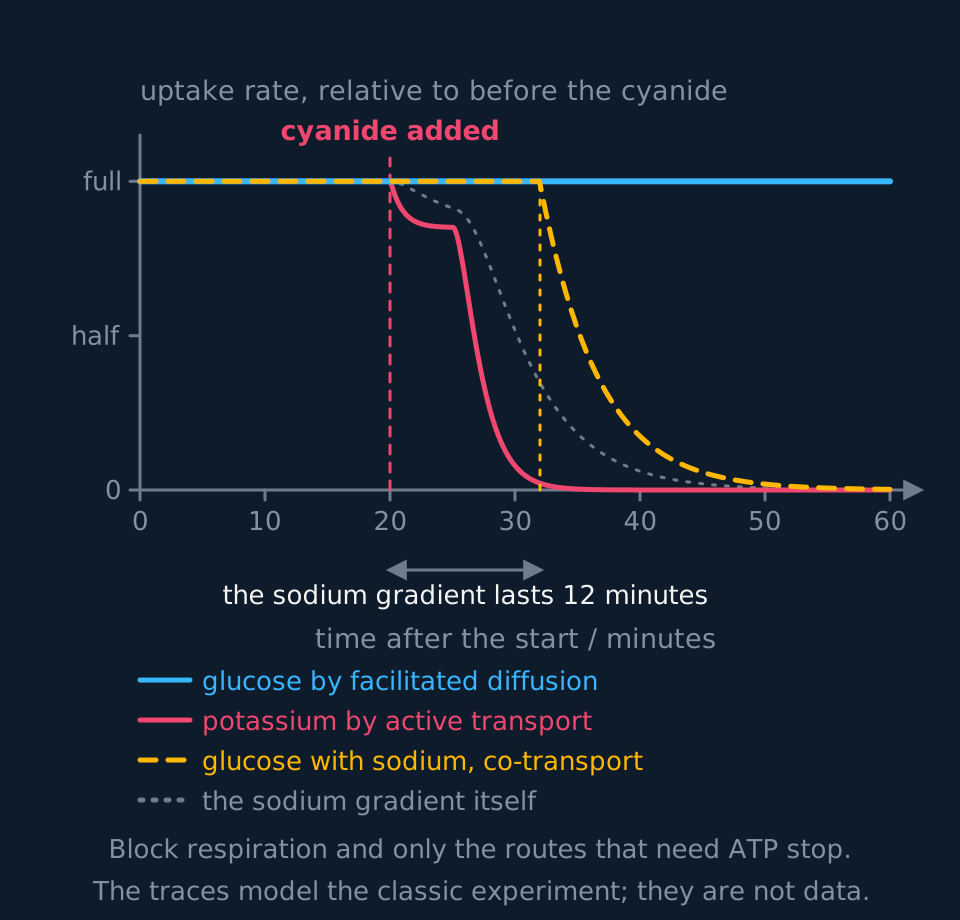
Because active transport depends on ATP supply, a respiratory inhibitor such as cyanide reduces it while facilitated diffusion continues. Two qualifications apply to that experiment: glycolysis still yields some ATP without oxygen, so transport may at first only slow, and co-transport continues until the ion gradient behind it has dissipated. The comparison is still the experimental means of distinguishing the two processes when data are supplied.
Describe the drawing
A modelled experiment rather than measured data. Four traces share one time axis, with the moment cyanide is added marked by a vertical line. Facilitated diffusion of glucose runs on at full rate, entirely unchanged. Active transport of potassium holds up for about five minutes on the ATP that glycolysis can still make, then falls away to nothing. Co-transport of glucose with sodium keeps its full rate for about twelve minutes and only then falls, and the fourth trace, the sodium gradient itself, crosses the level it needs at exactly that moment.
Cells with a high rate of active transport show two adaptations. An epithelial cell in a kidney tubule or the ileum contains many mitochondria, which supply ATP by aerobic respiration, and its exchange surface is folded into microvilli, which increase the surface area available for transport proteins.
The sodium-potassium pump
The best-studied example sits in the surface membrane of virtually every animal cell and runs continuously for the life of the cell.
Describe the drawing
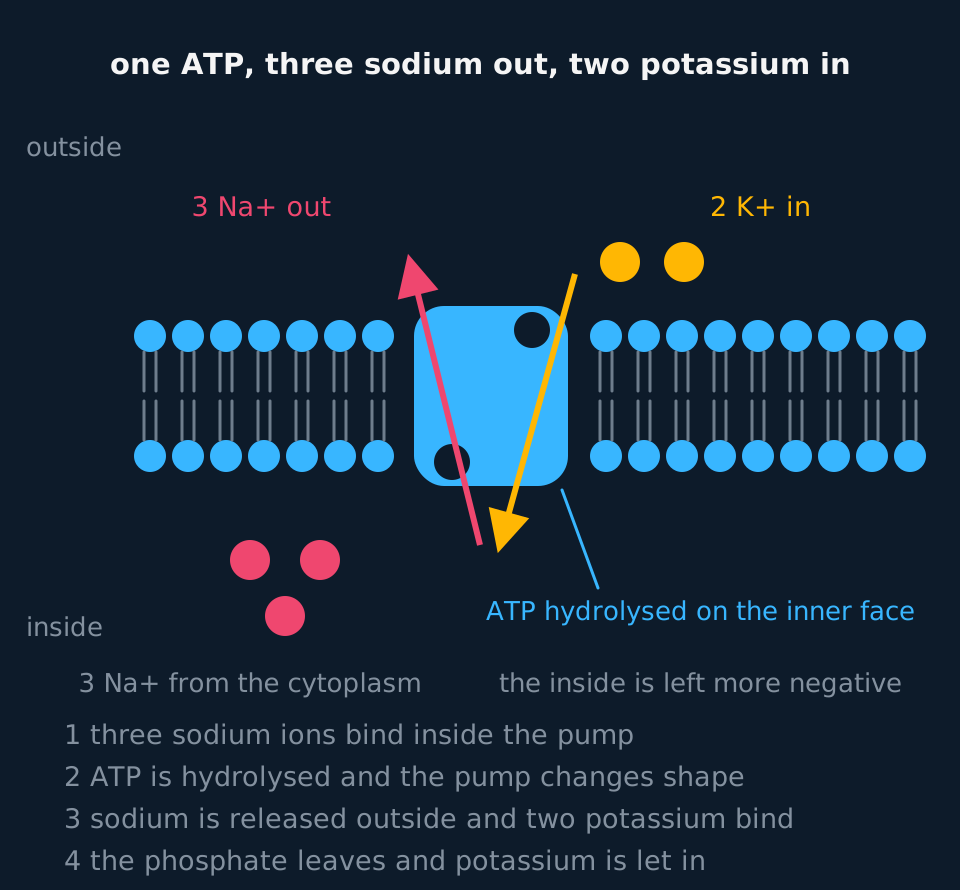
A membrane with a large carrier protein set through it. Below the membrane, inside the cell, three ions are drawn and labelled sodium; above the membrane, outside the cell, two ions are drawn and labelled potassium. One thick arrow runs from the three sodium ions up through the protein to the outside, and a second arrow runs from the two potassium ions down through it to the inside. A numbered list of four steps runs along the bottom, beginning with sodium binding and ending with potassium entering.
For each ATP hydrolysed, the pump moves three sodium ions out of the cell and two potassium ions in. Both movements are against the ion's gradient: sodium is already more concentrated outside, potassium already more concentrated inside, and the pump is what made that true in the first place.
Because the exchange is uneven, the pump is electrogenic. It moves net positive charge out and leaves the inside of the cell more negative than the outside. That contributes to the resting potential of a neurone, which is covered in the action potential topic. The pump also accounts for a large share of a cell's ATP consumption: roughly a quarter of the ATP produced in a resting cell, and a higher proportion in nerve tissue, where the ion distribution must be restored after each impulse.
The gradients the pump maintains are themselves a store of potential energy. A steep sodium gradient across a membrane can be coupled to the transport of another substance as sodium moves back down it, which is the basis of co-transport.
Co-transport in the ileum
Glucose absorption in the small intestine is the standard example. Glucose moves from the gut lumen into the epithelial cell even when the cell already contains more glucose than the lumen, which no diffusion mechanism could achieve, yet the protein carrying it hydrolyses no ATP.
Describe the drawing
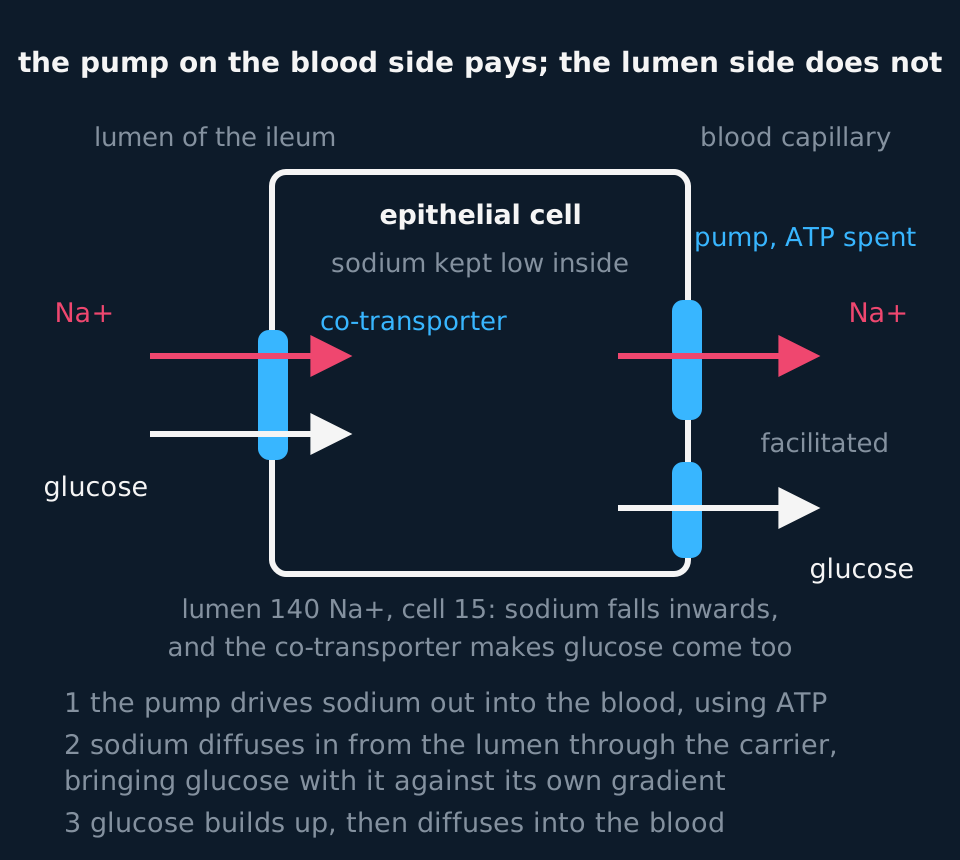
An epithelial cell of the ileum drawn as a large box with the gut lumen on the left and a blood capillary on the right. Two proteins sit in the left-hand membrane and two in the right. Arrows show sodium and glucose entering together from the lumen through one protein, sodium being pumped out into the blood at the top right using ATP, and glucose leaving into the blood lower down. A numbered list of three steps runs along the bottom.
The sequence in order:
The four steps and the location of the ATP
Explain how glucose is absorbed from the lumen of the ileum into the blood, including the role of ATP.
Show the working
1. Sodium-potassium pumps in the membrane facing the blood capillary actively transport sodium ions out of the epithelial cell, using ATP. This keeps the concentration of sodium ions inside the cell low, far lower than in the gut lumen.
2. Sodium ions therefore diffuse from the lumen into the cell down their own concentration gradient, through a co-transporter protein in the membrane facing the lumen.
3. That protein carries sodium only when it carries glucose at the same time, so glucose is carried in alongside the sodium, against its own concentration gradient, without the protein itself hydrolysing ATP.
4. Glucose accumulates in the cell until its concentration exceeds that in the blood, and then leaves into the capillary by facilitated diffusion through a separate carrier protein, down its gradient.
Begin the sequence at step 1. Starting at step 2 describes the mechanism without stating what establishes the sodium gradient, and omits the role of ATP.
- Co-transport
- The transport of two substances across a membrane by the same carrier protein at the same time, in which one moves down its concentration gradient and provides the means for the other to move against its own.
Because the process depends on the sodium gradient rather than on ATP at the co-transporter, it is sometimes called indirect or secondary active transport. Amino acids are absorbed the same way, and the kidney reabsorbs glucose from the filtrate in the proximal convoluted tubule using exactly this arrangement, which is why glucose appears in the urine of an untreated diabetic only once the co-transporters are saturated.
Endocytosis and exocytosis
Endocytosis moves material into a cell by forming a vesicle from the cell-surface membrane. Phagocytosis takes in large particles such as bacteria; pinocytosis takes in extracellular fluid; receptor-mediated endocytosis selects molecules that bind to membrane receptors. Exocytosis releases material when an intracellular vesicle fuses with the cell-surface membrane.
A transport protein carries an ion or a sugar. Material such as a bacterium, a droplet of fluid or a vesicle of digestive enzymes is moved by the membrane itself, which is possible because the membrane is fluid.
In phagocytosis, a neutrophil engulfing a bacterium forms a phagosome, which then fuses with a lysosome so that hydrolytic enzymes can digest the contents. In receptor-mediated endocytosis, a receptor on the membrane binds a specific molecule first, as in the uptake of cholesterol packaged as LDL.
In exocytosis the sequence is reversed. A vesicle, usually from the Golgi apparatus, moves to the cell surface membrane, the two membranes fuse, and the contents are released outside. Insulin leaving a β cell of the pancreas, digestive enzymes leaving an acinar cell and neurotransmitter leaving the presynaptic membrane are all released by exocytosis, which requires ATP for the movement of the vesicle along the cytoskeleton and for the fusion itself.
- Endocytosis
- The bulk transport of material into a cell by invagination of the cell surface membrane to form a vesicle; requires ATP.
- Exocytosis
- The bulk transport of material out of a cell by fusion of a vesicle with the cell surface membrane; requires ATP.
Both processes depend on the membrane being fluid enough to bend, pinch and fuse, which is an observable consequence of the fluid mosaic model. Both also depend on proteins that diagrams usually omit: coat proteins that shape the pit, motor proteins that move the vesicle along the cytoskeleton, and fusion proteins that bring the two membranes together. What bulk transport lacks is a transport protein with a binding site for the material moved, not proteins altogether.
The transport mechanisms compared
Learn the columns rather than the rows. For any named process, state its direction relative to the gradient, whether a protein is involved, and whether ATP is required.
| Process | Direction | Protein | ATP | Example |
|---|---|---|---|---|
| Simple diffusion | Down the gradient | None | No | Oxygen into a red blood cell |
| Facilitated diffusion | Down the gradient | Channel or carrier | No | Glucose into a red blood cell |
| Osmosis | Water: high to low water potential | Aquaporins, and the bilayer | No | Water into a root hair cell |
| Active transport | Against the gradient | Carrier | Yes | Nitrate ions into a root hair cell |
| Co-transport | One down, one against | Co-transporter | Not at the carrier itself | Glucose with sodium in the ileum |
| Endocytosis | Bulk, into the cell | No transport protein; coat and motor proteins shape and move the vesicle | Yes | A neutrophil engulfing a bacterium |
| Exocytosis | Bulk, out of the cell | No transport protein; motor and fusion proteins do the work | Yes | Insulin released from a β cell |
Sodium-glucose co-transport is secondary active transport. The co-transporter does not hydrolyse ATP directly; it uses the sodium electrochemical gradient established by the ATP-dependent sodium-potassium pump.
In the exam
- Name the energy source precisely: 'ATP hydrolysed to ADP and inorganic phosphate', rather than 'energy'.
- For the sodium-potassium pump, quote the stoichiometry: three sodium ions out, two potassium ions in, per ATP hydrolysed.
- In co-transport questions, begin with the pump: 'sodium is actively transported out of the cell into the blood'. That step establishes the gradient the rest of the sequence depends on.
- State the effect of the ATP on the protein: for a P-type ATPase, the phosphate group binds and the tertiary structure changes, so the binding site faces the other side of the membrane.
- If a question gives you data on a respiratory inhibitor, use it. A substance whose uptake stops when respiration is blocked is being actively transported; one whose uptake continues is not.
- Endocytosis and exocytosis both require ATP, even though no carrier protein is involved. The ATP is used for vesicle movement and membrane fusion.
Check yourself
Cells lining the proximal convoluted tubule of the kidney reabsorb glucose from the filtrate even when the concentration of glucose in the filtrate is lower than in the cell. These cells have many mitochondria and their surface facing the filtrate is covered in microvilli. Explain how glucose is reabsorbed, and account for the two features described.
Answer
Sodium-potassium pumps in the membrane facing the blood actively transport sodium ions out of the cell, hydrolysing ATP to do it. This keeps the concentration of sodium ions inside the cell low.
A sodium gradient therefore exists between the filtrate and the cell, and sodium ions diffuse in down it through a co-transporter protein in the membrane facing the filtrate. The same protein carries glucose at the same time, so glucose is brought in with the sodium against its own concentration gradient. No ATP is used at this protein: the energy came from the gradient the pump established.
Glucose then leaves the cell into the blood by facilitated diffusion through a carrier protein, down its concentration gradient, and the blood carries it away, which keeps that gradient in place.
The many mitochondria supply ATP by aerobic respiration for the sodium-potassium pumps, which run continuously and account for a large share of the cell's energy budget. The microvilli increase the surface area of the membrane facing the filtrate, so more co-transporter proteins can be held there and the rate of uptake is higher, which is the surface area term of the same relationship that governs diffusion.
Questions
Question 14 marks
Describe how a carrier protein moves a substance across a membrane by active transport, from the substance binding to the protein returning to its original shape.
Mark scheme
- B1 the substance binds to a specific binding site on the carrier protein, on the side it is starting from
- B1 ATP binds to the protein and is hydrolysed to ADP and inorganic phosphate
- B1 the phosphate group attaches to the protein and changes its tertiary structure, so the binding site now faces the other side of the membrane
- B1 the substance is released, the phosphate detaches, and the protein returns to its original shape ready to repeat the cycle
Question 24 marks
Explain why the absorption of glucose from the lumen of the ileum is described as active, even though the co-transporter protein that carries the glucose hydrolyses no ATP.
Mark scheme
- B1 glucose is moved into the epithelial cell against its own concentration gradient, which diffusion alone could never achieve
- B1 sodium-potassium pumps in the membrane facing the blood hydrolyse ATP to move sodium ions out of the cell, keeping the concentration of sodium inside the cell low
- B1 sodium ions then diffuse in from the lumen down the gradient this creates, through the co-transporter protein, which carries glucose at the same time
- B1 the ATP was therefore spent earlier, at a different protein and on a different ion; the energy is held in the sodium gradient rather than used at the co-transporter
Question 34 marks
Compare endocytosis with exocytosis, referring to the direction of movement, what the membrane does, and the energy required.
Mark scheme
- B1 in endocytosis material is brought into the cell, whereas in exocytosis material is released out of the cell
- B1 in endocytosis the cell surface membrane invaginates around the material and pinches off to form a vesicle, whereas in exocytosis a vesicle fuses with the cell surface membrane
- B1 both move material in bulk, with no channel or carrier protein involved
- B1 both require ATP, for moving the vesicle along the cytoskeleton and for the pinching off or fusion of the membrane
Question 44 marks
A tissue takes up two substances, X and Y. When a respiratory inhibitor is added, uptake of X falls almost to zero within minutes while uptake of Y continues unchanged. Suggest what this shows about how each substance crosses the membrane, and suggest one further observation that would support your conclusion about X.
Mark scheme
- B1 X is taken up by active transport, because its uptake depends on ATP from aerobic respiration
- B1 the inhibitor stops ATP production by aerobic respiration, so the carrier proteins cannot be phosphorylated and the shape change that carries X across cannot happen
- B1 Y crosses by a passive process, simple or facilitated diffusion, because it requires no ATP and is therefore unaffected by the inhibitor
- B1 any one supporting observation: X accumulating inside the cell to a higher concentration than outside, or uptake of X falling when the oxygen concentration is lowered
Question 54 marks
Compare primary active transport with co-transport, referring to where ATP is used and to what actually moves the transported substance against its gradient.
Mark scheme
- B1 in primary active transport, ATP is hydrolysed directly at the carrier protein moving the substance, such as the sodium-potassium pump
- B1 in co-transport, ATP is not hydrolysed at the co-transporter itself; instead a separate pump uses ATP to build up a concentration gradient of one ion, such as sodium
- B1 in co-transport the substance moves against its own gradient because it is carried alongside an ion that is itself moving down the gradient the pump created
- B1 both are still classed as active transport, because both ultimately depend on ATP and both move a substance against its own concentration gradient
Question 64 marks
A root hair cell takes up nitrate ions from soil water in which the nitrate concentration is lower than inside the cell. Suggest which transport mechanism must be responsible, giving your reasoning, and suggest two structural features the cell should have and why.
Mark scheme
- B1 nitrate is more concentrated inside the cell than outside, so it must be moving against its own concentration gradient
- B1 no passive process, simple or facilitated diffusion, can move a substance against its own gradient, so this must be active transport, using a carrier protein and ATP
- B1 the cell should contain many mitochondria, to supply enough ATP for this active transport by aerobic respiration
- B1 the root hair gives the cell a long thin extension, increasing the surface area available for nitrate carrier proteins and so increasing the possible rate of uptake
Question 74 marks
A carrier protein in a root hair cell moves nitrate ions into the cell at a rate of 4 × 10⁴ ions per second, using one ATP molecule for every two nitrate ions moved. Calculate the number of ATP molecules hydrolysed per second by one such carrier, and calculate how many ATP molecules it would use in one hour.
Mark scheme
- M1 ATP hydrolysed per second = 4 × 10⁴ ÷ 2
- A1 2 × 10⁴ ATP molecules per second
- M1 ATP used in one hour = 2 × 10⁴ × 3600
- A1 7.2 × 10⁷ ATP molecules
Question 83 marks
An epithelial cell from a kidney tubule is packed with mitochondria and its surface is folded into microvilli. Explain how each feature suits the cell to active transport.
Mark scheme
- B1 active transport uses energy from the hydrolysis of ATP at carrier proteins, and its rate depends on the ATP supply
- B1 mitochondria are the site of aerobic respiration, so a large number of them keeps the cell supplied with the ATP the carriers spend
- B1 microvilli give the membrane a large surface area, with room for many more carrier proteins, so more substance can be moved at once
Question 93 marks
Explain why the sodium-potassium pump is described as electrogenic, and explain the contribution this makes to a neurone's resting potential.
Mark scheme
- B1 for every ATP hydrolysed the pump moves three sodium ions out but only two potassium ions in, so net positive charge is moved out of the cell
- B1 the pump itself therefore makes the inside of the cell more negative relative to the outside, which is what electrogenic means
- B1 this pump-driven charge movement contributes to a neurone's resting potential, alongside the membrane's much greater permeability to potassium than to sodium, which is the larger contribution
Question 103 marks
Describe how receptor-mediated endocytosis allows a cell to take in LDL cholesterol specifically, rather than taking in extracellular fluid indiscriminately.
Mark scheme
- B1 a receptor on the cell surface membrane binds specifically to LDL, because the receptor's binding site is complementary to it
- B1 the receptors, with LDL bound, cluster in pits in the membrane, which invaginate and pinch off to form a vesicle carrying LDL at a far higher concentration than in the surrounding fluid
- B1 the cell therefore takes in LDL in bulk while other extracellular molecules not bound to a receptor enter only in the small volume of fluid inside the vesicle
Question 113 marks
Explain why an epithelial cell reabsorbing glucose in the kidney would show reduced glucose uptake if its sodium-potassium pumps were inhibited, even though the pumps themselves do not carry glucose.
Mark scheme
- B1 the sodium-potassium pumps normally keep the sodium ion concentration inside the cell low, by actively transporting sodium out
- B1 if the pumps are inhibited, sodium is no longer removed from the cell, so the sodium concentration gradient between the filtrate and the cell is lost or greatly reduced
- B1 the co-transporter that brings glucose into the cell depends on sodium diffusing in down that gradient to provide the energy for glucose uptake, so with the gradient gone glucose uptake would fall
Question 122 marks
State how many sodium ions and how many potassium ions the sodium-potassium pump moves for each molecule of ATP it hydrolyses, and state the direction of each movement.
Mark scheme
- B1 three sodium ions are moved out of the cell per ATP hydrolysed
- B1 two potassium ions are moved into the cell per ATP hydrolysed
Question 132 marks
The sodium-potassium pumps in a resting neurone's membrane hydrolyse 2 × 10⁶ molecules of ATP each second. Calculate how many sodium ions the pumps move out of the cell each second, and how many potassium ions they move in.
Mark scheme
- M1 each ATP hydrolysed moves three sodium ions out and two potassium ions in, so multiply the ATP count by 3 and by 2
- A1 6 × 10⁶ sodium ions out and 4 × 10⁶ potassium ions in, each second
Question 142 marks
Endocytosis takes two forms. In phagocytosis the cell surface membrane extends around a solid particle, such as a bacterium, and encloses it in a vesicle. In pinocytosis the membrane folds inwards around a droplet of the surrounding fluid, taking in whatever is dissolved in it. A cell takes up a dye that is dissolved in its culture medium and cannot cross the membrane by any other route, and doubling the concentration of the dye doubles its rate of uptake. Identify which form of endocytosis is responsible, and explain why the rate of uptake is proportional to the concentration of the dye.
Mark scheme
- B1 pinocytosis, because the dye is dissolved in the fluid rather than present as solid particles
- B1 each vesicle takes in a volume of fluid together with whatever it contains, and there is no carrier or binding site to become saturated, so doubling the concentration doubles the amount of dye in each vesicle
Question 152 marks
State what is meant by active transport, and state the energy source it uses.
Mark scheme
- B1 active transport is the movement of a substance across a membrane against its concentration gradient, using a carrier protein
- B1 the energy source is ATP, hydrolysed to ADP and inorganic phosphate
Worth remembering
- Active transport moves a substance against its gradient, using a carrier protein and ATP.
- In a P-type ATPase, ATP is hydrolysed, the phosphate binds to the carrier, and the resulting conformational change moves the substance across.
- The sodium-potassium pump moves three sodium ions out and two potassium ions in per ATP, leaving the inside more negative.
- In co-transport the ATP is spent at the pump, not at the co-transporter.
- Endocytosis and exocytosis move material in bulk by folding or fusing the membrane, and both need ATP.
CHECK YOUR PROGRESS
Rate how confident you are with each objective for this lesson. Ratings are saved in this browser, on this device, unless you sign in.
- Explain how a carrier protein moves a substance against its concentration gradient, and where the energy comes from.
- Describe the sodium-potassium pump, quoting what moves in each direction for each ATP hydrolysed.
- Work through co-transport of glucose in the ileum as an ordered sequence, and say which step uses ATP.
- Distinguish endocytosis from exocytosis and give a named example of each.
- Compare all the transport mechanisms by direction, proteins used and energy required.
Open the full revision checklist to see every objective in the curriculum in one place.
Practise this lesson
WORKBOOK
The questions from this topic, on paper with room to work, and a separate book of mark schemes. Free to use; please do not redistribute or sell.
Used later in Xylem and the transpiration stream · Phloem translocation and the mass-flow hypothesis · Digestion and absorption in the human gut · The Krebs cycle and oxidative phosphorylation