Biology › Photosynthesis and primary productivity
Photosynthesis and primary productivity
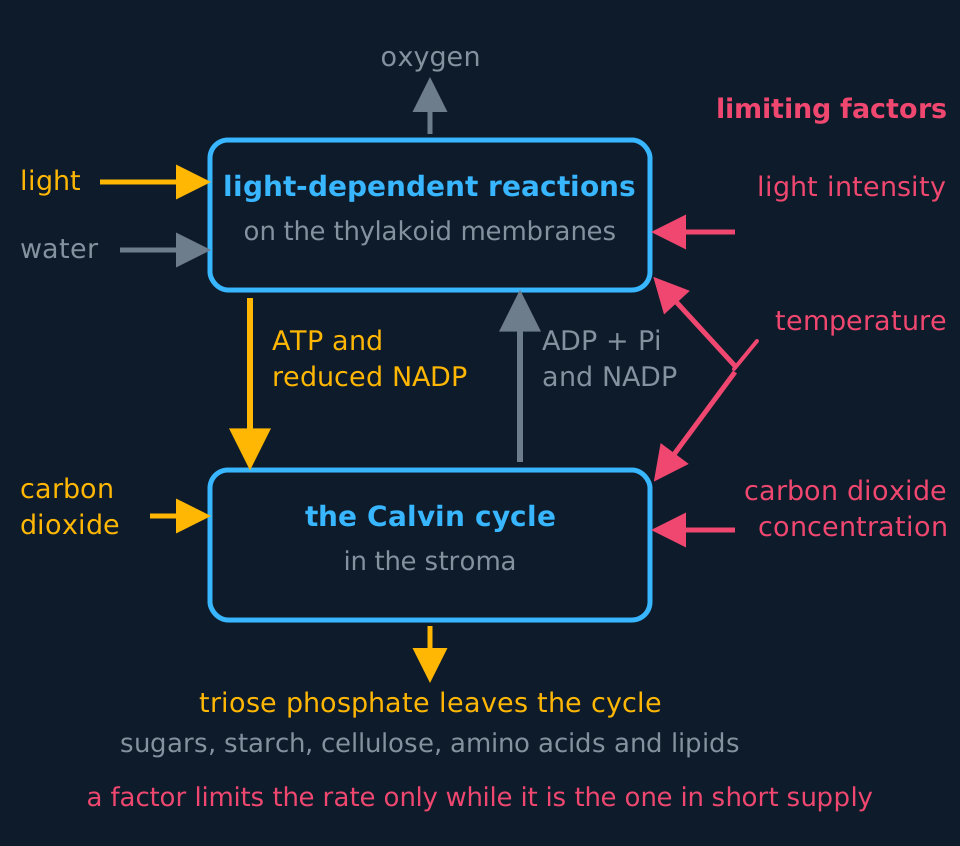
Photosynthesis runs in two stages, in two parts of one chloroplast. The light-dependent reactions take place on the thylakoid membranes: light is absorbed, water is split, oxygen is released, and ATP and reduced NADP are made. The Calvin cycle takes place in the stroma around those membranes: carbon dioxide is fixed onto RuBP, and the ATP and reduced NADP are spent reducing GP to triose phosphate. Overall, 6CO2 + 6H2O → C6H12O6 + 6O2.
Describe the drawing
A concept map of photosynthesis as two linked stages. The light-dependent reactions, on the thylakoid membranes, sit above the Calvin cycle, in the stroma. Light and water enter the light-dependent reactions from the left, and oxygen leaves from the top. A downward arrow carries ATP and reduced NADP from the light-dependent reactions to the Calvin cycle; an upward arrow returns ADP, inorganic phosphate and NADP to the thylakoid membranes to be recharged in the light. Carbon dioxide enters the Calvin cycle from the left, and triose phosphate leaves it at the bottom to become sugars, starch, cellulose, amino acids and lipids. Down the right, three limiting factors each point at the stage they act on: light intensity at the light-dependent reactions, carbon dioxide concentration at the Calvin cycle, and temperature at both, because both stages are run by enzymes.
The two stages are joined by those carriers and by nothing else, which is why the second stage stops in the dark although no step of it absorbs a photon: ATP and reduced NADP are made only in the light and neither is stored in quantity. The oxygen a plant gives off comes from water, split in the light, rather than from carbon dioxide, which is why the equation is sometimes written as 6CO2 + 12H2O → C6H12O6 + 6O2 + 6H2O. No carbon enters or leaves the light-dependent stage at all.
The overall rate is set by whichever of light intensity, carbon dioxide concentration and temperature is limiting at that moment, and raising either of the others changes nothing while it is. Light intensity acts on the light-dependent reactions, carbon dioxide on fixation in the Calvin cycle, and temperature on the enzymes both stages depend on, although the fall at high temperatures is usually read as the Calvin cycle's enzymes, rubisco among them, denaturing.
Notes
- Chloroplast structure and the light-dependent reactions
- The Calvin cycle
- Limiting factors and primary productivity