Biology › Photosynthesis and primary productivity › The Calvin cycle
The Calvin cycle
The Calvin cycle fixes carbon dioxide in the chloroplast stroma. Carbon dioxide combines with RuBP to form GP; GP is reduced to triose phosphate using ATP and reduced NADP; most triose phosphate regenerates RuBP. Six turns fix six carbon dioxide molecules, producing twelve triose phosphate molecules. Ten regenerate RuBP and two provide the net carbon needed to form one hexose phosphate.
Before this The light-dependent stage and its products · Chloroplast structure · Reduction as gain of hydrogen
COMMON MISCONCEPTION
The light-independent stage does not need light, which is why it is called the dark stage and why it carries on all night.
It stops within seconds of the light going out. No step of the cycle absorbs a photon, so it will run in a darkened flask for as long as ATP and reduced NADP are supplied to it. In a chloroplast they are not: both are made only in the light-dependent stage and neither is stored in quantity, so the supply fails almost at once. Light-independent is the name to use.
What you should be able to do
- Describe the three stages of the Calvin cycle and say where each takes place.
- State what rubisco does and how many molecules of GP one turn produces.
- Explain what reduced NADP and ATP each contribute to the reduction of GP.
- Work out how many turns, how many TP and how much ATP a molecule of glucose costs.
- Predict and explain the changes in GP, TP and RuBP when light or carbon dioxide is withdrawn.
- Say what the sugars from the cycle become, nucleic acids included, and what else each product needs.
- Predict and explain the effect of a change in temperature on the rate of the cycle and on the levels of GP, TP and RuBP.
The cycle in brief
Three steps, in this order, and an answer that names them and says what each one costs has most of the marks in this topic. The fuller account, with the evidence for the order and the predictions that come out of it, follows underneath.
1 Fixation. Rubisco joins one molecule of carbon dioxide to one molecule of RuBP, a five-carbon compound. The six-carbon product is unstable and splits at once into two molecules of GP, a three-carbon compound.
2 Reduction. Each GP is reduced to triose phosphate. Reduced NADP supplies the hydrogen and ATP supplies the energy, one of each per molecule of GP, and the oxidised NADP and the ADP go back to the thylakoid membranes.
3 Regeneration. Most of the triose phosphate is rearranged back into RuBP, at a cost of one further ATP for each RuBP rebuilt, so that an acceptor is waiting for the next carbon dioxide. Only the remainder leaves the cycle.
The arithmetic all follows from one carbon dioxide fixed per turn. One turn uses one RuBP and makes two GP and two triose phosphate, and the counts below are that turn repeated.
| Counted over | Three turns | Six turns |
|---|---|---|
| Carbon dioxide fixed | 3 | 6 |
| RuBP used, and rebuilt | 3 | 6 |
| GP made | 6 | 12 |
| Triose phosphate made | 6 | 12 |
| Triose phosphate leaving the cycle | 1 | 2 |
| Triose phosphate rebuilding RuBP | 5 | 10 |
| ATP used | 9 | 18 |
| Reduced NADP used | 6 | 12 |
| What comes out | one triose phosphate | one hexose |
So three turns is the cost of one triose phosphate leaving, and six turns the cost of one hexose, because two triose phosphate condense to make one. The carbon balances at every line: three RuBP carry 15 carbons, three carbon dioxide add 3, and the six triose phosphate made carry 18. One of those six leaves with 3 carbons and the other five carry the 15 that rebuild the three RuBP.
Where the cycle runs and what it requires
The Calvin cycle runs in the stroma, the fluid around the thylakoids, and every step is catalysed by an enzyme dissolved in it. That placement is not an accident: the ATP and reduced NADP made by the light-dependent stage are released into the stroma, so the cycle sits directly downstream of them with no membrane in between.
Three things arrive. Carbon dioxide diffuses in from the air through the stomata and across the chloroplast envelope. ATP and reduced NADP arrive from the thylakoid membranes a few nanometres away. Everything else the cycle needs, it makes itself.
- RuBP
- Ribulose bisphosphate, a five-carbon compound; the molecule that accepts carbon dioxide.
- Rubisco
- RuBP carboxylase-oxygenase, the enzyme that joins carbon dioxide to RuBP. Slow, able to bind oxygen in place of carbon dioxide, and probably the most abundant protein on Earth.
- GP
- Glycerate 3-phosphate, a three-carbon compound; the first stable product of fixation.
- TP
- Triose phosphate, a three-carbon sugar phosphate; the product of reducing GP, and the molecule that either leaves the cycle or rebuilds RuBP. Pearson Edexcel calls it GALP, glyceraldehyde 3-phosphate.
The name to be careful with is fixation. It means taking carbon from an inorganic molecule in the air and locking it into an organic one, and the moment it happens is the moment carbon dioxide joins RuBP. Everything after that is rearranging carbon that has already been fixed.
The name to be careful with next is dark stage, corrected at the top of this page. What an answer has to keep hold of is the distinction the old name hides: the cycle needs no light of its own, and it needs the products of light continuously. Both halves are true at once, so a plant in the dark stops fixing carbon within seconds, as soon as its ATP and reduced NADP run out.
Three steps, and where the carbon goes
Rubisco joins one molecule of carbon dioxide to one molecule of RuBP. The six-carbon compound that results is unstable and splits immediately into two molecules of GP. One carbon in, two three-carbon molecules out, and 5 + 1 = 3 + 3, which is the check worth doing every time you draw this.

Describe the drawing
The Calvin cycle animated as three linked stores of carbon: RuBP with five carbons at the top, GP with three at the right, TP with three at the left. First, carbon dioxide joins RuBP with rubisco and the six-carbon product splits into two molecules of GP. Second, reduced NADP and ATP convert each GP into TP. Third, an arrow out of the cycle shows that of the twelve TP made in six turns only two leave, and those two carry the six carbons of one hexose. Fourth, the remaining ten TP, with six more ATP, rebuild the six molecules of RuBP the cycle started with.
GP is then reduced to TP, and the two inputs have distinct roles. Reduced NADP supplies the hydrogen, which is what reduction means here, and ATP supplies the energy for the reaction. State them separately: hydrogen from reduced NADP, energy from ATP. The oxidised NADP and the ADP return to the thylakoid membranes to be used again.
TP has two fates. A small fraction leaves the cycle and is converted into the plant's organic products: two TP condense to form a hexose sugar such as glucose, which can be polymerised into starch for storage or cellulose for walls; other TP are converted into the glycerol of lipids, or, with nitrate taken up from the soil, into amino acids. Some GP is also used before it is reduced: its carbon skeleton, combined with nitrogen from absorbed nitrate, forms amino acids, and it also supplies the fatty acids of the plant's lipids. Either intermediate is an acceptable source of amino acids: Cambridge International 9700 names GP for some amino acids and TP for carbohydrates, lipids and amino acids. The remaining TP is used in regeneration: a sequence of rearrangements, requiring further ATP, that converts TP back into RuBP so the cycle can accept the next carbon dioxide.
Costing one molecule of glucose
Glucose has six carbons and each turn of the Calvin cycle fixes one carbon dioxide. Work out how many turns are needed, how many TP are made in that time, how many of them leave, and how much ATP and reduced NADP the whole thing costs.
Show the working
Six carbons in glucose, one carbon fixed per turn, so six turns. Those six turns start from six RuBP, which is 30 carbons, and add six more, giving 36 carbons in play.
Each turn makes two GP and each GP is reduced to one TP, so six turns make twelve TP. Twelve TP is 36 carbons, which matches: nothing has appeared or vanished.
Only two TP leave, carrying six carbons, and those two form the hexose. The remaining ten TP hold 30 carbons, exactly the amount needed to rebuild the six RuBP the cycle began with.
The reduction of twelve GP uses twelve ATP and twelve reduced NADP, one of each per molecule. Regenerating six RuBP costs a further six ATP, giving eighteen ATP in total.
Five sixths of the triose phosphate produced is used in regeneration rather than in synthesis. RuBP is not supplied from outside the chloroplast, so it must be regenerated within the cycle; if regeneration stopped, the supply of acceptor would run out and fixation would cease.
What the sugars become, nucleic acids included
Pearson Edexcel's Biology A specification lists four groups of molecule made from the simple sugars of photosynthesis: polysaccharides, amino acids, lipids and nucleic acids. It also says the sugars are used in respiration, by the plant and by the animals and other organisms that feed on it, and that is where most of them go. AQA makes the same point directly: most of the sugars a plant makes are respired by the plant itself, and only the rest are built into the other molecules that make up its biomass.
Three of the four groups were traced in the section above. Nucleic acids take more, because a nucleotide has three parts and the sugars supply only one of them. The pentose, ribose in RNA and deoxyribose in DNA, is made from the plant's sugar phosphates; the regeneration of RuBP itself passes through five-carbon sugar phosphates, so the cycle already makes molecules of the right size. Deoxyribose is made from ribose, once it is part of a nucleotide, by removing the oxygen atom on its second carbon. The nitrogenous bases contain nitrogen, taken up from the soil as nitrate or ammonium ions, and they are assembled largely from amino acids. The phosphate groups come from phosphate ions absorbed by the roots.
| Product | Carbon skeleton from | Also needs |
|---|---|---|
| Starch and cellulose | Hexose, made from two TP | Nothing further |
| Lipids | Glycerol from TP; fatty acids from GP | Phosphate ions, for phospholipids |
| Amino acids | GP or TP | Nitrogen from nitrate; sulfur for a few |
| Nucleic acids | Pentose from the plant's sugar phosphates | Nitrogen for the bases; phosphate ions |
The right-hand column is why a plant short of nitrate or phosphate grows poorly in full sun. It can still fix carbon, but it cannot turn enough of that carbon into proteins and nucleic acids, and without them it cannot make new cells.
- Pentose
- A sugar whose molecules contain five carbon atoms. Ribose, in RNA, and deoxyribose, in DNA, are the pentoses of nucleotides.
Predicting the effect of removing light or carbon dioxide
The concentrations of GP, TP and RuBP after a change do not need to be memorised as a list. Two rules generate every version of the answer.
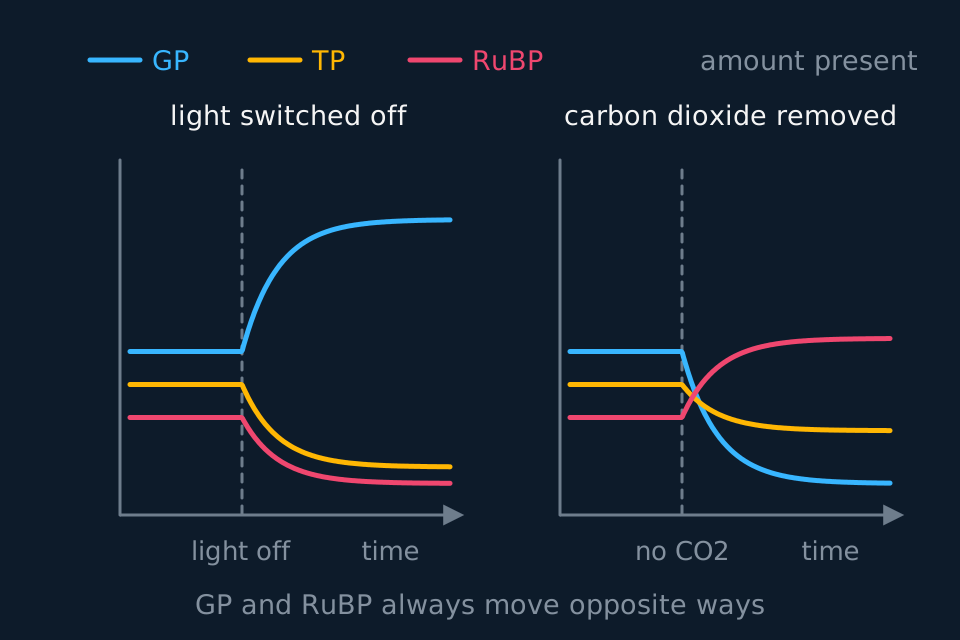
Rule one: work out which single step has been blocked. Rule two: the substance immediately before the block accumulates, because it is still being made and no longer used; the substance immediately after the block falls, because it is still being used and no longer made.
Describe the drawing
Two graphs side by side, each plotting the amounts of GP, TP and RuBP in a chloroplast against time, with a dashed vertical line marking the moment of a change. In the left graph the light is switched off: GP climbs steeply, while TP and RuBP both fall. In the right graph the carbon dioxide is taken away instead: GP falls, RuBP climbs, and TP falls. Before the change all six traces are flat.
Light switched off. The blocked step is the reduction of GP, because ATP and reduced NADP stop arriving within seconds. GP is immediately before the block, so GP rises, because rubisco carries on fixing carbon dioxide onto the RuBP that is still there. TP is immediately after the block, so TP falls. RuBP falls as well, and for a reason worth spelling out: it is still being consumed by fixation, but it is regenerated from TP, and there is no longer any TP to regenerate it from.
Carbon dioxide removed. Now the blocked step is fixation itself. RuBP is immediately before that block, so RuBP rises: TP keeps arriving and keeps being converted into RuBP, while nothing is using it up. GP is immediately after, so GP falls sharply, because it is still being reduced to TP but nothing is replacing it. TP falls too, a little later, once the supply of GP it is made from has run out.
| Change | GP | TP | RuBP | Step that is blocked |
|---|---|---|---|---|
| Light removed | rises | falls | falls | Reduction of GP to TP |
| CO2 removed | falls | falls | rises | Fixation of CO2 onto RuBP |
| Light intensity increased | falls | rises | rises | None: reduction speeds up |
| CO2 increased | rises | rises | falls | None: fixation speeds up |
The bottom two rows apply the same reasoning to an increase rather than a removal, and the levels do not all rise. More light means faster reduction, so GP is consumed faster than it is replaced and its level falls even though the cycle as a whole is running quicker. Levels are not rates. The two increase rows also carry a condition worth stating: they hold only if the factor being raised was the one limiting the rate, with the other conditions held fixed. Raise a factor that was already in excess and the levels barely move.
TRY IT: A sudden change, explained in full
A plant is photosynthesising steadily in bright light with a normal supply of carbon dioxide. The carbon dioxide concentration around it is suddenly reduced to almost zero, the light being left on. Describe and explain what happens to the concentrations of RuBP and of GP in the stroma over the next minute.
Check your answer
RuBP rises. RuBP is used up when rubisco fixes carbon dioxide onto it, and with almost no carbon dioxide available that reaction nearly stops. It is still being regenerated from TP, using ATP that the light reactions are still supplying, so it is made and not used, and it accumulates.
GP falls. GP is produced only by fixation, which has stopped, but it continues to be reduced to TP because reduced NADP and ATP are still arriving in the light. Made no longer, used still, so its concentration drops quickly.
Both changes level off rather than continuing indefinitely. RuBP cannot rise for ever because the pool of TP available to make it is finite, and once GP has been used up there is nothing left to reduce, so TP stops being made as well.
Each direction of change is explained in the same form: still being made but no longer used, or still being used but no longer made. Name the reaction on each side of the blocked step.
Why rubisco limits the rate
Rubisco has a low turnover number. A single molecule fixes about three carbon dioxide molecules per second, which is slow for an enzyme, and plants compensate by making large quantities of it. It can account for half the soluble protein in a leaf.
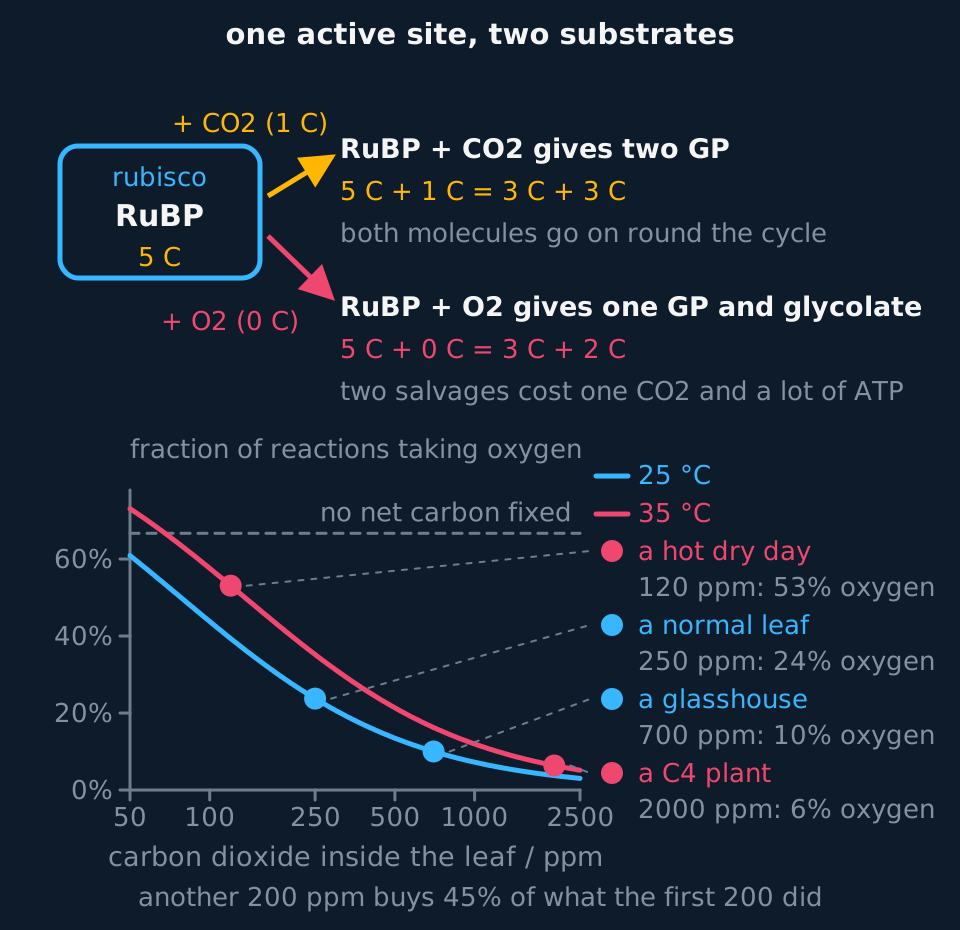
The active site accepts oxygen as well as carbon dioxide. When it binds oxygen instead, the products are one GP and a two-carbon compound that the plant has to spend energy recovering. On a hot dry day, when stomata close to conserve water, carbon dioxide inside the leaf falls and oxygen from photosynthesis builds up, so the odds tip further towards oxygen and productivity drops.
Describe the drawing
Two panels. The upper one has the rubisco active site holding five-carbon RuBP with two arrows out of it: carbon dioxide joins and gives two molecules of GP, five carbons plus one making three plus three, while oxygen joins and gives one GP and a two-carbon glycolate, five plus none making three plus two, which the plant then has to salvage at the cost of a carbon dioxide and a good deal of ATP. The lower panel plots the calculated fraction of reactions that take oxygen against the carbon dioxide inside the leaf on a logarithmic scale, one falling curve for a leaf at twenty-five degrees and a higher one for a leaf at thirty-five. Four points are marked and named: a hot dry day with the stomata shut at a hundred and twenty parts per million, where more than half the reactions take oxygen, a normal leaf at about a quarter, an enriched glasshouse at a tenth, and a C4 plant, which concentrates carbon dioxide before rubisco sees it, lowest of all. A dashed line marks the share at which the leaf fixes no carbon at all.
This is the reason raising carbon dioxide concentration in a glasshouse works so well, and the reason it stops working once the concentration is high enough to keep rubisco busy. It is also why C4 plants such as maize and sugarcane, which concentrate carbon dioxide around their rubisco before the Calvin cycle sees it, outproduce wheat in a hot climate.
Temperature, and the levels of GP, RuBP and TP
Light and carbon dioxide each supply one step, so the step a change in either one blocks can be named. Temperature supplies no step. It changes the rate of every enzyme-catalysed reaction in the cycle at once: fixation by rubisco, the reduction of GP and the regeneration of RuBP. The absorption of light in the light-dependent stage hardly depends on temperature. OCR asks for the effect of temperature on the levels of GP, RuBP and TP as well as on the rate. Two answers are taught. They agree about GP and TP and differ over RuBP, because they start from different assumptions.
The usual answer: GP, TP and RuBP all fall. This is the answer most OCR revision guides give for a fall in temperature below the optimum. Molecules have less kinetic energy, so substrates collide with the active sites of all the cycle's enzymes less often and fewer enzyme-substrate complexes form. Every step slows together and the cycle turns more slowly. GP is made more slowly by fixation, so less TP is made from it, and less TP is available to regenerate RuBP, so all three levels fall. The rate of photosynthesis falls.
The alternative: RuBP rises, GP and TP fall. This answer assumes that fixation is the step a fall in temperature slows most, because rubisco is the slowest enzyme in the cycle and usually sets its pace. The two rules from the section on removing light or carbon dioxide then apply as they did for a fall in carbon dioxide. RuBP is still being regenerated from TP but is used more slowly, so it rises. GP is made more slowly but is still being reduced, so it falls, and TP falls after it because there is less GP to reduce.
Each answer is sound on its own assumption, and the real shifts are small, because the reduction of GP and the regeneration of RuBP slow down alongside fixation. In an answer, say which assumption you are making and explain each level from it. If a question gives data, explain the direction the data show.
Temperature raised towards the optimum. Each answer reverses. If the whole cycle speeds up together, all three levels rise; if fixation speeds up most, GP and TP rise and RuBP falls. The rate rises, provided temperature was the limiting factor: in dim light it was not, and warming the plant changes little.
Temperature raised above the optimum. The enzymes begin to denature. Bonds holding their tertiary structure break, the shape of the active site changes and substrates no longer fit. On either answer the levels move as they do for cooling, but the cause is different, and denatured enzyme does not recover its shape when the leaf cools. Two other effects of heat slow fixation in particular: stomata close to save water, cutting the carbon dioxide supply, and rubisco takes up oxygen in place of carbon dioxide more often as the temperature rises.
| Change in temperature | Usual answer: every enzyme changes rate together | If fixation is the step most affected | Rate of photosynthesis |
|---|---|---|---|
| Lowered, below the optimum | GP, TP and RuBP all fall | GP and TP fall; RuBP rises | falls |
| Raised towards the optimum | GP, TP and RuBP all rise | GP and TP rise; RuBP falls | rises |
| Raised above the optimum | GP, TP and RuBP all fall | GP and TP fall; RuBP rises | falls and stays low |
What to do next
The questions for this topic come next, after the notes, each with its mark scheme folded under it, and the same questions have a page of their own if you would rather work through them away from the notes.
The lesson that follows is limiting factors and primary productivity, which is where the rate of this cycle is decided, and the photosynthesis unit page holds all three lessons, their questions and the practical work in one place.
In the exam
- Name rubisco as the enzyme catalysing fixation and state that one turn gives two molecules of GP.
- Reduced NADP supplies hydrogen; ATP supplies energy. Give the role of each separately rather than stating that both are used in the reduction.
- Six turns per hexose, twelve TP made, two leave, eighteen ATP spent. Quantitative questions in this topic are almost always one of those four numbers.
- For levels-after-a-change questions, name the blocked step before stating any direction of change, and explain each direction from the reactions on either side of that step.
- Do not call it the dark stage in an answer. Say light-independent, and if you have room, say that it stops in the dark because ATP and reduced NADP stop arriving.
- For temperature there is no single blocked step. Say that temperature changes the rate of rubisco and the other enzymes of the cycle. The usual answer for cooling is that GP, TP and RuBP all fall as the whole cycle slows; if you take fixation as the step most affected, RuBP rises instead. State the assumption, then explain each level.
- A nucleotide needs nitrogen and phosphate as well as a sugar. Name the pentose as the part made from the products of the Calvin cycle.
Check yourself
In an experiment, algae photosynthesising in bright light were given carbon dioxide labelled with the isotope carbon-14. Samples were killed at intervals of a few seconds and their compounds separated. After five seconds the label was found almost entirely in GP; after thirty seconds it was in GP, TP and RuBP; after two minutes it was also in glucose and starch. Explain this sequence.
Answer
Labelled carbon dioxide is fixed by rubisco onto RuBP, and the six-carbon product splits at once into two molecules of GP. GP is therefore the first compound the label can possibly appear in, which is why after five seconds it is almost the only one labelled.
By thirty seconds the labelled GP has been reduced to TP using reduced NADP and ATP, so the label appears in TP. Some of that labelled TP has then been used to regenerate RuBP, so the label reaches RuBP as well, and that also shows RuBP is rebuilt from TP rather than supplied from outside.
By two minutes, some labelled TP has left the cycle. Two TP condense into a hexose, and hexoses are polymerised into starch, so the label finally turns up in the products the plant stores.
The order of appearance is the evidence for the order of the pathway, which is how the cycle was worked out in the first place. Notice how long the label takes to reach glucose compared with GP: most of the TP never leaves the cycle at all.
Questions
Question 15 marks
Each turn of the Calvin cycle fixes one molecule of carbon dioxide and produces two molecules of GP. Reducing each GP to triose phosphate uses one ATP and one reduced NADP, and regenerating the RuBP used in each turn uses one further ATP. Calculate the number of turns of the cycle, the number of molecules of triose phosphate made, the number of molecules of ATP used and the number of molecules of reduced NADP used in producing two molecules of glucose.
Mark scheme
- M1 each turn fixes one carbon dioxide and a hexose holds six carbons, so six turns are needed per hexose and 6 × 2 = 12 turns in all
- M1 each turn makes two GP and each GP is reduced to one triose phosphate, so 2 × 12 = 24 molecules of triose phosphate
- A1 reducing 24 molecules of GP uses 24 ATP and 24 reduced NADP, one of each per molecule
- M1 regenerating RuBP costs one further ATP per turn, so 12 more ATP
- A1 36 molecules of ATP and 24 molecules of reduced NADP in total, which is eighteen ATP per hexose
Question 25 marks
Two identical flasks of an algal suspension are photosynthesising steadily in bright light, each bubbled with air containing carbon dioxide. At time zero the gas stream to one flask is switched to carbon dioxide-free air, the light being left on; the second flask is left on the original gas stream. Samples from both are run into boiling methanol at intervals and their GP and RuBP measured, giving the constructed readings in the table. Explain what the control flask contributes to this investigation, and explain what the readings from the treated flask show about the step at which carbon dioxide acts.
| Time after the gas stream was switched / s | GP, carbon dioxide removed / arbitrary units | RuBP, carbon dioxide removed / arbitrary units | GP, control flask / arbitrary units | RuBP, control flask / arbitrary units |
|---|---|---|---|---|
| 0 | 120 | 60 | 120 | 60 |
| 10 | 46 | 96 | 118 | 61 |
| 30 | 20 | 118 | 121 | 59 |
| 60 | 9 | 128 | 119 | 60 |
| 120 | 6 | 130 | 120 | 60 |
Mark scheme
- B1 the control flask is set up, lit, warmed, bubbled and sampled in exactly the same way and at the same times, and differs in one thing only, the carbon dioxide in its gas stream, so it isolates that one variable
- B1 its readings stay level throughout, GP between 118 and 121 and RuBP between 59 and 61 arbitrary units, which shows that neither time spent in the flask nor the sampling and killing procedure changes the concentrations by itself; without that comparison the fall in GP in the treated flask could have been caused by the method rather than by the treatment
- B1 in the treated flask GP falls from 120 to 6 arbitrary units, because GP is produced only by fixation, which has stopped for want of carbon dioxide, while ATP and reduced NADP are still arriving in the light so GP goes on being reduced to triose phosphate
- B1 RuBP rises from 60 to 130 arbitrary units over the same period, because it is still being regenerated from triose phosphate using the ATP the light-dependent stage is still supplying, and is no longer being consumed by fixation
- A1 RuBP therefore lies immediately before the blocked step and GP immediately after it, which places the action of carbon dioxide at fixation onto RuBP by rubisco and nowhere later in the cycle. The sizes agree as well: GP falls by 114 arbitrary units while RuBP rises by only about 70, and five triose phosphate are needed to rebuild three RuBP, so 114 × 3 ÷ 5 = 68 is what regeneration predicts. The reasoning is set out in the lesson section 'Predicting the effect of removing light or carbon dioxide'
Question 35 marks
A wheat leaf is held in a lit chamber at a constant high light intensity, and its temperature raised in steps, the composition of the air supplied to the chamber unchanged. The active site of rubisco can bind oxygen instead of carbon dioxide, which gas it binds depends on the ratio of the two around it, and a reaction with oxygen fixes no carbon. The table gives constructed measurements taken once the leaf had settled at each temperature. Explain how the first three columns of measurements account for the fall in the net uptake of carbon dioxide, and explain why the net uptake falls proportionally very much further than the share of rubisco's reactions that fix carbon dioxide does.
| Leaf temperature / °C | Carbon dioxide in the air spaces / µmol mol⁻¹ | Oxygen in the air spaces / % | Reactions of rubisco that fixed carbon dioxide / % | Net uptake of carbon dioxide / µmol m⁻² s⁻¹ |
|---|---|---|---|---|
| 25 | 270 | 21.0 | 78 | 18.4 |
| 30 | 230 | 21.2 | 75 | 15.1 |
| 35 | 180 | 21.5 | 70 | 10.4 |
| 40 | 120 | 21.8 | 60 | 3.4 |
Mark scheme
- B1 as the leaf warms its stomata close to conserve water, so the carbon dioxide in the air spaces falls steeply, from 270 to 120 µmol mol⁻¹, while the oxygen released by the light-dependent stage builds up a little in a leaf that can vent it less freely, from 21.0 to 21.8 %
- B1 the active site of rubisco accepts either gas, and which one it binds depends on the ratio of the two around it; that ratio falls to well under half its starting value and the falling carbon dioxide does nearly all of the work, since the oxygen figure moves by less than a twentieth, so the share of reactions that fix carbon falls from 78 % to 60 %; accept also that rubisco's preference for carbon dioxide over oxygen falls as the leaf warms
- B1 the two falls are of quite different sizes: net uptake falls to 3.4 ÷ 18.4 = 0.18, that is to 18 % of its starting value, whereas the fixing share falls only to 60 ÷ 78 = 0.77, or 77 %, so the shift in the ratio cannot on its own account for the collapse in uptake
- B1 rubisco is nowhere near saturated at these concentrations, so the falling carbon dioxide also slows every carboxylation that does still happen, as well as making carboxylations a smaller share of the total; fewer of them, and each one slower, multiply together rather than adding
- A1 what the last column measures is a net figure, gross fixation minus the carbon dioxide the leaf's own respiration releases, and respiration rises steeply with temperature across this range while gross fixation is falling; a growing loss subtracted from a shrinking gain falls faster than either does alone, which is why the net uptake drops away ahead of every other column
Question 44 marks
Describe the three stages of the Calvin cycle, naming the compounds involved and saying what reduced NADP and ATP each contribute.
Mark scheme
- B1 fixation: rubisco joins one molecule of carbon dioxide to the five-carbon RuBP, and the six-carbon product is so unstable that it splits immediately into two molecules of GP
- B1 reduction: GP is reduced to triose phosphate, with reduced NADP supplying the hydrogen and ATP supplying the energy for the reaction
- B1 the oxidised NADP and the ADP go straight back to the thylakoid membranes to be used again
- B1 regeneration: most of the triose phosphate is rearranged, at a further cost in ATP, back into RuBP, while the rest leaves the cycle to be built into hexose sugars, lipids or amino acids
Question 54 marks
A plant photosynthesising steadily in bright light is placed in complete darkness, with its carbon dioxide supply unchanged. Explain what happens to the concentrations of GP, of triose phosphate and of RuBP in the stroma over the following minute.
Mark scheme
- B1 ATP and reduced NADP are made only in the light and are not stored in quantity, so within seconds the blocked step is the reduction of GP to triose phosphate
- B1 GP rises, because it lies immediately before the block: rubisco carries on fixing carbon dioxide onto the RuBP still present, so GP is still being made and is no longer being used
- B1 triose phosphate falls, because it lies immediately after the block: it is still being used and is no longer being made
- B1 RuBP falls as well, because it is still being consumed by fixation but is regenerated from triose phosphate, and there is no longer any triose phosphate to regenerate it from
Question 64 marks
A plant photosynthesising steadily in bright light has its carbon dioxide supply cut off completely, with the light kept on. Explain what happens to the concentrations of RuBP and of GP in the stroma over the following minute, and state which step has become blocked.
Mark scheme
- B1 the blocked step is fixation itself, since rubisco has no carbon dioxide to add to RuBP
- B1 RuBP rises: it is immediately before the block, so it is still being regenerated from triose phosphate, using ATP the light reactions are still supplying, but is no longer being used up by fixation
- B1 GP falls: it is immediately after the block, so it is no longer being made by fixation, but reduced NADP and ATP are still available and it continues to be reduced to triose phosphate
- A1 because GP falls, triose phosphate is affected as well: it continues to be made from what GP remains and is still used in regeneration, so once the GP supply is exhausted triose phosphate falls too, a little later than GP
Question 74 marks
Describe two of the biosynthetic uses for triose phosphate or GP that leave the Calvin cycle, other than forming glucose.
Mark scheme
- B1 triose phosphate can be converted into the glycerol part of a lipid molecule
- B1 GP's carbon skeleton, combined with nitrogen from nitrate absorbed by the roots, can be converted into an amino acid
- B1 fatty acids for a lipid molecule can also be built from triose phosphate or GP, so a lipid's glycerol and its fatty acid chains can both trace back to the Calvin cycle
- A1 amino acid synthesis by this route needs nitrate taken up from the soil as well as fixed carbon, tying the Calvin cycle's output to mineral nutrition as well as to carbon dioxide
Question 84 marks
In a C3 plant such as wheat, rubisco in the mesophyll cells fixes carbon dioxide that has diffused in from the air through the stomata. In a C4 plant such as maize, a different enzyme in the mesophyll cells, which does not react with oxygen, first fixes carbon dioxide into a four-carbon compound; this passes into cells around the leaf veins and releases carbon dioxide there, around rubisco, at several times the concentration in the air. Rubisco can react with oxygen in place of carbon dioxide, which wastes energy and fixes less carbon. Explain why maize outproduces wheat in a hot, dry, bright climate.
Mark scheme
- B1 in hot, dry conditions the stomata partly close to reduce water loss, so carbon dioxide inside the leaf falls while oxygen from photosynthesis builds up
- B1 in wheat, rubisco is exposed to this low carbon dioxide and high oxygen, so it reacts with oxygen more often and less carbon is fixed
- B1 in maize, the first enzyme goes on fixing carbon dioxide even at low concentration, because oxygen does not compete with it, and the carbon dioxide it delivers keeps the concentration around rubisco high
- B1 so maize's rubisco rarely reacts with oxygen and fixation stays fast even with the stomata partly closed, giving higher productivity
Question 94 marks
In an experiment, a chloroplast suspension fixes 18 molecules of carbon dioxide in one minute. Each turn of the Calvin cycle fixes one molecule of carbon dioxide and produces two molecules of GP. Reducing each GP to triose phosphate uses one ATP and one reduced NADP, and regenerating the RuBP used in each turn uses one further ATP. Calculate the number of complete turns of the cycle this represents, the number of molecules of GP produced, and the total number of ATP molecules used inside the cycle, assuming exactly one RuBP is regenerated for each one used.
Mark scheme
- M1 one turn of the cycle fixes one molecule of carbon dioxide, so 18 molecules of carbon dioxide fixed is 18 turns of the cycle
- A1 each turn produces two molecules of GP, so 18 × 2 = 36 molecules of GP
- M1 reducing 36 GP uses 36 ATP, and regenerating 18 RuBP uses a further 18 ATP
- A1 total ATP used = 36 + 18 = 54 molecules of ATP
Question 104 marks
A suspension of algae photosynthesising steadily in bright light was switched into complete darkness at time zero, its carbon dioxide supply unchanged. The table gives the concentrations of GP, of triose phosphate and of RuBP in the stroma, all on the same scale, over the minute that followed. Calculate the change in the concentration of GP and the change in the concentration of RuBP between 0 s and 60 s, calculate the ratio of the two changes, and state what that ratio shows about the reaction still running. The readings are constructed for this question rather than measured.
| Time after the light was switched off / s | GP / arbitrary units | Triose phosphate / arbitrary units | RuBP / arbitrary units |
|---|---|---|---|
| 0 | 100 | 60 | 80 |
| 5 | 158 | 33 | 51 |
| 10 | 206 | 15 | 27 |
| 20 | 244 | 4 | 8 |
| 40 | 260 | 1 | 0 |
| 60 | 260 | 1 | 0 |
Mark scheme
- M1 reads both compounds from the 0 s row and the 60 s row and takes the difference in each: GP 260 − 100, RuBP 0 − 80
- A1 GP rises by 160 arbitrary units and RuBP falls by 80 arbitrary units; the stem states that the three compounds are measured on the same scale, which is what makes the two changes comparable at all
- A1 ratio of the rise in GP to the fall in RuBP = 160 ÷ 80 = 2 : 1, a ratio with no units
- B1 rubisco joins one carbon dioxide to one RuBP and the six-carbon product splits at once into two molecules of GP, so every RuBP consumed yields exactly two GP; a 2 : 1 ratio held over the whole minute is therefore what you would see if fixation is the only step still running, with the reduction of GP already stopped for want of ATP and reduced NADP. The one-carbon-in, two-molecules-out arithmetic is set out in the lesson section 'Three steps, and where the carbon goes'
Question 114 marks
The table gives constructed concentrations of GP, triose phosphate and RuBP in the stroma of an alga that was photosynthesising steadily in bright light until the light was switched off at time zero, its carbon dioxide supply unchanged. Explain why the concentration of GP stops rising after 40 s although the alga is still in darkness, and explain why the concentration of triose phosphate falls rather than rising.
| Time after the light was switched off / s | GP / arbitrary units | Triose phosphate / arbitrary units | RuBP / arbitrary units |
|---|---|---|---|
| 0 | 100 | 60 | 80 |
| 5 | 158 | 33 | 51 |
| 10 | 206 | 15 | 27 |
| 20 | 244 | 4 | 8 |
| 40 | 260 | 1 | 0 |
| 60 | 260 | 1 | 0 |
Mark scheme
- B1 GP is made only by fixation, and fixation needs an acceptor; the table shows RuBP has reached zero by 40 s, so from 40 s onwards there is no RuBP left for carbon dioxide to be fixed onto and no further GP can be made
- B1 the route by which nearly all GP is removed is its reduction to triose phosphate, and that needs ATP and reduced NADP, both of which are made only in the light-dependent stage and are not stored in quantity, so removal stopped within seconds of the switch-off; neither made nor used, GP holds level at 260 arbitrary units
- B1 triose phosphate lies immediately after the blocked step, so it is no longer being made from GP
- A1 it is still being drawn out of the cycle into the plant's products, so it is used and not replaced and falls almost to nothing, from 60 arbitrary units to 1. The rule is set out in the lesson section 'Predicting the effect of removing light or carbon dioxide'
Question 124 marks
In an investigation of the Calvin cycle, a thin, flat, transparent flask holding a suspension of the alga Chlorella is lit from both sides, held at 25 °C in a water bath, stirred continuously and bubbled with a gas stream of known composition. At intervals a tap in the base of the flask is opened and a sample of the suspension runs straight down into boiling methanol. Suggest why the sample must run into boiling methanol rather than into an empty cold tube, and suggest why the flask is made thin and flat and the suspension is stirred.
Mark scheme
- B1 the intermediates of the Calvin cycle turn over in seconds, so a sample that goes on reacting while it is being collected gives the concentrations at some unknown later moment rather than at the moment the tap was opened
- B1 boiling methanol denatures the enzymes of the cycle, rubisco among them, the instant the sample meets it, so every reaction stops at a known time and the concentrations measured are the ones the cells were actually holding; it also dissolves the compounds out of the cells ready to be separated
- B1 light is absorbed as it passes through a suspension, so in a thick flask the cells at the back would be shaded by those in front of them; thin, flat and lit from both sides means every cell receives about the same light intensity
- A1 stirring keeps the dissolved carbon dioxide even throughout, so when the gas stream is changed every cell meets the new concentration at the same moment; without it a sample would be an average over cells in different conditions, and any change would look slower and less sharp than it really is
Question 134 marks
Algae photosynthesising in bright light were given carbon dioxide labelled with carbon-14, and samples were killed at intervals and their compounds separated. The table gives the share of the labelled carbon found in each compound, constructed for this question rather than measured. Explain why the label appears in triose phosphate before it appears in RuBP, even though RuBP is the molecule that carbon dioxide is fixed onto.
| Time in labelled carbon dioxide / s | GP / % of label | Triose phosphate / % of label | RuBP / % of label | Sugars and starch / % of label |
|---|---|---|---|---|
| 2 | 92 | 6 | 2 | 0 |
| 5 | 78 | 14 | 6 | 2 |
| 15 | 52 | 20 | 17 | 11 |
| 30 | 38 | 19 | 22 | 21 |
| 120 | 21 | 11 | 18 | 50 |
Mark scheme
- B1 carbon dioxide is joined to RuBP, but the labelled carbon does not stay there: the six-carbon compound formed is unstable and splits at once into two molecules of GP, so the RuBP that accepted the label no longer exists and the label is already in GP, which is why 92 % of it is in GP after only 2 s
- B1 RuBP can only become labelled once labelled carbon is built back into it, and the one route to RuBP is regeneration from triose phosphate, since RuBP is not supplied to the chloroplast from outside
- B1 triose phosphate therefore lies between GP and RuBP along the path the label takes, which is why the table shows more label in triose phosphate than in RuBP at 5 s, 14 % against 6 %, and still at 15 s, 20 % against 17 %
- A1 the order in which a label appears is evidence for the order of the reactions, so this result is itself the evidence that RuBP is rebuilt from triose phosphate inside the cycle rather than fed into it; the half of the label sitting in sugars and starch by 120 s is the fraction that has left the cycle altogether. Regeneration is set out in the lesson section 'Three steps, and where the carbon goes'
Question 144 marks
The table counts what the Calvin cycle uses and produces over nine turns and over twelve turns, on the assumption that the triose phosphate not needed for regeneration leaves the cycle. Four cells are marked with a question mark. Complete the table by working out those four values, giving your reasoning for each.
| Counted over | Nine turns | Twelve turns |
|---|---|---|
| Carbon dioxide fixed | 9 | 12 |
| GP made | 18 | ? |
| Triose phosphate made | ? | 24 |
| Triose phosphate leaving the cycle | 3 | ? |
| ATP used | ? | 36 |
| Reduced NADP used | 18 | 24 |
Mark scheme
- M1 every row is proportional to the number of turns, so the value per turn found from the complete column gives the missing value in the other
- A1 GP made over twelve turns is 24, at 2 per turn, and triose phosphate made over nine turns is 18, also 2 per turn, one for each GP reduced
- A1 triose phosphate leaving over twelve turns is 4, since 3 over nine turns is one for every three turns
- A1 ATP used over nine turns is 27, since 36 over twelve turns is 3 per turn: one for each of the two GP reduced and one to regenerate the RuBP
Question 154 marks
A grower raises the carbon dioxide concentration in a glasshouse in steps, with light intensity and temperature held constant, and records the constructed readings in the table. The grower concludes: 'Between 0.04 % and 0.10 % the GP concentration rose by 60 per cent, so the Calvin cycle is running 60 per cent faster.' Evaluate that conclusion.
| Carbon dioxide in the glasshouse air / % | GP in leaf samples / arbitrary units | RuBP in leaf samples / arbitrary units | Rate of carbon dioxide uptake / µmol m⁻² s⁻¹ |
|---|---|---|---|
| 0.04 | 100 | 120 | 12.0 |
| 0.07 | 134 | 88 | 14.8 |
| 0.10 | 160 | 66 | 16.5 |
| 0.14 | 168 | 60 | 16.9 |
Mark scheme
- B1 the direction of the conclusion is supported. The measured rate of carbon dioxide uptake did rise, from 12.0 to 16.5 µmol m⁻² s⁻¹, and the fall in RuBP from 120 to 66 arbitrary units agrees with it, since more carbon dioxide means RuBP is consumed by fixation faster than it is regenerated
- B1 the size of the conclusion is not supported, because it reads a level as though it were a rate. The rise in the measured rate is (16.5 − 12.0) ÷ 12.0 × 100 = 37.5 %, not 60 %
- B1 a concentration of an intermediate rises whenever it is made faster than it is used up. The reduction of GP did speed up, since at a steady rate of uptake GP is used as fast as it is made, but light intensity was held constant, so the supply of ATP and reduced NADP could rise only so far; GP had to build up before its reduction kept pace with the faster fixation, so part of the 60 % rise is GP queueing in front of that step, not carbon travelling round the cycle faster
- A1 so the judgement is that the grower's direction is right and the figure is wrong, and only the rate column could have supported a figure at all. The last row makes the same point again: from 0.10 % to 0.14 % the rate rises by only 0.4 µmol m⁻² s⁻¹, so carbon dioxide has nearly stopped being the limiting factor, while GP has still moved. Levels and rates are separated in the lesson section 'Predicting the effect of removing light or carbon dioxide'
Question 164 marks
A plant photosynthesising in bright light with plenty of carbon dioxide is cooled from 25 °C to 10 °C. Explain the effect on the concentrations of RuBP and of GP in the stroma.
Mark scheme
- B1 at the lower temperature molecules have less kinetic energy, so fewer enzyme-substrate complexes form and the enzymes of the Calvin cycle, rubisco among them, work more slowly
- B1 states which steps are taken to slow: every step of the cycle together (fixation, reduction of GP and regeneration of RuBP), or fixation by rubisco, the slowest step, most of all
- B1 GP falls, because fixation of carbon dioxide onto RuBP is slower so GP is made more slowly; accept that it is still being reduced to triose phosphate
- B1 RuBP falls, because less triose phosphate is made and the regeneration of RuBP is slower; OR RuBP rises, because fixation slows most, so RuBP is still regenerated from triose phosphate but used more slowly; credit either direction only with its matching reason
Question 174 marks
The table gives constructed concentrations of GP and triose phosphate in the stroma of a leaf at 25 °C and ten minutes after it was heated to 45 °C, in bright light with plenty of carbon dioxide throughout. Explain the changes, suggest the effect on the concentration of RuBP, and explain why the rate of photosynthesis stayed low when the leaf was cooled to 25 °C again.
| Temperature / °C | GP / arbitrary units | Triose phosphate / arbitrary units |
|---|---|---|
| 25 | 100 | 60 |
| 45, after 10 minutes | 55 | 35 |
Mark scheme
- B1 45 °C is above the optimum, so enzymes including rubisco denature: the active site changes shape and substrates no longer fit
- B1 fixation of carbon dioxide onto RuBP slows, so GP is made more slowly and falls from 100 to 55, and triose phosphate falls from 60 to 35 because less GP is reduced
- B1 RuBP falls, because the enzymes that regenerate it are denatured too and less triose phosphate is available; OR RuBP rises, because rubisco is the step most affected, so RuBP is still regenerated but used more slowly; credit either direction only with its matching reason
- B1 denaturation is permanent: the enzymes do not regain their shape when the leaf cools, so the rate stays low; accept that stomata close at high temperature, cutting carbon dioxide supply, as a further cause of the changes
Question 183 marks
Six turns of the Calvin cycle make twelve molecules of triose phosphate, and only two of them leave the cycle. Explain why the other ten cannot be allowed to leave.
Mark scheme
- B1 the ten that remain hold thirty carbons, which is exactly the number needed to rebuild the six molecules of RuBP the six turns started from
- B1 RuBP is not supplied from outside the chloroplast, so the only source of it is regeneration from triose phosphate
- B1 if all twelve left, there would be no acceptor for the next carbon dioxide and the cycle would stop after a single round, so no further carbon could be fixed
Question 193 marks
Rubisco can bind oxygen at its active site in place of carbon dioxide. When it does, RuBP is split into one GP and a two-carbon compound, and the plant spends ATP converting the two-carbon compound back into GP, losing some of its carbon as carbon dioxide. On a hot, dry, bright day the productivity of a wheat crop falls even though light intensity is high. Suggest how the properties of rubisco account for this.
Mark scheme
- B1 the stomata close to reduce water loss, so less carbon dioxide enters the leaf while oxygen from the light-dependent reaction builds up inside it
- B1 oxygen and carbon dioxide compete for the same active site, so with the ratio of oxygen to carbon dioxide higher, rubisco binds oxygen more often
- B1 each time it does, one GP is made instead of two, ATP is spent and carbon is lost in the recovery, so less carbon is fixed overall and productivity falls
Question 203 marks
When light intensity is raised in an otherwise unchanged, already photosynthesising plant, the concentration of GP in the stroma is found to fall, even though the overall rate of the Calvin cycle has increased. Suggest why a fall in GP concentration does not mean the cycle has slowed down.
Mark scheme
- B1 raising light intensity increases the supply of ATP and reduced NADP, so GP is reduced to triose phosphate faster than before
- B1 fixation, the only source of GP, also speeds up as RuBP rises, but at first by less than reduction does, since the carbon dioxide supply has not changed, so for a time GP is used up faster than it is made and its concentration falls to a new, lower level
- A1 a falling concentration of an intermediate shows only that it is being consumed faster than it is produced at that moment; it does not mean the pathway making it has slowed
Question 213 marks
Explain why calling the Calvin cycle the 'dark stage' is misleading, even though none of its steps directly absorbs a photon of light.
Mark scheme
- B1 it is true that no step in the Calvin cycle itself absorbs light directly, so in principle the reactions could run in a darkened flask if ATP and reduced NADP were supplied artificially
- B1 in an intact, real chloroplast, ATP and reduced NADP are made only in the light-dependent reactions and neither is stored in any quantity
- A1 within seconds of the light being switched off, the cycle stalls for lack of its own raw materials, meaning that in practice the cycle does depend on light, and 'light-independent' is the more accurate name
Question 223 marks
Rubisco can account for half of all the soluble protein in a leaf. Each rubisco molecule fixes only about three molecules of carbon dioxide a second, whereas many enzymes act on thousands of substrate molecules a second. Explain why a plant needs to make so much of this one enzyme.
Mark scheme
- B1 when substrate is plentiful, the rate of an enzyme-catalysed reaction is proportional to the number of enzyme molecules, so with each rubisco working this slowly, a high rate of fixation needs a very large number of them
- B1 fixation by rubisco is the only route by which carbon enters the cycle, so it limits the rate at which the plant can make all of its organic compounds
- B1 plenty of rubisco lets fixation keep pace with the ATP and reduced NADP supplied by the light-dependent reaction in bright light, so that supply is not wasted
Question 233 marks
Carbon dioxide concentration around an already photosynthesising plant is suddenly raised, with light intensity kept the same. Suggest what happens to the concentrations of RuBP and of GP in the stroma as a result, explaining your reasoning.
Mark scheme
- B1 with more carbon dioxide available, rubisco fixes it onto RuBP faster than before, so GP is produced faster and its concentration rises
- B1 RuBP is used up by fixation faster than before, and because reduced NADP and ATP have not increased, the reduction of GP and the regeneration of RuBP proceed at their previous rate, so RuBP falls as it is consumed faster than it is replaced
- A1 this shows fixation was the step limited by carbon dioxide before the increase; if reduction or regeneration had instead been the limiting step, raising carbon dioxide would have made little difference to either concentration
Question 243 marks
A plant growing in soil that lacks nitrate ions and phosphate ions photosynthesises in bright light but grows very little. Explain why it cannot make nucleic acids from the products of the Calvin cycle alone.
Mark scheme
- B1 the pentose sugar of each nucleotide, ribose or deoxyribose, is made from the sugar phosphates the Calvin cycle produces, so only this part comes from photosynthesis
- B1 the nitrogenous bases contain nitrogen, which has to be taken up from the soil as nitrate (or ammonium) ions
- B1 the phosphate groups come from phosphate ions absorbed by the roots, so without both ions nucleotides cannot be assembled and DNA and RNA cannot be made for new cells
Question 252 marks
State the name of the enzyme that catalyses the fixation of carbon dioxide in the Calvin cycle, and state how many molecules of GP one turn of the cycle produces.
Mark scheme
- B1 the enzyme is rubisco, also called RuBP carboxylase
- B1 one turn produces two molecules of GP
Question 262 marks
State what is meant by carbon fixation, and state where in the chloroplast fixation takes place.
Mark scheme
- B1 carbon fixation is the joining of carbon from an inorganic molecule, carbon dioxide, to an organic molecule already present in the cell, converting the inorganic carbon into an organic form
- B1 fixation takes place in the stroma, where rubisco and the other Calvin cycle enzymes are dissolved
Worth remembering
- Rubisco fixes one CO2 onto one RuBP and the product splits immediately into two GP.
- Reduced NADP gives the hydrogen, ATP gives the energy, and GP becomes TP.
- Six turns, twelve TP, two out and ten back into RuBP, eighteen ATP spent.
- Whatever comes before a blocked step accumulates; whatever comes after it falls.
- GP and RuBP lie on either side of fixation, so removing light or carbon dioxide changes their concentrations in opposite directions.
- Temperature acts on every enzyme in the cycle. Cooling: GP, TP and RuBP usually all fall; if fixation slows most, RuBP rises instead.
- Most of the sugar is respired; the rest becomes polysaccharides, lipids, amino acids and nucleic acids.
CHECK YOUR PROGRESS
Rate how confident you are with each objective for this lesson. Ratings are saved in this browser, on this device, unless you sign in.
- Describe the three stages of the Calvin cycle and say where each takes place.
- State what rubisco does and how many molecules of GP one turn produces.
- Explain what reduced NADP and ATP each contribute to the reduction of GP.
- Work out how many turns, how many TP and how much ATP a molecule of glucose costs.
- Predict and explain the changes in GP, TP and RuBP when light or carbon dioxide is withdrawn.
- Say what the sugars from the cycle become, nucleic acids included, and what else each product needs.
- Predict and explain the effect of a change in temperature on the rate of the cycle and on the levels of GP, TP and RuBP.
Open the full revision checklist to see every objective in the curriculum in one place.
Practise this lesson
Practise the Calvin cycle with 26 original questions and point-by-point mark schemes
WORKBOOK
The written questions from this topic, on paper with room to work, and a separate book of mark schemes. The 8 questions that are set on a diagram stay on this page, where the diagram can be drawn. Free to use; please do not redistribute or sell.
Used later in The carbon cycle and climate change