Biology › Photosynthesis and primary productivity › Chloroplast structure and the light-dependent reactions
Chloroplast structure and the light-dependent reactions
A chloroplast has two compartments with distinct functions. The thylakoid membranes absorb light and use it to build a proton gradient and make ATP and reduced NADP; the stroma around them is where those products are used. Chloroplast structure, the photosynthetic pigments, the two photosystems, photophosphorylation and photolysis are set out here.
Before this Eukaryotic cell ultrastructure · Chemiosmosis in aerobic respiration · ATP as the immediate energy currency
COMMON MISCONCEPTION
Chlorophyll absorbs green light, and that is why leaves are green.
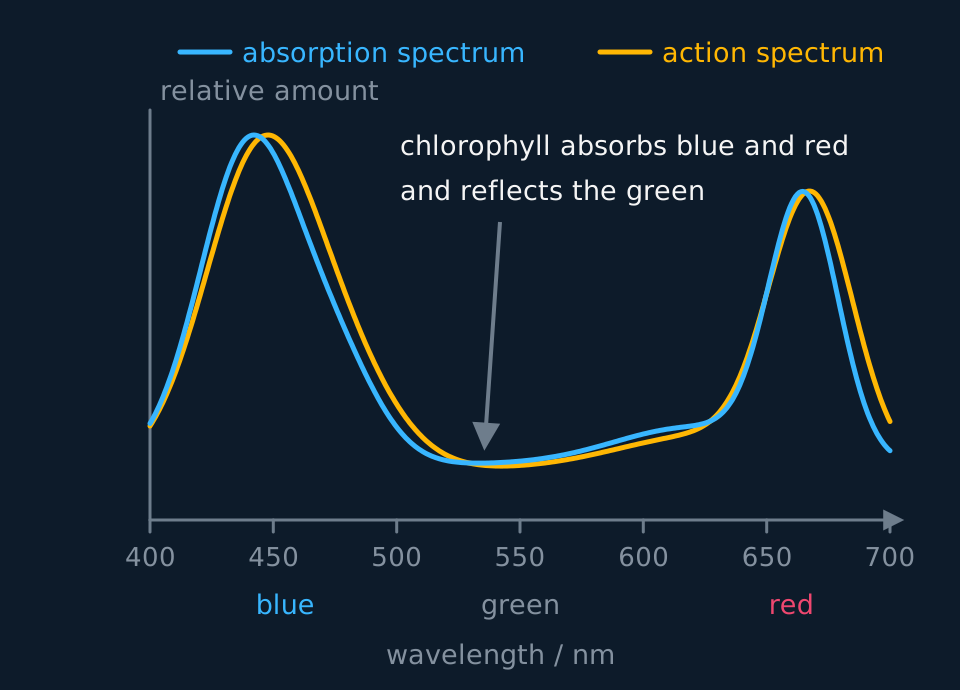
Chlorophyll absorbs red and blue wavelengths strongly but absorbs green wavelengths weakly. Much of the green light is reflected or transmitted, so leaves appear green.
What you should be able to do
- Name the parts of a chloroplast and give each one a job it does in photosynthesis.
- Explain why a leaf looks green, using the absorption spectrum of chlorophyll.
- Say what an action spectrum measures and why it resembles an absorption spectrum.
- Separate leaf pigments by chromatography and calculate an Rf value from your own chromatogram.
- Describe the light-dependent reactions in order, from a photon to reduced NADP.
- Distinguish non-cyclic from cyclic photophosphorylation by their products.
- Isolate chloroplasts in cold, buffered, isotonic medium and use DCPIP to measure how a named factor changes the rate of the light-dependent reactions.
The structure of a chloroplast
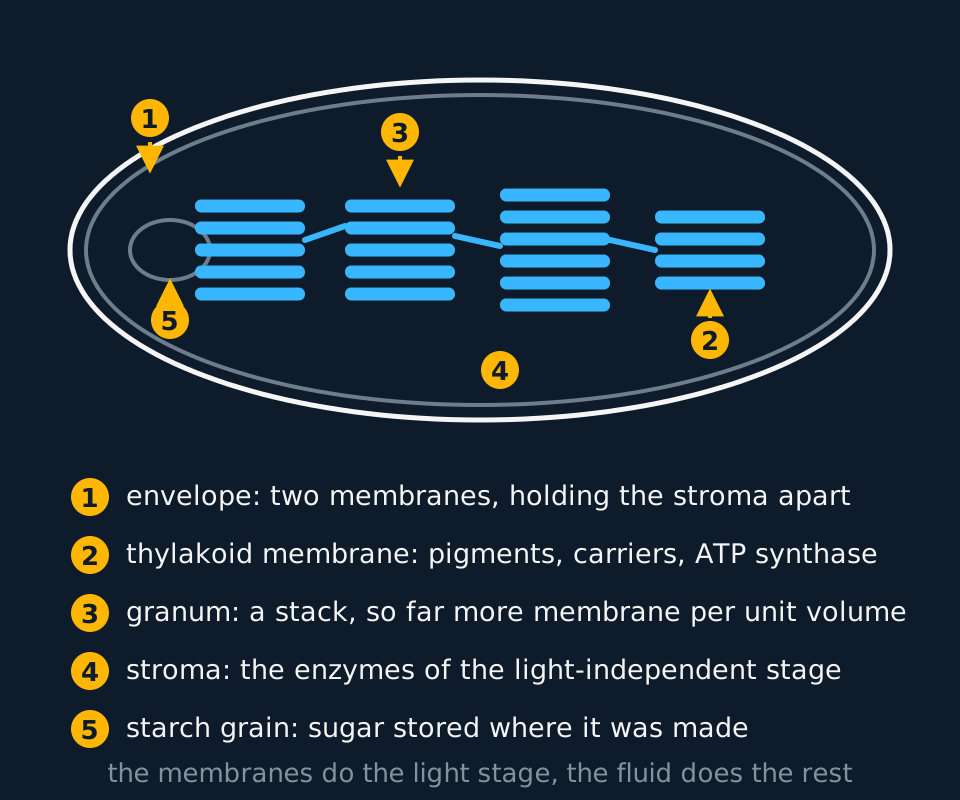
A chloroplast is between two and ten micrometres long, which makes it comfortably visible under a light microscope, and it is wrapped in two membranes rather than one. Inside the envelope sits a thick fluid, the stroma, and running through the stroma is a separate, closed membrane system: flattened sacs called thylakoids, stacked in places into columns called grana and joined between the stacks by single sheets called intergranal lamellae.
Describe the drawing
A chloroplast drawn in section: an outer and an inner membrane enclosing a fluid stroma, four stacks of flattened thylakoid sacs forming grana, single membranes running between the stacks, and a starch grain. Five numbered markers pick out the envelope, a thylakoid membrane, a granum, the stroma and the starch grain, and a numbered key beneath names the job each one does.
The reason for the stacking is surface area. Chlorophyll molecules are held in the thylakoid membrane, so more membrane means more pigment and more light absorbed per chloroplast. The membranes also have to be sealed: the whole light-dependent stage depends on protons being concentrated on one side of them, and a leaky sac would let that gradient drain away as fast as it was built.
- Thylakoid
- A flattened, membrane-bound sac inside a chloroplast; the membrane holds the pigments, the electron carriers and ATP synthase.
- Granum
- A stack of thylakoids, giving a large area of membrane within a small volume.
- Stroma
- The fluid surrounding the thylakoids, containing the enzymes of the light-independent stage, along with DNA and 70S ribosomes.
- Photosystem
- A cluster of pigment molecules held in a thylakoid membrane, funnelling absorbed energy to the chlorophyll a at its reaction centre.
Chloroplast DNA and 70S ribosomes are the features chloroplasts share with prokaryotes, and with mitochondria. They are the standard evidence cited for the endosymbiotic origin of eukaryotic cells.
Which light actually gets used
Leaves contain several pigments, not one. Chlorophyll a is the one at the reaction centre of every photosystem and the only one that can pass an electron on. Chlorophyll b and the carotenoids (carotene and the xanthophylls) are accessory pigments: they absorb wavelengths chlorophyll a is poor at, and hand the energy over to it. A plant with only chlorophyll a would waste much of the blue-green light.
Describe the drawing
Two curves plotted against wavelength from four hundred to seven hundred nanometres. The absorption spectrum of the leaf pigments rises to a tall peak in the blue near four hundred and forty nanometres and a second peak in the red near six hundred and sixty five, and falls almost to nothing across the green around five hundred and fifty. The action spectrum, the rate of photosynthesis at each wavelength, has peaks in the same two places and the same trough in the green, where a label points out that chlorophyll absorbs blue and red and reflects the green.
An absorption spectrum is a graph of how much light a pigment absorbs at each wavelength. An action spectrum is a graph of the rate of photosynthesis at each wavelength. They are different measurements. Plotted on the same axes they make one argument: photosynthesis is fastest at the wavelengths the pigments absorb best, so those pigments are what captures the light.
In the middle of both curves, around 550 nm, absorption falls to a fraction of its blue peak and the rate of photosynthesis falls with it. Green light is largely reflected and transmitted rather than absorbed, so a leaf under green light photosynthesises slowly.
Reading the two spectra together
A student shines light of 550 nm on pondweed and counts far fewer bubbles than under light of 440 nm at the same intensity. Explain the result, and explain why the difference is smaller than the difference in absorption by chlorophyll a alone.
Show the working
At 440 nm the pigments absorb strongly, so more energy is captured, more electrons are excited and more ATP and reduced NADP are made. More water is split to replace the lost electrons, so oxygen is released faster. At 550 nm most of the light passes through or reflects off the leaf without being absorbed at all.
Two things make the difference smaller than chlorophyll a's own absorption suggests. Chlorophyll a is not working alone: chlorophyll b and the carotenoids absorb some of the light it misses and pass the energy on to it. And inside a whole leaf, light is scattered through many chloroplasts, so even weakly absorbed green light is partly captured and a little photosynthesis still happens at 550 nm.
Pulling the pigments apart
You can show that a leaf holds more than one pigment with a strip of chromatography paper or a thin-layer chromatography (TLC) plate coated in silica gel, which OCR's practical uses; the method and the Rf calculation are the same. Grind the leaf with a little propanone, spot the extract onto a pencil origin line, let it dry and spot it again, five or six times, so the spot is concentrated but small. Then stand the paper in a shallow layer of solvent with the origin line above the solvent surface.
Two details in that method are essential. The line is drawn in pencil, because ink would dissolve and run up the paper with the pigments. And the origin sits above the solvent, because a spot dipped into the solvent dissolves off the paper instead of travelling up it.
The running solvent is largely non-polar: typically petroleum ether with a little propanone (about 9 : 1 is a common mix), or a commercially prepared chromatography solvent. Keep a lid on the tank so the air inside stays saturated with solvent vapour; otherwise solvent evaporates from the paper as it rises and the front runs unevenly. Both solvents are highly flammable and their vapour is harmful, so work in a ventilated room away from flames, and check the CLEAPSS Hazcard and your school's risk assessment before starting.
Describe the drawing
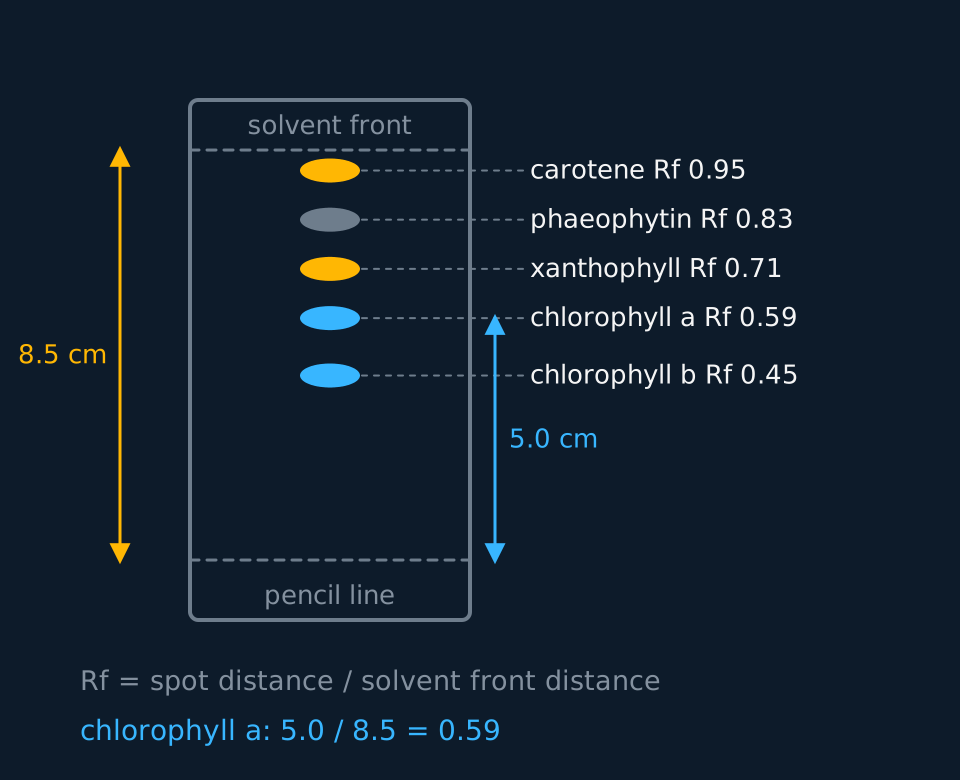
A rectangle of chromatography paper with a pencil origin line near the bottom and the solvent front marked near the top. Five pigment spots sit at different heights up the paper, each joined by a dotted line to its name and its Rf value, from carotene highest at nought point nine five down to chlorophyll b lowest at nought point four five. Measuring arrows show the eight point five centimetres the solvent ran and the five centimetres chlorophyll a moved, and the division is worked out beneath.
Pigments separate because they differ in how strongly they are attracted to the paper and how soluble they are in the solvent. A pigment that is very soluble and holds weakly to the paper travels a long way; one that clings to the paper barely moves. Carotene, a hydrocarbon with no polar groups at all, runs almost to the solvent front. Chlorophyll b, the most polar of the group, lags at the back.
Rf = distance moved by the spot ÷ distance moved by the solventBoth distances measured from the pencil line, in the same units, so Rf has no units and can never exceed 1.
Because the ratio cancels the units, an Rf value is the same whether the solvent ran three centimetres or thirteen, which is what makes it worth quoting. It is only reproducible for a given solvent, though: change the solvent and every value changes, so a table of Rf values always comes with the solvent named.
The light-dependent stage, in the order it happens
Everything in this section takes place on or across a thylakoid membrane. Four processes occur together in the intact chloroplast, and are set out below in causal sequence.

Describe the drawing
The light-dependent reactions animated across a thylakoid membrane, with the stroma above it and the thylakoid space below. First, light strikes photosystem II and an electron is excited out of the chlorophyll. Second, two water molecules are split in the thylakoid space into four protons, four electrons and oxygen, and the electrons replace the one that left. Third, the excited electron passes along a chain of carriers to photosystem I, where light re-energises it, while the energy released pumps protons from the stroma into the thylakoid space, which fills with them. Fourth, the protons flow back out through ATP synthase, ATP is made from ADP and phosphate, and the electron finally reduces NADP.
Photoionisation. A photon is absorbed by the pigments of photosystem II and its energy funnels to the chlorophyll a at the reaction centre. An electron in that molecule is raised to a higher energy level and leaves the molecule altogether. The chlorophyll has lost a negative charge, so it is now positively charged, which is what photoionisation means, and it must gain a replacement electron before it can absorb again.
Photolysis. The replacement comes from water. An enzyme on the inner face of the thylakoid membrane, named the oxygen-evolving complex and bound to photosystem II, splits water using light energy: 2H2O → 4H+ + 4e− + O2. The electrons refill photosystem II, the protons join the growing pool inside the thylakoid space, and the oxygen is released as a by-product. Isotope labelling shows that the oxygen given off in photosynthesis comes from water, not from carbon dioxide.
The electron transport chain. The excited electron is picked up by a carrier in the membrane and passed from carrier to carrier, losing energy at each transfer. That energy is not wasted: it drives protons from the stroma into the thylakoid space, so the space fills with H+ and a steep concentration gradient builds across the membrane.
Chemiosmosis. The membrane is impermeable to protons except at one place: the channel through ATP synthase. Protons flow back out into the stroma through that channel, down their gradient, and the flow drives the enzyme to phosphorylate ADP. Because the energy for it came from light, the process is called photophosphorylation.
At the far end, the electron reaches photosystem I, is re-energised by light absorbed there, and is passed to NADP along with a proton from the stroma. Reduced NADP and ATP are the two things the light-dependent stage exists to produce, and both are released into the stroma, where they are used by the Calvin cycle.
Electron transfer can be followed in a test tube using an artificial electron acceptor. DCPIP is a redox indicator: blue when oxidised and colourless when reduced. Added to a suspension of isolated chloroplasts, it accepts electrons from the chain in place of NADP. In the light the blue colour fades; in the dark it is retained; and the time taken to decolourise measures the rate of the light-dependent reactions. The decolourising of DCPIP by illuminated chloroplasts is the Hill reaction, the standard practical on this stage. Cambridge International also names methylene blue, which is likewise blue when oxidised and colourless when reduced and can take the place of DCPIP.
- Photoionisation
- The loss of an electron from a chlorophyll molecule after it absorbs light energy, leaving the molecule positively charged. Cambridge International calls the step photoactivation.
- Photolysis
- The splitting of water using light energy, giving electrons, protons and oxygen.
- Chemiosmosis
- The movement of protons down a concentration gradient through ATP synthase, driving the synthesis of ATP.
- Photophosphorylation
- The synthesis of ATP from ADP and inorganic phosphate using energy that originally came from light.
Two routes, two sets of products
The path just described is non-cyclic photophosphorylation: electrons travel from water, through photosystem II, along the chain, through photosystem I and onto NADP, and never come back. It needs photolysis to keep photosystem II supplied, so it produces oxygen, and it produces both ATP and reduced NADP.
There is a second route. In cyclic photophosphorylation only photosystem I is involved. The excited electron is passed to a carrier and then returned to the same photosystem instead of going on to NADP. Protons are still pumped and ATP is still made, but nothing is reduced and no water needs splitting, so there is no oxygen and no reduced NADP.
| Non-cyclic | Cyclic | |
|---|---|---|
| Photosystems used | PS II and PS I | PS I only |
| Where the electron ends up | On NADP | Back on PS I |
| Is water split? | Yes | No |
| Oxygen produced? | Yes | No |
| Products | ATP and reduced NADP | ATP only |
Cyclic photophosphorylation supplies ATP without producing reduced NADP, which suits a cell using ATP for a process other than carbon fixation. Guard cells are the standard example: opening a stoma depends on ion movement driven by ATP, and requires no reduced NADP.
TRY IT: Explaining an inhibitor
A herbicide binds to a carrier in the electron transport chain between photosystem II and photosystem I, and blocks it. Predict the effect on the amount of oxygen released by a treated plant and on the amount of reduced NADP in its chloroplasts, and explain both predictions.
Check your answer
Oxygen release falls close to zero. Photolysis only happens because photosystem II keeps losing electrons and needs replacements; with the chain blocked, photosystem II fills up with electrons it cannot pass on, so water is no longer split and no oxygen is produced.
Reduced NADP falls too, and for a different reason: the electrons that would have reduced it can no longer reach photosystem I. Whatever reduced NADP was already in the stroma will be used up by the Calvin cycle and not replaced.
A complete answer connects the block to each named product separately, and reaches oxygen through photolysis rather than asserting that photosynthesis stops.
The Hill reaction: dehydrogenase activity in isolated chloroplasts
optional
AQA sets this as required practical 8: Investigation into the effect of a named factor on the rate of dehydrogenase activity in extracts of chloroplasts. Pearson Edexcel Biology A (9BN0) sets it as Core Practical 11: Investigate photosynthesis using isolated chloroplasts (the Hill reaction). Cambridge International and OCR A examine the same method. DCPIP takes electrons from the chain in place of NADP, so the Calvin cycle stops and the rate measured is that of the light-dependent stage alone.
Isolating the chloroplasts. Blend leaves without their midribs in short bursts in isolation medium: 0.4 mol dm⁻³ sucrose in phosphate buffer at pH 7.0, ice-cold. Cold slows the enzymes released from broken cells, which would digest the chloroplasts. Isotonic medium stops them bursting or shrinking by osmosis. The buffer holds the pH, so the proteins of the chain are not denatured. Filter through muslin, centrifuge slowly to remove debris, then faster to pellet the chloroplasts, and resuspend them in cold medium. Keep them on ice in the dark and use them within the hour.
| Tube | Contents | Result and meaning |
|---|---|---|
| Test | DCPIP, medium, suspension, in the light | Blue fades: DCPIP is reduced |
| Dark control | As the test, wrapped in foil | Stays blue: light is needed |
| Boiled control | Boiled suspension | Stays blue: working proteins are needed |
| Colour standard | Suspension and medium, no DCPIP | The green end-point a tube reaches |
Readings. Time t until a tube matches the colour standard, or use a colorimeter with a red filter, zeroed on the colour standard. The rate is 1 ÷ t. For light intensity, vary the lamp distance d with the tubes in a water bath and a heat filter in front of the lamp. Taking intensity as 1 ÷ d² assumes a point source, so a light meter is better. Temperature or an inhibitor can be the factor instead. Run three repeats at each value, work through the values in a random order, and take the mean.
Risk assessment. DCPIP stains skin and clothing. Run the centrifuge balanced with its lid shut, wear eye protection, and check the CLEAPSS Hazcard and your school's risk assessment before starting; where they differ from this page, follow them.
The full method, with volumes and idealised results, is in the Hill reaction practical guide.
In the exam
- State that chlorophyll absorbs blue and red light and reflects green light. The absorption spectrum shows this directly.
- Photolysis splits water. Write the equation with H2O on the left and be explicit that the oxygen given off comes from water, not from carbon dioxide. Questions using isotopes of oxygen test precisely that.
- Name the location. 'In the chloroplast' is too vague once a question is worth more than a mark: say thylakoid membrane for the light-dependent stage, stroma for the light-independent stage.
- Rf values are ratios, so they have no units and are never greater than 1. If you calculate 1.4 you have divided the wrong way round.
- For cyclic photophosphorylation, state all three outcomes explicitly: ATP is made, and neither oxygen nor reduced NADP is produced.
- Say what an action spectrum measures if you are asked to compare it with an absorption spectrum. One is a rate, the other is light absorbed; the similarity between them is the evidence, not the definition.
Check yourself
A student illuminates isolated chloroplasts in a buffer containing a blue dye that turns colourless when it is reduced. The dye loses its colour in the light and stays blue in the dark. Explain these observations, and predict what would happen if the thylakoid membranes were first punctured.
Answer
In the light, photosystem II absorbs energy and electrons are lost from chlorophyll. Those electrons pass along the carriers in the thylakoid membrane, and the dye intercepts them, acting in place of NADP as the final electron acceptor. Gaining electrons is reduction, so the dye is reduced and loses its colour.
In the dark no electrons are excited, so nothing is passed along the chain, nothing reduces the dye and it stays blue. The reaction needs light directly, which is what makes it part of the light-dependent stage.
Puncturing the thylakoids would leave the dye still losing its colour, because the carriers are in the membrane and can still pass electrons to it. What would stop is ATP synthesis: protons pumped into the thylakoid space would leak straight back out, no gradient could build, and there would be nothing to drive ATP synthase.
That last part is the discriminating one. It separates the electron chain, which needs an intact membrane only as a scaffold, from chemiosmosis, which needs an intact membrane as a barrier.
Questions
Question 15 marks
Describe the light-dependent reactions of photosynthesis, in the order in which they happen, from the absorption of a photon to the formation of reduced NADP.
Mark scheme
- B1 a photon is absorbed by the pigments of photosystem II and the energy is funnelled to the chlorophyll a at the reaction centre, from which an electron is raised to a higher energy level and lost altogether, leaving the molecule positively charged
- B1 the lost electron is replaced by the photolysis of water on the inner face of the thylakoid membrane, which gives protons, electrons and oxygen
- B1 the excited electron is passed from carrier to carrier along the thylakoid membrane, losing energy at each transfer
- B1 that energy drives protons from the stroma into the thylakoid space, so a steep proton gradient builds across the membrane
- B1 protons flow back into the stroma through ATP synthase, driving photophosphorylation, while the electron reaches photosystem I, is re-energised by light and is passed with a proton to NADP, giving reduced NADP
Question 24 marks
Compare non-cyclic photophosphorylation with cyclic photophosphorylation.
Mark scheme
- B1 non-cyclic uses photosystem II and photosystem I, whereas cyclic uses photosystem I alone
- B1 in non-cyclic the electron ends up on NADP and never returns, whereas in cyclic it is passed to a carrier and returned to the same photosystem
- B1 non-cyclic needs photolysis of water to replace the electrons photosystem II loses, so it releases oxygen, whereas cyclic splits no water and releases none
- B1 non-cyclic produces both ATP and reduced NADP, whereas cyclic produces ATP only, which suits a job such as pumping potassium ions into a guard cell
Question 34 marks
Explain why thylakoids are stacked into grana rather than existing as single flattened sacs, and explain why the thylakoid membrane must be sealed.
Mark scheme
- B1 chlorophyll molecules are held in the thylakoid membrane, so stacking thylakoids into grana packs a large area of membrane, and so a large quantity of pigment, into a small volume
- B1 more membrane area means more light can be absorbed per chloroplast
- B1 the light-dependent stage depends on protons being concentrated on one side of the thylakoid membrane, forming a steep concentration gradient
- A1 a leaky membrane would let that proton gradient drain away as fast as it was built, so the membrane has to be sealed for chemiosmosis to work at all
Question 44 marks
Describe how a chromatogram of leaf pigments is prepared, and describe why the origin line must be drawn in pencil and kept above the level of the solvent.
Mark scheme
- B1 the leaf is ground with a little propanone, and the extract is spotted onto a pencil line drawn near the bottom of a strip of chromatography paper, letting each spot dry before adding the next so it stays small and concentrated
- B1 the paper is then stood in a shallow layer of solvent, with the origin line held above the surface of the solvent
- B1 the line must be drawn in pencil because ink would dissolve in the solvent and run up the paper along with the pigments, making the result impossible to interpret
- A1 the origin must be kept above the solvent surface because a spot dipped directly into the solvent would dissolve straight off the paper into the solvent rather than travelling up the paper as the solvent rises
Question 54 marks
On a chromatogram the solvent has travelled 92 mm from the origin, and the centre of the chlorophyll b spot lies 34 mm from the origin. Calculate the Rf value of chlorophyll b, and calculate how far a carotene spot would have travelled if its Rf value is 0.94 under the same conditions.
Mark scheme
- M1 Rf = distance moved by the spot ÷ distance moved by the solvent, so for chlorophyll b that is 34 ÷ 92
- A1 Rf = 0.37, to two significant figures
- M1 for carotene, distance moved by the spot = Rf × distance moved by the solvent = 0.94 × 92
- A1 86 mm, to two significant figures
Question 64 marks
Describe how the Hill reaction, using the redox indicator DCPIP, is used to measure the rate of the light-dependent reactions in a suspension of isolated chloroplasts.
Mark scheme
- B1 DCPIP is blue when oxidised and colourless when reduced, and it is added to a suspension of isolated chloroplasts in place of NADP as an artificial electron acceptor
- B1 in the light, electrons excited in the chloroplasts' electron transport chain are passed to DCPIP instead of to NADP, and gaining electrons is reduction, so the DCPIP loses its blue colour
- B1 in the dark no electrons are excited, so DCPIP is not reduced and stays blue
- A1 the time taken for the blue colour to disappear, or the rate at which it fades, is a measure of the rate of the light-dependent reactions, so this can be compared between different light intensities or wavelengths
Question 74 marks
A student varies light intensity by moving a lamp to different distances from tubes of chloroplast suspension and DCPIP, and takes the relative intensity at each distance to be 1 ÷ distance². Explain two problems with this way of varying light intensity, and explain how each can be overcome.
Mark scheme
- B1 first problem explained, one of: a lamp close to a tube warms it, and temperature changes the rate for a reason other than light; intensity is proportional to 1 ÷ distance² only for a point source, which a real lamp is not; light from the room adds an intensity that was not measured
- B1 the fix for that problem: a water bath at a fixed temperature with a heat filter between lamp and tubes, or an LED; a light meter reading taken where the tube stands; a darkened room with the tubes screened
- B1 a second, different problem from the same list, explained
- B1 the fix for the second problem, from the same list of fixes
Question 83 marks
Explain why a leaf appears green, referring to the absorption spectrum of chlorophyll.
Mark scheme
- B1 chlorophyll absorbs strongly in the blue region and in the red region of the spectrum
- B1 its absorption falls to a small fraction of that peak in the green band around 550 nm, so green light is barely absorbed
- B1 the green light is reflected and transmitted instead, so it is the light that reaches the eye, and a leaf lit only by green light photosynthesises slowly
Question 93 marks
On a chromatogram of leaf pigments the solvent front has run 84 mm from the pencil origin line, and the centre of the carotene spot lies 79 mm from that line. Calculate the Rf value of carotene.
Mark scheme
- M1 Rf = distance moved by the spot ÷ distance moved by the solvent, with both distances measured from the pencil line and the spot measured to its centre
- M1 79 ÷ 84
- A1 Rf = 0.94, a ratio with no units, which can never exceed 1
Question 103 marks
A plant is watered with water in which the oxygen is the heavy isotope oxygen-18, while the carbon dioxide it is given contains only ordinary oxygen. Suggest where the oxygen-18 will first be detected, and justify your answer.
Mark scheme
- B1 the oxygen-18 appears in the oxygen gas the plant releases
- B1 the oxygen given off in photosynthesis comes from the photolysis of water at the thylakoid membrane, not from carbon dioxide
- B1 water is split into protons, electrons and oxygen, so any label carried by the water leaves in the gas; had the oxygen come from carbon dioxide, unlabelled gas would have been released instead
Question 113 marks
Explain why the presence of DNA and 70S ribosomes inside a chloroplast is used as evidence that chloroplasts evolved from free-living prokaryotic cells.
Mark scheme
- B1 DNA and 70S ribosomes are features of prokaryotic cells, and chloroplasts carry both
- B1 a eukaryotic cell's own ribosomes, outside its chloroplasts and mitochondria, are the larger 80S type, so a chloroplast's ribosomes do not match the rest of the cell they are found in
- A1 the simplest explanation for a chloroplast carrying its own DNA and a prokaryote-type ribosome is that it was once a free-living prokaryotic cell, engulfed by an ancestral eukaryotic cell and retained rather than digested
Question 123 marks
Explain why photosystem II cannot keep absorbing light and losing electrons unless water is continuously split nearby.
Mark scheme
- B1 each time photosystem II absorbs a photon, the chlorophyll a at its reaction centre loses an electron and becomes positively charged, and it must regain an electron before it can absorb light and lose one again
- B1 photolysis of water, catalysed by the oxygen-evolving complex on the inner face of the thylakoid membrane, releases electrons that refill photosystem II
- A1 without a continuous supply of replacement electrons from water, photosystem II would quickly run out of electrons to lose and light absorption at that photosystem would stop, so the whole non-cyclic pathway depends on photolysis continuing at the same rate as photoionisation
Question 133 marks
A poison specifically inhibits ATP synthase in the thylakoid membrane, without affecting any other protein there. Suggest what happens to the proton concentration in the thylakoid space, and suggest what happens to the rate of the light-independent reactions as a result.
Mark scheme
- B1 protons continue to be pumped into the thylakoid space by the electron transport chain, but can no longer flow back out through ATP synthase, so the proton concentration inside the thylakoid space keeps rising
- B1 with ATP synthase blocked, ATP production stops, even though electron transport and photolysis may continue for a while
- A1 the light-independent reactions need a continuous supply of ATP to reduce GP to triose phosphate and to regenerate RuBP, so with no ATP being made the light-independent reactions in the stroma slow and then stop, even though light is still available
Question 143 marks
Compare the role of chlorophyll a with the role of the accessory pigments, chlorophyll b and the carotenoids, in capturing light energy.
Mark scheme
- B1 chlorophyll a sits at the reaction centre of every photosystem and is the only pigment able to pass an excited electron on to the next carrier, whereas the accessory pigments cannot do this themselves
- B1 the accessory pigments absorb wavelengths chlorophyll a absorbs poorly, particularly in the blue-green between about 450 and 520 nm, and pass the energy they capture on to chlorophyll a at the reaction centre
- A1 a plant with only chlorophyll a would therefore be able to use the light energy it did absorb, but would waste much of the blue-green light that the accessory pigments would otherwise capture
Question 153 marks
In an investigation of dehydrogenase activity in chloroplasts, leaves were blended in an isolation medium that was ice-cold, buffered, and of the same water potential as the chloroplasts. Explain why each of these three properties was needed.
Mark scheme
- B1 ice-cold, so that enzymes released from the broken cells, which would digest the chloroplast membranes and proteins, work slowly
- B1 same water potential, so there is no net movement of water into or out of the chloroplasts by osmosis and they do not burst or shrink
- B1 buffered, so the pH stays constant and the proteins of the electron transport chain are not denatured
Question 163 marks
A student follows the reduction of DCPIP by a suspension of isolated chloroplasts with a colorimeter. Explain why a red filter is used, and why the colorimeter is set to zero absorbance with a tube of chloroplast suspension and medium containing no DCPIP.
Mark scheme
- B1 oxidised DCPIP is blue, so it absorbs red light, and the absorbance of red light falls as the DCPIP is reduced and loses its colour
- B1 chlorophyll in the suspension also absorbs red light, and the tube without DCPIP cancels out that absorbance
- B1 so the reading measures only the DCPIP still oxidised, and zero absorbance is the end-point the tube reaches when all its DCPIP has been reduced
Question 172 marks
State what an absorption spectrum measures, and state what an action spectrum measures.
Mark scheme
- B1 an absorption spectrum shows how much light a pigment absorbs at each wavelength
- B1 an action spectrum shows the rate of photosynthesis at each wavelength
Question 182 marks
State the location within a chloroplast of the light-dependent reactions, and state the location of the light-independent reactions.
Mark scheme
- B1 the light-dependent reactions occur on and across the thylakoid membranes
- B1 the light-independent reactions occur in the stroma surrounding the thylakoids
Worth remembering
- Thylakoid membranes do the light-dependent stage; the stroma does the light-independent stage.
- Chlorophyll absorbs blue and red, reflects green, and that is why leaves look green.
- Photolysis splits water into electrons, protons and oxygen.
- Protons are pumped into the thylakoid space and flow back through ATP synthase: that is chemiosmosis.
- Non-cyclic gives ATP, reduced NADP and oxygen; cyclic gives ATP alone.
CHECK YOUR PROGRESS
Rate how confident you are with each objective for this lesson. Ratings are saved in this browser, on this device, unless you sign in.
- Name the parts of a chloroplast and give each one a job it does in photosynthesis.
- Explain why a leaf looks green, using the absorption spectrum of chlorophyll.
- Say what an action spectrum measures and why it resembles an absorption spectrum.
- Separate leaf pigments by chromatography and calculate an Rf value from your own chromatogram.
- Describe the light-dependent reactions in order, from a photon to reduced NADP.
- Distinguish non-cyclic from cyclic photophosphorylation by their products.
- Isolate chloroplasts in cold, buffered, isotonic medium and use DCPIP to measure how a named factor changes the rate of the light-dependent reactions.
Open the full revision checklist to see every objective in the curriculum in one place.
Practise this lesson
WORKBOOK
The questions from this topic, on paper with room to work, and a separate book of mark schemes. Free to use; please do not redistribute or sell.
Used later in Limiting factors and primary productivity