Biology › Practicals › Required practical 7: chromatography of leaf pigments
Required practical 7: chromatography of leaf pigments
A green leaf holds several pigments, and chromatography pulls them apart. Spot an extract on a pencil line, stand the paper in a non-polar solvent, and each pigment climbs a different distance. The ratio of that distance to the solvent's, the Rf value, identifies the pigment. Run two leaves on one paper and you can compare which pigments each has, and roughly how much.
The capability this develops
This guide is one investigation under capability P10: Chromatography and the separation of pigments, which sets out the techniques the investigation belongs to, the calculations it carries and the errors that cost marks in all of them. The notes behind the biology are in Photosynthesis and primary productivity.
Where this sits on the specifications
This library maps a qualification to its own specification one numbered heading at a time, against a document whose sha256 is recorded, and publishes the result as a route map. These are the headings whose practical work this investigation serves, on the five qualifications mapped so far. Each links to the route map the row belongs to.
| Qualification | Heading |
|---|---|
| AQA 7401/7402 | 3.5.1 Photosynthesis |
| OCR H020/H420 | 5.2.1 Photosynthesis |
| Cambridge International 9700 | 13.1 Photosynthesis as an energy transfer process |
| Pearson Edexcel Biology A (Salters-Nuffield) 8BN0/9BN0 | 5.7 The light-dependent reactions |
| Pearson Edexcel Biology B 8BI0/9BI0 | 5.6 ii Photosynthetic pigments |
Some boards number their practical activities, and those lists were read here from the same specifications as the headings above. This investigation is numbered on them as:
- AQA 7401/7402 required practical 7
- OCR Biology A H020/H420 PAG 6
- Pearson Edexcel Biology B 8BI0/9BI0 core practical 11
The other qualifications above are matched by specification heading only, because none of them numbers an activity that is this investigation. Use your awarding organisation’s current specification and its practical handbook as the authority on which activities your course requires and how they are assessed.
The principle
Pigments separate because they differ in how strongly they are attracted to the paper and how soluble they are in the solvent. A pigment that is very soluble and holds weakly to the paper travels a long way; one that clings to the paper barely moves. Carotene, a hydrocarbon with no polar groups, runs almost to the solvent front. Chlorophyll b, the most polar of the group, lags at the back.
The Rf value is the distance moved by the spot divided by the distance moved by the solvent, both measured from the pencil line. It has no unit and cannot be more than 1.
Because the ratio cancels the units, an Rf value is the same whether the solvent ran three centimetres or thirteen, so it is worth quoting. It is only reproducible for a given solvent, though: change the solvent and every value changes, so a table of Rf values always comes with the solvent named.
Running two leaves on the same paper means they share the solvent, the run and the solvent front. A pigment in both leaves then gives spots at the same height, and any difference between the leaves is in which spots are present and how strong they are.
- Rf value
- The distance moved by a spot divided by the distance moved by the solvent front, both from the origin line.
- Origin
- The pencil line on which the extract is spotted, drawn above the level of the solvent.
- Solvent front
- The furthest point the solvent reached up the paper, marked as soon as the paper is taken out.
Apparatus
- Two kinds of leaf: one from a plant in full sun, and one from a shade-tolerant plant on the floor of a wood, such as ivy
- A mortar and pestle, a little clean sand, and propanone
- Chromatography paper, or a thin-layer chromatography plate, and a pencil and ruler
- Fine glass capillary tubes for spotting
- A tall tank or boiling tube with a lid or bung
- Running solvent: petroleum ether and propanone, about 9 : 1, or a commercially prepared chromatography solvent
- A hair dryer on a cool setting, used away from the solvents, or time to let each spot dry
- Eye protection
Safety
Work to your school’s risk assessment. Propanone and the running solvent are highly flammable and their vapour is harmful, so use them in a well-ventilated room or a fume cupboard, with no naked flame anywhere in the room, and keep the tank lidded. Check the CLEAPSS Hazcard for each solvent before starting. Grinding leaves with sand can flick grit and solvent, so wear eye protection while grinding. Glass capillaries break easily and go in the broken-glass container.
Variables
Independent variable
The leaf: one from a plant growing in full sun and one from a shade-tolerant plant growing in shade.
Dependent variable
The pigments present, identified by their Rf values, and the size and depth of colour of each spot as a rough measure of how much of it there is.
Control variables
- The solvent and the run. Both extracts on one paper, run in one tank, so the solvent and the front are the same for both.
- The extract. The same mass of leaf ground with the same volume of propanone, so spot strength reflects the leaf and not the extraction.
- The spotting. The same number of applications for each extract, each dried before the next.
- The origin. One pencil line, above the solvent surface, for both spots.
Method
Extracting the pigments
- Cut 2 g of each leaf into small pieces, avoiding the main veins, and grind each separately with a little sand and 5 cm³ of propanone until the liquid is dark green.
- Let the debris settle, or filter the liquid, and keep each extract in a stoppered tube out of bright light.
Spotting and running
- Draw a pencil line 2 cm from the bottom of the paper, and mark two points on it 3 cm apart, one for each leaf.
- Spot the extract onto a pencil origin line, let it dry and spot it again, five or six times, so the spot is concentrated but small.
- Then stand the paper in a shallow layer of solvent with the origin line above the solvent surface.
- Keep a lid on the tank so the air inside stays saturated with solvent vapour; otherwise solvent evaporates from the paper as it rises and the front runs unevenly.
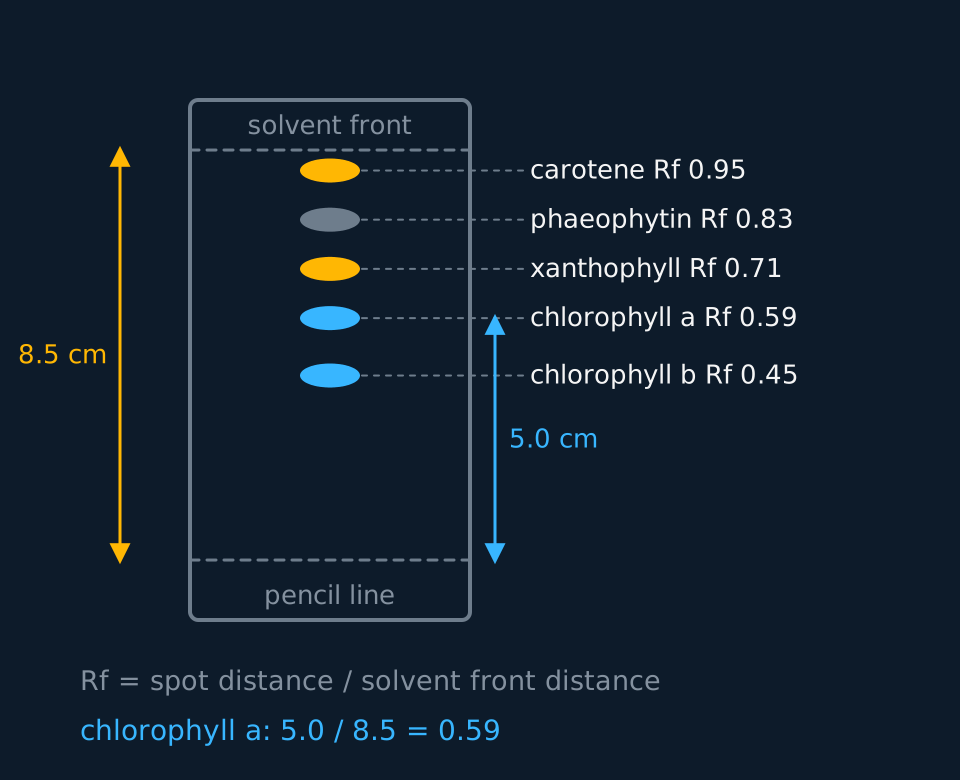
Describe the drawing
A rectangle of chromatography paper with a pencil origin line near the bottom and the solvent front marked near the top. Five pigment spots sit at different heights up the paper, each joined by a dotted line to its name and its Rf value, from carotene highest at nought point nine five down to chlorophyll b lowest at nought point four five. Measuring arrows show the eight point five centimetres the solvent ran and the five centimetres chlorophyll a moved, and the division is worked out beneath.
Marking and measuring
- Take the paper out when the solvent is about 1 cm from the top, and mark the solvent front in pencil at once.
- Draw round each spot in pencil before the colours fade, and mark the centre of each.
- Measure from the origin line to the centre of each spot, and from the origin line to the solvent front, and calculate each Rf.
Sample data
These results are idealised. The Rf values are the ones the lesson's chromatogram shows, run here over a 10.0 cm solvent front, and the spot descriptions were made up to show how two leaves are compared. Nothing here is a record of an experiment.
| Spot, from the top | Colour | Distance from origin / cm | Rf | Sun leaf | Shade leaf |
|---|---|---|---|---|---|
| Carotene | Orange-yellow | 9.5 | 0.95 | Clear | Faint |
| Phaeophytin | Grey | 8.3 | 0.83 | Faint | Faint |
| Xanthophyll | Yellow | 7.1 | 0.71 | Clear | Clear |
| Chlorophyll a | Blue-green | 5.9 | 0.59 | Strong | Strong |
| Chlorophyll b | Yellow-green | 4.5 | 0.45 | Small | Large, nearly as strong as chlorophyll a |
The solvent front was 10.0 cm from the origin. For chlorophyll a, Rf = 5.9 ÷ 10.0 = 0.59.
Both leaves gave all five spots at the same heights, because they shared the paper and the solvent. So the two leaves contain the same pigments, and the difference between them is in the amounts.
The shade leaf's chlorophyll b spot is the clearest difference. Shade leaves often carry more chlorophyll b relative to chlorophyll a than sun leaves do. Chlorophyll b absorbs some wavelengths that chlorophyll a absorbs poorly, which helps a leaf in the dim light under a canopy.
Reading the chromatogram
Identify by Rf, not by colour. Two yellow spots, carotene and xanthophyll, are told apart by how far they ran, and a spot is matched to a pigment by comparing its Rf with values found in the same solvent.
The order of the spots is the order of polarity. Carotene, with no polar groups, is most soluble in the non-polar solvent and least held by the paper, so it is at the top. Chlorophyll b, the most polar, is at the bottom.
Phaeophytin is not a pigment the leaf was using. It is chlorophyll that lost its magnesium ion while it was being extracted, which is why the spot is grey and faint, and why an extract made quickly and kept out of the light gives less of it.
Comparing amounts. Spot size and depth of colour are a judgement by eye, enough to say that the shade leaf's chlorophyll b spot is larger and not enough to say by how much. To put a number on it, cut out each spot, dissolve the pigment out in a fixed volume of propanone and read its absorbance in a colorimeter.
Leaves of different colours. The same method compares a green leaf with a red or purple one. A red leaf still shows the chlorophyll spots; its red pigment dissolves in water rather than in the non-polar solvent, so it stays at or near the origin.
Evaluation
Each of these is a real source of error in this investigation, and the middle column is the part an answer earns marks for: what it does to the result, and in which direction.
| Source of error | What it does to the result | What to do about it |
|---|---|---|
| The origin below the solvent surface | The spots dissolve off the paper into the solvent in the tank instead of running up the paper, and the chromatogram is blank or faint. | Pour a shallow layer of solvent and check the line is above it before the paper goes in. |
| Spots too large or too dilute | A large spot runs as a streak and neighbouring pigments overlap, so the centres cannot be placed and the Rf values are uncertain. A dilute spot gives faint spots that may be missed. | Apply small drops, dry each before the next, and build the spot up five or six times. |
| The tank left open | Solvent evaporates from the paper as it climbs, so the front runs unevenly and the spots move different distances across the paper. | Keep the lid on the tank from the moment the paper goes in. |
| The solvent front not marked straight away | The front cannot be seen once the paper dries, so its position is guessed. A front placed too low makes every Rf too large by the same factor. | Mark the front in pencil the moment the paper comes out. |
| Spots measured to their edges | Spots spread as they run, so the distance to an edge is not a defined point, and two people get different Rf values. | Measure to the centre of each spot, and say that you did. |
| Unequal extracts | If more leaf or less propanone went into one extract, its spots are stronger for a reason that is not the leaf. | Grind the same mass of each leaf with the same volume of propanone, and spot each the same number of times. |
Questions
Question 1 (2 marks)
Explain why the origin line is drawn in pencil, not ink.
Check your answer
ink contains pigments that dissolve in the solvent;
and would run up the paper, mixing with the leaf pigments (pencil graphite does not dissolve).
Question 2 (2 marks)
A spot moved 5.9 cm and the solvent front moved 10.0 cm. Calculate the Rf value.
Check your answer
Rf = 5.9 ÷ 10.0;
= 0.59 (no units).
Question 3 (2 marks)
Explain why the origin line must be above the surface of the solvent.
Check your answer
if the spots were below the surface, the pigments would dissolve into the solvent in the tank;
instead of being carried up the paper, so they would not separate.
Question 4 (3 marks)
Explain why carotene travels further up the paper than chlorophyll b.
Check your answer
carotene has no polar groups, so it is more soluble in the non-polar solvent;
and is held less strongly by the paper;
chlorophyll b is the most polar, so it is held most strongly and moves least.
Question 5 (2 marks)
A student compares her Rf values with a table from another school. Explain why the comparison may not be valid.
Check your answer
Rf values depend on the solvent (and the paper and temperature);
so values are comparable only if the same solvent was used.
Coverage maps are available for AQA 7401/7402, OCR Biology A H020/H420, Cambridge International 9700, Pearson Edexcel Biology A (Salters-Nuffield) 8BN0/9BN0 and Pearson Edexcel Biology B 8BI0/9BI0. Use the relevant route map to check what InkBiology covers, and your awarding organisation’s current specification as the final authority on examinable content.