Chemistry › Acids and bases › Buffer solutions and buffer calculations
Buffer solutions and buffer calculations
A drop of bench hydrochloric acid in a beaker of pure water takes the pH from 7 to about 3. The same drop in blood barely moves it. Blood is a buffer: a weak acid and its conjugate base held together in large amounts, so that each takes up what is added. The pH of an acidic buffer comes straight from Ka and the ratio of the two.
Key terms Every definition in acids and bases, lesson by lesson
Before this Weak acids, Ka and pKa; Kw and strong bases – the Ka expression and pKa · Titration curves and choosing an indicator – the flat region before equivalence and pH = pKa at half-neutralisation
COMMON MISCONCEPTION
A buffer is a neutral solution that keeps the pH at 7 whatever is added to it.
A buffer holds the pH near its own value, which is set by the acid's pKa and the ratio of salt to acid, and that value is rarely 7. Blood is buffered at 7.4, ethanoic acid and sodium ethanoate near 4.8. It resists small additions of acid or alkali; a large enough addition uses up one reservoir and the pH then changes freely.
What you should be able to do
- Define a buffer solution, and describe how acidic and basic buffers are made.
- Explain, with equations, how an acidic buffer and a basic buffer resist a change in pH when a small amount of acid or base is added.
- Calculate the pH of an acidic buffer from Ka and the concentrations or amounts of the weak acid and its salt.
- Calculate the pH of an acidic buffer after a small amount of strong acid or strong base has been added.
- Outline how the carbonic acid–hydrogencarbonate system controls the pH of blood.
- Write and use the expression for Ksp, and explain the common ion effect on the solubility of a salt.CAIE
What a buffer resists
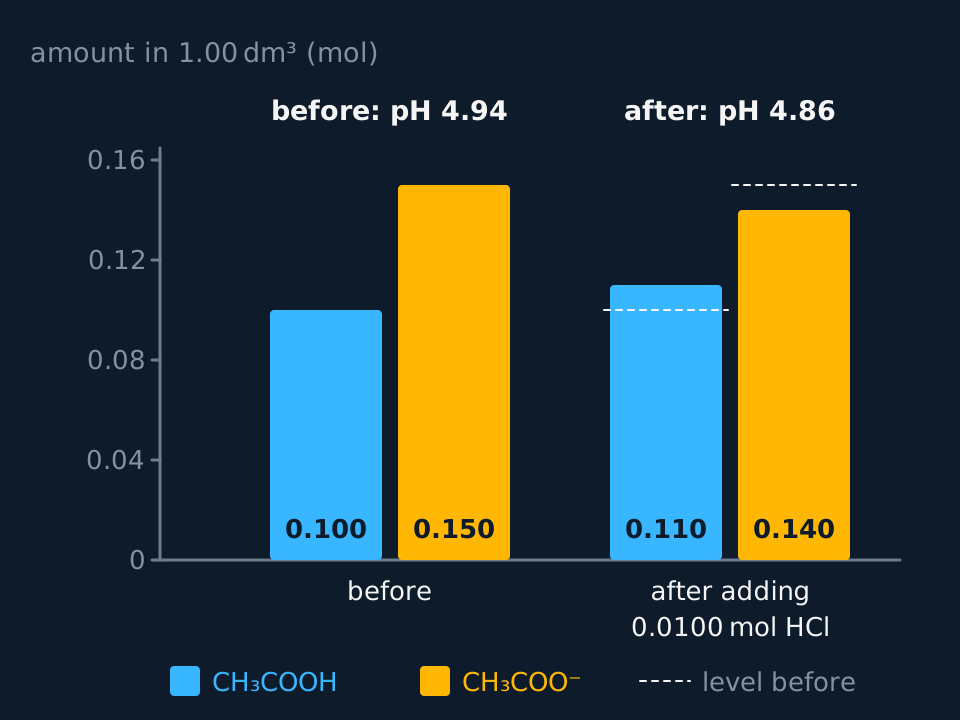
A buffer is a solution that resists a change in pH when small amounts of acid or base are added. The difference it makes is large. 0.0100 mol of hydrogen chloride added to 1.00 dm³ of pure water takes the pH from 7.00 to 2.00. The same amount added to 1.00 dm³ of a solution that is 0.100 mol dm⁻³ in ethanoic acid and 0.150 mol dm⁻³ in sodium ethanoate takes it from 4.94 to 4.86.
The word is resists, not prevents. The pH of a buffer does change, by a small amount, and a large enough addition overwhelms it. Nor is a buffer neutral: this one holds its pH near 5, a phosphate buffer near 7, an ammonia buffer near 9. A buffer is chosen for the pH it holds.
Buffers are used wherever pH has to stay put. Blood is held at 7.40. Eye drops and shampoos are buffered so they do not sting. Enzyme experiments in biology run in buffer because the reaction itself can change the pH, and a pH meter is calibrated in buffer solutions because their pH is known and stable.
- Buffer
- A solution that maintains an approximately constant pH when small amounts of acid or base are added, or when it is diluted.
- Acidic buffer
- A buffer with a pH below 7, made from a weak acid and a salt of that acid, such as ethanoic acid and sodium ethanoate.
- Basic buffer
- A buffer with a pH above 7, made from a weak base and a salt of that base, such as ammonia and ammonium chloride.
How an acidic buffer works
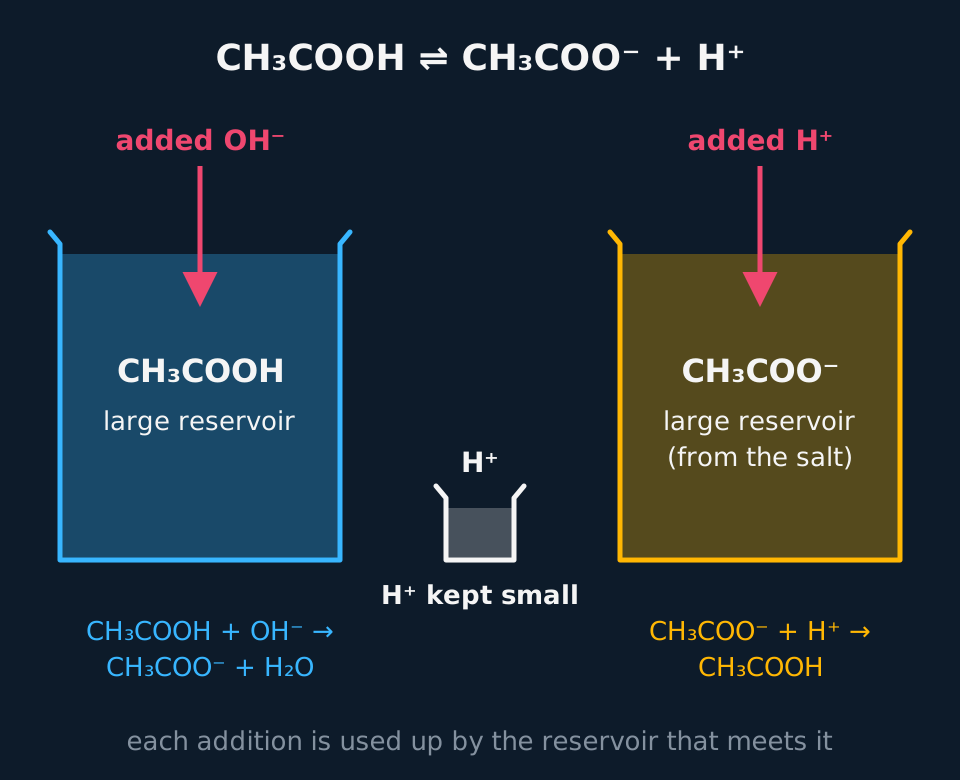
Everything depends on having large amounts of two species at once: the weak acid, and its conjugate base. Ethanoic acid on its own has plenty of CH₃COOH but very little CH₃COO⁻, because it hardly dissociates. Sodium ethanoate supplies the missing reservoir. It is an ionic salt and fully dissociated, so 0.150 mol dm⁻³ of it puts 0.150 mol dm⁻³ of CH₃COO⁻ into solution, and that extra ethanoate pushes the acid's own dissociation even further to the left.
CH₃COOH(aq) ⇌ CH₃COO⁻(aq) + H⁺(aq)In a buffer, CH₃COOH and CH₃COO⁻ are both present in large amounts.
Describe the drawing
The equilibrium CH₃COOH, ethanoate and H⁺ drawn as two tall, full tanks of equal height: CH₃COOH on the left, a large reservoir, and ethanoate on the right, a large reservoir from the salt, with a tiny beaker of H⁺ between them. An arrow marked added OH⁻ points into the ethanoic acid tank, which reacts to give ethanoate and water; an arrow marked added H⁺ points into the ethanoate tank, which takes it up to give ethanoic acid. [H⁺] is kept small.
When acid is added, the extra H⁺ ions combine with ethanoate ions, and the position of equilibrium shifts to the left. Most of the added H⁺ is removed, so [H⁺] and the pH change very little. Because the ethanoate reservoir is large, using a little of it barely changes the ratio of acid to conjugate base.
CH₃COO⁻(aq) + H⁺(aq) → CH₃COOH(aq)Added acid is removed.
When alkali is added, the extra OH⁻ ions react with ethanoic acid molecules, forming water and ethanoate. The same result can be reached in two stages: OH⁻ removes H⁺ as water, and the position of equilibrium shifts to the right as more CH₃COOH dissociates to replace the H⁺ lost. Either way the OH⁻ is removed and [H⁺] barely falls.
CH₃COOH(aq) + OH⁻(aq) → CH₃COO⁻(aq) + H₂O(l)Added alkali is removed.
Both explanations need the word large. A buffer works because the amounts of HA and A⁻ are large compared with the acid or alkali added. Add more H⁺ than there is A⁻ and the reservoir is used up; after that, the pH falls as it would in water.
A buffer does not have to be made from a bottle of the salt. Adding sodium hydroxide to an excess of ethanoic acid converts some of the acid to ethanoate and leaves the rest, so the mixture contains both. Half-neutralising 0.200 mol of ethanoic acid with 0.100 mol of sodium hydroxide gives 0.100 mol of each, and a buffer whose pH equals the pKa, 4.76.
A strong acid and its salt do not make a buffer. Hydrochloric acid with sodium chloride has plenty of Cl⁻, but Cl⁻ is too weak a base to take up added H⁺, and there is no reservoir of HCl molecules to react with added OH⁻.
- Common ion effect
- The shift in position of an equilibrium involving ions, away from those ions, when a soluble compound supplying one of them is added: ethanoate ions suppress the dissociation of ethanoic acid, and chloride ions lower the solubility of silver chloride.
Basic buffers
Ammonia, a weak base, with ammonium chloride, its salt, buffers from the other side. Ammonia is only slightly protonated in water, so on its own it provides plenty of NH₃ but little NH₄⁺. Ammonium chloride is fully dissociated and supplies a large NH₄⁺ reservoir.
NH₃(aq) + H₂O(l) ⇌ NH₄⁺(aq) + OH⁻(aq)In the buffer, NH₃ and NH₄⁺ are both present in large amounts.
Added acid is taken up by the ammonia, and added alkali by the ammonium ions. Each time, the large reservoirs absorb the change, the ratio of NH₃ to NH₄⁺ barely moves, and so the pH barely moves. With equal amounts of the two, this buffer holds a pH of 9.25, the pKa of the ammonium ion.
NH₃(aq) + H⁺(aq) → NH₄⁺(aq)Added acid is removed.
NH₄⁺(aq) + OH⁻(aq) → NH₃(aq) + H₂O(l)Added alkali is removed.
A basic buffer is explained in words and equations; the buffer calculations that follow are for acidic buffers. There are three ways to make a buffer, and each leaves large amounts of a weak acid and its conjugate base side by side.
| Method | Example | Reservoirs it holds | pH held near |
|---|---|---|---|
| Weak acid with a salt of that acid | Ethanoic acid with sodium ethanoate | CH₃COOH and CH₃COO⁻ | The pKa of the acid, 4.76 |
| Weak acid partly neutralised by a strong base | 0.200 mol of CH₃COOH with 0.100 mol of NaOH | CH₃COOH left over and CH₃COO⁻ formed | 4.76 when exactly half the acid is neutralised |
| Weak base with a salt of that base | Ammonia with ammonium chloride | NH₃ and NH₄⁺ | The pKa of NH₄⁺, 9.25 |
Calculating the pH of an acidic buffer
The Ka expression holds in any solution containing the weak acid, buffer or not. Rearranged for [H⁺], it gives the pH of the buffer.
[H⁺] = Ka × [HA] / [A⁻]Then pH = −log[H⁺].
In a buffer the approximations differ from those for the acid alone. [HA] is the concentration of acid put in, because so little dissociates, and less still with the ethanoate pushing the equilibrium left. [A⁻] is the concentration of the salt, because the salt is fully dissociated and the acid's own contribution is tiny beside it. [H⁺] no longer equals [A⁻]; using [H⁺]² here gives the pH of the acid alone, not of the buffer.
HA and A⁻ are in the same volume, so the ratio of their concentrations equals the ratio of their amounts in moles. A calculation can stay in moles to the end, and the volume never has to be found. The same fact explains why diluting a buffer leaves its pH almost unchanged: both concentrations fall by the same factor, so the ratio stays the same.
The pH of an ethanoate buffer
Calculate the pH of a buffer that is 0.100 mol dm⁻³ in ethanoic acid and 0.150 mol dm⁻³ in sodium ethanoate. Ka = 1.74 × 10⁻⁵ mol dm⁻³.
Show the working
[CH₃COOH] = 0.100 mol dm⁻³, and [CH₃COO⁻] = 0.150 mol dm⁻³ from the fully dissociated salt.
[H⁺] = Ka × [CH₃COOH] / [CH₃COO⁻] = 1.74 × 10⁻⁵ × 0.100 ÷ 0.150 = 1.16 × 10⁻⁵ mol dm⁻³.
pH = −log(1.16 × 10⁻⁵) = 4.94.
There is more conjugate base than acid, so the pH is above the pKa of 4.76. Equal concentrations would give exactly 4.76.
The same buffer after adding acid
0.0100 mol of hydrogen chloride is added to 1.00 dm³ of the buffer above, with no change in volume. Calculate the new pH.
Show the working
Before the addition the 1.00 dm³ holds 0.100 mol of CH₃COOH and 0.150 mol of CH₃COO⁻.
The H⁺ reacts with ethanoate, CH₃COO⁻(aq) + H⁺(aq) → CH₃COOH(aq), so 0.0100 mol of CH₃COO⁻ is used and 0.0100 mol of CH₃COOH is made.
After the addition: CH₃COOH = 0.100 + 0.0100 = 0.110 mol, and CH₃COO⁻ = 0.150 − 0.0100 = 0.140 mol.
[H⁺] = 1.74 × 10⁻⁵ × 0.110 ÷ 0.140 = 1.37 × 10⁻⁵ mol dm⁻³, so the pH is 4.86.
The pH fell by 0.08. In 1.00 dm³ of water the same acid gives pH 2.00, a fall of five units. Adding a strong base is the same calculation in the other direction: OH⁻ turns CH₃COOH into CH₃COO⁻.
Describe the drawing
A grouped bar chart of amounts in 1.00 dm³, on an axis starting at zero. Before any acid is added the buffer holds 0.100 mol CH₃COOH and 0.150 mol CH₃COO⁻, pH 4.94. After 0.0100 mol HCl it holds 0.110 mol CH₃COOH and 0.140 mol CH₃COO⁻, pH 4.86. Dashed marks show the old heights: one bar has grown and the other shrunk by the same small amount.
Taking logarithms of the same equation gives pH = pKa + log([A⁻]/[HA]), the Henderson–Hasselbalch equation. It is the Ka expression rearranged and gives identical answers: 4.76 + log(0.150 ÷ 0.100) = 4.94. Either route reaches the same pH.
TRY IT: A buffer by partial neutralisation
25.0 cm³ of 0.100 mol dm⁻³ sodium hydroxide is added to 50.0 cm³ of 0.200 mol dm⁻³ ethanoic acid. Calculate the pH of the buffer formed. Ka = 1.74 × 10⁻⁵ mol dm⁻³.
Check your answer
Moles of CH₃COOH at the start = 0.200 × 0.0500 = 0.0100 mol; moles of OH⁻ added = 0.100 × 0.0250 = 2.50 × 10⁻³ mol.
The OH⁻ converts 2.50 × 10⁻³ mol of acid to ethanoate, leaving 7.50 × 10⁻³ mol of CH₃COOH and 2.50 × 10⁻³ mol of CH₃COO⁻, both in the same 75.0 cm³.
[H⁺] = 1.74 × 10⁻⁵ × (7.50 × 10⁻³ ÷ 2.50 × 10⁻³) = 5.22 × 10⁻⁵ mol dm⁻³, so the pH is 4.28. The volume cancels and is never needed.
The same expression runs backwards to make a buffer to order: fix [H⁺] from the target pH, then solve for the amount of salt.
Making a buffer of a chosen pH
Calculate the mass of sodium ethanoate, CH₃COONa (Mr = 82.0), to dissolve in 250 cm³ of 0.200 mol dm⁻³ ethanoic acid to make a buffer of pH 4.90. Ka = 1.74 × 10⁻⁵ mol dm⁻³; assume the volume does not change.
Show the working
[H⁺] = 10^(−4.90) = 1.259 × 10⁻⁵ mol dm⁻³.
[CH₃COO⁻] = Ka × [CH₃COOH] ÷ [H⁺] = 1.74 × 10⁻⁵ × 0.200 ÷ 1.259 × 10⁻⁵ = 0.2764 mol dm⁻³.
Moles of CH₃COONa = 0.2764 × 0.250 = 0.0691 mol, so the mass = 0.0691 × 82.0 = 5.67 g.
The ratio of salt to acid is 1.38, close to 1, so pH 4.90 sits well inside ethanoic acid's buffer range. A target of pH 6.50 would need a ratio of 55, leaving almost no ethanoic acid to take up added alkali. The acid is therefore chosen first, by its pKa, and the ratio second.
- Henderson–Hasselbalch equation
- pH = pKa + log([A⁻]/[HA]), the Ka expression for a weak acid rearranged in logarithmic form.
Where a buffer works best, and blood
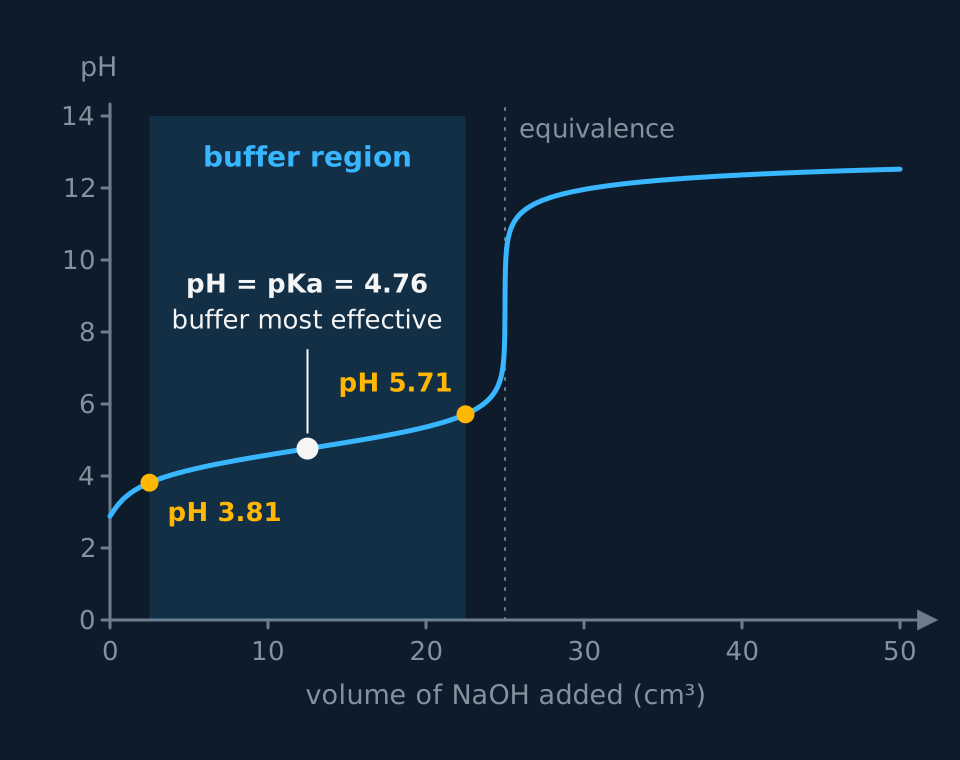
A buffer resists change best when [HA] and [A⁻] are equal, which is where pH = pKa, and it works usefully for about one pH unit either side. That is the flat region of the weak acid–strong base titration curve, centred on the half-neutralisation point. To hold a chosen pH, pick an acid whose pKa is close to it, then set the ratio of acid to salt. Laboratory buffers near pH 7 use the dihydrogenphosphate ion, H₂PO₄⁻, pKa 7.21, with hydrogenphosphate, HPO₄²⁻, as its conjugate base. Near pH 9 the ammonium ion and ammonia are used, and near pH 5 ethanoic acid and ethanoate.
Describe the drawing
The pH curve for 25.0 cm³ of 0.100 mol dm⁻³ ethanoic acid titrated with 0.100 mol dm⁻³ sodium hydroxide, with a lightly shaded vertical band from 2.5 to 22.5 cm³ labelled buffer region. Its edges meet the curve at pH 3.81 and 5.71, and its centre at 12.5 cm³ is marked pH equals pKa, 4.76, where the curve is flattest and the buffer most effective. A dotted line marks equivalence at 25.0 cm³.
Blood plasma is held between pH 7.35 and 7.45. Its main buffer is carbonic acid with hydrogencarbonate ions, and the carbonic acid comes from carbon dioxide made in respiration dissolving in the blood.
CO₂(aq) + H₂O(l) ⇌ H₂CO₃(aq) ⇌ H⁺(aq) + HCO₃⁻(aq)
Lactic acid from working muscle adds H⁺, which combines with HCO₃⁻ to form H₂CO₃. That breaks down to carbon dioxide and water, and the lungs breathe the carbon dioxide out. A fall in [H⁺] is met by more H₂CO₃ dissociating. In blood the ratio of HCO₃⁻ to H₂CO₃ is about 20 to 1, which suits a body that produces far more acid than alkali: the large hydrogencarbonate reservoir is the one that has to take it up. Breathing adjusts [CO₂] within minutes, and the kidneys adjust [HCO₃⁻] over hours.
Blood below pH 7.35 is acidosis and above 7.45 is alkalosis. Outside about 6.8 to 7.8 life cannot continue, because the charges on proteins change and enzymes lose their shape.
- Buffer range
- The range of pH, roughly pKa ± 1, over which a buffer resists changes in pH effectively.
Other boards: solubility product and the common ion effect
Silver chloride is the white precipitate of the halide test, and it is called insoluble. It is not quite. Shaken with water at 298 K, about 1.3 × 10⁻⁵ mol dm⁻³ of it dissolves, and the saturated solution is in equilibrium with the solid left over. Cambridge sets this equilibrium and its constant; AQA, OCR and Edexcel do not examine them.
AgCl(s) ⇌ Ag⁺(aq) + Cl⁻(aq)
The solid is left out of the expression, as in any heterogeneous equilibrium. What remains is the solubility product, Ksp: the product of the ion concentrations in a saturated solution, each raised to the power of its coefficient in the equation. Its units follow from the formula.
Ksp = [Ag⁺][Cl⁻] = 1.80 × 10⁻¹⁰ mol² dm⁻⁶ at 298 K
CaF₂(s) ⇌ Ca²⁺(aq) + 2F⁻(aq); Ksp = [Ca²⁺][F⁻]²Units: mol³ dm⁻⁹.
If the ion concentrations in a mixture multiply to more than Ksp, solid precipitates until the product falls back to Ksp. If they multiply to less, more solid can dissolve.
Ksp from a solubility
The solubility of calcium fluoride in water at 298 K is 2.14 × 10⁻⁴ mol dm⁻³. Calculate Ksp.
Show the working
Each CaF₂ that dissolves gives one Ca²⁺ and two F⁻, so [Ca²⁺] = 2.14 × 10⁻⁴ mol dm⁻³ and [F⁻] = 4.28 × 10⁻⁴ mol dm⁻³.
Ksp = [Ca²⁺][F⁻]² = 2.14 × 10⁻⁴ × (4.28 × 10⁻⁴)² = 3.92 × 10⁻¹¹ mol³ dm⁻⁹.
Squaring 2.14 × 10⁻⁴ without first doubling it gives a value four times too small: [F⁻] is twice the solubility.
Silver chloride dissolved in 0.100 mol dm⁻³ sodium chloride behaves differently. The solution already holds Cl⁻, the ion the two salts have in common, and Ksp still has to be met. With [Cl⁻] fixed near 0.100 mol dm⁻³, [Ag⁺] can reach only Ksp ÷ 0.100, and the equilibrium is pushed to the left. This is the common ion effect, the same suppression that ethanoate ions exert on ethanoic acid in a buffer.
Silver chloride in sodium chloride solution
Calculate the solubility of silver chloride in pure water and in 0.100 mol dm⁻³ sodium chloride at 298 K. Ksp = 1.80 × 10⁻¹⁰ mol² dm⁻⁶.
Show the working
In water [Ag⁺] = [Cl⁻] = s, so s² = 1.80 × 10⁻¹⁰ and s = 1.34 × 10⁻⁵ mol dm⁻³.
In the sodium chloride [Cl⁻] = 0.100 mol dm⁻³; the chloride from the dissolved silver chloride is negligible beside it.
s = [Ag⁺] = 1.80 × 10⁻¹⁰ ÷ 0.100 = 1.80 × 10⁻⁹ mol dm⁻³, about seven and a half thousand times less than in water.
- Solubility
- The amount of a solute that dissolves in a stated volume of solvent to give a saturated solution at a stated temperature, here in mol dm⁻³.
- Solubility product, Ksp
- The product of the concentrations of the ions in a saturated solution of a sparingly soluble salt, each raised to the power of its coefficient in the equation.
In the exam
- Define a buffer as a solution that resists changes in pH when small amounts of acid or base are added. The scheme does not accept 'keeps the pH constant', and 'small amounts' is part of the definition.
- Explain buffer action with an equation for each addition and a statement about the reservoirs: added H⁺ reacts with the large amount of A⁻, added OH⁻ reacts with the large amount of HA, and the ratio [HA]/[A⁻] stays almost the same.
- In a buffer calculation [H⁺] does not equal [A⁻]. Take [A⁻] from the salt, or from the moles of base added; working with [H⁺]² gives the pH of the acid alone and the scheme awards no method mark for it.
- After an addition, work in moles: subtract from one reservoir, add to the other, then use the ratio. Give the pH to two decimal places.
- For Ksp, raise each ion concentration to the power of its coefficient and give units to match: mol² dm⁻⁶ for AgCl, mol³ dm⁻⁹ for CaF₂.
Check yourself
A pharmacist needs a buffer at pH 4.00 and has ethanoic acid (pKa 4.76) and methanoic acid (pKa 3.75), with their sodium salts. Evaluate which acid to use, and calculate the ratio of salt to acid needed with your choice.
Answer
A buffer works best when its pH is close to the pKa of the acid, where [HA] and [A⁻] are similar and both reservoirs are large. Methanoic acid's pKa is 0.25 from the target; ethanoic acid's is 0.76 from it.
With methanoic acid, [A⁻]/[HA] = Ka ÷ [H⁺] = 10^(−3.75) ÷ 10^(−4.00) = 1.78, so the salt and acid are present in similar amounts. With ethanoic acid the ratio would be 10^(−4.76) ÷ 10^(−4.00) = 0.174, leaving only a small ethanoate reservoir to take up added acid.
Methanoic acid is the better choice, with about 1.78 mol of sodium methanoate for every mole of acid. Ethanoic acid could reach pH 4.00, but that buffer would resist added acid poorly.
Questions
Question 16 marks
Explain, with equations, how a solution of propanoic acid and sodium propanoate resists a change in pH when a small amount of acid or of alkali is added, and why it stops working when a large amount is added.
Mark scheme
Indicative content
- the buffer contains large amounts of both CH₃CH₂COOH and CH₃CH₂COO⁻, the propanoate coming from the fully dissociated salt
- added H⁺ reacts with propanoate ions, CH₃CH₂COO⁻(aq) + H⁺(aq) → CH₃CH₂COOH(aq), so most of it is removed
- added OH⁻ reacts with propanoic acid molecules, CH₃CH₂COOH(aq) + OH⁻(aq) → CH₃CH₂COO⁻(aq) + H₂O(l)
- both reservoirs are large compared with the amount added, so the ratio [HA]/[A⁻] changes very little
- [H⁺] = Ka × [HA]/[A⁻], so with the ratio almost unchanged [H⁺] and the pH change only slightly
- once the added acid or alkali exceeds the propanoate or the propanoic acid present, that reservoir is used up and the pH changes sharply
Levels
- Level 3 (5–6 marks) both reservoirs are identified with the salt as the source of propanoate, both equations are correct and matched to added acid and added alkali, the small change in the [HA]/[A⁻] ratio is linked to [H⁺] through Ka, and the limit is explained as a reservoir being used up
- Level 2 (3–4 marks) both equations are given and the removal of added H⁺ and OH⁻ is explained; the answer does not get from the [HA]/[A⁻] ratio to [H⁺] through Ka, or does not say why a large addition overwhelms the buffer
- Level 1 (1–2 marks) the buffer is said to contain a weak acid and its salt, usually with the claim that its pH cannot change at all; one equation at most, and nothing on large additions
Question 25 marks
Calculate the mass of sodium ethanoate, CH₃COONa, that must be dissolved in the ethanoic acid described in the table to give a buffer of pH 5.00. Assume no change in volume.
| Quantity | Value |
|---|---|
| Volume of ethanoic acid | 250 cm³ |
| Concentration of ethanoic acid | 0.100 mol dm⁻³ |
| Ka of ethanoic acid | 1.74 × 10⁻⁵ mol dm⁻³ |
| Mr of CH₃COONa | 82.0 |
Mark scheme
- M1 [H⁺] = 10^(−5.00) = 1.00 × 10⁻⁵ mol dm⁻³
- M1 [CH₃COO⁻] = Ka × [CH₃COOH] ÷ [H⁺] = 1.74 × 10⁻⁵ × 0.100 ÷ 1.00 × 10⁻⁵ = 0.174 mol dm⁻³
- M1 moles of CH₃COONa = 0.174 × 0.250 = 0.0435 mol
- M1 mass = moles × Mr = 0.0435 × 82.0
- A1 mass = 3.57 g, to three significant figures
Question 35 marksCAIE
Calculate the solubility of lead(II) iodide, PbI₂, in water at 298 K, in mol dm⁻³, given that Ksp = 9.80 × 10⁻⁹ mol³ dm⁻⁹, and give the expression for its Ksp with its units.
Mark scheme
- B1 Ksp = [Pb²⁺][I⁻]², for PbI₂(s) ⇌ Pb²⁺(aq) + 2I⁻(aq)
- B1 the units are mol³ dm⁻⁹
- M1 if the solubility is s, [Pb²⁺] = s and [I⁻] = 2s
- M1 Ksp = s × (2s)² = 4s³ = 9.80 × 10⁻⁹, so s³ = 2.45 × 10⁻⁹
- A1 s = 1.35 × 10⁻³ mol dm⁻³, to three significant figures
All 19 questions with mark schemes, the other 16 set out in full on the question page.
Worth remembering
- 'Keeps the pH constant' describes no real buffer; a buffer resists change.
- Pair the weak acid with its conjugate base; hydrochloric acid with sodium chloride is no buffer, since Cl⁻ cannot take up added H⁺.
- Take [A⁻] from the salt inside a buffer; setting [H⁺] = [A⁻] gives the pH of the acid alone.
- Adding the moles of acid to the wrong reservoir moves the pH the wrong way.
- An account of buffer action with no equation, or no mention of large reservoirs, is incomplete.
CHECK YOUR PROGRESS
Rate how confident you are with each objective for this lesson. Ratings are saved in this browser, on this device, unless you sign in.
- Define a buffer solution, and describe how acidic and basic buffers are made.
- Explain, with equations, how an acidic buffer and a basic buffer resist a change in pH when a small amount of acid or base is added.
- Calculate the pH of an acidic buffer from Ka and the concentrations or amounts of the weak acid and its salt.
- Calculate the pH of an acidic buffer after a small amount of strong acid or strong base has been added.
- Outline how the carbonic acid–hydrogencarbonate system controls the pH of blood.
- Write and use the expression for Ksp, and explain the common ion effect on the solubility of a salt.CAIE
Open the full revision checklist to see every objective in the curriculum in one place.
Practise this lesson
WORKBOOK
The written questions from this topic, on paper with room to work, and a separate book of mark schemes. The 5 questions that are set on a diagram stay on this page, where the diagram can be drawn. Free to use; please do not redistribute or sell.