Chemistry › Acids and bases › Weak acids, Ka and pKa; Kw and strong bases
Weak acids, Ka and pKa; Kw and strong bases
Pure water conducts electricity, very slightly, because a few of its molecules are always passing protons to one another. That small equilibrium fixes the pH of every alkali. A weak acid sets up an equilibrium of its own, and its dissociation constant Ka turns a concentration into a pH and a measured pH back into Ka and pKa.
Key terms Every definition in acids and bases, lesson by lesson
Before this Brønsted–Lowry acids and bases, pH and strong acids – pH = −log[H⁺], and strong against weak · The equilibrium constant Kc – writing the expression and working out its units
COMMON MISCONCEPTION
Pure water always has a pH of 7, so water at pH 6.6 must have acid in it.
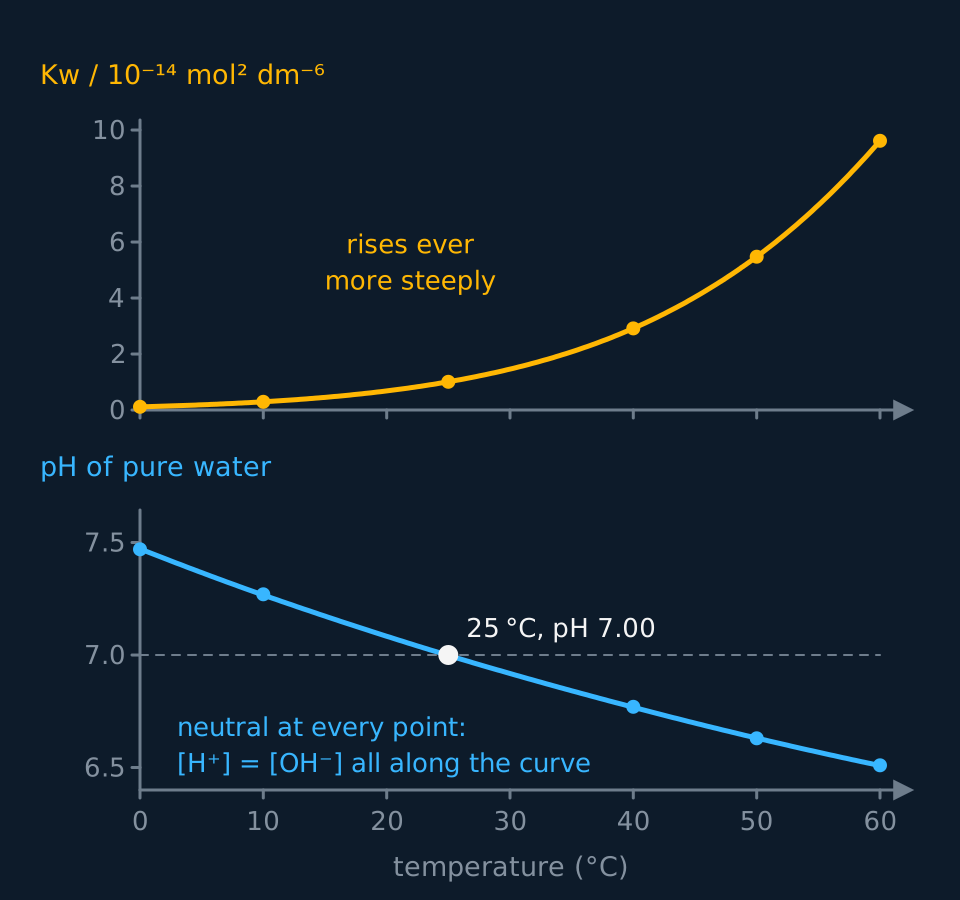
Pure water is neutral because [H⁺] = [OH⁻], and that gives pH 7.00 only at 25 °C. Dissociation is endothermic, so Kw rises with temperature: at 50 °C Kw = 5.5 × 10⁻¹⁴ mol² dm⁻⁶ and neutral water has pH 6.6. At 0 °C neutral water has pH 7.47.
What you should be able to do
- State the expression for Kw and its value at 298 K, and explain why it increases with temperature.
- Calculate the pH of a strong base, and of pure water at a temperature other than 298 K.
- Write the expression for Ka of a weak acid with its units, and convert between Ka and pKa.
- Calculate the pH of a weak acid from Ka, stating the two approximations used and when they fail.
- Calculate Ka and pKa from the concentration and measured pH of a weak acid.
Water ionises, a little
The purest water that can be made still conducts electricity, about a millionth as well as sea water. The current is carried by ions, and the ions come from the water itself: one water molecule donates a proton to another.
H₂O(l) + H₂O(l) ⇌ H₃O⁺(aq) + OH⁻(aq)Usually shortened to H₂O(l) ⇌ H⁺(aq) + OH⁻(aq).
The equilibrium lies a very long way to the left. At 298 K about two molecules in every thousand million are dissociated at any instant. The concentration of water, about 55.5 mol dm⁻³, is so large and changes so little that it is treated as constant and taken into the equilibrium constant. The result is the ionic product of water, Kw.
Kw = [H⁺][OH⁻] = 1.00 × 10⁻¹⁴ mol² dm⁻⁶ at 298 K
Kw holds in every aqueous solution, not only in pure water. In pure water every H⁺ is matched by an OH⁻, so [H⁺] = [OH⁻] = √(1.00 × 10⁻¹⁴) = 1.00 × 10⁻⁷ mol dm⁻³ and the pH is 7.00. A solution is neutral when [H⁺] = [OH⁻], not when its pH is 7. The two coincide only at 298 K.
The dissociation of water is endothermic: it is the reverse of neutralisation, which releases about 57 kJ for every mole of water formed. Raising the temperature shifts the equilibrium to the right, in the endothermic direction, so [H⁺] and [OH⁻] both rise and Kw increases. At 50 °C Kw is 5.48 × 10⁻¹⁴ mol² dm⁻⁶, so in pure water [H⁺] = √(5.48 × 10⁻¹⁴) = 2.34 × 10⁻⁷ mol dm⁻³ and the pH is 6.63. The water is still neutral, because [OH⁻] has risen by exactly the same amount.
Describe the drawing
Two graphs stacked on a shared temperature axis from 0 to 60 °C. The upper graph shows Kw rising from 0.114 to 9.61 × 10⁻¹⁴ on a curve that climbs ever more steeply. The lower graph shows the pH of pure water falling from 7.47 at 0 °C to 6.51 at 60 °C, meeting a dashed line at pH 7.00 at 25 °C, and notes that the water is neutral, with [H⁺] equal to [OH⁻], at every point on the curve.
- Ionic product of water, Kw
- The product of the concentrations of hydrogen ions and hydroxide ions in water or an aqueous solution, Kw = [H⁺][OH⁻].
- Neutral
- Describes a solution in which the concentration of hydrogen ions equals the concentration of hydroxide ions.
The pH of a strong base
Sodium hydroxide is a strong base: it is fully dissociated, so 0.0500 mol dm⁻³ NaOH contains 0.0500 mol dm⁻³ of OH⁻. That number does not give the pH directly, because pH is about H⁺. Kw connects the two. With [OH⁻] high, [H⁺] has to be very low for the product to stay at 1.00 × 10⁻¹⁴.
The pH of 0.0500 mol dm⁻³ sodium hydroxide
Calculate the pH of 0.0500 mol dm⁻³ sodium hydroxide at 298 K.
Show the working
NaOH is fully dissociated, so [OH⁻] = 0.0500 mol dm⁻³.
[H⁺] = Kw ÷ [OH⁻] = 1.00 × 10⁻¹⁴ ÷ 0.0500 = 2.00 × 10⁻¹³ mol dm⁻³.
pH = −log(2.00 × 10⁻¹³) = 12.70.
For a base with two hydroxide ions per formula, [OH⁻] is twice the concentration of the base before Kw is used: 0.0250 mol dm⁻³ Ba(OH)₂ also has [OH⁻] = 0.0500 mol dm⁻³ and pH 12.70.
At another temperature the method is the same with that temperature's Kw. 0.0500 mol dm⁻³ NaOH at 50 °C has [H⁺] = 5.48 × 10⁻¹⁴ ÷ 0.0500 = 1.10 × 10⁻¹² mol dm⁻³ and a pH of 11.96, lower than at 298 K although [OH⁻] has not changed. A shortcut that subtracts from 14.00 works only at 298 K, where Kw is 1.00 × 10⁻¹⁴.
Dilution works in the mirror image of a strong acid. A tenfold dilution of sodium hydroxide divides [OH⁻] by ten, so [H⁺] rises tenfold and the pH falls by one unit, from 12.70 to 11.70 for 0.0500 mol dm⁻³ sodium hydroxide at 298 K. Diluted further, it approaches 7 from above and never passes it.
Not every base is strong. Ammonia accepts a proton from water, but only partly: in 0.100 mol dm⁻³ ammonia about one molecule in a hundred is protonated at any moment, and the rest stay as NH₃. Ammonia is a weak base, and so are the amines, which accept a proton on the same kind of nitrogen lone pair. Its [OH⁻] is far below the concentration of base, so 0.100 mol dm⁻³ ammonia has a pH of about 11.1, not the 13.00 of sodium hydroxide at the same concentration.
Weak bases are described here, not calculated. The number later calculations use is the reverse view: NH₄⁺, the conjugate acid of ammonia, is a weak acid with its own Ka, and its pKa is 9.25.
- Strong base
- A base that dissociates completely into ions in aqueous solution, such as sodium hydroxide.
- Weak base
- A base that is only partially protonated in aqueous solution, such as ammonia, so [OH⁻] is much less than the concentration of the base.
The acid dissociation constant, Ka
A weak acid HA sets up an equilibrium in water, and like any equilibrium it has a constant. Written with H⁺ for H₃O⁺, and with the water left out as it was for Kw, that constant is the acid dissociation constant, Ka.
HA(aq) ⇌ H⁺(aq) + A⁻(aq)
Ka = [H⁺][A⁻] / [HA]Units: (mol dm⁻³ × mol dm⁻³) ÷ mol dm⁻³ = mol dm⁻³.
The larger Ka, the further the equilibrium lies to the right and the stronger the acid. Use 'dissociates' or 'ionises' for what the acid does in water; 'dissolves' describes something else. Values for ordinary weak acids spread across many powers of ten, so they are often quoted as pKa = −log Ka, just as [H⁺] is quoted as pH. Because of the minus sign, a smaller pKa means a stronger acid.
A pKa calculation is one line each way. Ka = 1.74 × 10⁻⁵ mol dm⁻³ for ethanoic acid gives pKa = −log(1.74 × 10⁻⁵) = 4.76, and Ka = 10^(−pKa) converts back. pKa has no units and is given to two decimal places.
Ka measures strength; pH does not. The pH of an acid depends on its concentration as well as its strength, so 1.00 mol dm⁻³ ethanoic acid, pH 2.38, is more acidic than 0.00100 mol dm⁻³ hydrochloric acid, pH 3.00. Ka is the same at any concentration. Like every equilibrium constant it changes with temperature, and tables quote it at 298 K.
| Acid | Formula | Ka / mol dm⁻³ | pKa |
|---|---|---|---|
| Chloroethanoic acid | ClCH₂COOH | 1.35 × 10⁻³ | 2.87 |
| Methanoic acid | HCOOH | 1.78 × 10⁻⁴ | 3.75 |
| Benzoic acid | C₆H₅COOH | 6.31 × 10⁻⁵ | 4.20 |
| Ethanoic acid | CH₃COOH | 1.74 × 10⁻⁵ | 4.76 |
| Propanoic acid | CH₃CH₂COOH | 1.35 × 10⁻⁵ | 4.87 |
| Carbonic acid (first proton) | H₂CO₃ | 4.47 × 10⁻⁷ | 6.35 |
| Ammonium ion | NH₄⁺ | 5.62 × 10⁻¹⁰ | 9.25 |
| Phenol | C₆H₅OH | 1.0 × 10⁻¹⁰ | 10.0 |
The table is ranked strongest first, and three of its rows come up again. Chloroethanoic acid is nearly eighty times stronger than ethanoic acid, because the electronegative chlorine draws electron density away from the carboxylate group and spreads its negative charge, so the anion is less ready to take the proton back. The ammonium ion is a weak acid, so ammonium chloride solution is slightly acidic. And each extra alkyl group pushes electron density towards the carboxylate, so methanoic acid is stronger than ethanoic, which is stronger than propanoic.
Describe the drawing
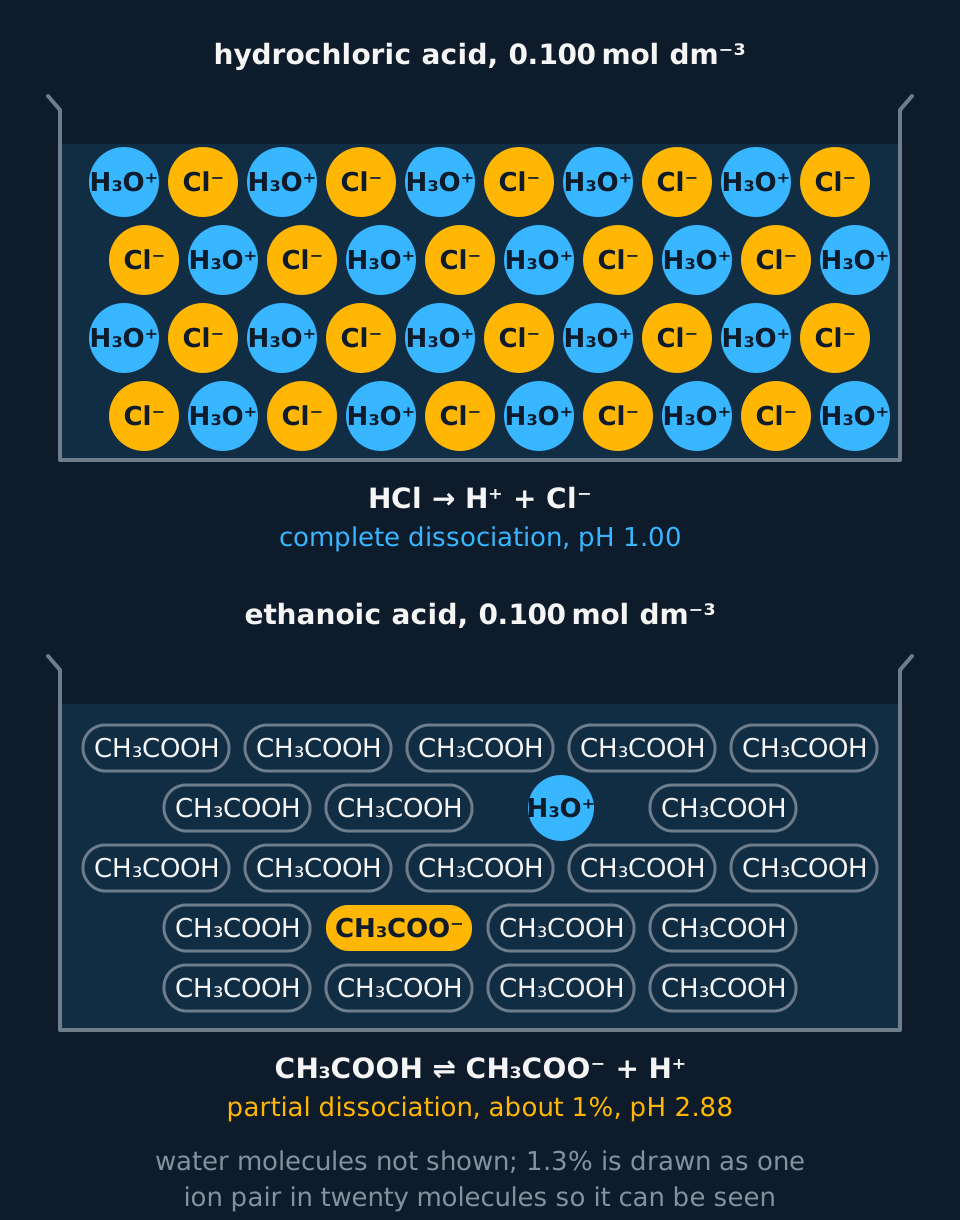
Two beakers, one above the other, each holding acid at 0.100 mol dm⁻³. The hydrochloric acid beaker is filled with twenty H₃O⁺ and twenty Cl⁻ ions as labelled discs and no HCl molecules: complete dissociation, pH 1.00. The ethanoic acid beaker holds twenty whole CH₃COOH molecules with a single H₃O⁺ and a single CH₃COO⁻ among them: partial dissociation, about 1 per cent, pH 2.88. A note says water is not shown and the dissociation is exaggerated so it can be seen.
- Acid dissociation constant, Ka
- The equilibrium constant for the dissociation of a weak acid, Ka = [H⁺][A⁻]/[HA], in mol dm⁻³.
- pKa
- The negative logarithm to base 10 of the acid dissociation constant, pKa = −log Ka; the smaller the pKa, the stronger the acid.
The pH of a weak acid, and two approximations
Ka holds three unknown concentrations and a pH calculation starts from only one number, the concentration of acid put in. Two approximations close the gap. The first: every H⁺ in the solution came from the acid, so [H⁺] = [A⁻]. That ignores the H⁺ from water, which is fair while the acid supplies far more than 10⁻⁷ mol dm⁻³. The second: so little of the acid dissociates that [HA] at equilibrium equals the concentration put in.
Ka = [H⁺]² / [HA], so [H⁺] = √(Ka × [HA])Valid while the acid is less than about 5% dissociated.
The pH of 0.100 mol dm⁻³ ethanoic acid
Calculate the pH of 0.100 mol dm⁻³ ethanoic acid at 298 K. Ka = 1.74 × 10⁻⁵ mol dm⁻³.
Show the working
Ka = [H⁺][CH₃COO⁻] / [CH₃COOH]. With [H⁺] = [CH₃COO⁻] and [CH₃COOH] = 0.100 mol dm⁻³, Ka = [H⁺]² ÷ 0.100.
[H⁺]² = 1.74 × 10⁻⁵ × 0.100 = 1.74 × 10⁻⁶, so [H⁺] = 1.32 × 10⁻³ mol dm⁻³.
pH = −log(1.32 × 10⁻³) = 2.88.
Check the second approximation: 1.32 × 10⁻³ is 1.3% of 0.100, so [CH₃COOH] is really 0.0987 mol dm⁻³. Solving without the approximation also gives 2.88.
The square root explains why a weak acid behaves differently on dilution. Diluting ethanoic acid tenfold divides [HA] by ten, so [H⁺] falls by √10 = 3.16 and the pH rises by 0.50, not 1.00: 0.100 mol dm⁻³ has pH 2.88 and 0.0100 mol dm⁻³ has pH 3.38. That is Le Chatelier's principle in numbers. Dilution favours the side of the equilibrium with more dissolved particles, so a greater fraction of the acid dissociates and [H⁺] falls by less than the concentration does.
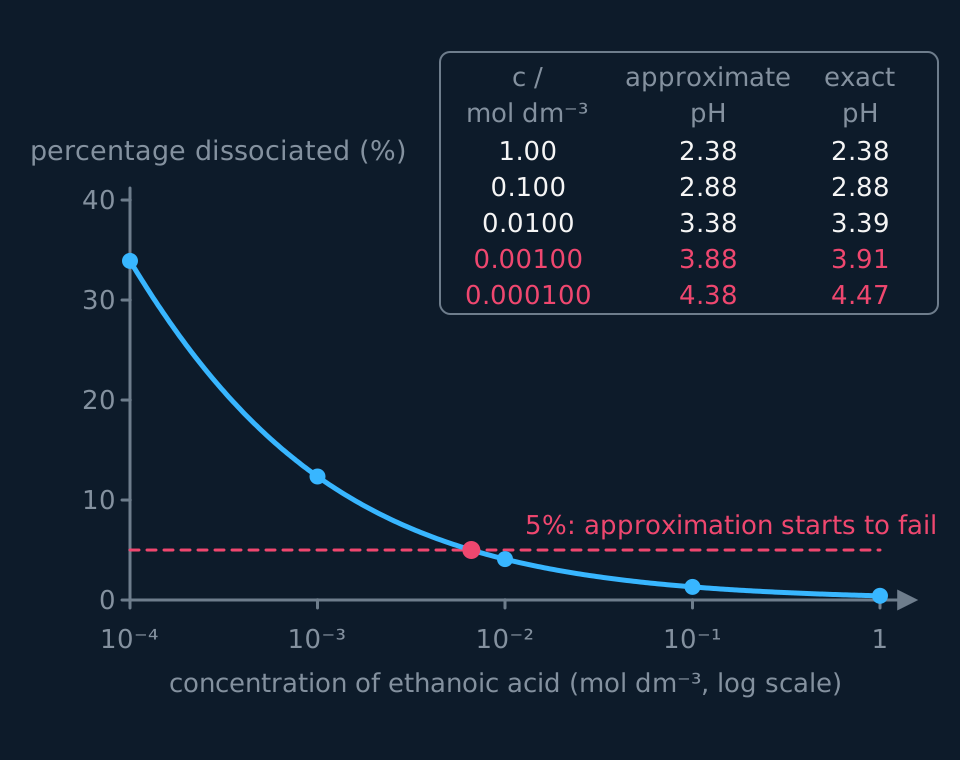
The second approximation gets worse as a larger fraction of the acid dissociates, which happens as the acid is diluted or as Ka gets larger. For ethanoic acid at 0.100 mol dm⁻³ the fraction is 1.3%. At 0.00100 mol dm⁻³ it is 12%, and the approximate pH, 3.88, is 0.03 below the true 3.91. At 1.00 × 10⁻⁴ mol dm⁻³ a third of the acid is dissociated and the approximation is 0.09 out. For a stronger weak acid such as dichloroethanoic acid, Ka about 5 × 10⁻², it fails even at ordinary concentrations.
Describe the drawing
A graph of percentage of ethanoic acid dissociated against concentration on a logarithmic axis from 10⁻⁴ to 1 mol dm⁻³. The curve rises to the left, from 0.42% at 1 mol dm⁻³ to 33.9% at 10⁻⁴ mol dm⁻³, and crosses a dashed 5% line, marked approximation starts to fail, at about 0.007 mol dm⁻³. An inset table gives approximate and exact pH at five concentrations; they agree to 3.38 and 3.39 at 0.0100 and part at 3.88 against 3.91 and 4.38 against 4.47 below that.
The first approximation fails somewhere else: when the acid is so dilute or so weak that its [H⁺] is close to 10⁻⁷ mol dm⁻³, and the H⁺ from water is no longer negligible. Questions on weak acids keep well clear of both limits unless they are asking about the limits.
- Monoprotic acid
- An acid in which each molecule can donate one proton, such as HCl or CH₃COOH.
Ka from a measured pH
The same approximations run backwards turn a pH reading into Ka, which is how values like those in the table are found. A pH meter gives [H⁺]; the first approximation then gives [A⁻], and the second gives [HA].
Ka of an unknown acid from its pH
A 0.200 mol dm⁻³ solution of a weak monoprotic acid HA has a pH of 2.70 at 298 K. Calculate Ka and pKa, and check whether the approximations were justified.
Show the working
[H⁺] = 10^(−2.70) = 1.995 × 10⁻³ mol dm⁻³.
The acid is the only significant source of H⁺, so [A⁻] = [H⁺] = 1.995 × 10⁻³ mol dm⁻³, and [HA] = 0.200 mol dm⁻³.
Ka = [H⁺][A⁻] / [HA] = (1.995 × 10⁻³)² ÷ 0.200 = 1.99 × 10⁻⁵ mol dm⁻³. Rounding [H⁺] to 2.00 × 10⁻³ first gives 2.00 × 10⁻⁵, so the unrounded value is carried.
pKa = −log(1.99 × 10⁻⁵) = 4.70.
The acid is 1.995 × 10⁻³ ÷ 0.200 × 100 = 1.0% dissociated, so [HA] is really 0.198 mol dm⁻³ and treating it as 0.200 is safe. Its [H⁺] is twenty thousand times the 10⁻⁷ mol dm⁻³ from water, so the first approximation holds too.
A pKa calculation from a single pH reading doubles any error in the reading. Here pKa = 2pH + log[HA], so a meter reading 0.05 too high makes pKa 0.10 too high. At the half-neutralisation point of a titration pKa equals the pH reading, and the same fault moves it by only 0.05.
Ka, the concentration and the pH are three numbers tied by one equation, so any two give the third. The remaining direction starts from Ka and a pH and finds how much acid was dissolved.
The concentration of a weak acid from its pH
A solution of propanoic acid has a pH of 2.90 at 298 K. Calculate the concentration of the acid, and the mass of propanoic acid (Mr = 74.0) in 250 cm³ of the solution. Ka = 1.35 × 10⁻⁵ mol dm⁻³.
Show the working
[H⁺] = 10^(−2.90) = 1.259 × 10⁻³ mol dm⁻³, and [CH₃CH₂COO⁻] = [H⁺].
[CH₃CH₂COOH] = [H⁺]² ÷ Ka = (1.259 × 10⁻³)² ÷ 1.35 × 10⁻⁵ = 0.117 mol dm⁻³.
Moles in 250 cm³ = 0.1174 × 0.250 = 0.02935 mol, so the mass = 0.02935 × 74.0 = 2.17 g.
The acid is 1.1% dissociated, so taking the equilibrium [HA] as the concentration dissolved is safe.
Kw and Ka come together whenever an alkali is left in excess. The mixing method for a strong acid and a strong base finds the leftover ion; if that ion is OH⁻, Kw converts it to [H⁺].
TRY IT: Sodium hydroxide in excess
20.0 cm³ of 0.100 mol dm⁻³ hydrochloric acid is mixed with 30.0 cm³ of 0.100 mol dm⁻³ sodium hydroxide. Calculate the pH of the mixture at 298 K.
Check your answer
Moles of H⁺ = 2.00 × 10⁻³ mol and moles of OH⁻ = 3.00 × 10⁻³ mol, so 1.00 × 10⁻³ mol of OH⁻ remains after neutralisation.
[OH⁻] = 1.00 × 10⁻³ ÷ 0.0500 = 0.0200 mol dm⁻³, so [H⁺] = Kw ÷ [OH⁻] = 1.00 × 10⁻¹⁴ ÷ 0.0200 = 5.00 × 10⁻¹³ mol dm⁻³.
pH = −log(5.00 × 10⁻¹³) = 12.30.
Other boards: pKw, pOH and core practical 9
Edexcel's specification also uses pKw = −log Kw, which is 14.00 at 298 K. Taking logarithms of Kw = [H⁺][OH⁻] gives pH + pOH = pKw, where pOH = −log[OH⁻]. Neutral water has pH = pOH = ½pKw: 7.00 at 298 K, and 6.63 at 50 °C, where pKw is 13.26. The pH of a strong base is then pKw − pOH, which is the subtraction from 14.00 that works only at 298 K.
- pKw
- The negative logarithm to base 10 of the ionic product of water, pKw = −log Kw, equal to 14.00 at 298 K.
Edexcel asks for Ka both ways: from the pH of a solution of known concentration, as in the worked examples, and, in core practical 9, from the half-neutralisation point of a titration, where pH = pKa. The second route halves the effect of a badly calibrated meter on the answer.
OCR's specification names the limits of the two approximations for 'stronger' weak acids, and an OCR answer should say which assumption fails: for an acid with Ka near 10⁻² or a very dilute solution, [HA] at equilibrium is well below the concentration put in.
In the exam
- Give Kw with its units, mol² dm⁻⁶, and Ka with its units, mol dm⁻³. Where units are asked for, the scheme does not accept Kw's unit on Ka.
- The two assumptions in a weak-acid calculation earn a mark each: [H⁺] = [A⁻] because the H⁺ from water is negligible, and [HA] at equilibrium equals the initial concentration because dissociation is slight.
- Carry the unrounded [H⁺] through to Ka. Rounding at the second line can move the third significant figure.
- For pure water at another temperature, calculate the pH from √Kw and state that the water is still neutral because [H⁺] = [OH⁻]; 'neutral because the pH is 7' is rejected.
- In a pKa calculation give pKa to two decimal places and with no units; the answer must come from −log Ka, not from Ka read as a power of ten.
Check yourself
At 37 °C, Kw = 2.40 × 10⁻¹⁴ mol² dm⁻⁶. Blood has a pH of 7.40. A student says blood is 'only just alkaline, since 7.40 is close to 7'. Use Kw to evaluate the statement at body temperature.
Answer
Neutral water at 37 °C has [H⁺] = √(2.40 × 10⁻¹⁴) = 1.55 × 10⁻⁷ mol dm⁻³, so neutral is pH 6.81 at body temperature, not 7.00.
Blood at pH 7.40 has [H⁺] = 10^(−7.40) = 3.98 × 10⁻⁸ mol dm⁻³ and [OH⁻] = 2.40 × 10⁻¹⁴ ÷ 3.98 × 10⁻⁸ = 6.03 × 10⁻⁷ mol dm⁻³.
[OH⁻] is about fifteen times [H⁺], so blood is alkaline, and 0.59 units above neutral rather than 0.40. The student's comparison with 7 uses the neutral point for 298 K, which does not apply at 37 °C.
Questions
Question 16 marks
Describe how a student could find Ka and pKa for benzoic acid from a single pH measurement on a solution of known concentration, and explain the assumptions in the calculation and when they would fail.
Mark scheme
Indicative content
- measure the pH of a benzoic acid solution of accurately known concentration with a pH meter calibrated against buffers
- convert the reading to [H⁺] with [H⁺] = 10^(−pH), carrying the unrounded value into the next step of the calculation
- assume [H⁺] = [A⁻], because the hydrogen ions from the dissociation of water are negligible beside those from the acid
- assume [HA] at equilibrium equals the concentration made up, because only a small fraction of the weak acid dissociates
- calculate Ka = [H⁺]² ÷ [HA] in mol dm⁻³, then pKa = −log Ka, giving pKa to two decimal places with no units
- the second assumption fails if more than about 5% of the acid dissociates, as in very dilute solutions or for acids with a large Ka
Levels
- Level 3 (5–6 marks) every stage is present in order: the calibrated pH measurement on a solution of known concentration, the conversion to [H⁺], both assumptions stated with the reason for each, Ka and pKa calculated correctly with units handled, and the condition under which the small-dissociation assumption fails
- Level 2 (3–4 marks) the measurement, the conversion to [H⁺] and the Ka expression are right and one assumption is stated; why it holds, or when it fails, is left vague, or the pKa step is not finished
- Level 1 (1–2 marks) the pH is measured and Ka written down; a frequent slip is to take [H⁺] as equal to the acid concentration, as for a strong acid, and no assumption is justified
Question 24 marks
Calculate Ka and pKa for a weak monoprotic acid, given that a 0.0800 mol dm⁻³ solution of it has a pH of 3.10 at 298 K.
Mark scheme
- M1 [H⁺] = 10^(−3.10) = 7.94 × 10⁻⁴ mol dm⁻³
- M1 Ka = [H⁺]² / [HA] = (7.94 × 10⁻⁴)² ÷ 0.0800
- A1 Ka = 7.89 × 10⁻⁶ mol dm⁻³, to three significant figures; allow 7.88 to 7.90
- A1 pKa = −log(7.89 × 10⁻⁶) = 5.10, to two decimal places; allow error carried forward from Ka
Question 34 marks
Explain why the pH of pure water falls as its temperature rises, and why the water remains neutral.
Mark scheme
- B1 the dissociation H₂O ⇌ H⁺ + OH⁻ is endothermic
- B1 a rise in temperature shifts the equilibrium to the right, so Kw increases
- B1 [H⁺] increases, so pH = −log[H⁺] falls below 7
- B1 [OH⁻] increases by the same amount, so [H⁺] = [OH⁻] and the water is still neutral; reject 'neutral because pH 7'
All 22 questions with mark schemes, the other 19 set out in full on the question page.
Worth remembering
- Taking pH 7 as neutral at a temperature other than 298 K puts the neutral point in the wrong place.
- Convert [OH⁻] to [H⁺] with Kw before taking −log; [OH⁻] straight into −log gives pOH.
- Applying [H⁺] = √(Ka × [HA]) to a strong acid or a buffer uses an approximation that does not hold there.
- Keep [H⁺] unrounded until it is squared; rounding first can move the third figure of Ka.
- Reading a larger pKa as a stronger acid turns the scale upside down.
CHECK YOUR PROGRESS
Rate how confident you are with each objective for this lesson. Ratings are saved in this browser, on this device, unless you sign in.
- State the expression for Kw and its value at 298 K, and explain why it increases with temperature.
- Calculate the pH of a strong base, and of pure water at a temperature other than 298 K.
- Write the expression for Ka of a weak acid with its units, and convert between Ka and pKa.
- Calculate the pH of a weak acid from Ka, stating the two approximations used and when they fail.
- Calculate Ka and pKa from the concentration and measured pH of a weak acid.
Open the full revision checklist to see every objective in the curriculum in one place.
Practise this lesson
WORKBOOK
The written questions from this topic, on paper with room to work, and a separate book of mark schemes. The question that is set on a diagram stays on this page, where the diagram can be drawn. Free to use; please do not redistribute or sell.
Used later in Buffer solutions and buffer calculations · Metal-aqua ions and the acidity of their solutions · Carboxylic acids, esters and biodiesel