Maths › Complex numbers › Roots of unity and complex roots
Roots of unity and complex roots
Every non-zero number has exactly n distinct nth roots, arranged as a regular polygon on the Argand diagram. Once one root is found, rotating it about the origin in steps of 2π/n gives the rest.
Builds on De Moivre's theorem and trigonometric identities and Radians, arcs and small angles.
IN THIS TOPIC
- Find all nth roots of unity and place them on the unit circle.
- Solve z to the n = w for any non-zero complex w, spacing the roots by 2π/n, and know that w = 0 gives z = 0 with multiplicity n.
- Use the geometry, including regular polygons and roots summing to zero.
COMMON MISCONCEPTION
A number has one cube root, so z³ = 8i has exactly one solution.
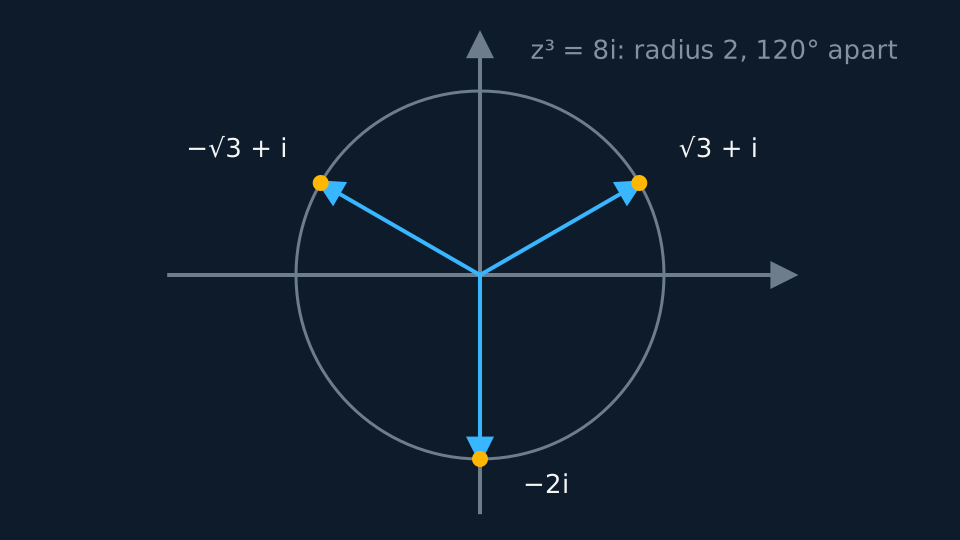
A non-zero complex number has exactly n distinct nth roots. Take the real positive nth root of the modulus, divide the argument by n, then space the rest 2π/n apart: 8i has modulus 8 and argument π/2, so the cube roots are √3 + i, −√3 + i and −2i, an equilateral triangle on the circle of radius 2. Only zn = 0 has a single root.
The roots of unity
zn = 1 asks for numbers whose modulus has nth power 1 and whose argument times n is a whole number of turns. Every root therefore has modulus 1 and argument 2πk/n for k = 0, 1, …, n − 1, giving exactly n distinct roots equally spaced round the unit circle, the vertices of a regular n-gon with one vertex at 1.
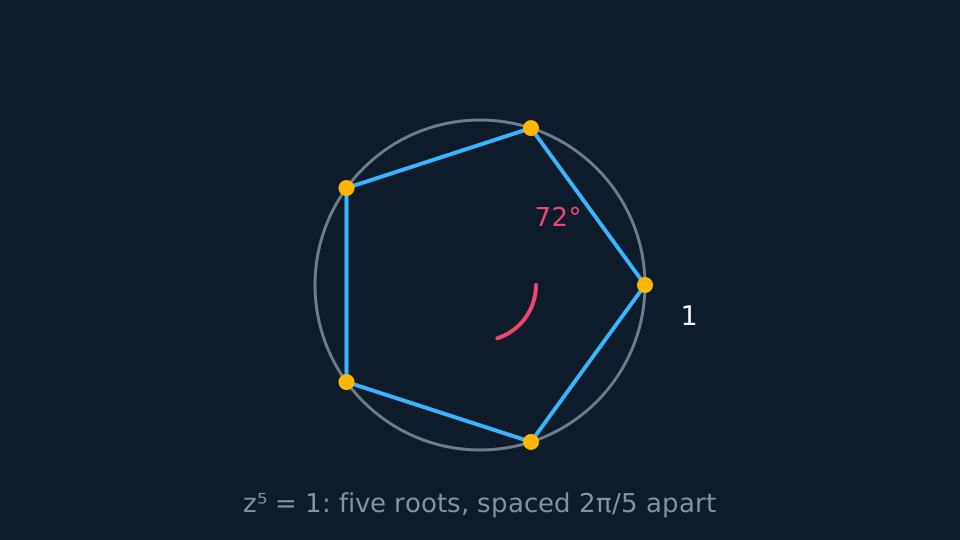
Write ω = e2πi/n; the set of roots is then 1, ω, ω², …, ωn−1, the powers of a single root. For n ≥ 2 their sum is zero; for n = 1 the only root is 1 and the sum is 1. Proof for n ≥ 2: multiplying every root by ω permutes the set, so the sum S satisfies ωS = S, that is (ω − 1)S = 0. Since ω ≠ 1 when n ≥ 2, S = 0.
Roots of any non-zero number
The same method solves every equation zn = w with w ≠ 0. Write w in modulus-argument form, take the real positive nth root of the modulus, divide the argument by n to obtain one root, then space the remaining roots 2π/n apart. Multiplying that first root by each nth root of unity gives the same set. Either way, a non-zero complex number has exactly n distinct nth roots.
For square roots there is an alternative method, preferable when the argument is not a standard angle. Instead of halving such an argument, square x + yi and compare real and imaginary parts, as with 3 + 4i in the complex arithmetic lesson. This keeps the answer exact rather than leaving an inverse tangent in it.
Zero is the exception. zn = 0 forces |z| = 0, so z = 0 is the only solution, a single root of multiplicity n rather than n distinct ones. Zero has no argument to divide, and there is no polygon to draw.
WORKED EXAMPLE
The three cube roots of 8i
Solve z³ = 8i.
8i has modulus 8 and argument π/2, so one root has modulus 2 and argument π/6, namely z = 2(cos π/6 + i sin π/6) = √3 + i.
The other two sit 2π/3 further round, at arguments 5π/6 and −π/2, giving −√3 + i and −2i.
Check the first. (√3 + i)³ has modulus 8 and argument π/2, which is 8i. The three roots are the vertices of an equilateral triangle on a circle of radius 2.
GUIDED PRACTICE
Fourth roots, read from a square
Solve z⁴ = 16 and describe the roots' arrangement.
Show the working
16 has modulus 16 and argument 0, so one root is 2 and the rest sit π/2 apart, giving 2, 2i, −2, −2i.
Each powers to 16. For 2i, (2i)⁴ = 16i⁴ = 16.
The four roots are the corners of a square of circumradius 2, with one corner on the positive real axis.
ASSESSMENT FOCUS
- Check the count: zⁿ = w with w non-zero has exactly n distinct roots.
- Space arguments by 2π/n from the first root, then reduce each into (−π, π].
- Give roots in the form asked for; exact surd form and r eiθ form both come up.
- For 'show the roots sum to zero', give the argument in full: multiplying the set by ω permutes it, so ωS = S and hence S = 0 when ω ≠ 1.
CHECK YOURSELF
Solve z³ = 27, giving all three roots exactly, and state the shape they make on the Argand diagram.
Show a hint
One root is real; the others sit 2π/3 either side.
Show the answer
27 has modulus 27 and argument 0, so the roots have modulus 3 and arguments 0, 2π/3, −2π/3. That gives z = 3, and 3(−1/2 ± (√3/2)i) = −3/2 ± (3√3/2)i. They form an equilateral triangle of circumradius 3 with one vertex at 3.
nth roots of a non-zero number: take the real positive nth root of the modulus, divide the argument by n, then space the roots by 2π/n.
The n roots of unity form a regular n-gon on the unit circle and, for n ≥ 2, sum to zero.
Every root of zⁿ = w is one root times a root of unity, and zⁿ = 0 has only z = 0.
WORKBOOK
Printable practice for this topic: original exam-style questions with room to work, and a fully worked answer book. Free to use; please do not redistribute or sell.
Or read them with their worked answers on the roots of unity and complex roots questions page.
CHECK YOUR PROGRESS
Rate how confident you feel with each objective for this lesson. Ratings are saved in this browser, on this device, unless you sign in.
- Find all nth roots of unity and place them on the unit circle.
- Solve z to the n = w for any non-zero complex w, spacing the roots by 2π/n, and know that w = 0 gives z = 0 with multiplicity n.
- Use the geometry, including regular polygons and roots summing to zero.
Open the full revision checklist to see every objective in the course in one place.