Maths › Complex numbers › De Moivre's theorem and trigonometric identities
De Moivre's theorem and trigonometric identities
De Moivre's theorem converts powers of a complex number in polar form into powers of its modulus and multiples of its argument. Expanding the same power algebraically and equating real or imaginary parts produces multiple-angle identities. The theorem also holds for negative integer powers of a non-zero complex number, and it is used to sum series of cosines and sines.
Builds on Modulus, argument and loci and The binomial expansion and Geometric series.
IN THIS TOPIC
- Use De Moivre's theorem to evaluate powers of complex numbers.
- Write numbers in exponential form and use it for products and powers.
- Derive multiple-angle identities such as cos 3θ in terms of cos θ.
- Derive z + 1/z = 2 cos θ and z − 1/z = 2i sin θ, and use them to rewrite a power of cos θ or sin θ as multiple angles ready to integrate.
- Sum a series of cosines or sines by summing one geometric series with a complex ratio, quoting the condition it needs.
COMMON MISCONCEPTION
To find (1 + i)⁸ there is no alternative to multiplying out the brackets eight times.
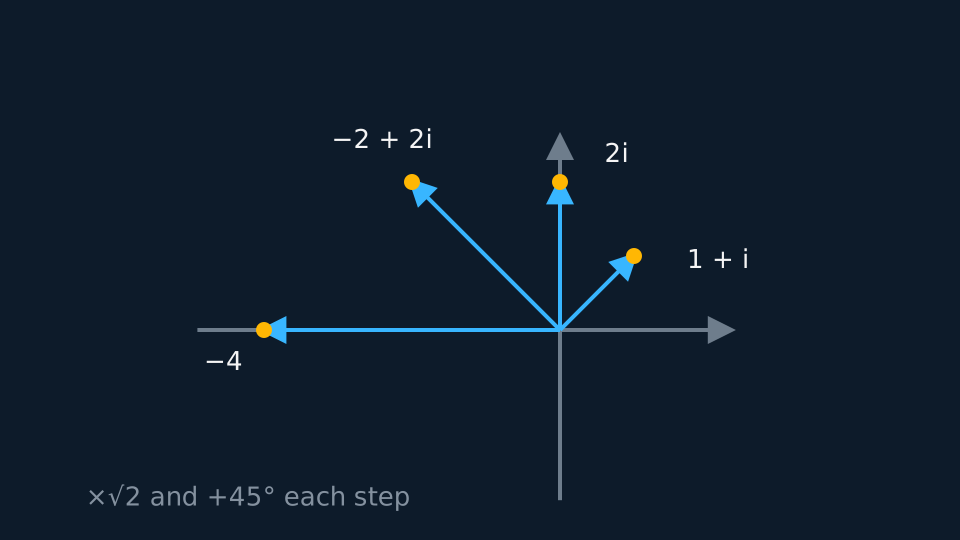
De Moivre's theorem turns the power into two short calculations, since |zn| = |z|n and arg(zn) ≡ n arg z (mod 2π). 1 + i has modulus √2 and argument π/4, so (1 + i)8 has modulus (√2)8 = 16 and argument 8 × π/4 = 2π, the direction of the positive real axis, which makes the answer 16.
The theorem
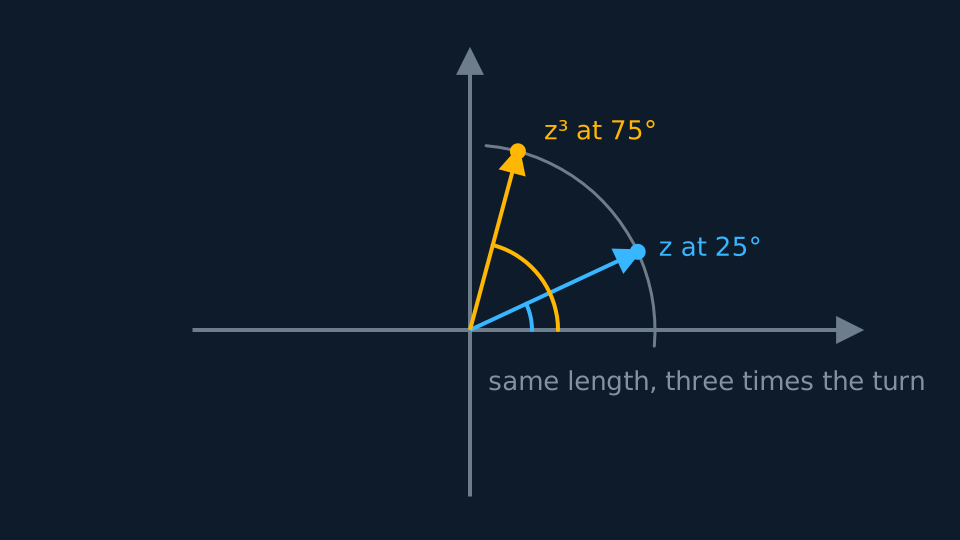
Multiplying complex numbers multiplies moduli and adds arguments, so raising to a power does both n times over. That observation is De Moivre's theorem:
Check the current formula booklet for your awarding organisation; whether or not the result is supplied, you must know when it applies and how to derive it if the question asks for a proof. Write z in modulus-argument or exponential form before applying De Moivre's theorem. Then |zn| = |z|n, and the arguments satisfy arg(zn) ≡ n arg z (mod 2π). A high power then requires two calculations rather than repeated multiplication.
WORKED EXAMPLE
An eighth power in two lines
Evaluate (1 + i)⁸.
1 + i has modulus √2 and argument π/4.
So (1 + i)⁸ has modulus (√2)⁸ = 16 and argument 8 × π/4 = 2π, which is the direction of the positive real axis.
(1 + i)⁸ = 16. The bracket-expansion route agrees, since (1 + i)² = 2i, squared gives −4, and squared again gives 16.
Exponential form
Compare the Maclaurin series for ex, cos θ and sin θ and one identity drops out, cos θ + i sin θ = eiθ. Every complex number therefore has the compact exponential form z = r eiθ, with r the modulus and θ the argument. In this notation De Moivre's theorem takes the form of an index law, (r eiθ)n = rn einθ, and products and quotients follow the same laws. Setting r = 1 and θ = π gives eiπ = −1.
Use the form the question uses. Pearson Edexcel 9FM0 questions frequently ask for answers in the form r eiθ, and this form is also convenient for roots of unity.
Multiple-angle identities
Expanding the same power in two ways produces trigonometric identities. Expand (cos θ + i sin θ)³ by the binomial theorem; De Moivre's theorem gives the same number as cos 3θ + i sin 3θ. Two expressions for one complex number are equal part by part, so the real parts give cos 3θ and the imaginary parts sin 3θ.
WORKED EXAMPLE
cos 3θ from a cube
Express cos 3θ in terms of cos θ.
(cos θ + i sin θ)³ = cos³θ + 3i cos²θ sin θ − 3 cos θ sin²θ − i sin³θ.
Equate real parts: cos 3θ = cos³θ − 3 cos θ sin²θ.
Replace sin²θ with 1 − cos²θ to get cos 3θ = 4 cos³θ − 3 cos θ.
The imaginary parts of the same expansion give sin 3θ = 3 sin θ − 4 sin³θ.
GUIDED PRACTICE
A power with a turn
Use De Moivre's theorem to evaluate (√3 + i)⁶.
Show the working
√3 + i has modulus 2 and argument π/6.
So the sixth power has modulus 2⁶ = 64 and argument 6 × π/6 = π.
An argument of π points along the negative real axis, so (√3 + i)⁶ = −64.
Powers into multiple angles
Expanding (cos θ + i sin θ)ⁿ expresses cos nθ in powers of cos θ. Integration requires the opposite conversion: there is no standard integral for cos⁴θ, while a sum of cosines of multiples of θ integrates term by term. The reverse conversion uses z = cos θ + i sin θ and its reciprocal.
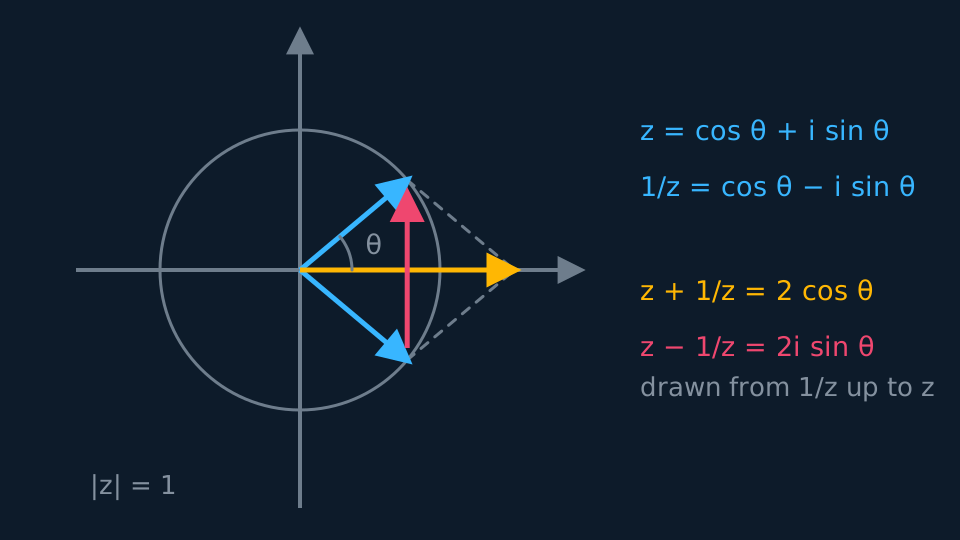
De Moivre's theorem with n = −1, valid because z ≠ 0, gives 1/z = cos(−θ) + i sin(−θ) = cos θ − i sin θ. Add that to z and the imaginary parts cancel; subtract it and the real parts do. So z + 1/z = 2 cos θ and z − 1/z = 2i sin θ. Powers behave the same way, since zn = cos nθ + i sin nθ and 1/zn = cos nθ − i sin nθ, giving zn + 1/zn = 2 cos nθ and zn − 1/zn = 2i sin nθ. Check the current formula booklet for your awarding organisation, and write out this two-line derivation at the start of the answer rather than quoting the four results.
Describe the drawing
A unit circle carrying z at forty degrees above the real axis and one over z the same angle below it, the two of them reflections in that axis. The dashed parallelogram closes on the real axis, where the amber sum arrow reaches two cos theta, and the coral arrow from one over z up to z is vertical, of length two sin theta.
WORKED EXAMPLE
cos⁴θ as a sum of cosines
Express cos⁴θ in terms of cosines of multiples of θ, and hence find ∫cos⁴θ dθ.
Since z + 1/z = 2 cos θ, raising both sides to the fourth power gives (z + 1/z)⁴ = 16 cos⁴θ.
Expand the left side binomially: z⁴ + 4z² + 6 + 4/z² + 1/z⁴.
Pair the terms from the ends inwards. (z⁴ + 1/z⁴) + 4(z² + 1/z²) + 6 = 2 cos 4θ + 8 cos 2θ + 6.
So 16 cos⁴θ = 2 cos 4θ + 8 cos 2θ + 6, and cos⁴θ = (cos 4θ + 4 cos 2θ + 3)/8. Setting θ = 0 checks it: the right side is (1 + 4 + 3)/8 = 1, and cos⁴0 = 1.
Integrating term by term, ∫cos⁴θ dθ = (sin 4θ)/32 + (sin 2θ)/4 + 3θ/8 + c.
Pairing terms from the ends inwards works because terms equidistant from the ends carry matching powers of z and 1/z. The same method rewrites cos⁶θ, sin⁴θ or any other single power, which is why 'express in terms of cosines of multiples of θ' and 'hence integrate' commonly appear as consecutive parts of one question.
GUIDED PRACTICE
An odd power of sine
Show that sin³θ = (3 sin θ − sin 3θ)/4.
Show the working
z − 1/z = 2i sin θ, so (z − 1/z)³ = (2i sin θ)³ = −8i sin³θ, using i³ = −i.
Expanding the left side gives z³ − 3z + 3/z − 1/z³, which pairs as (z³ − 1/z³) − 3(z − 1/z) = 2i sin 3θ − 6i sin θ.
So −8i sin³θ = 2i sin 3θ − 6i sin θ, and dividing by −8i gives sin³θ = (3 sin θ − sin 3θ)/4. Odd powers of sine introduce i³ = −i, so determine the sign before dividing; substituting θ = π/2 checks the result, since both sides equal 1.
Summing a series
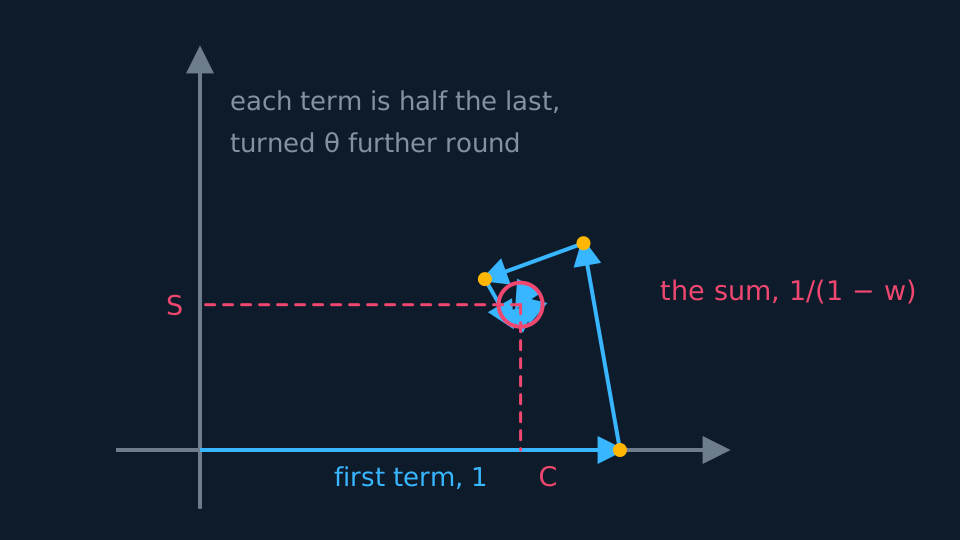
A series of cosines and the matching series of sines are the real and imaginary parts of a single complex series. Write C for the cosine series and S for the sine series, then add them: each pair of terms cos rθ + i sin rθ becomes eirθ in exponential form, so the trigonometric sum becomes a geometric series with a complex common ratio. Sum that series, then take real and imaginary parts to obtain both sums.
Describe the drawing
Seven term arrows drawn nose to tail from the origin, each half the length of the one before and turned a hundred degrees further round, so the running totals spiral in on one point. Dashed lines drop from that point to the two axes: its horizontal coordinate is the sum of the cosine series and its vertical one the sum of the sine series.
WORKED EXAMPLE
A cosine series with halving coefficients
Find the sum to infinity of C = 1 + (1/2)cos θ + (1/4)cos 2θ + …
Let S = (1/2)sin θ + (1/4)sin 2θ + …, the matching sine series. Then C + iS = 1 + (1/2)eiθ + (1/4)e2iθ + …, geometric with first term 1 and common ratio w = (1/2)eiθ.
|w| = 1/2, which is below 1, so the sum to infinity is 1/(1 − w) = 1/(1 − (1/2)cos θ − (1/2)i sin θ).
Multiply top and bottom by the conjugate of the denominator. The denominator becomes (1 − (1/2)cos θ)² + (1/4)sin²θ = 1 − cos θ + 1/4 = (5 − 4 cos θ)/4.
So C + iS = (4 − 2 cos θ + 2i sin θ)/(5 − 4 cos θ), and the real part gives C = (4 − 2 cos θ)/(5 − 4 cos θ). The imaginary part gives S = 2 sin θ/(5 − 4 cos θ).
Test it at θ = π/3. The formula gives (4 − 1)/(5 − 2) = 1, and the first ten terms of the series add to 1.000 to three decimal places.
State the condition required by the geometric series. Here the ratio has modulus 1/2 < 1, so the sum to infinity exists. With coefficients all equal to 1 the ratio would have modulus 1 and there would be no sum to infinity. The same method applies to a finite series, where the n-term formula requires only that the ratio is not 1, which for the equal-coefficient ratio eiθ means θ is not a multiple of 2π.
ASSESSMENT FOCUS
- Write z in modulus-argument or exponential form before applying De Moivre's theorem; then |zⁿ| = |z|ⁿ and arg(zⁿ) ≡ n arg z (mod 2π).
- Reduce final arguments into (−π, π] before interpreting the answer.
- For identities, expand with the binomial theorem, then equate real or imaginary parts and say which you took.
- Convert powers of sin back via sin²θ = 1 − cos²θ when the target is written all in cos.
- Answers demanded in the form r eiθ need θ in radians and exact where possible.
- Use the binomial expansion of (cos θ + i sin θ)ⁿ to write a multiple angle in powers, and (z ± 1/z)ⁿ to write a power in multiple angles.
- Derive z + 1/z = 2 cos θ and z − 1/z = 2i sin θ before using them, and check the current formula booklet for your awarding organisation.
- For a series, define C and S, sum the one geometric series, and state which part you took at the end.
- Quote the condition on the ratio. A sum to infinity needs its modulus below 1; the n-term formula needs the ratio not to be 1.
CHECK YOURSELF
Use De Moivre's theorem to evaluate (1 + i)¹⁰, and give the answer in the form r eiθ.
Show a hint
Modulus √2, argument π/4; reduce the final argument by full turns.
Show the answer
Modulus (√2)¹⁰ = 32, argument 10π/4 = 5π/2, which reduces by a full turn to π/2, the positive imaginary axis. So (1 + i)¹⁰ = 32i, which is 32 eiπ/2.
Powers in modulus-argument form: |zⁿ| = |z|ⁿ and arg(zⁿ) ≡ n arg z (mod 2π); in the form z = r eiθ this is an index law.
For identities, expand (cos θ + i sin θ)ⁿ binomially and equate parts with cos nθ + i sin nθ.
With z = cos θ + i sin θ, zn + 1/zn = 2 cos nθ and zn − 1/zn = 2i sin nθ, which turn a power of cos θ or sin θ into multiple angles.
For a series of cosines or sines, sum C + iS as one geometric series, then take the part you were asked for.
WORKBOOK
Printable practice for this topic: original exam-style questions with room to work, and a fully worked answer book. Free to use; please do not redistribute or sell.
Or read them with their worked answers on the De Moivre's theorem and trigonometric identities questions page.
CHECK YOUR PROGRESS
Rate how confident you feel with each objective for this lesson. Ratings are saved in this browser, on this device, unless you sign in.
- Use De Moivre's theorem to evaluate powers of complex numbers.
- Write numbers in exponential form and use it for products and powers.
- Derive multiple-angle identities such as cos 3θ in terms of cos θ.
- Derive z + 1/z = 2 cos θ and z − 1/z = 2i sin θ, and use them to rewrite a power of cos θ or sin θ as multiple angles ready to integrate.
- Sum a series of cosines or sines by summing one geometric series with a complex ratio, quoting the condition it needs.
Open the full revision checklist to see every objective in the course in one place.