Maths › Trigonometry › Radians, arcs and small angles
Radians, arcs and small angles
A radian measures an angle by the arc length it subtends on a unit circle. In radians the arc length and sector area formulae become s = rθ and A = ½r²θ, the derivatives of sine and cosine take their standard form, and for small angles the trig functions are well approximated by simple polynomials.
Builds on Trigonometric graphs and equations.
Used in InkPhysics: Circular motion.
IN THIS TOPIC
- Convert between degrees and radians, and know the standard angles in both.
- Use s = rθ and A = ½r²θ for arcs and sectors.
- Find a segment area as sector minus triangle.
- Apply the small-angle approximations, in radians only.
COMMON MISCONCEPTION
The small-angle approximations work in degrees too.
θ must be in radians. In degrees the approximations fail immediately, since sin 1° = 0.0175 while θ = 1. The same condition governs the arc length rθ and the sector area ½r2θ, so convert before substituting rather than after. The formulae booklet prints the three approximations but not the radian condition attached to them.
The natural unit
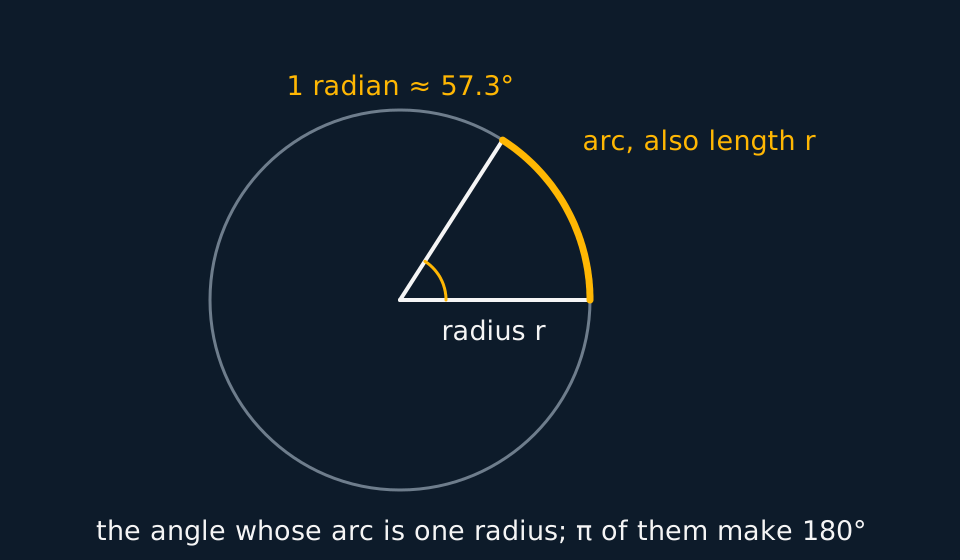
A radian is the angle whose arc equals the radius. A full turn has circumference 2πr, so a full turn is exactly 2π radians and π radians = 180°. The standard angles become fractions of π: 30° is π/6, 45° is π/4, 60° is π/3 and 90° is π/2, and the exact values are unchanged by the change of unit.
Arcs, sectors and segments
In radians the arc length and sector area formulae, both of which must be learnt, become
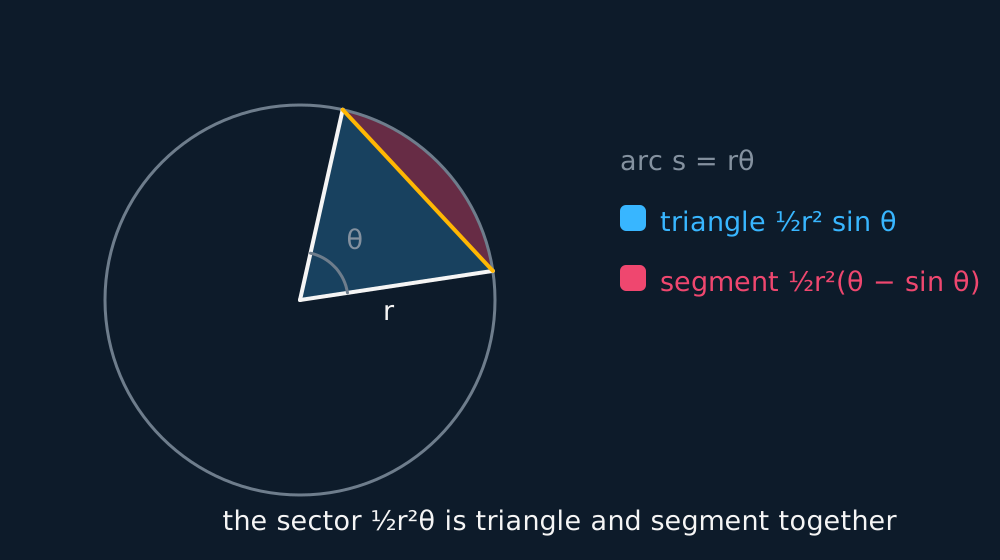
with θ in radians; in degrees each formula carries a factor of θ/360. A segment is the region between a chord and its arc, so its area is the sector minus the triangle joining the two radii, ½r²θ − ½r² sin θ.
Describe the drawing
A circle with two radii enclosing an angle theta: the triangle between the radii is shaded cyan, the crescent between the amber chord and the arc is shaded coral as the segment, and the legend records that the sector half r squared theta is the two together, so the segment is half r squared times theta minus sine theta.
WORKED EXAMPLE
A sector, measured completely
A sector has radius 6 cm and angle 1.2 radians. Find its arc length, its perimeter, and its area.
Arc: s = 6 × 1.2 = 7.2 cm.
Perimeter: arc plus two radii, 7.2 + 12 = 19.2 cm.
Area: ½ × 36 × 1.2 = 21.6 cm².
The perimeter of a sector is its whole boundary: the arc and the two radii.
GUIDED PRACTICE
A segment, by subtraction
Find the area of the minor segment cut off by a chord subtending π/3 at the centre of a circle of radius 5 cm, before opening the working.
Show the working
Sector area: ½ × 25 × π/3 = 13.09 cm².
Triangle area: ½ × 25 × sin (π/3) = 10.83 cm².
Segment = sector − triangle = 2.26 cm².
The triangle and the sector use the same angle θ, in radians in both formulae.
Small angles
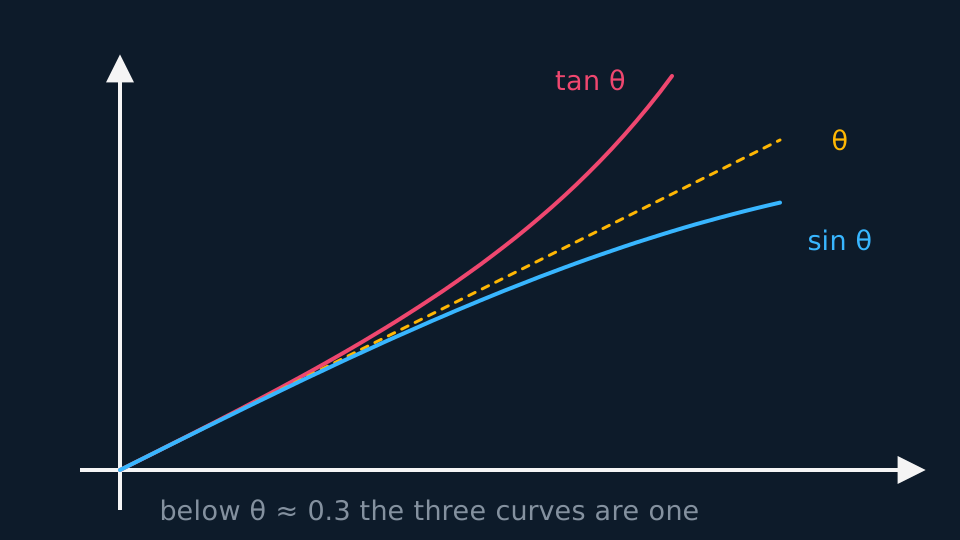
For θ near 0, with θ in radians, the trigonometric functions are approximated by polynomials. All three approximations are printed in the formulae booklet,
together with the condition that θ is measured in radians. In degrees they fail immediately, since sin 1° = 0.0175 while θ = 1.
The cosine approximation carries a squared term because cos θ has a stationary point at θ = 0, while sin θ and tan θ pass through zero with gradient 1.
INDEPENDENT PRACTICE
A limit by approximation
For small θ, find the approximate value of (1 − cos 2θ)/(θ sin θ).
Show the working
Replace each piece. cos 2θ ≈ 1 − (2θ)2/2 = 1 − 2θ2, and sin θ ≈ θ.
The numerator becomes 2θ2 and the denominator θ2, so the whole expression is approximately 2.
A numerical check at θ = 0.05 gives 1.9992, and the approximation improves as θ decreases. Substitute the angle exactly as it appears: the whole angle 2θ goes into the cosine approximation.
ASSESSMENT FOCUS
- Set the calculator to radians for these questions: the formulae s = rθ, A = ½r²θ and the small-angle approximations are all stated for θ in radians.
- s = rθ and A = ½r²θ demand θ in radians. Convert first, never after.
- A sector's perimeter includes the two radii, and a segment's area is the sector minus a triangle on the same angle.
- The small-angle approximations and their radian condition are both in the formulae booklet. Still state “θ in radians” when you use them.
- Substitute multiples like 2θ into the approximations whole, brackets and all, then simplify.
CHECK YOURSELF
An arc of length 10 cm subtends an angle θ at the centre of a circle of radius 8 cm. Find θ and the area of the sector.
Show a hint
Rearrange s = rθ first.
Show the answer
θ = s/r = 10/8 = 1.25 radians.
Area = ½ × 64 × 1.25 = 40 cm².
Both formulae were used with θ in radians, which is the condition they require.
A radian is the angle subtended by an arc equal to the radius; π radians = 180°.
Arc length is rθ and sector area ½r²θ; for small θ in radians, sin θ ≈ θ, tan θ ≈ θ and cos θ ≈ 1 − θ²/2.
WORKBOOK
Printable practice for this topic: original exam-style questions with room to work, and a fully worked answer book. Free to use; please do not redistribute or sell.
Or read them with their worked answers on the radians, arcs and small angles questions page.
USED LATER IN
CHECK YOUR PROGRESS
Rate how confident you feel with each objective for this lesson. Ratings are saved in this browser, on this device, unless you sign in.
- Convert between degrees and radians, and know the standard angles in both.
- Use s = rθ and A = ½r²θ for arcs and sectors.
- Find a segment area as sector minus triangle.
- Apply the small-angle approximations, in radians only.
Open the full revision checklist to see every objective in the course in one place.