Maths › Further Mechanics 1 › Oblique impact and impact with a smooth surface
Oblique impact and impact with a smooth surface
In an oblique impact each velocity is resolved along the line of impact and perpendicular to it. Along the line of impact the relative velocity is multiplied by −e, while each perpendicular component is unchanged.
Builds on Successive impacts and impacts with a wall and Impulse and momentum as vectors and Vectors in two dimensions.
IN THIS TOPIC
- Resolve a velocity into components along and perpendicular to a smooth surface.
- Apply restitution to the perpendicular component only, and find the outgoing speed and direction.
- Calculate the kinetic energy lost in an oblique impact.
- Solve an oblique impact between two smooth spheres by resolving along the line of centres.
- Follow a ball through successive oblique impacts with two surfaces.
COMMON MISCONCEPTION
In an oblique impact with a smooth wall, the ball leaves at the same angle to the wall as it arrived, like light in a mirror.
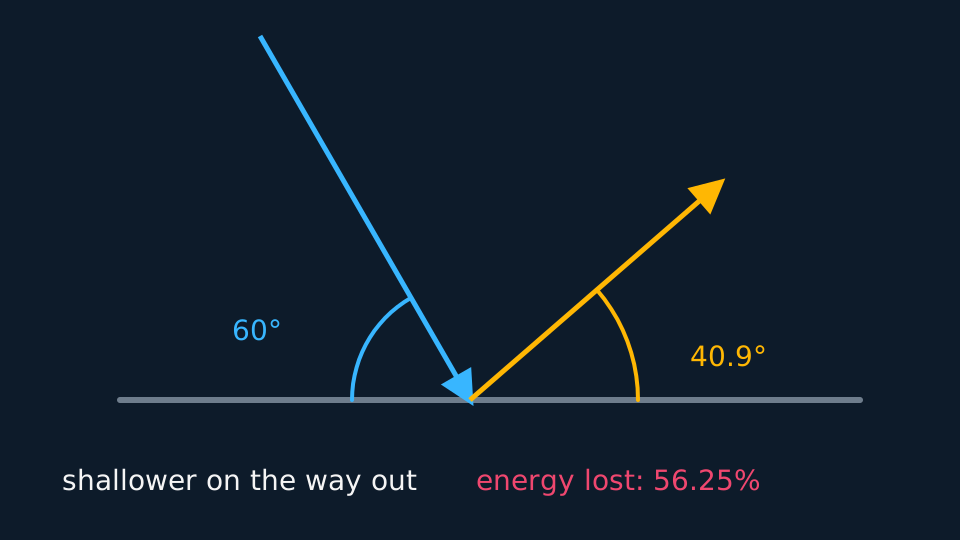
A smooth wall exerts no force along itself, so the parallel component of velocity is unchanged while the perpendicular one is reversed and multiplied by e. Only one of the two shrinks, so the outgoing path hugs the wall more closely whenever e < 1. A ball arriving at 60° to a wall with e = 0.5 leaves at 40.9°, and the angles match only when e = 1.
Split it in two
A smooth surface can exert no force along itself, so the component of velocity parallel to the surface is completely unchanged. The perpendicular component is reversed and reduced by the factor e, exactly as in a direct impact.
Only one of the two components can shrink, so the outgoing path lies no farther from the surface than the incoming one, and strictly closer when e < 1 and both components are non-zero. A true mirror rebound would need e = 1, the one case where the angles do match.
WORKED EXAMPLE
A ball off a wall
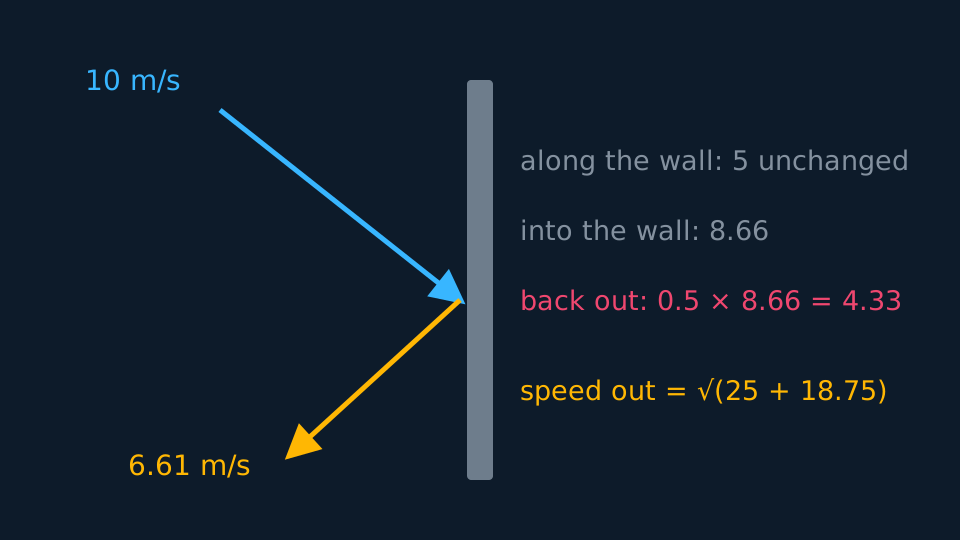
A ball moving at 10 m/s strikes a smooth wall at 60° to the wall. The coefficient of restitution is 0.5. Find the speed and direction afterwards.
Parallel component = 10 cos60° = 5 m/s, unchanged.
Perpendicular component = 10 sin60° = 8.66 m/s, becoming 0.5 × 8.66 = 4.33 m/s the other way.
Speed = √(25 + 18.75) = 6.61 m/s, and the angle to the wall is arctan(4.33/5) = 40.9°.
Angles and energy
The angle to the surface shrinks whenever e < 1, since the parallel component stays and the perpendicular one is cut. A ball skimming in nearly along a wall leaves at almost the same angle. One arriving nearly perpendicular keeps only about e times its speed.
Kinetic energy is a scalar, so the loss comes from the speeds. Compare ½mv² before and after, or take the ratio of the squared speeds when a percentage is wanted. Only the perpendicular component contributes to the loss, keeping e² of its own energy, while the parallel part is untouched.
When a ball bounces off two walls in turn, treat each impact separately with its own pair of directions. The velocity leaving the first wall is the velocity arriving at the second. If the walls are perpendicular and the coefficients are e₁ and e₂, each component is multiplied once: an arrival velocity (u, v) leaves as (−e₁u, −e₂v), so the line of travel has its gradient scaled by e₂/e₁, or its reciprocal, depending on which wall is met first. The speeds shrink by both factors; the slope changes by their ratio, and only when e₁ = e₂ does the ball leave parallel to the line it arrived along.
GUIDED PRACTICE
The energy lost
For the impact above, find the percentage of kinetic energy lost.
Show the working
Speed before 10, so the energy is proportional to 100.
Speed after 6.61, so the energy is proportional to 25 + 18.75 = 43.75.
Fraction remaining = 43.75/100, so the loss is 56.25%.
Checking directly: the perpendicular part keeps e² = 0.25 of its 75, that is 18.75, and the parallel 25 is untouched.
Two spheres, off centre
Two smooth spheres colliding obliquely need the same split, taken along the line of centres. Because the spheres are smooth, the impulse between them acts along that line, so each sphere keeps its own perpendicular component unchanged. Along the line of centres you are back to a direct impact, with conservation of momentum and restitution as usual.
So there are three equations and no new ideas. Resolve both velocities along and perpendicular to the line of centres, write momentum and restitution for the components along it, and carry the perpendicular components through untouched. Recombine at the end for each sphere's speed and direction.
WORKED EXAMPLE
An off-centre collision
A sphere of mass 2 kg moving at 5 m/s strikes a stationary sphere of mass 3 kg. At the moment of impact the 2 kg sphere is moving at 60° to the line of centres, and e = 0.5. Find both velocities afterwards.
Resolving: along the line of centres 5cos60° = 2.5 m/s; perpendicular 5sin60° = 4.33 m/s, which the 2 kg sphere keeps.
Momentum along the line of centres: 2(2.5) = 2a + 3b. Restitution: b − a = 0.5(2.5) = 1.25.
Solving, a = 0.25 and b = 1.5 m/s.
The 3 kg sphere moves off at 1.5 m/s along the line of centres. The 2 kg sphere has components 0.25 and 4.33, so its speed is 4.34 m/s at 86.7° to the line of centres: its direction has turned from 60° to 86.7° and its speed has fallen from 5 to 4.34 m/s.
ASSESSMENT FOCUS
- Draw the surface, or the line of centres, and mark the two directions before resolving anything.
- Apply e to the perpendicular component only. Leaving it on both is the standard error.
- Recombine with Pythagoras for the speed and an inverse tangent for the angle, and say which line the angle is measured from.
- For the energy, work with squared speeds. The mass cancels if a percentage is wanted.
- For two spheres, resolve along the line of centres, and say that the perpendicular components are unchanged because the spheres are smooth.
- Watch whether an angle is given to the surface or to the normal; the sine and cosine swap over.
CHECK YOURSELF
A ball hits a smooth floor at 8 m/s at 30° to the floor with e = 0.5. Find the two components after impact.
Show a hint
Resolve along and perpendicular to the floor.
Show the answer
Parallel: 8cos30° = 6.93 m/s, unchanged. Perpendicular: 8sin30° = 4 m/s becomes 0.5 × 4 = 2 m/s upwards.
A smooth surface leaves the parallel component untouched and multiplies the perpendicular component by −e.
The outgoing path therefore hugs the surface more closely than the incoming one whenever e < 1.
All the energy lost comes from the perpendicular component, which keeps only e² of its share.
For two smooth spheres the impulse acts along the line of centres, so resolve there and leave both perpendicular components alone.
WORKBOOK
Printable practice for this topic: original exam-style questions with room to work, and a fully worked answer book. Free to use; please do not redistribute or sell.
Or read them with their worked answers on the oblique impact and impact with a smooth surface questions page.
CHECK YOUR PROGRESS
Rate how confident you feel with each objective for this lesson. Ratings are saved in this browser, on this device, unless you sign in.
- Resolve a velocity into components along and perpendicular to a smooth surface.
- Apply restitution to the perpendicular component only, and find the outgoing speed and direction.
- Calculate the kinetic energy lost in an oblique impact.
- Solve an oblique impact between two smooth spheres by resolving along the line of centres.
- Follow a ball through successive oblique impacts with two surfaces.
Open the full revision checklist to see every objective in the course in one place.