Maths › Vectors › Vectors in two dimensions
Vectors in two dimensions
Represent two-dimensional vectors in column or i, j form. Calculate magnitude and direction, add and scale vectors, identify parallel vectors, form unit vectors, and use position vectors in coordinate geometry.
Builds on Straight lines and Triangles and the sine and cosine rules.
Used in InkPhysics: Scalars and vectors.
IN THIS TOPIC
- Work in column and i-j notation, converting between components and magnitude-direction form.
- Add vectors, scale them, and recognise parallel vectors.
- Use position vectors, = b − a, and distances to solve geometric problems.
- Find the unit vector in the direction of a given vector, and scale it to any length asked for.
COMMON MISCONCEPTION
The magnitude of a + b is |a| + |b|.
The triangle inequality gives |a + b| ≤ |a| + |b|, with equality only when the non-zero vectors point the same way. For a = (3, 4) and b = (4, −3) the two magnitudes sum to 10, while a + b = (7, 1) has magnitude √50 ≈ 7.07. Add the components first, then apply Pythagoras to the result.
Arrows with components
A vector carries magnitude and direction together, and two notations hold it. Column form stacks the components. The i-j form writes multiples of the unit vectors i, one step across, and j, one step up. Magnitude |a| is Pythagoras on the components; direction comes from trigonometry. So (3, 4) has magnitude 5 and points 53.1° above the horizontal. Dividing a non-zero vector by its own magnitude gives a unit vector, of length 1 in the same direction, which can then be scaled to any required magnitude.
WORKED EXAMPLE
Between the two forms
Find the magnitude and direction of a = 3i + 4j, and the unit vector in the direction of a.
|a| = √(32 + 42) = 5.
Direction: tan θ = 4/3, so θ = 53.1° above the positive x-direction.
The unit vector is a divided by its length, (3/5)i + (4/5)j, whose own magnitude is 1 by construction.
Converting the other way, a vector of magnitude 6 at 30° has components (6 cos 30°, 6 sin 30°) = (3√3, 3). The two notations describe the same vector, and a question may use either.
Adding, scaling, comparing
Vector addition is performed component by component and corresponds geometrically to the triangle law, with the two vectors placed tip to tail. Multiplying by a positive scalar changes the magnitude and not the direction, and a negative scalar reverses the direction, so two non-zero vectors are parallel exactly when one is a scalar multiple of the other: 6i − 8j = 2(3i − 4j).
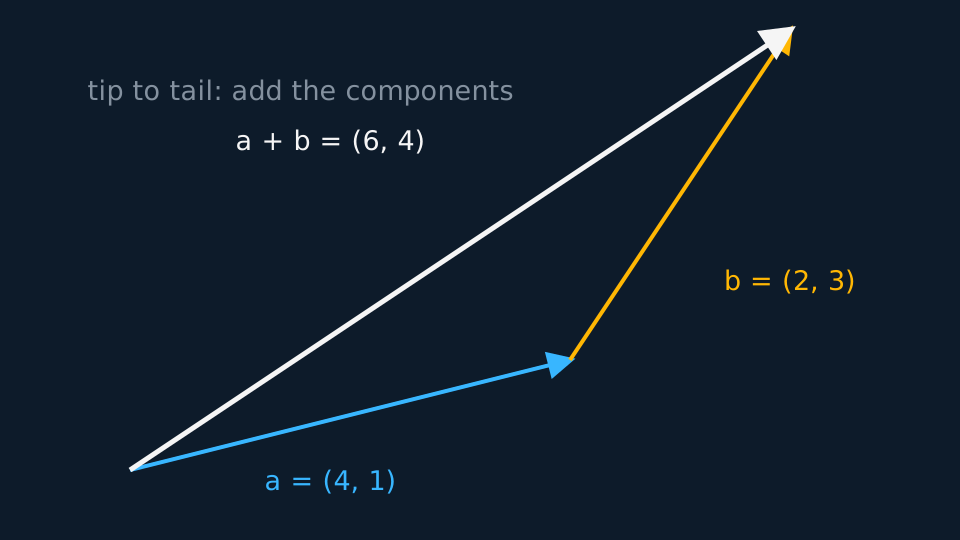
The triangle inequality gives |a + b| ≤ |a| + |b|, with equality when the non-zero vectors have the same direction. For a = (3, 4) and b = (4, −3), |a| + |b| = 10 while |a + b| = √50 ≈ 7.07.
GUIDED PRACTICE
Parallel or not
Given p = 2i − 5j and q = −6i + 15j, show that p and q are parallel, and state the ratio of their magnitudes, before opening the working.
Show the working
q = −3p, a scalar multiple, so the two are parallel, pointing opposite ways because the scalar is negative.
|q| = 3|p|, so the ratio is 1 : 3.
The method is to find the scalar. One pair of components gives a candidate value; both pairs must agree for the vectors to be parallel.
Position vectors and geometry
Fix an origin O and every point acquires a position vector, a for the point A. The vector from A to B is then
destination minus start, and its magnitude is the distance between the two points. This identity converts geometric statements into component arithmetic: a midpoint is the average of two position vectors, and opposite sides of a parallelogram are equal vectors.
WORKED EXAMPLE
From one point to another
The points A(1, 5) and B(4, 1) have position vectors a and b. Find the vector and the distance |AB|.
= b − a = (4 − 1)i + (1 − 5)j = 3i − 4j.
The distance is |AB| = √(9 + 16) = 5. In the notation, the arrow marks the difference: is the displacement from A to B, direction included, while |AB| without it is the distance alone.
Subtract in the order destination minus start. The other order gives the vector from B to A, which has the opposite sign in every component.
INDEPENDENT PRACTICE
Completing the parallelogram
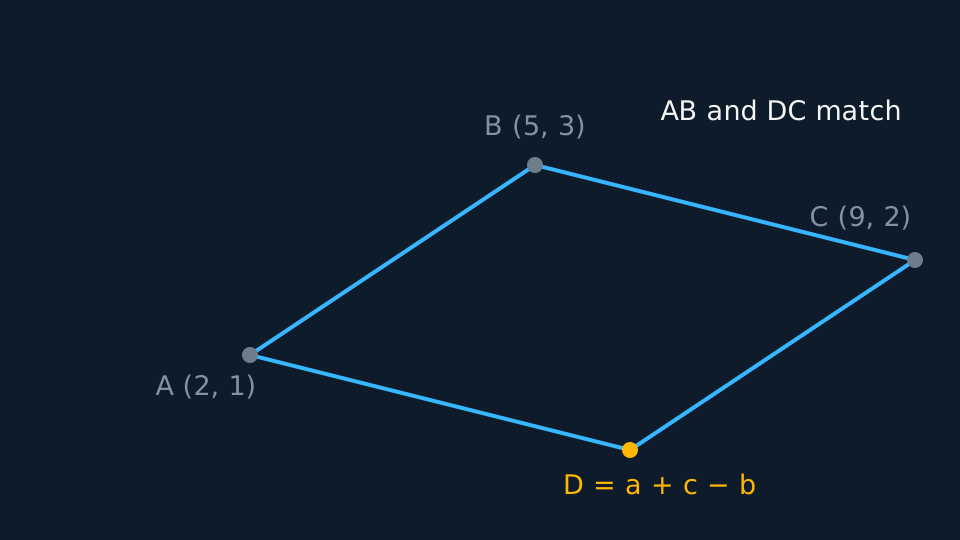
ABCD is a parallelogram with A(2, 1), B(5, 3) and C(9, 2). Find the position vector of D.
Show the working
In a parallelogram = , so b − a = c − d.
Rearranging, d = a + c − b = (2 + 9 − 5)i + (1 + 2 − 3)j = 6i + 0j, the point (6, 0).
A check is built in. = c − d = 3i + 2j, which matches = 3i + 2j, so the shape closes.
The order of the labels matters: ABCD names the vertices in sequence around the shape, and a different order gives a different parallelogram with a different fourth vertex.
ASSESSMENT FOCUS
- Set out vector working in column or i-j form and keep to one notation throughout the solution.
- Magnitude is Pythagoras on components; direction is trigonometry, quoted against a stated reference direction.
- Parallel means scalar multiple. Write the scalar down explicitly, sign included.
- In shape problems, translate the geometric fact into a vector equation, = for a parallelogram, before touching any numbers.
CHECK YOURSELF
Given a = 5i − 12j, find |a|, the unit vector in the direction of a, and a vector of magnitude 39 parallel to a.
Show a hint
5, 12 and a familiar hypotenuse; then scale.
Show the answer
|a| = √(25 + 144) = 13.
The unit vector is (5/13)i − (12/13)j.
Magnitude 39 is 3 × 13, so 3a = 15i − 36j has magnitude 39, and so does −3a, which is parallel to a in the opposite direction. State both.
Vectors add component by component, a scalar multiple changes magnitude and possibly direction, and parallel vectors are scalar multiples of each other.
= b − a, destination minus start, and its magnitude |AB| is the distance.
WORKBOOK
Printable practice for this topic: original exam-style questions with room to work, and a fully worked answer book. Free to use; please do not redistribute or sell.
Or read them with their worked answers on the vectors in two dimensions questions page.
USED LATER IN
CHECK YOUR PROGRESS
Rate how confident you feel with each objective for this lesson. Ratings are saved in this browser, on this device, unless you sign in.
- Work in column and i-j notation, converting between components and magnitude-direction form.
- Add vectors, scale them, and recognise parallel vectors.
- Use position vectors, = b − a, and distances to solve geometric problems.
- Find the unit vector in the direction of a given vector, and scale it to any length asked for.
Open the full revision checklist to see every objective in the course in one place.