Maths › Further Mechanics 1 › Successive impacts and impacts with a wall
Successive impacts and impacts with a wall
A wall behaves like a sphere of infinite mass, so an impact with one uses the restitution equation alone. In a sequence of collisions, a common question is whether the next impact happens at all.
Builds on Direct impact and Newton's law of restitution and Kinematics with constant acceleration.
IN THIS TOPIC
- Apply restitution to an impact with a fixed wall or floor.
- Follow a chain of impacts and decide whether a further collision occurs.
- Handle repeated bounces, including the total distance travelled.
COMMON MISCONCEPTION
When a ball bounces off the floor, momentum is conserved, so its speed is unchanged.
Momentum is not conserved for the ball on its own against a fixed surface, since the floor is attached to the Earth and absorbs whatever it needs to. What survives is restitution: the rebound speed is e times the approach speed. Dropped from height h the ball returns to e2h, so successive heights form a geometric sequence of ratio e2.
Impact with a fixed wall
In an impact with a fixed surface, momentum is not conserved for the ball on its own. The wall is attached to the Earth and absorbs whatever it needs to. What survives is the restitution equation, which for a direct impact says the rebound speed is e times the approach speed. Conserving the ball's momentum here would apply a conservation law to a system that was never isolated.
Drop a ball from height h and it arrives at √(2gh), rebounds at e√(2gh), and so reaches e²h. Repeat, and the heights form a geometric sequence of ratio e². The total distance travelled before the ball comes to rest sums to h(1 + e²)/(1 − e²).
WORKED EXAMPLE
A bouncing ball
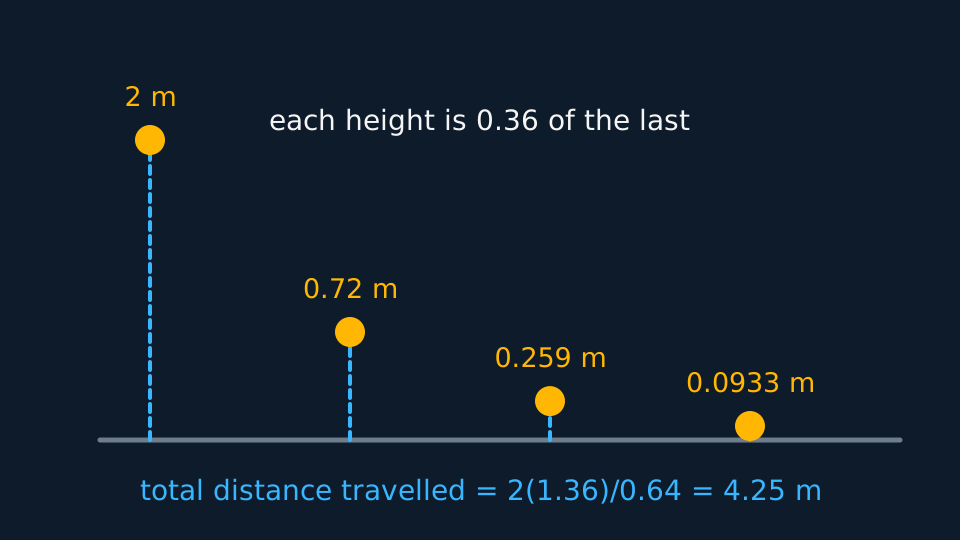
A ball is dropped from 2 m onto a floor with e = 0.6. Find the height of the first rebound and the total distance travelled before it stops bouncing.
The first rebound reaches 0.6² × 2 = 0.72 m.
Successive heights are 2, 0.72, 0.259, ... with common ratio 0.36.
Total distance = 2 + 2(0.72 + 0.259 + …) = 2 + 2(0.72/0.64) = 4.25 m, since every height after the first is travelled twice.
Does it happen again?
In a chain of impacts, the answer to each stage feeds the next, and the question usually ends by asking whether a further collision occurs. Answering it needs only a comparison of velocities. The two bodies meet again exactly when the one behind is still gaining on the one in front.
Set the work out stage by stage with a fresh diagram each time, carrying the velocities forward with their signs. A negative velocity coming out of one stage is the correct input to the next. Reasoning about directions in words instead loses track of the signs.
GUIDED PRACTICE
Two collisions and a wall
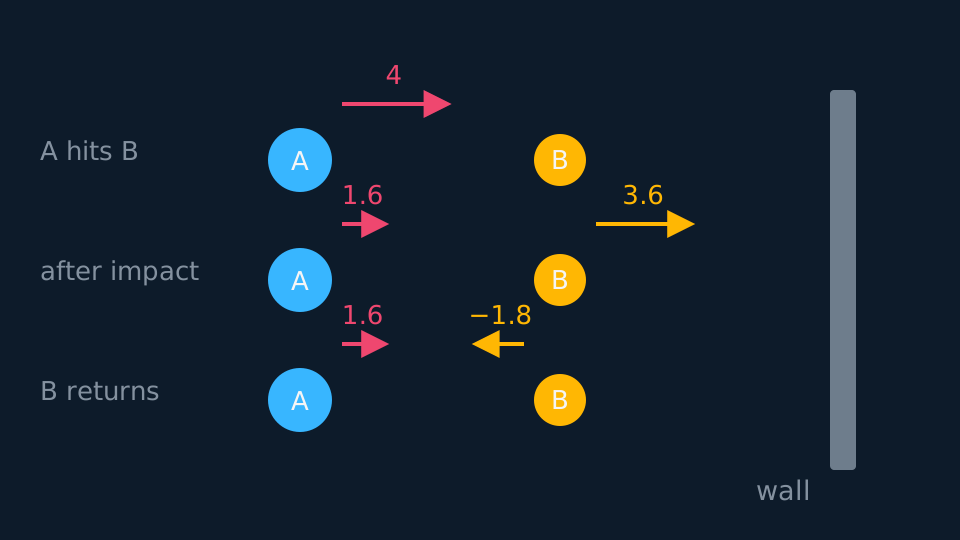
A sphere A of mass 3 kg moving at 4 m/s strikes a stationary sphere B of mass 2 kg with e = 0.5. B then strikes a wall, rebounding with coefficient of restitution 0.5. Show that A and B collide again.
Show the working
First impact. Momentum: 3(4) = 3vA + 2vB. Restitution: vB − vA = 0.5(4) = 2.
Substituting: 5vA = 8, so vA = 1.6 m/s and vB = 3.6 m/s.
At the wall B rebounds at 0.5 × 3.6 = 1.8 m/s back towards A.
A is still moving forwards at 1.6 and B is now moving backwards at 1.8, so they approach at 3.4 m/s and must collide again.
ASSESSMENT FOCUS
- For a wall, use restitution alone. Momentum is not conserved for the ball by itself.
- Redraw the diagram for each stage instead of tracking everything on one.
- To decide whether a further impact occurs, compare velocities with their signs, not speeds.
- For repeated bounces, identify the geometric ratio e² and say whether you are summing heights or distances.
CHECK YOURSELF
A ball strikes a floor at 7 m/s and rebounds at 4.2 m/s. Find e, and the height it reaches, taking g = 9.8 m/s².
Show a hint
Restitution first, then the usual constant-acceleration result.
Show the answer
e = 4.2/7 = 0.6. Height = 4.2²/(2 × 9.8) = 17.64/19.6 = 0.9 m.
Against a fixed surface only restitution applies: the rebound speed is e times the approach speed, and momentum is not conserved for the ball alone.
In a chain of impacts, carry signed velocities forward; a further collision happens exactly when the bodies are still approaching.
WORKBOOK
Printable practice for this topic: original exam-style questions with room to work, and a fully worked answer book. Free to use; please do not redistribute or sell.
Or read them with their worked answers on the successive impacts and impacts with a wall questions page.
CHECK YOUR PROGRESS
Rate how confident you feel with each objective for this lesson. Ratings are saved in this browser, on this device, unless you sign in.
- Apply restitution to an impact with a fixed wall or floor.
- Follow a chain of impacts and decide whether a further collision occurs.
- Handle repeated bounces, including the total distance travelled.
Open the full revision checklist to see every objective in the course in one place.