Maths › Further Mechanics 2 › Oscillations on strings and springs
Oscillations on strings and springs
Hooke's law supplies a restoring force proportional to displacement, which is exactly the simple harmonic condition. The only care needed is where the motion is centred and whether the string stays taut.
Builds on Simple harmonic motion and Elastic potential energy.
IN THIS TOPIC
- Prove that a mass on a spring moves with simple harmonic motion and find ω.
- Locate the centre of the oscillation at the equilibrium position.
- Recognise when a string goes slack and the motion stops being simple harmonic.
- Use the kinetic, gravitational and elastic energy of an oscillation as one constant total, and find a speed from it.
COMMON MISCONCEPTION
A mass hanging on a spring oscillates about the position where the spring has its natural length.
The oscillation is centred on the equilibrium position, where the tension already balances the weight and the spring is stretched. Measured from that point the weight cancels and the equation of motion is acceleration = −(λ/ml)x, so ω2 = λ/ml. Weight decides where the centre sits and has no effect at all on the period.
Why Hooke's law gives oscillation
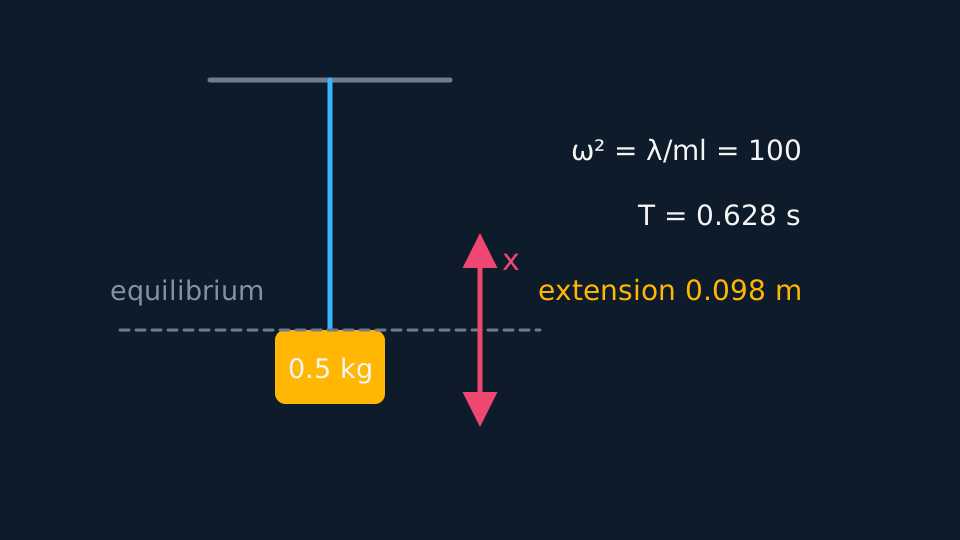
Measure x from the equilibrium position, not from the natural length. At equilibrium the tension already balances the weight, so displacing the particle by x changes the tension by λx/l and changes nothing else. The equation of motion is therefore:
Gravity has dropped out entirely. The oscillation is centred on the equilibrium position and not on the natural length. Weight decides where the centre sits and has no effect whatever on the period.
WORKED EXAMPLE
A mass on a spring
A particle of mass 0.5 kg hangs on a spring of natural length 0.4 m and modulus 20 N. Find the equilibrium extension and the period of small oscillations, taking g = 9.8 m/s².
Equilibrium: 20e/0.4 = 0.5(9.8), so 50e = 4.9 and e = 0.098 m.
ω² = λ/(ml) = 20/(0.5 × 0.4) = 100, so ω = 10 rad/s.
T = 2π/10 = 0.628 s, and the mass would have to quadruple to double it.
When the string goes slack
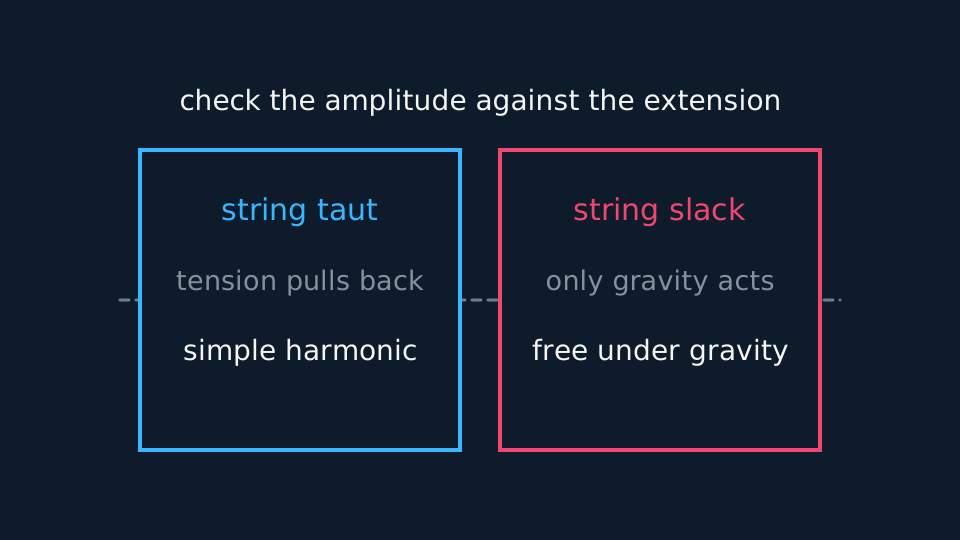
A spring pushes as well as pulls, so the motion stays simple harmonic however large the amplitude. A string cannot push. As soon as the particle rises above the natural length the tension vanishes, gravity acts alone, and the particle moves freely until the string tightens again.
Compare the amplitude with the equilibrium extension. If it is smaller, the string stays taut and the motion is simple harmonic all the way. If it is larger, the motion is simple harmonic in part and free under gravity in the rest, with the two pieces handled separately and joined at the moment the string goes slack.
While the string is taut, v2 = ω2(a2 − x2) gives the speed at any displacement, but it does not apply above the natural length, where the motion is no longer simple harmonic. Conservation of energy holds across both parts of the motion. Kinetic, gravitational and elastic energy add to one constant total, so writing that total at two instants and equating them gives a speed whether or not the string stayed taut in between. The elastic term is λx2/(2l), with x the extension from the natural length and nothing stored while the string is slack, and every height is measured from one zero level, stated once and used on both sides.
WORKED EXAMPLE
Finding a speed by energy
A particle of mass 1 kg hangs in equilibrium from an elastic string of natural length 0.5 m and modulus 49 N. It is pulled down a further 0.3 m and released from rest. Find its speed at the moment the string goes slack, taking g = 9.8 m/s2.
Equilibrium: 49e/0.5 = 1(9.8), so e = 0.1 m, and the extension at release is 0.1 + 0.3 = 0.4 m. The string goes slack at the natural length, 0.4 m higher.
Take the release point as the zero level for height. The particle is at rest there, so the total is elastic alone: 49 × 0.42/(2 × 0.5) = 7.84 J.
At the natural length the string stores nothing, the height is 0.4 m and the gravitational term is 1 × 9.8 × 0.4 = 3.92 J, so the total there is ½(1)v2 + 3.92.
One constant total: ½v2 + 3.92 = 7.84, so v2 = 7.84 and v = 2.8 m/s.
Had the second instant been the equilibrium position instead, the string would still be stretched there, and an elastic term would appear on both sides, each worked out from its own extension.
GUIDED PRACTICE
Released from the natural length
The same particle is pulled up to the point where the spring has its natural length and released from rest. Find its greatest speed, and say what would change if the spring were a string.
Show the working
The release point is 0.098 m above equilibrium and the particle starts at rest there, so the amplitude is 0.098 m.
Greatest speed = aω = 0.098 × 10 = 0.98 m/s, at the equilibrium position.
With a string, the particle would reach exactly the natural length at the top of each swing, where the tension is zero.
Any larger amplitude and the string would go slack there, and the particle would rise as a free body before the string snapped taut again.
ASSESSMENT FOCUS
- Measure the displacement from the equilibrium position and say that you are doing so.
- Show the weight cancelling. That step is what makes the motion simple harmonic and it carries marks.
- Compare the amplitude with the equilibrium extension before assuming the motion is simple harmonic throughout.
- For energy questions, include kinetic, gravitational and elastic terms and use one zero level for height.
CHECK YOURSELF
A mass of 2 kg hangs on a spring of natural length 0.5 m and modulus 100 N. Find the period of small oscillations.
Show a hint
ω² = λ/(ml).
Show the answer
ω² = 100/(2 × 0.5) = 100, so ω = 10 rad/s and T = 2π/10 = 0.628 s.
Measured from equilibrium the weight cancels, leaving acceleration = −(λ/ml)x: simple harmonic with ω² = λ/ml.
A spring stays simple harmonic throughout; a string goes slack above its natural length, so compare the amplitude with the equilibrium extension.
WORKBOOK
Printable practice for this topic: original exam-style questions with room to work, and a fully worked answer book. Free to use; please do not redistribute or sell.
Or read them with their worked answers on the oscillations on strings and springs questions page.
CHECK YOUR PROGRESS
Rate how confident you feel with each objective for this lesson. Ratings are saved in this browser, on this device, unless you sign in.
- Prove that a mass on a spring moves with simple harmonic motion and find ω.
- Locate the centre of the oscillation at the equilibrium position.
- Recognise when a string goes slack and the motion stops being simple harmonic.
- Use the kinetic, gravitational and elastic energy of an oscillation as one constant total, and find a speed from it.
Open the full revision checklist to see every objective in the course in one place.