Maths › Further Mechanics 2 › Further kinematics: acceleration as a function of x, t or v
Further kinematics: acceleration as a function of x, t or v
Acceleration can be written as dv/dt or as v dv/dx, and the choice depends on whether the force is given as a function of x, t or v. The skill is picking the form that separates, after which the integration is routine.
Builds on Newton's laws with a variable force and Solving differential equations.
IN THIS TOPIC
- Choose the form of the acceleration that separates for a given problem.
- Solve the resulting equation and apply the conditions correctly.
- Interpret limiting behaviour, including terminal speed and total distance.
COMMON MISCONCEPTION
Acceleration is dv/dt, so any kinematics problem can be solved by integrating with respect to time.
Acceleration has two equal forms, dv/dt and v dv/dx, and the pairing that separates is the one to use. With the acceleration given against x, dv/dt leaves three variables in one equation and nowhere to go, while v dv/dx separates at once. A deceleration of 0.5v answered against time gives v = 10e−0.5t, and answered against distance gives v = 10 − 0.5x.
Pick the pairing that separates
Acceleration has two equal forms, dv/dt and v dv/dx, and the choice between them is settled by the variable on the right-hand side together with the variable the question asks about:
Pearson Edexcel 9FM0 formulae booklet: neither form of the acceleration is included. Know both, and know which one separates in each case.
Choosing dv/dt when the acceleration depends on x leaves you with three variables in one equation and nowhere to go; v dv/dx separates at once. Ask first what the acceleration depends on, then what the answer is wanted in terms of.
Once separated, integrate both sides and apply the conditions immediately, before any rearranging. If displacement is wanted from a velocity that depends on time, a second integration follows.
WORKED EXAMPLE
Resistance proportional to speed
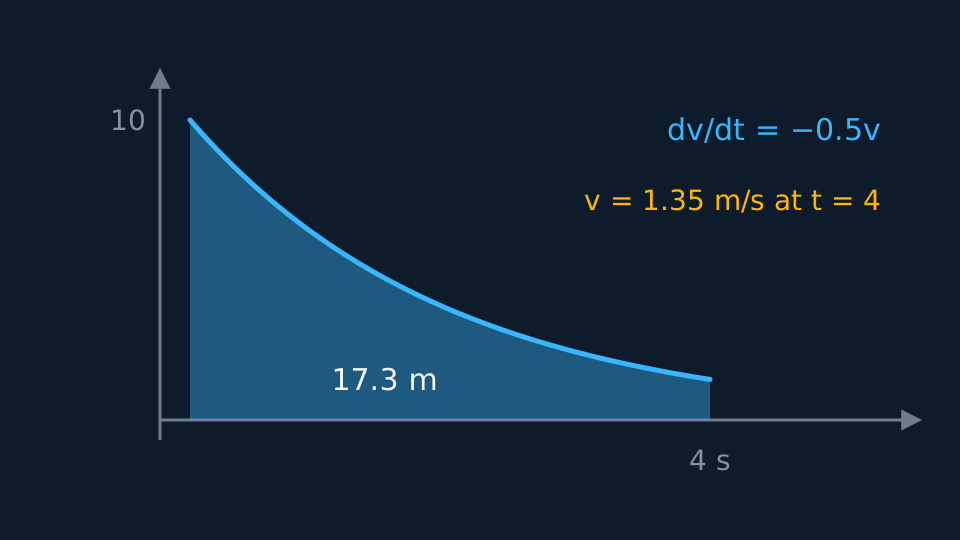
A particle moving at 10 m/s decelerates at 0.5v m/s². Find its speed after 4 s and the distance it covers in that time.
The acceleration depends on v, and time is asked for, so use dv/dt = −0.5v.
Separating: ∫dv/v = −0.5∫dt gives ln v = −0.5t + c, and v = 10 at t = 0 gives v = 10e−0.5t.
At t = 4: v = 10e−2 = 1.35 m/s.
Distance = ∫v dt = 20(1 − e−2) = 17.3 m.
The same problem against distance
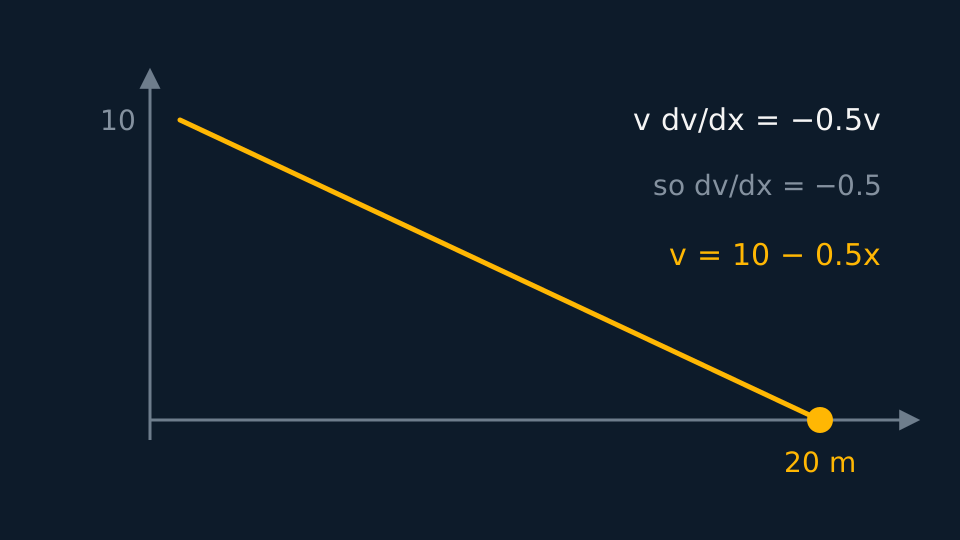
Change the question from 'after 4 seconds' to 'how far before it stops' and the identical physics needs the other pairing. Write the acceleration as v dv/dx, cancel the v, and a decaying exponential turns into a straight line. Two lines of work replace an integral over all time.
Read off the limiting behaviour while you are there. Under this resistance the speed approaches zero without reaching it in finite time, yet the total distance is finite at 20 m. Put a constant driving force against a resistance that grows with speed and the limit becomes a terminal speed instead, found by setting the acceleration to zero.
GUIDED PRACTICE
How far before it stops
For the same particle, find the total distance it travels before coming to rest, and comment.
Show the working
The acceleration depends on v and distance is wanted, so use v dv/dx = −0.5v.
Cancelling v, which is valid while the particle is moving: dv/dx = −0.5, so v = 10 − 0.5x.
v = 0 gives x = 20 m.
The particle never actually stops in finite time, since v decays exponentially, yet the distance it covers is finite.
ASSESSMENT FOCUS
- State which form of the acceleration you are using and why, before separating anything.
- Apply the initial conditions as soon as you have integrated, not after rearranging.
- Watch for cancelling v. It is valid while the particle moves, and worth saying so.
- For terminal speed, set the acceleration to zero instead of taking a limit.
- Check the sign of a deceleration. Writing dv/dt = 0.5v instead of −0.5v turns a stopping particle into a runaway.
CHECK YOURSELF
A particle has acceleration 4t m/s² and speed 3 m/s at t = 0. Find its speed at t = 2.
Show a hint
The acceleration depends on t, so integrate with respect to t.
Show the answer
dv/dt = 4t, so v = 2t² + c, and v = 3 at t = 0 gives c = 3. At t = 2: v = 8 + 3 = 11 m/s.
Match the form of the acceleration to what it depends on: dv/dt for t or v, v dv/dx for x or v.
Separate, integrate, then apply the conditions at once.
A terminal speed is found by setting the acceleration to zero, not by taking a limit.
WORKBOOK
Printable practice for this topic: original exam-style questions with room to work, and a fully worked answer book. Free to use; please do not redistribute or sell.
Or read them with their worked answers on the further kinematics: acceleration as a function of x, t or v questions page.
CHECK YOUR PROGRESS
Rate how confident you feel with each objective for this lesson. Ratings are saved in this browser, on this device, unless you sign in.
- Choose the form of the acceleration that separates for a given problem.
- Solve the resulting equation and apply the conditions correctly.
- Interpret limiting behaviour, including terminal speed and total distance.
Open the full revision checklist to see every objective in the course in one place.