Maths › Further Mechanics 2 › Simple harmonic motion
Simple harmonic motion
Simple harmonic motion is oscillation governed by the equation acceleration = −ω²x, where x is the displacement from the equilibrium position. Prove that the equation holds in a given situation, read off ω, and apply the standard results for period, displacement and speed.
Builds on Newton's laws with a variable force and Differentiating trig, exponentials and logs.
IN THIS TOPIC
- Recognise and prove the simple harmonic condition from an equation of motion.
- Use the standard formulae for displacement, speed and period.
- Link speed to displacement without ever finding the time.
- Solve problems mixing time, displacement and speed.
COMMON MISCONCEPTION
In simple harmonic motion the particle moves fastest at the ends of its path, where the force on it is largest.
The particle is fastest at the centre and momentarily at rest at the ends. The acceleration is −ω2x, so the force is largest at the ends and zero at the centre, so the two maxima sit at opposite places: v2 = ω2(a2 − x2) gives a greatest speed of aω at x = 0 and v = 0 at both ends.
One equation, one constant
A particle moves with simple harmonic motion when its acceleration is proportional to its displacement from a fixed point and directed back towards it:
Pearson Edexcel 9FM0 formulae booklet: not included; the defining equation, its solutions and the period are not printed there. Proving that the defining equation holds is the standard first part of a question. Set up the equation of motion, measure x from the equilibrium position, and show the acceleration comes out as a negative constant times x. That constant is ω², and everything else follows from it.
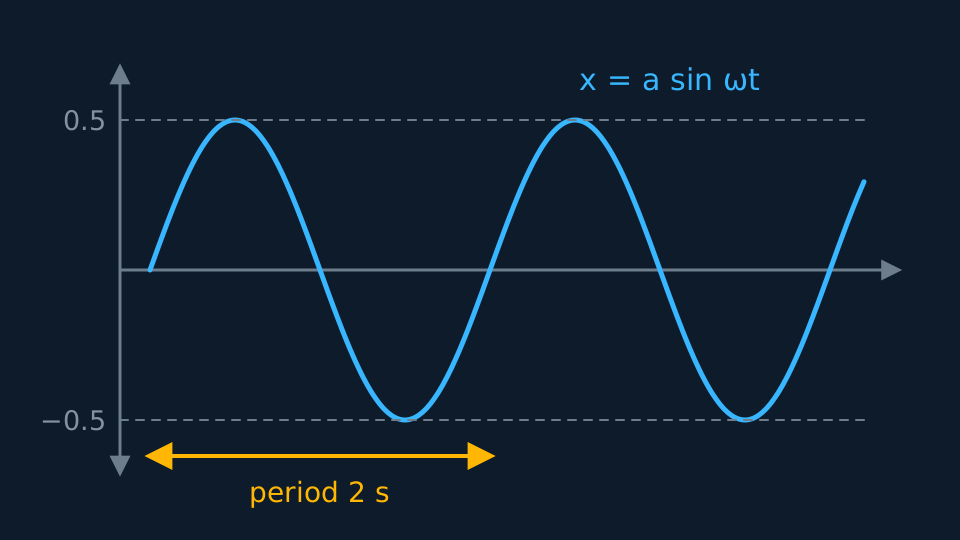
The solutions are x = a sin ωt if timing starts at the centre, or x = a cos ωt if it starts at an end. Period is T = 2π/ω, independent of the amplitude, and that independence is what makes pendulum clocks possible.
WORKED EXAMPLE
Reading off the standard results
A particle moves with simple harmonic motion of amplitude 0.5 m and period 2 s. Find its maximum speed and maximum acceleration.
ω = 2π/T = π rad/s.
Maximum speed = aω = 0.5π = 1.57 m/s, at the centre.
Maximum acceleration = aω² = 0.5π² = 4.93 m/s², at the ends.
The two maxima happen at opposite places: greatest speed at the centre, greatest acceleration at the ends.
Speed against displacement
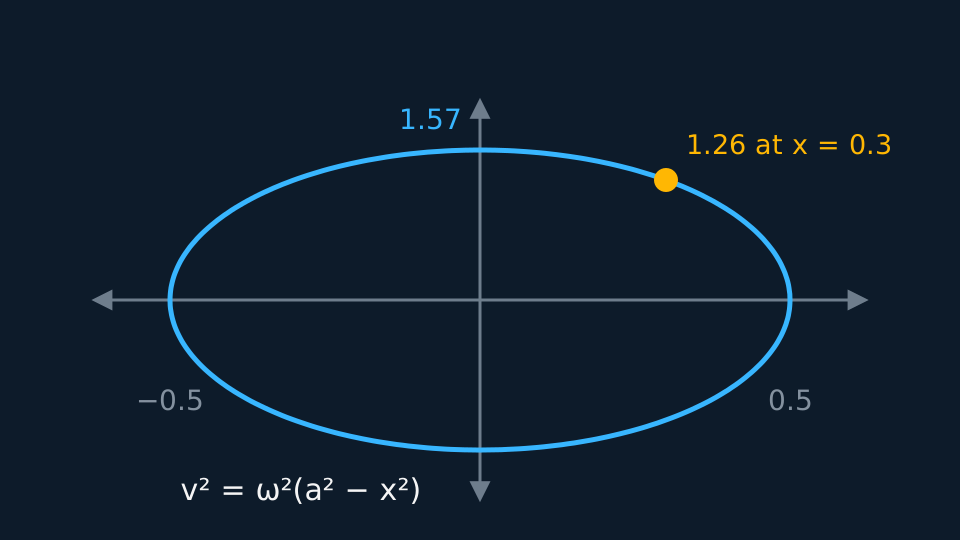
Eliminate t between the displacement and the velocity and a separate result drops out, one that answers questions about position without any mention of time:
Not printed either. Learn it, or be ready to eliminate t each time. Plotted, it is an ellipse, symmetric about both axes, with the greatest speed at the centre and zero speed at the ends. It also gives the amplitude from any single matching pair of values of x and v, which is how most questions supply the amplitude without saying so.
Getting at the time
Time questions need the sine or cosine form. Choose whichever puts t = 0 at the moment the question describes, and say which you chose. Then remember that the particle passes each interior point twice per cycle, so an inverse sine has two solutions in every period and a question asking for 'the times' wants both.
GUIDED PRACTICE
Mixing the two forms
For the same motion, find the speed when the displacement is 0.3 m, and the time taken to first reach that point from the centre.
Show the working
v² = π²(0.25 − 0.09) = π²(0.16), so v = 0.4π = 1.26 m/s.
Starting at the centre, x = 0.5 sin πt, so 0.3 = 0.5 sin πt gives sin πt = 0.6.
πt = 0.6435, so t = 0.205 s.
The particle returns to x = 0.3 later in the same cycle, at t = 1 − 0.205 = 0.795 s.
ASSESSMENT FOCUS
- Measure x from the equilibrium position, not from a fixed end of the motion.
- To prove simple harmonic motion, produce the equation in the form acceleration = −(constant)x and name ω².
- Use v² = ω²(a² − x²) whenever time is not mentioned. It saves several lines.
- Choose sine or cosine to match where the particle is at t = 0, and say which you chose.
- Work in radians throughout, and check the calculator is in radian mode before the first inverse sine.
CHECK YOURSELF
A particle moves with simple harmonic motion of amplitude 2 m and ω = 3 rad/s. Find its speed at a displacement of 1 m.
Show a hint
One standard formula.
Show the answer
v² = 9(4 − 1) = 27, so v = 5.20 m/s to three significant figures.
Simple harmonic motion is the equation acceleration = −ω²x, with solutions a sin ωt or a cos ωt.
The period is 2π/ω whatever the amplitude.
Speed and displacement are linked by v² = ω²(a² − x²): fastest at the centre, at rest at the ends.
WORKBOOK
Printable practice for this topic: original exam-style questions with room to work, and a fully worked answer book. Free to use; please do not redistribute or sell.
Or read them with their worked answers on the simple harmonic motion questions page.
CHECK YOUR PROGRESS
Rate how confident you feel with each objective for this lesson. Ratings are saved in this browser, on this device, unless you sign in.
- Recognise and prove the simple harmonic condition from an equation of motion.
- Use the standard formulae for displacement, speed and period.
- Link speed to displacement without ever finding the time.
- Solve problems mixing time, displacement and speed.
Open the full revision checklist to see every objective in the course in one place.