Maths › Further proof › Induction: divisibility and matrices
Induction: divisibility and matrices
The induction argument extends to three further kinds of statement: expressions divisible by a fixed number, formulae for matrix powers, and inequalities. The structure of the proof is unchanged; the algebra in the inductive step differs, and an inequality is proved by chaining a second inequality onto the assumed one rather than by rearrangement.
Builds on Proof by induction: sums and series.
IN THIS TOPIC
- Prove divisibility statements by induction using the subtract-a-multiple rearrangement.
- Prove a formula for the nth power of a matrix by induction, shown entry by entry.
- Prove an inequality by induction, chaining a second inequality onto the assumed one.
- Find the value of n from which an inequality holds, and put the base case there.
COMMON MISCONCEPTION
The inductive step does all the work; the base case is a formality that can be skipped.
The step passes a property from k to k + 1; the base case is what gives it a true value to start from. Take the false claim that 4n + 1 is divisible by 3: the step goes through, since 4k+1 + 1 = 4(4k + 1) − 3, yet 4 + 1 = 5 is not a multiple of 3 and the claim fails for every n. Put the base case at the first value of the stated range.
Divisibility by induction
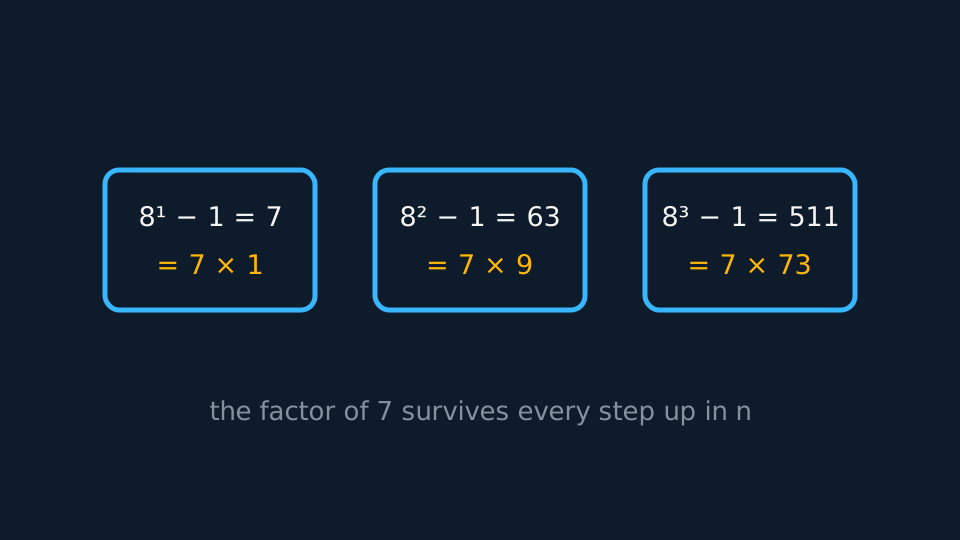
In a divisibility proof, rewrite f(k + 1) so that the inductive hypothesis supplies one divisible part and the remaining terms contain the required divisor explicitly. For '8n − 1 is divisible by 7 for all positive integers n', the base case is the calculation 8 − 1 = 7, and the step writes 8k+1 − 1 as a multiple of 8k − 1 plus an explicit multiple of 7.
WORKED EXAMPLE
8 to the n, minus one
Prove by induction that 8n − 1 is divisible by 7 for all positive integers n.
Base case, n = 1. 8 − 1 = 7, divisible by 7. True.
Assume 8k − 1 = 7m for some integer m.
Then 8k+1 − 1 = 8 × 8k − 1 = 8(8k − 1) + 7 = 8 × 7m + 7 = 7(8m + 1), a multiple of 7.
True for n = 1 and inherited from k to k + 1, so true for all positive integers n by induction. ∎
The rearrangement 8 × 8k − 1 = 8(8k − 1) + 7 is the general pattern: extract a multiple of the assumed expression, then show that the remaining terms are divisible by the same divisor. Write the hypothesis as 7m with m an integer so that the final expression can be factorised as an explicit multiple of 7.
Matrix powers by induction
For a matrix identity, multiply the assumed expression for Mk by M in the correct order and simplify to the formula for Mk+1. The inductive step is a single matrix multiplication.
GUIDED PRACTICE
A shear, raised to the n
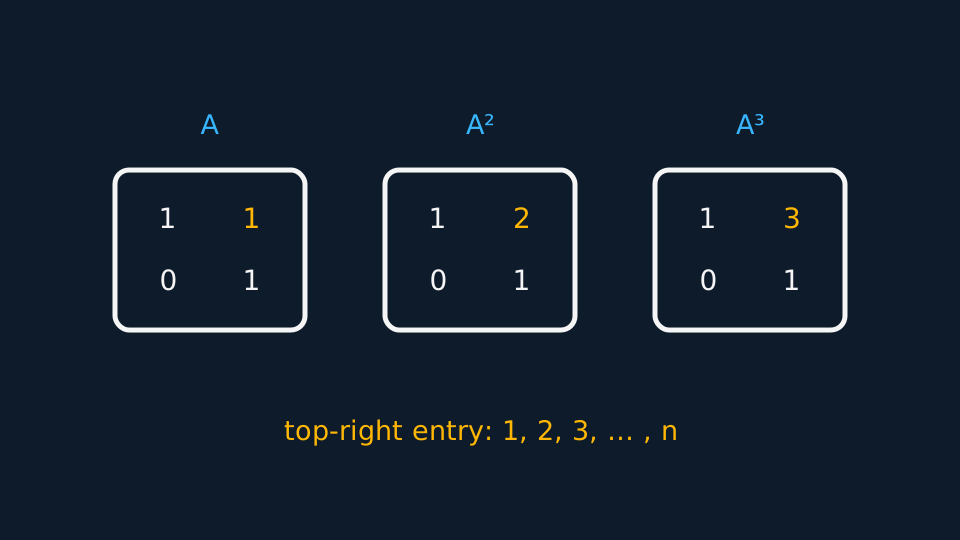
A is the matrix with rows (1, 1) and (0, 1). Prove by induction that An has rows (1, n) and (0, 1) for all positive integers n.
Show the working
Base case, n = 1. The claimed matrix with n = 1 is A itself. True.
Assume Ak has rows (1, k) and (0, 1). Then Ak+1 = AkA, and multiplying gives top row (1 × 1 + k × 0, 1 × 1 + k × 1) = (1, k + 1), bottom row (0, 1).
That is the formula at n = k + 1, so by induction it holds for every positive integer n. ∎ Show the multiplication entry by entry rather than stating the product.
Inequalities by induction
For an inequality the inductive step chains two inequalities rather than rearranging an identity: start from the assumed inequality, then supply a second inequality that reaches the target. Work from the k + 1 expression towards the k one so that the assumption can be applied, and state the second inequality explicitly before using it.
An inequality of this kind often holds only from some value of n onwards, so place the base case at the first value of the stated range rather than at n = 1.
WORKED EXAMPLE
2 to the n against n squared
Prove that 2n > n2 for all integers n ≥ 5.
Base case, n = 5. 2⁵ = 32 and 5² = 25, and 32 > 25. True.
Assume 2k > k2 for some integer k ≥ 5.
Then 2k+1 = 2 × 2k > 2k2, using the assumption.
Second inequality: 2k2 − (k + 1)2 = k2 − 2k − 1 = (k − 1)2 − 2, which is positive for k ≥ 5, so 2k2 > (k + 1)2.
Chaining the two, 2k+1 > 2k2 > (k + 1)2, the statement at n = k + 1. True at n = 5 and inherited from k to k + 1, so 2n > n2 for all integers n ≥ 5 by induction. ∎
The starting value matters here. The statement holds at n = 1, fails at n = 2, 3 and 4, where 2ⁿ is 4, 8 and 16 against 4, 9 and 16, and holds again from n = 5 onwards. A base case at n = 1 would establish nothing about n = 5, because the implication from k to k + 1 does not hold across that range. State the range in the conclusion sentence as well as in the base case.
GUIDED PRACTICE
Three to the n against n cubed
Prove that 3n > n3 for all integers n ≥ 4.
Show the working
Base case, n = 4. 3⁴ = 81 and 4³ = 64, and 81 > 64. True.
Assume 3k > k3 for some integer k ≥ 4. Then 3k+1 = 3 × 3k > 3k3.
The second inequality is 3k3 > (k + 1)3, which rearranges to 3 > (1 + 1/k)³. For k ≥ 4, (1 + 1/k)³ ≤ (5/4)³ = 125/64 < 3, so 3k3 > (k + 1)3.
So 3k+1 > 3k3 > (k + 1)3. True at n = 4 and inherited from k to k + 1, so the result holds for all integers n ≥ 4 by induction. ∎ State the second inequality on its own line before joining the chain.
Why the base case is required
Without a base case the inductive step establishes nothing, because the implication from k to k + 1 has no true starting value to propagate. Consider the false statement '4n + 1 is divisible by 3'. The inductive step is valid, since 4k+1 + 1 = 4(4k + 1) − 3, but 4 + 1 = 5 is not divisible by 3, and the claim is false for every n.
ASSESSMENT FOCUS
- Introduce the hypothesis with a letter. 'Assume 8k − 1 = 7m for an integer m' makes the final factorisation checkable.
- For divisibility, rearrange the k + 1 expression around the assumed one before touching anything else.
- For matrix proofs, multiply the assumed power by A and show all four entries of the product.
- The conclusion sentence is the same in each case: base case, the implication from k to k + 1, and 'by induction'.
- If the final bracket is not obviously a multiple, factor out the divisor explicitly and say so.
- For an inequality, use the assumption first, then state a second inequality explicitly, and finish by joining the two into one chain.
- Identify where the stated range begins. Put the base case at the first value of that range and state that value again in the conclusion.
CHECK YOURSELF
Prove by induction that 9n + 11 is divisible by 4 for all positive integers n.
Show a hint
Write 9k+1 + 11 as 9(9k + 11) minus a constant, and check the constant.
Show the answer
Base case, n = 1. 9 + 11 = 20 = 4 × 5, true. Assume 9k + 11 = 4m for an integer m. Then 9k+1 + 11 = 9(9k + 11) − 88 = 9 × 4m − 88 = 4(9m − 22), a multiple of 4. True for n = 1 and inherited from k to k + 1, so true for all positive integers n by induction.
Divisibility steps rewrite the k + 1 case as (multiple of the k case) + (visible multiple).
Matrix steps are one multiplication, A to the k times A, worked entry by entry.
Inequality steps chain: assumption first, then a second inequality you state, and the base case sits where the range starts.
WORKBOOK
Printable practice for this topic: original exam-style questions with room to work, and a fully worked answer book. Free to use; please do not redistribute or sell.
Or read them with their worked answers on the induction: divisibility and matrices questions page.
USED LATER IN
CHECK YOUR PROGRESS
Rate how confident you feel with each objective for this lesson. Ratings are saved in this browser, on this device, unless you sign in.
- Prove divisibility statements by induction using the subtract-a-multiple rearrangement.
- Prove a formula for the nth power of a matrix by induction, shown entry by entry.
- Prove an inequality by induction, chaining a second inequality onto the assumed one.
- Find the value of n from which an inequality holds, and put the base case there.
Open the full revision checklist to see every objective in the course in one place.