Maths › Further Pure 2 › Groups and their axioms
Groups and their axioms
A group is a set with a binary operation satisfying four axioms: closure, associativity, an identity and inverses. Symmetries of a shape, arithmetic modulo n and sets of matrices can all form groups, which is why one body of results applies to all of them.
Builds on Matrix algebra and transformations and The structure of proof and Disproof and proof by contradiction.
IN THIS TOPIC
- State the four group axioms and test whether a set and operation satisfy them.
- Prove or refute associativity for an operation defined by a formula.
- Build and read a Cayley table, and spot the identity and the inverses in it.
- Find the order of a group and the order of an element, a quantity some specifications call its period.
- Recognise cyclic groups and name a generator, and generate a non-cyclic group from two elements.
- Work with an infinite group, and say which of the finite results stop applying to it.
COMMON MISCONCEPTION
Closure just means the answer lies somewhere sensible, in the universal set if nowhere else.
Closure is stricter than an answer existing somewhere. The product of two elements of G must itself lie in G, and landing in some larger set fails the axiom, however sensible the answer looks. It is the first of four checks, the others being associativity, an identity, and an inverse for every element.
Four rules
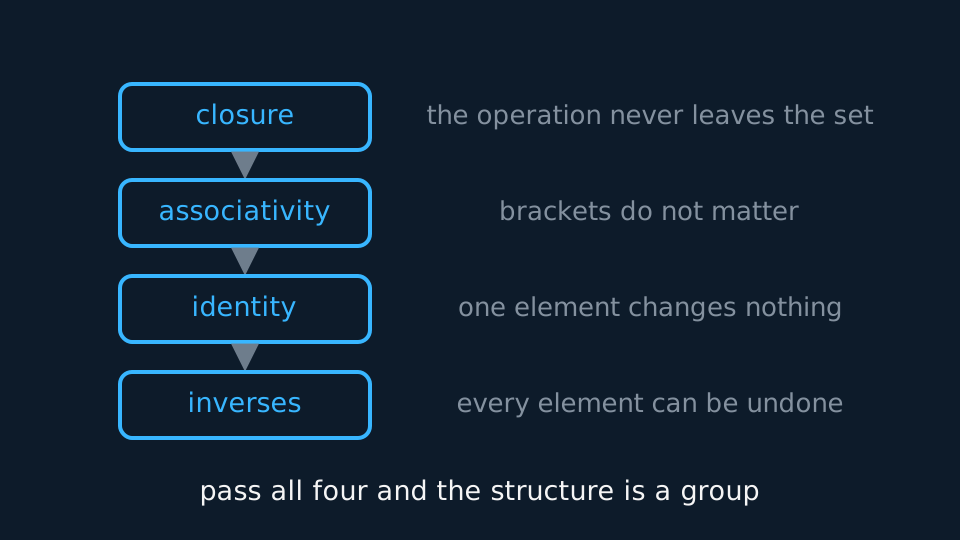
A group is a set G with a binary operation satisfying four axioms. Closure keeps the operation inside the set. Associativity lets you bracket however you like. An identity element leaves everything unchanged, and every element needs an inverse. Closure is stricter than answers merely existing somewhere: the product of two elements of G must itself lie in G, and landing in some larger set fails the axiom. Nothing in the list mentions numbers, either. The elements can be rotations, matrices or permutations, and the theory does not care.
WORKED EXAMPLE
Three groups that look nothing alike
Verify that the integers modulo 5 under addition, and the set {1, −1, i, −i} under multiplication, are both groups.
Modulo 5: sums stay in the set, addition is associative, 0 is the identity, and a has inverse 5 − a reduced modulo 5. All four axioms hold.
The complex set: products stay inside, since i × i = −1 and so on, multiplication is associative, 1 is the identity, and each element has an inverse in the set.
One set has five elements and the other four, and they share no arithmetic at all, yet both satisfy the same four rules. The rotational symmetries of a square make a third example with the same structure as the second.
Three of those four checks were quick because the arithmetic was familiar, and associativity was quickest of all: it was inherited. Addition and multiplication of numbers, composition of functions and multiplication of matrices are associative, settled long before any group appeared, so a structure built from them may quote the property rather than test it. Matrix multiplication is the instructive case, since it is associative while failing to commute, which shows the two properties are independent.
Meet an operation defined by a formula and nothing is inherited. Then the only route is to expand (a * b) * c and a * (b * c) separately and compare them, or to refute the property with a single counter example.
WORKED EXAMPLE
Associativity from the formula alone
On the real numbers, a * b = a + b + ab. Establish whether * is associative.
Left bracketing: (a * b) * c = (a + b + ab) * c = (a + b + ab) + c + (a + b + ab)c = a + b + c + ab + ac + bc + abc.
Right bracketing: a * (b * c) = a * (b + c + bc) = a + (b + c + bc) + a(b + c + bc) = a + b + c + bc + ab + ac + abc.
The two expansions agree term for term, so * is associative. That the answer came out symmetric in a, b and c is a sign the expansion went right, since neither bracketing favours a letter.
Change the rule to a * b = a + 2b and one counter example settles it the other way: (0 * 0) * 1 = 0 * 1 = 2, while 0 * (0 * 1) = 0 * 2 = 4. Since 2 ≠ 4 the operation is not associative, and no further testing is wanted.
Cayley tables and order
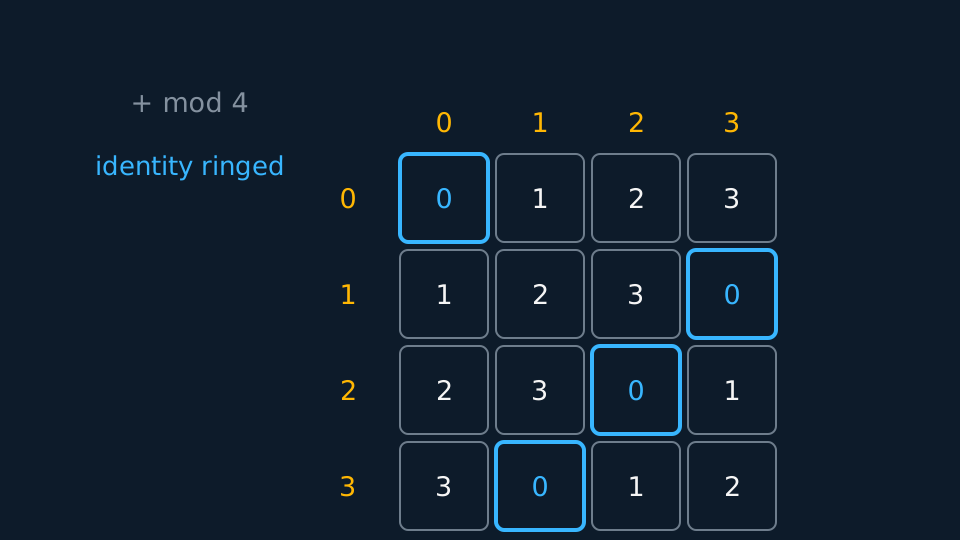
A Cayley table lists every product. The identity's row and column repeat the headings unchanged, and each element appears exactly once in every row and every column. That Latin square property is a quick sanity check on any table you build. The order of a group is how many elements it has, and the order of an element is the smallest positive power that returns the identity. Some specifications use period as a synonym for the order of an element, so a question asking for the period of x is asking how many times x has to be combined with itself to reach the identity.
WORKED EXAMPLE
Orders inside a small group
In the integers modulo 6 under addition, find the order of each element.
0 has order 1. Adding 1 repeatedly needs six steps to reach 0, so 1 has order 6, and so does 5.
2 + 2 + 2 = 0, so 2 has order 3, as does 4. And 3 + 3 = 0, so 3 has order 2.
Every one of those orders divides 6. This is an instance of Lagrange's theorem.
Cyclic groups, and what the axioms do not require
A group generated by a single element is cyclic. The integers modulo n under addition always are, generated by 1. In a cyclic group of prime order every element except the identity is a generator, since its order divides the prime and is not 1.
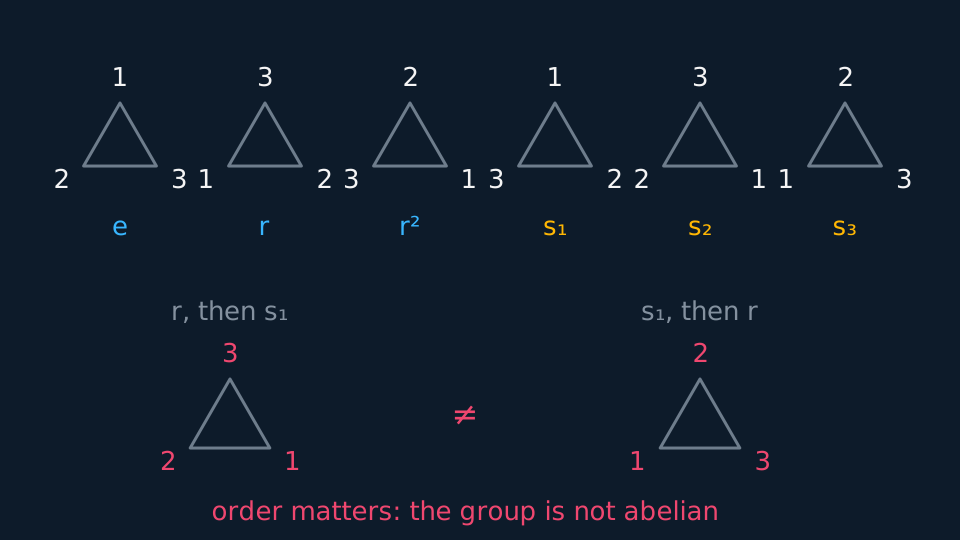
Notice what the axioms never asked for. There is no requirement that the operation commutes, and plenty of groups do not. The six symmetries of an equilateral triangle form a group in which a reflection followed by a rotation differs from the same pair the other way round. A group that does commute is called abelian, and it is worth saying so explicitly when a question turns on the distinction.
Describe the drawing
Six small triangles across the top show where the corner labels one, two and three land under the identity, the two rotations and the three reflections. Below, the same reflection and rotation are composed in both orders: rotating then reflecting puts the labels in one arrangement, reflecting then rotating in another, with the corners that disagree picked out in coral. Both results are still among the six, but they differ, so the group of triangle symmetries is not abelian.
That triangle also shows what generation looks like when one element is not enough. A group is generated by a set of elements when taking their powers, their inverses and their products in every combination returns the group and nothing outside it. A cyclic group is the case where a single element suffices.
WORKED EXAMPLE
Building a group from two elements
Show that the six symmetries of an equilateral triangle are generated by the rotation r through 120° together with the reflection s₁ drawn above.
Powers of r alone give three symmetries: the identity e, then r, then r2, and r3 = e closes the list. Powers of s₁ alone give two, e and s₁, since s₁2 = e. Neither element on its own reaches more than half the group, so neither generates it.
Now take products as well. rs₁ and r2s₁ are the two symmetries the powers missed, and both are reflections: they are s₂ and s₃, in an order that depends on which way round the composition is read.
That is e, r, r2, s₁, rs₁, r2s₁: six symmetries, the whole group, from two generators. So this group is generated by {r, s₁} and is not cyclic, since no single one of its elements has period 6.
Nor did the axioms ask for finitely many elements. The integers under addition pass each of the four: a sum of integers is an integer, addition is associative, 0 is the identity, and −n undoes n. That is an infinite group, and a cyclic one, generated by 1, because repeatedly adding 1 or its inverse reaches any integer you name.
What changes is the vocabulary that depends on counting. Apart from 0, no element has a finite period, since adding n to itself walks off in one direction and does not come back. Lagrange's theorem has no group order to divide into and so says nothing at all. And a subgroup of an infinite group may be infinite, like the even integers, or finite: inside the non-zero complex numbers under multiplication, which is another infinite group, the four elements {1, −1, i, −i} from the first example sit as a subgroup of order 4.
GUIDED PRACTICE
Is it a group?
Decide whether the set {1, 2, 3, 4} under multiplication modulo 5 forms a group, and if so, name a generator.
Show the working
Closure holds, since 5 is prime and none of these is a multiple of it, so every product reduces to one of 1, 2, 3, 4. Multiplication is associative and 1 is the identity.
Inverses: 2 × 3 = 6 = 1, so 2 and 3 are mutual inverses; 4 × 4 = 16 = 1, so 4 is its own; 1 is its own.
It is a group of order 4. Powers of 2 give 2, 4, 3, 1, which is every element, so 2 is a generator and the group is cyclic.
ASSESSMENT FOCUS
- Check the four axioms in order and name each one as you check it.
- Check closure explicitly: the product of two elements of G must lie in G, and landing in a larger set fails the axiom.
- For an unfamiliar operation, expand (a * b) * c and a * (b * c) in full before comparing; to refute associativity, one counter example with numbers is enough.
- In a Cayley table, every row and column must be a rearrangement of the elements. Use it to catch errors.
- The order of an element is the smallest positive power giving the identity, not any power that works.
- Say whether a group is abelian when the question mentions commuting, and give a counterexample if it is not.
CHECK YOURSELF
In the group of integers modulo 8 under addition, find the order of the element 6.
Show a hint
Add 6 repeatedly modulo 8 until you reach 0.
Show the answer
6, then 12 = 4, then 18 = 2, then 24 = 0. Four steps, so 6 has order 4. As Lagrange requires, 4 divides the group's order 8.
A group needs four axioms: closure, associativity, an identity, and an inverse for every element.
The order of an element is the least positive power reaching the identity, a quantity some specifications call its period; the order of a group is its size.
A group generated by one element is cyclic, and the integers modulo n under addition always are.
Associativity is inherited from familiar arithmetic; for an operation given by a formula, expand both bracketings.
WORKBOOK
Printable practice for this topic: original exam-style questions with room to work, and a fully worked answer book. Free to use; please do not redistribute or sell.
Or read them with their worked answers on the groups and their axioms questions page.
CHECK YOUR PROGRESS
Rate how confident you feel with each objective for this lesson. Ratings are saved in this browser, on this device, unless you sign in.
- State the four group axioms and test whether a set and operation satisfy them.
- Prove or refute associativity for an operation defined by a formula.
- Build and read a Cayley table, and spot the identity and the inverses in it.
- Find the order of a group and the order of an element, a quantity some specifications call its period.
- Recognise cyclic groups and name a generator, and generate a non-cyclic group from two elements.
- Work with an infinite group, and say which of the finite results stop applying to it.
Open the full revision checklist to see every objective in the course in one place.