Maths › Further Pure 2 › Subgroups, Lagrange's theorem and isomorphism
Subgroups, Lagrange's theorem and isomorphism
A group can contain smaller groups, called subgroups. In a finite group, Lagrange's theorem states that the order of a subgroup divides the order of the group. Two groups with the same multiplication structure are isomorphic.
Builds on Groups and their axioms and Proof by induction.
IN THIS TOPIC
- Test whether a subset is a subgroup, and name the proper and non-trivial ones.
- Apply Lagrange's theorem to rule out impossible subgroup orders.
- Prove a property of an arbitrary group from the axioms, with no table and no named elements.
- Decide whether two groups of the same order are isomorphic.
- Quote how many structures exist at each order up to seven, and use it to identify a small group.
COMMON MISCONCEPTION
A group of order 12 could have a subgroup of order 5, since 5 is smaller than 12.
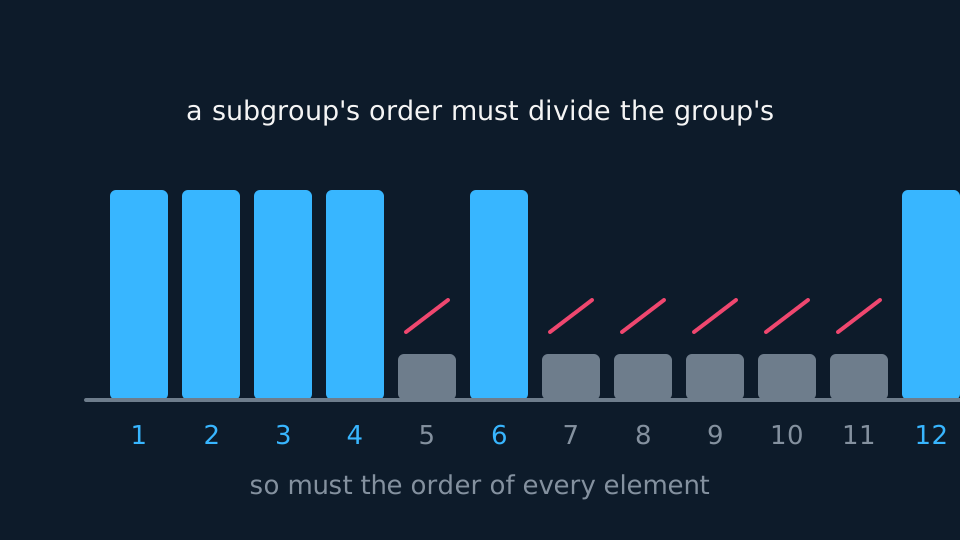
Lagrange's theorem says that in a finite group the order of any subgroup divides the order of the group, so a group of order 12 has subgroups of orders 1, 2, 3, 4, 6 and 12 only. Since 5 does not divide 12, no subgroup of order 5 exists. The same theorem makes every element's order divide 12, because the powers of an element form a subgroup.
Groups inside groups
A subgroup is a subset that is itself a group under the same operation. Associativity is inherited, so only three things need checking: whether the identity is present, whether the subset is closed, and whether every element's inverse lies inside it. Every group has two subgroups immediately, the identity on its own and the whole group. Those two are distinct in any group of order greater than 1, so such a group has at least two subgroups. In the trivial group they are the same subgroup and there is only one.
WORKED EXAMPLE
All the subgroups of a small group
Find every subgroup of the integers modulo 6 under addition.
The trivial ones are {0} of order 1, and the whole group of order 6.
{0, 3} is closed, since 3 + 3 = 0, and it contains inverses, so it is a subgroup of order 2.
{0, 2, 4} is closed with 2 + 4 = 0, giving order 3.
Four subgroups, of orders 1, 2, 3 and 6. Every one of those divides 6, and nothing of order 4 or 5 exists.
Those four carry names that exam questions use without explaining. {0} on its own is the trivial subgroup, and a subgroup with more than one element is non-trivial. A subgroup that is not the parent group is a proper subgroup. So of the four found above, {0, 3} and {0, 2, 4} are the proper non-trivial ones, and a question asking for those excludes both {0} and the whole group. Some sources fold both conditions into the word proper, so where a question uses it alone, state which subgroups you are counting.
Lagrange's theorem turns that pattern into a law. In a finite group, the order of any subgroup divides the order of the group. A group of order 12 therefore has no subgroup of order 5, since 5 does not divide 12. The theorem also explains why every element's order divides the group's, because the powers of an element form a subgroup all by themselves.
Arguing from the axioms alone
The properties above were settled with the elements listed, in a table or a list. A question can instead describe an arbitrary group, give one fact about it, and ask what follows. The four axioms are then the only available premises.
Two short arguments cover most such questions. The first is cancellation: if ab = ac then b = c. Multiply on the left by a−1, which the inverse axiom supplies, to get a−1(ab) = a−1(ac); rebracket by associativity, which is the axiom that licenses it, and the left sides become (a−1a)b = eb = b and (a−1a)c = ec = c. Multiplying on the right instead shows that ba = ca forces b = c. Cancellation is the reason each element appears once in every row and column of a Cayley table, since a repeat in a row would say ab = ac for two different elements b and c, and it is what fills in a table left with gaps.
The second is that the identity is unique. If e and f both leave everything unchanged then e = ef, reading f as an identity, and ef = f, reading e as one, so e = f. The same move gives each element one inverse and no more.
WORKED EXAMPLE
Self-inverse forces an abelian group
In a group G, x2 = e for each element x. Show that G is abelian.
Take any two elements a and b. By closure ab lies in G as well, so the assumption applies to it: (ab)2 = e, which written out is abab = e.
Multiply on the left by a and use a2 = e: a(abab) = ae, so bab = a.
Multiply on the right by b and use b2 = e: (bab)b = ab, so ba = ab.
The elements a and b were arbitrary, so the operation commutes throughout and G is abelian. No element of G was ever named and no table was drawn, which is what makes this an argument about groups rather than about one group.
The Klein group in the next section is the smallest non-cyclic group meeting that condition, and the argument above is why nobody needs to check its table for commuting.
Isomorphism, and how many groups exist at each order
Two groups are isomorphic when their elements can be paired up so that the operation is preserved, which amounts to a relabelling that turns one Cayley table into the other. Any two cyclic groups of the same order are isomorphic, so at each order the real question is how many genuinely different structures exist.
WORKED EXAMPLE
Telling two order-four groups apart
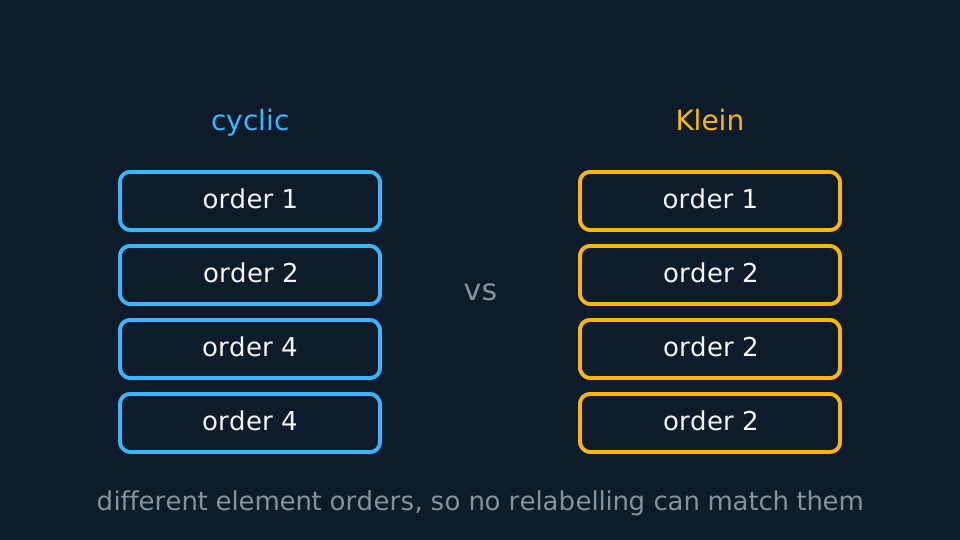
Show that {1, −1, i, −i} under multiplication and the Klein group, in which every non-identity element squares to the identity, are not isomorphic.
In the first, i has order 4, since i, −1, −i, 1 takes four steps to return.
In the Klein group every non-identity element has order 2 by definition, so nothing has order 4.
Isomorphism preserves the order of elements, so no relabelling can match them. Both have four elements and they are different groups, and those two are the only groups of order 4 there are.
At the small orders the count is short, and knowing it identifies an unfamiliar group of order six as one of two possibilities without building its table.
| Order | How many groups | Which |
|---|---|---|
| 1 | 1 | The identity on its own |
| 2 | 1 | Cyclic |
| 3 | 1 | Cyclic |
| 4 | 2 | Cyclic, and the Klein group |
| 5 | 1 | Cyclic |
| 6 | 2 | Cyclic, and the symmetries of an equilateral triangle |
| 7 | 1 | Cyclic |
Most of that table is Lagrange's theorem again. At a prime order p, each element other than the identity has order dividing p, so its order is p and it generates the group, which makes the group cyclic; since two cyclic groups of the same order are isomorphic, orders 2, 3, 5 and 7 hold one structure each.
Order 4 splits in two, as the example above showed: either some element has order 4, giving the cyclic group, or each non-identity element squares to the identity, giving the Klein group. Order 6 splits in two as well, into the cyclic group and the symmetries of an equilateral triangle, which is the smallest non-abelian group. Ruling out a third structure at order 6 takes an argument beyond the scope of this course, so the count is quoted rather than proved and used to identify a given group.
GUIDED PRACTICE
Ruling things out with Lagrange
A group has order 10. List the possible orders of its subgroups, and of its elements.
Show the working
Subgroup orders must divide 10, so only 1, 2, 5 and 10 are possible.
The powers of any element form a subgroup, so element orders come from the same list.
No element can have order 3, 4, 6, 7, 8 or 9, however large the group looks. Lagrange rules them out with no calculation at all.
ASSESSMENT FOCUS
- For a subgroup test, check identity, closure and inverses; associativity is inherited and needs no proof.
- Quote Lagrange by name when you use it, and state which order divides which.
- Read 'proper' as ruling out the whole group and 'non-trivial' as ruling out the identity on its own.
- In an abstract proof, name the axiom at each step: multiply by an inverse, rebracket, cancel.
- To disprove an isomorphism, find a structural difference. Element orders and whether the group is abelian both work.
CHECK YOURSELF
A group has order 15. Explain why it cannot contain a subgroup of order 6.
Show a hint
Lagrange's theorem constrains subgroup orders.
Show the answer
By Lagrange's theorem the order of any subgroup divides 15, and the divisors are 1, 3, 5 and 15. Since 6 does not divide 15, no such subgroup exists.
A subgroup needs the identity, closure and inverses; associativity is inherited from the parent group.
Lagrange: every subgroup's order divides the group's order, and so does every element's order.
Proper rules out the whole group; non-trivial rules out the identity alone.
Orders 1 to 7 hold 1, 1, 1, 2, 1, 2, 1 groups: a cyclic one at each order, plus the Klein group at 4 and the triangle at 6.
WORKBOOK
Printable practice for this topic: original exam-style questions with room to work, and a fully worked answer book. Free to use; please do not redistribute or sell.
Or read them with their worked answers on the subgroups, Lagrange's theorem and isomorphism questions page.
CHECK YOUR PROGRESS
Rate how confident you feel with each objective for this lesson. Ratings are saved in this browser, on this device, unless you sign in.
- Test whether a subset is a subgroup, and name the proper and non-trivial ones.
- Apply Lagrange's theorem to rule out impossible subgroup orders.
- Prove a property of an arbitrary group from the axioms, with no table and no named elements.
- Decide whether two groups of the same order are isomorphic.
- Quote how many structures exist at each order up to seven, and use it to identify a small group.
Open the full revision checklist to see every objective in the course in one place.