Maths › Hyperbolic functions › Calculus with hyperbolic functions
Calculus with hyperbolic functions
Differentiate sinh and cosh from their exponential definitions, and use cosh²x − sinh²x = 1 to simplify derivatives and integrals. State the domain of each inverse hyperbolic function and the branch represented by its logarithmic form, and use those inverses to integrate expressions containing x² + a² and x² − a².
Builds on Hyperbolic functions and identities and Calculus with inverse trigonometric functions.
IN THIS TOPIC
- Differentiate sinh, cosh and tanh directly from the exponential definitions.
- Derive the derivatives of arsinh, arcosh and artanh by implicit differentiation, with the ranges deciding each sign.
- Integrate 1/√(x² + a²) and 1/√(x² − a²) via arsinh and arcosh.
- Choose a hyperbolic substitution when recognition alone will not do.
- Integrate sinh x, cosh x and sech² x by reading their derivatives backwards.
COMMON MISCONCEPTION
Just like cos, differentiating cosh must introduce a minus sign.
cosh' = sinh, with no minus sign, and sinh' = cosh. Differentiating (ex + e−x)/2 term by term gives (ex − e−x)/2, which is sinh x: the minus sign already sits inside the definition of sinh rather than arriving on differentiation. The quotient rule then gives tanh' = sech2x, again with no sign change.
Differentiating sinh and cosh
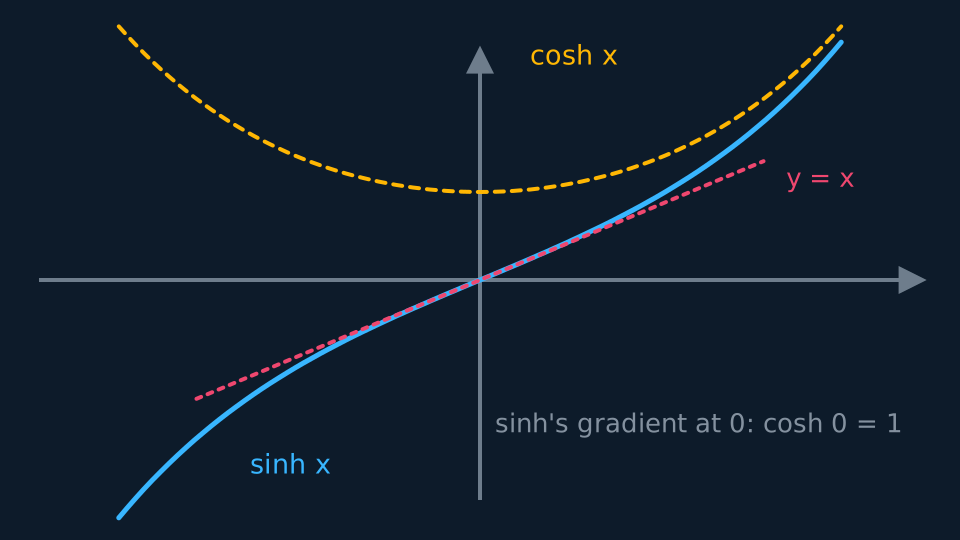
Differentiate the definitions term by term. (ex − e−x)/2 differentiates to (ex + e−x)/2 and back again, so sinh' = cosh and cosh' = sinh. Neither derivative introduces a minus sign, because the minus sign is already inside the definition of sinh.
WORKED EXAMPLE
A tangent to sinh
Find the equation of the tangent to y = sinh x at x = 0.
dy/dx = cosh x, and cosh 0 = 1.
sinh 0 = 0, so the tangent is y = x.
Near zero sinh x ≈ x, just as sin x ≈ x, since both functions pass through the origin with gradient 1.
Applying the quotient rule to sinh/cosh gives tanh' = sech²x, which corresponds to tan' = sec²x with no sign change. Reversing all three gives the integrals ∫cosh x dx = sinh x + c, ∫sinh x dx = cosh x + c and ∫sech²x dx = tanh x + c.
Differentiating the inverse functions
The three inverse hyperbolic functions are differentiated as arcsin and arctan were, by implicit differentiation and one identity. Put y = arsinh x, so sinh y = x. Differentiating gives cosh y (dy/dx) = 1, and cosh y = √(1 + sinh²y) = √(1 + x²), the positive root because cosh is positive throughout. So d(arsinh x)/dx = 1/√(x² + 1), for any real x.
arcosh takes the same three lines. cosh y = x differentiates to sinh y (dy/dx) = 1, and sinh y = √(cosh²y − 1) = √(x² − 1), so d(arcosh x)/dx = 1/√(x² − 1) for x > 1. The positive root is the right one here for a reason worth stating in a proof: arcosh returns y ≥ 0, the range left behind when cosh was cut down to a one-to-one function, and sinh y is not negative on that half.
artanh needs the identity in its divided form. tanh y = x gives sech²y (dy/dx) = 1, and sech²y = 1 − tanh²y = 1 − x², so d(artanh x)/dx = 1/(1 − x²) for −1 < x < 1, which is artanh's own domain.
Each of the three corresponds to an inverse trigonometric result with a sign changed: 1/√(1 − x²) becomes 1/√(x² + 1), and 1/(1 + x²) becomes 1/(1 − x²). The last agrees with the logarithmic form of artanh, since partial fractions give ∫1/(1 − x²) dx = ½ln((1 + x)/(1 − x)) + c for |x| < 1, which is artanh x + c.
The inverse integrals
The first two derivatives, read backwards, become standard integrals, with one sign changed inside the root:
with a > 0, valid for all real x. The corresponding result is ∫1/√(x² − a²) dx = arcosh(x/a) + c on an interval with x > a, which is the branch the arcosh form represents. On an interval with x < −a, use the logarithmic form with absolute values, ln|x + √(x² − a²)| + c. Check the current formula booklet for your awarding organisation, which may print the logarithmic forms alongside. Where a² − x² leads to arcsin, the change of sign inside the square root leads to arsinh or arcosh instead, so identify the quadratic under the root first.
WORKED EXAMPLE
An integral that lands on ln 2
Evaluate ∫ 1/√(x² + 16) dx from 0 to 3.
a = 4, so the integral is arsinh(x/4), evaluated from 0 to 3.
arsinh(3/4) = ln(3/4 + √(9/16 + 1)) = ln(3/4 + 5/4).
= ln 2. Convert to logarithmic form when the question asks for an exact value.
INDEPENDENT PRACTICE
The arcosh cousin
Evaluate ∫ 1/√(x² − 4) dx from 2 to 4, exactly.
Show the working
The integrand is unbounded at x = 2, so the integral is improper: write it as the limit as b → 2⁺ of the integral from b to 4.
a = 2 in the standard form, so the antiderivative is arcosh(x/2), evaluated from b to 4, which is arcosh 2 − arcosh(b/2).
As b → 2⁺ this tends to arcosh 2 − arcosh 1 = ln(2 + √3) − ln(1 + 0).
= ln(2 + √3), since arcosh 1 = ln 1 = 0. The limit exists, so the integral converges. Its value is about 1.317.
Hyperbolic substitutions
Other integrands require a substitution, chosen using the identity. For an integrand containing √(x² + a²) with a > 0, put x = a sinh u, since a² + a²sinh²u = a²cosh²u removes the square root. For √(x² − a²) put x = a cosh u, with u ≥ 0 so that the positive root is taken. In each case dx supplies the matching derivative and the integral becomes one in powers of cosh or sinh.
Such questions usually state the substitution. Convert the limits to values of u when substituting, state the identity used, and convert back to logarithmic form at the end if an exact answer is required.
ASSESSMENT FOCUS
- For a 'show that', derive sinh' and cosh' from the exponential definitions.
- A 'show that' on an inverse hyperbolic derivative wants sinh y = x, cosh y = x or tanh y = x differentiated implicitly, and the choice of root justified by the range.
- Read the sign inside the root first: x² + a² gives arsinh, x² − a² gives arcosh on x > a, and a² − x² gives arcsin on |x| < a.
- For ∫cosh²x dx, use cosh 2x = 2cosh²x − 1, the hyperbolic double angle with no sign flip.
- Convert arsinh and arcosh answers to log form when the question says exact.
CHECK YOURSELF
Differentiate y = cosh 3x, and state the gradient at x = 0.
Show a hint
Chain rule; cosh' = sinh with no minus.
Show the answer
dy/dx = 3 sinh 3x. At x = 0, sinh 0 = 0, so the gradient is 0. cosh 3x has its minimum there, value 1.
sinh' = cosh and cosh' = sinh, with no minus sign; tanh' = sech²x.
arsinh' = 1/√(x² + 1) for all real x; arcosh' = 1/√(x² − 1) for x > 1; artanh' = 1/(1 − x²) for −1 < x < 1.
Integrals of 1/√(x² + a²) give arsinh(x/a); integrals of 1/√(x² − a²) give arcosh(x/a) on x > a, and the logarithmic form with absolute values covers x < −a.
Substitute x = a sinh u or x = a cosh u, with a > 0, when the integrand is not in a standard form.
WORKBOOK
Printable practice for this topic: original exam-style questions with room to work, and a fully worked answer book. Free to use; please do not redistribute or sell.
Or read them with their worked answers on the calculus with hyperbolic functions questions page.
CHECK YOUR PROGRESS
Rate how confident you feel with each objective for this lesson. Ratings are saved in this browser, on this device, unless you sign in.
- Differentiate sinh, cosh and tanh directly from the exponential definitions.
- Derive the derivatives of arsinh, arcosh and artanh by implicit differentiation, with the ranges deciding each sign.
- Integrate 1/√(x² + a²) and 1/√(x² − a²) via arsinh and arcosh.
- Choose a hyperbolic substitution when recognition alone will not do.
- Integrate sinh x, cosh x and sech² x by reading their derivatives backwards.
Open the full revision checklist to see every objective in the course in one place.