Maths › Hyperbolic functions › Hyperbolic functions and identities
Hyperbolic functions and identities
The hyperbolic functions are defined by exponentials. These definitions give their parity, identities, graphs and inverse functions. Derive identities algebraically or apply Osborn's rule with the correct sign change for each pair of sine factors, and state the domain and range of each function and each inverse.
Builds on Exponential functions and e and Trigonometric graphs and equations.
IN THIS TOPIC
- Define sinh, cosh, tanh and their reciprocals from exponentials, and sketch the graphs.
- State the domain and range of all six hyperbolic functions and of the three inverses.
- Prove and use cosh²x − sinh²x = 1 and its relatives.
- Apply Osborn's rule to convert a trigonometric identity into the corresponding hyperbolic identity.
- Solve hyperbolic equations exactly via the logarithmic forms of the inverses.
COMMON MISCONCEPTION
Functions with names like sinh and cosh must be periodic like sine and cosine.
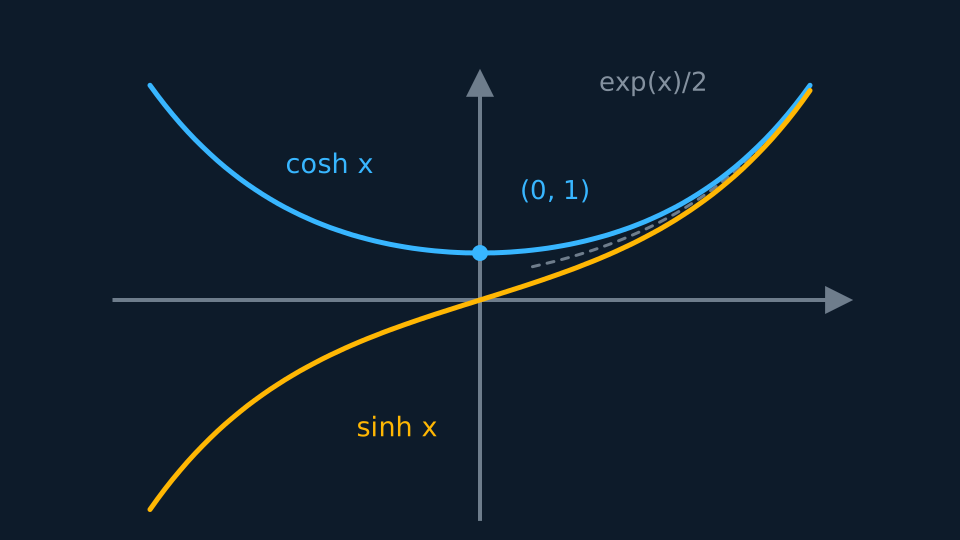
None of them is periodic. They are the even and odd halves of the exponential: cosh x = (ex + e−x)/2 has minimum value 1 at x = 0, sinh x = (ex − e−x)/2 increases through the origin and takes every real value, and tanh x approaches 1 and −1 without attaining either. The name comes from the curve: (cosh t, sinh t) lies on x2 − y2 = 1.
Splitting the exponential
The hyperbolic functions split ex into its even and odd halves:
Check the current formula booklet for your awarding organisation; whether or not the definitions, identities or logarithmic forms are supplied, you must know when each applies and how to derive it. tanh x is the ratio sinh x / cosh x. None of these functions is periodic: cosh has a minimum value 1 at x = 0, sinh is increasing through the origin and takes every real value, and tanh tends to 1 and −1 without attaining either. For large positive x both cosh x and sinh x are close to ex/2.
Three reciprocals complete the set. sech x = 1/cosh x, cosech x = 1/sinh x and coth x = 1/tanh x. Only sech is defined everywhere, since the other two need sinh x ≠ 0 and so exclude x = 0.
Written as ranges: cosh x ≥ 1; sinh x takes every real value; and −1 < tanh x < 1, with both bounds approached and neither attained. Each reciprocal's range follows by inverting the parent's. Dividing 1 by a value not less than 1 gives 0 < sech x ≤ 1, the greatest value occurring where cosh is least, at x = 0, so the graph of sech has a single maximum of height 1 and tends to zero in both directions.
The other two reciprocals are undefined at x = 0, so their graphs have two branches. On the domain x ≠ 0, sinh takes every real value except 0, so cosech takes every real value but 0 as well, drawn as two branches, one in the first quadrant and one in the third, with the y-axis as an asymptote between them and the x-axis as an asymptote far out. coth inverts a number lying strictly between −1 and 1 and away from 0, so coth x > 1 for positive x and coth x < −1 for negative x, and its two branches fall from the vertical asymptote at x = 0 towards the horizontal lines y = 1 and y = −1, approaching them from outside.
The identities, and Osborn's rule
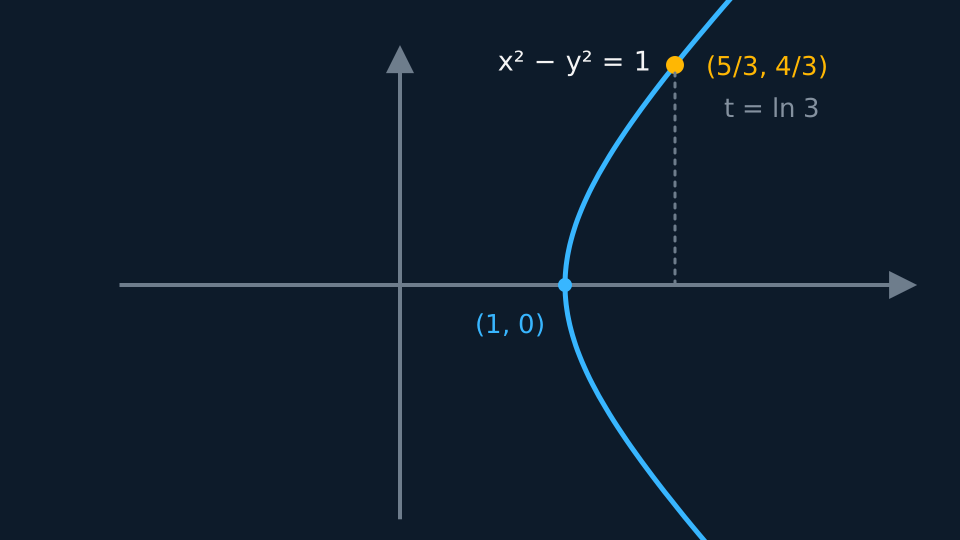
Square the definitions and subtract. The cross terms cancel, leaving cosh²x − sinh²x = 1, so the point (cosh t, sinh t) lies on the hyperbola x² − y² = 1, which is the origin of the name. At t = ln 3, cosh t = 5/3 and sinh t = 4/3, and 25/9 − 16/9 = 1.
Dividing that identity by cosh²x gives 1 − tanh²x = sech²x, and dividing by sinh²x gives coth²x − 1 = cosech²x. Osborn's rule gives the remaining identities. To convert a trigonometric identity using Osborn's rule, replace cos by cosh and sin by sinh, then reverse the sign for each pair of sine factors. Thus a term with two sine factors changes sign; a term with four does not. So cos 2θ = 1 − 2sin²θ becomes cosh 2x = 1 + 2sinh²x, while sin 2θ = 2 sin θ cos θ becomes sinh 2x = 2 sinh x cosh x, with no change. A tan² term contains two sine factors, so 1 + tan²θ = sec²θ becomes 1 − tanh²x = sech²x.
The inverse functions in logarithmic form
Because the functions are defined by ex, their inverses can be written as logarithms. Setting y = sinh x and clearing the fraction gives a quadratic in ex whose positive root gives arsinh x = ln(x + √(x² + 1)). The same method gives arcosh x = ln(x + √(x² − 1)) for x ≥ 1, and artanh x = ½ln((1 + x)/(1 − x)) for |x| < 1. These exact forms are used to solve hyperbolic equations.
An inverse exchanges domain and range, so each condition above is the parent function's range read as a domain, and each inverse's range is the parent's domain. arsinh has domain and range the whole real line. artanh has domain −1 < x < 1 and range all real numbers.
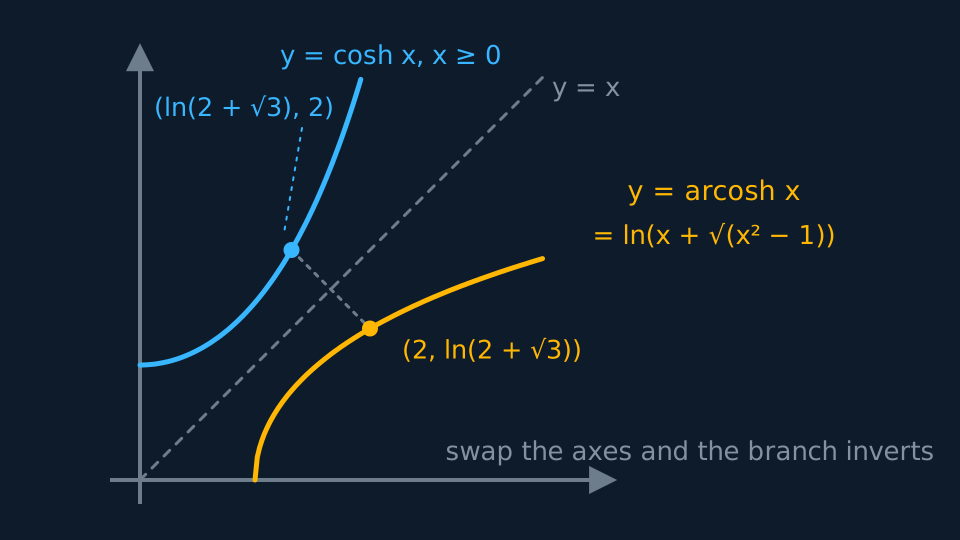
arcosh requires a restriction, because cosh is not one-to-one. The branch used here is x ≥ 0, so the range of arcosh is y ≥ 0. That choice corresponds to taking the positive root of the quadratic in the derivation, and the formula reflects it: for x ≥ 1 the expression x + √(x² − 1) is at least 1, so its logarithm comes out at 0 or above, with the value 0 at x = 1.
Describe the drawing
The right half of the cosh valley climbing away from its minimum at nought comma one, its mirror image arcosh curving along below the dashed line y equals x, and a dashed perpendicular joining the matched pair of points where cosh of ln 2 plus root 3 equals 2. Restricting cosh to x greater than or equal to nought is what makes the reflection a function, and solving for the inverse turns it into the logarithm ln of x plus the root of x squared minus one.
WORKED EXAMPLE
Solving cosh x = 2 exactly
Solve cosh x = 2, giving both answers in exact form.
arcosh 2 = ln(2 + √3) is one solution.
cosh is even, so x = ±ln(2 + √3).
Numerically that is ±1.317, and cosh(1.317) = 2.00 to three significant figures, which checks the logarithmic form.
Solving hyperbolic equations
An equation involving two hyperbolic functions is solved by the same method. Use an identity to express everything in terms of one function, solve the resulting quadratic, then convert each root using a logarithmic form. Count the solutions: cosh x = k has two solutions for k > 1, while sinh x = k has exactly one for every real k.
WORKED EXAMPLE
A quadratic in disguise
Solve cosh 2x − 3 sinh x = 3, giving exact answers.
Osborn on cos 2θ = 1 − 2sin²θ gives cosh 2x = 1 + 2sinh²x.
The equation becomes 2sinh²x − 3 sinh x − 2 = 0, so (2 sinh x + 1)(sinh x − 2) = 0.
sinh x = −1/2 or sinh x = 2, and sinh is one-to-one, so each gives exactly one root.
x = ln((√5 − 1)/2) or ln(2 + √5), roughly −0.481 and 1.444.
GUIDED PRACTICE
A sinh equation with a tidy answer
Solve sinh x = 3/4 exactly.
Show the working
x = arsinh(3/4) = ln(3/4 + √(9/16 + 1)) = ln(3/4 + 5/4).
= ln 2.
Check: sinh(ln 2) = (2 − 1/2)/2 = 3/4. sinh is one-to-one, so this is the only solution and no ± is needed.
ASSESSMENT FOCUS
- Prove identities from the exponential definitions rather than quoting them.
- cosh x = k has two solutions for k > 1, and sinh x = k has exactly one for every real k. State which case applies.
- Reduce a mixed equation to a quadratic in one hyperbolic function before solving anything.
- Quote arsinh, arcosh and artanh in log form whenever the question says exact.
- Reject roots that fall outside a range or domain, such as cosh x = −2 or arcosh of anything below 1.
- A question asking for domain and range requires both sets to be stated. arcosh has domain x ≥ 1 and range y ≥ 0, the branch chosen when cosh was restricted.
CHECK YOURSELF
Using the definitions, find the exact values of cosh(ln 3) and sinh(ln 3), and verify the identity connecting them.
Show a hint
eln 3 = 3 and e−ln 3 = 1/3.
Show the answer
cosh(ln 3) = (3 + 1/3)/2 = 5/3 and sinh(ln 3) = (3 − 1/3)/2 = 4/3. Then 25/9 − 16/9 = 1, which is cosh²x − sinh²x = 1.
cosh and sinh are the even and odd parts of ex, and cosh²x − sinh²x = 1 follows from the definitions.
Ranges: cosh x ≥ 1, 0 < sech x ≤ 1, |tanh x| < 1 and |coth x| > 1; sinh takes every real value and cosech takes every real value except 0.
Osborn's rule replaces cos by cosh and sin by sinh, reversing the sign once for each pair of sine factors.
arsinh x = ln(x + √(x² + 1)); arcosh x = ln(x + √(x² − 1)) for x ≥ 1, returning y ≥ 0; artanh x = ½ln((1 + x)/(1 − x)) for −1 < x < 1.
WORKBOOK
Printable practice for this topic: original exam-style questions with room to work, and a fully worked answer book. Free to use; please do not redistribute or sell.
Or read them with their worked answers on the hyperbolic functions and identities questions page.
CHECK YOUR PROGRESS
Rate how confident you feel with each objective for this lesson. Ratings are saved in this browser, on this device, unless you sign in.
- Define sinh, cosh, tanh and their reciprocals from exponentials, and sketch the graphs.
- State the domain and range of all six hyperbolic functions and of the three inverses.
- Prove and use cosh²x − sinh²x = 1 and its relatives.
- Apply Osborn's rule to convert a trigonometric identity into the corresponding hyperbolic identity.
- Solve hyperbolic equations exactly via the logarithmic forms of the inverses.
Open the full revision checklist to see every objective in the course in one place.