Maths › Further calculus › Calculus with inverse trigonometric functions
Calculus with inverse trigonometric functions
Derivatives of inverse trigonometric functions follow from implicit differentiation. Their standard antiderivatives are recognised after completing the square or by an appropriate trigonometric substitution. State the domain and parameter conditions with each formula.
Builds on Implicit differentiation and Reciprocal and inverse trigonometric functions.
IN THIS TOPIC
- Differentiate arcsin x, arccos x and arctan x from scratch via implicit differentiation.
- Integrate 1/√(a² − x²) and 1/(a² + x²) by recognising the patterns.
- Complete the square and use partial fractions to reach the same two patterns.
- Divide an improper fraction down first, whether its denominator is linear or quadratic, and split what is left.
- Choose and carry out the substitutions x = a sin θ and x = a tan θ for the associated forms.
COMMON MISCONCEPTION
Since arcsin is an inverse trigonometric function, its derivative must involve sines and cosines.
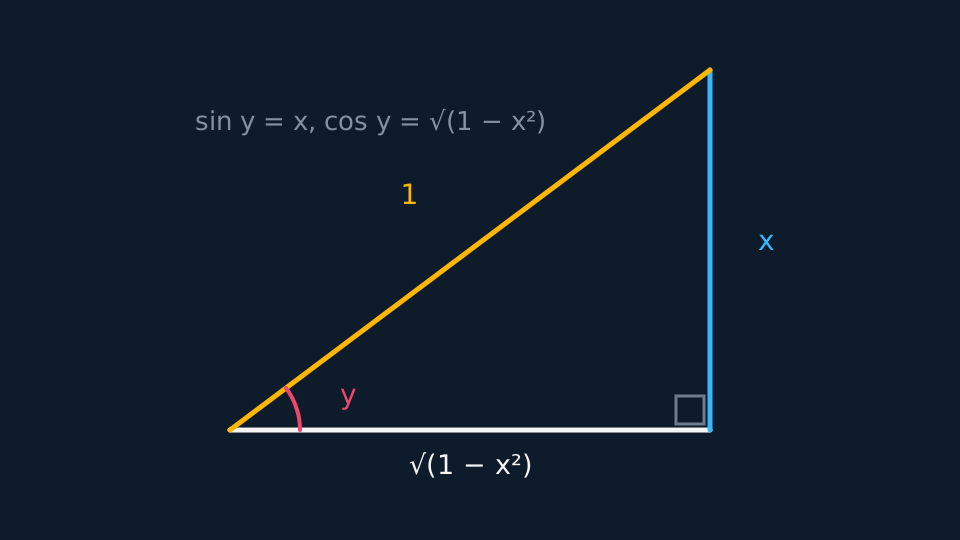
The derivatives of arcsin x and arctan x are both algebraic. Put sin y = x and differentiate implicitly: cos y (dy/dx) = 1, and on the principal branch cos y = √(1 − x2), so the derivative of arcsin x is 1/√(1 − x2) for |x| < 1. The same route gives 1/(1 + x2) for arctan x, for every real x.
Differentiating the inverse functions
Let y = arcsin x, so sin y = x. Differentiating implicitly gives cos y (dy/dx) = 1. On the principal branch cos y ≥ 0, and cos y = √(1 − sin²y) = √(1 − x²), so the derivative is algebraic:
The first holds for |x| < 1, where the square root is non-zero; the second holds for all real x. Check the current formula booklet for your awarding organisation, and be able to derive each result, since a 'show that' question requires the derivation. The derivative of arccos differs from that of arcsin only in sign, because arcsin x + arccos x = π/2.
WORKED EXAMPLE
A gradient with no trig in it
Find the gradient of y = arcsin x at x = 1/2.
dy/dx = 1/√(1 − x²) = 1/√(1 − 1/4) = 1/√(3/4).
= 2/√3 ≈ 1.155.
As x → 1⁻ the denominator tends to 0, so the gradient is unbounded at the ends of the domain, consistent with arcsin being the reflection of sin in y = x.
The corresponding standard integrals
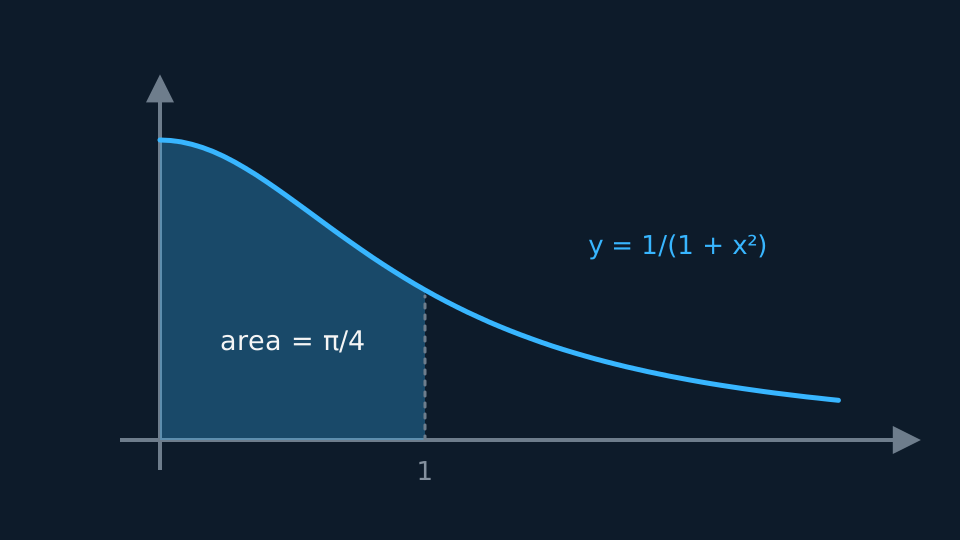
Reversing each derivative and scaling x by a gives two standard integrals. For a > 0, ∫1/√(a² − x²) dx = arcsin(x/a) + c on an interval inside |x| < a, and ∫1/(a² + x²) dx = (1/a) arctan(x/a) + c for all real x. Identify the form, state a, and include the constant of integration.
WORKED EXAMPLE
π from an algebraic fraction
Evaluate ∫ 1/(9 + x²) dx from 0 to 3.
Here a = 3, so the integral is (1/3) arctan(x/3).
At the limits: (1/3)(arctan 1 − arctan 0) = (1/3)(π/4).
= π/12. The π enters through the exact value arctan 1 = π/4.
GUIDED PRACTICE
An arcsin integral
Evaluate ∫ 1/√(4 − x²) dx from 0 to 1.
Show the working
a = 2, so the integral is arcsin(x/2).
arcsin(1/2) − arcsin 0 = π/6 − 0.
The answer is π/6. Give an exact value unless the question requests a decimal approximation.
Reducing an integrand to a standard form
Most integrands must be rearranged first, and two operations cover the usual cases. Complete the square when the denominator is a general quadratic, so ∫1/(x² + 2x + 5) dx becomes ∫1/((x + 1)² + 4) dx = ½arctan((x + 1)/2) + c. Split the numerator when it contains an x, since ∫x/(x² + 4) dx is a logarithm by recognition while ∫1/(x² + 4) dx is an arctan; keeping them together produces neither.
A third operation precedes both when it applies. A fraction whose numerator has degree greater than or equal to that of the denominator is improper, and a partial fraction decomposition requires a polynomial to be extracted first. Long division handles a linear divisor; against a quadratic or cubic denominator, rewrite the numerator as a multiple of the denominator plus a remainder. So (x2 + 3)/(x2 + 4) = 1 − 1/(x2 + 4), a constant plus a proper fraction, and the proper part then splits or integrates as usual.
WORKED EXAMPLE
A top-heavy fraction
Find ∫ (x³ + 3x + 2)/(x2 + 1) dx.
Degree 3 over degree 2, so divide before anything else. x³ + 3x + 2 = x(x2 + 1) + (2x + 2).
The integrand is therefore x + (2x + 2)/(x2 + 1), and what is left over the quadratic is proper.
Split that fraction in two. 2x/(x2 + 1) integrates by recognition, because the numerator is the denominator's derivative, and 2/(x2 + 1) is an arctan.
The integral is x2/2 + ln(x2 + 1) + 2 arctan x + c. Differentiating the result returns the integrand, which checks the answer.
The division cannot be omitted. Setting an improper fraction equal to A/(x + 1) + (Bx + C)/(x2 + 4) gives inconsistent equations, because the right-hand side is proper and the left-hand side is not. Compare the degrees before writing any partial fractions.
WORKED EXAMPLE
Partial fractions with a quadratic factor
Find ∫ (x + 4)/((x + 1)(x² + 4)) dx.
The quadratic factor needs a linear numerator, so write (x + 4)/((x + 1)(x² + 4)) = A/(x + 1) + (Bx + C)/(x² + 4).
Multiplying up, x + 4 = A(x² + 4) + (Bx + C)(x + 1). Putting x = −1 gives 5A = 3, and comparing x² and constant terms gives B = −3/5, C = 8/5.
The second fraction splits again, into −(3/5)x/(x² + 4) and (8/5)/(x² + 4).
Integrating: (3/5)ln|x + 1| − (3/10)ln(x² + 4) + (4/5)arctan(x/2) + c.
Over an irreducible quadratic factor, use a linear numerator Bx + C, including at each repeated power: for (x² + 4)², write (Bx + C)/(x² + 4) + (Dx + E)/(x² + 4)². A constant numerator over an irreducible quadratic does not give a valid decomposition.
Trigonometric substitution
The two standard forms above are recognised directly, but the same quadratics occur in forms that are not standard: √(a² − x²) alone, or (a² + x²) raised to a power. Use a substitution chosen so that a Pythagorean identity simplifies the quadratic. For a² − x², set x = a sin θ, with a > 0 and θ in [−π/2, π/2], because a² − a²sin²θ = a²cos²θ. For a² + x², set x = a tan θ, with θ in (−π/2, π/2), because a² + a²tan²θ = a²sec²θ. Choose the substitution that removes the square root or the higher power.
WORKED EXAMPLE
x = a sin θ on a square root
Evaluate ∫ √(4 − x²) dx from 0 to 2.
The root fits neither standard pattern, so substitute. Set x = 2 sin θ, so dx = 2 cos θ dθ, and the limits x = 0 and x = 2 become θ = 0 and θ = π/2.
√(4 − 4 sin²θ) = 2 cos θ, taking the positive root since cos θ ≥ 0 across [0, π/2]. The integral is ∫ 4 cos²θ dθ = ∫ 2(1 + cos 2θ) dθ.
= [2θ + sin 2θ] from 0 to π/2 = π.
The region is a quarter of the disc x² + y² ≤ 4, of area πr²/4 = π with r = 2, which confirms the value.
WORKED EXAMPLE
x = a tan θ on a squared quadratic
Find ∫ 1/(1 + x²)² dx from 0 to 1.
Squared, the denominator is beyond the arctan pattern. Set x = tan θ, so dx = sec²θ dθ and 1 + x² = sec²θ.
The integrand becomes sec²θ/sec⁴θ = cos²θ, and the limits x = 0 and x = 1 become θ = 0 and θ = π/4.
∫ cos²θ dθ = ∫ ½(1 + cos 2θ) dθ = [θ/2 + (sin 2θ)/4] from 0 to π/4.
= π/8 + 1/4. The 1/4 comes from the sin 2θ term, which the arctan standard form does not produce.
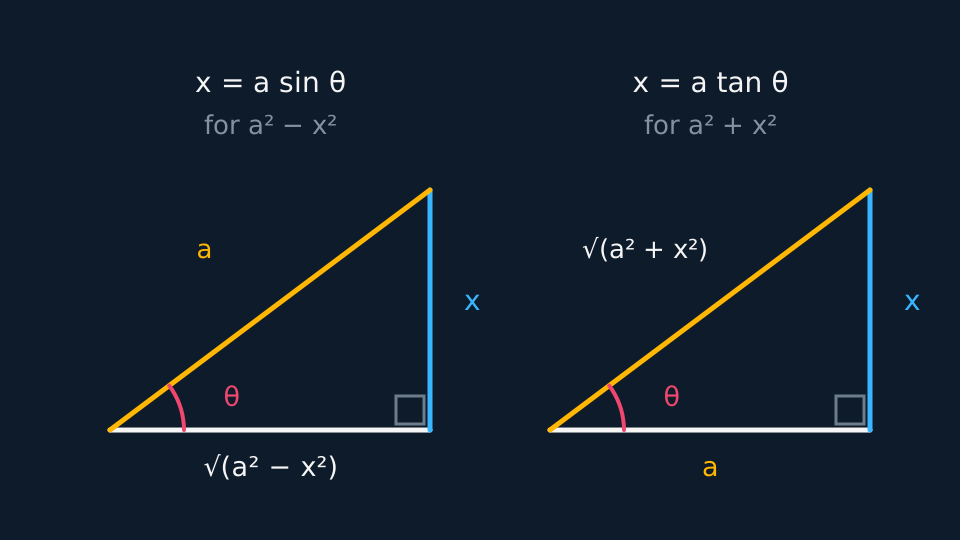
With definite limits, convert the limits once and stay in θ to the end. For an indefinite integral the answer has to come back to x: write θ = arcsin(x/a) or arctan(x/a), expand any sin 2θ first, and rebuild sin θ and cos θ from the right triangle that defined the substitution.
Describe the drawing
Two right triangles sharing the same angle theta at the base. In the left one, for x equals a sin theta, x stands opposite theta, the hypotenuse is a, and the remaining side is the root of a squared minus x squared. In the right one, for x equals a tan theta, x is again opposite but a is now the adjacent side, so the hypotenuse becomes the root of a squared plus x squared. Reading sides off the correct triangle is how sin theta and cos theta are rebuilt in terms of x at the end of a substitution.
ASSESSMENT FOCUS
- For a 'show that', derive the derivative of arcsin by implicit differentiation rather than quoting it, and state the domain |x| < 1.
- Identify a before integrating: a² is the constant term, so 9 + x² gives a = 3, and a > 0.
- The arctan standard form carries a factor 1/a and the arcsin form does not.
- Complete the square before using a standard form; x² + bx + c matches neither directly.
- Compare degrees first. A numerator of degree at least that of the denominator must be divided down before any decomposition; against a quadratic denominator, write the numerator as (quotient × denominator) + remainder.
- Give an exact value unless the question requests a decimal approximation.
- When the quadratic is rooted, squared or otherwise beyond the two patterns, substitute: x = a sin θ simplifies a² − x², and x = a tan θ simplifies a² + x².
CHECK YOURSELF
Evaluate ∫ 1/(1 + x²) dx from 0 to 1, exactly.
Show a hint
arctan at the two limits.
Show the answer
[arctan x] from 0 to 1 = arctan 1 − arctan 0 = π/4 − 0 = π/4.
Differentiate the inverse functions implicitly: sin y = x gives dy/dx = 1/√(1 − x²) for |x| < 1, and d(arctan x)/dx = 1/(1 + x²) for all real x.
For a > 0, ∫1/√(a² − x²) dx = arcsin(x/a) + c on an interval inside |x| < a, and ∫1/(a² + x²) dx = (1/a) arctan(x/a) + c.
Complete the square, split numerators, divide an improper fraction down first, and give every irreducible quadratic factor a Bx + C numerator, including at each repeated power.
Beyond the standard forms, substitute: x = a sin θ simplifies a² − x², x = a tan θ simplifies a² + x².
WORKBOOK
Printable practice for this topic: original exam-style questions with room to work, and a fully worked answer book. Free to use; please do not redistribute or sell.
Or read them with their worked answers on the calculus with inverse trigonometric functions questions page.
USED LATER IN
CHECK YOUR PROGRESS
Rate how confident you feel with each objective for this lesson. Ratings are saved in this browser, on this device, unless you sign in.
- Differentiate arcsin x, arccos x and arctan x from scratch via implicit differentiation.
- Integrate 1/√(a² − x²) and 1/(a² + x²) by recognising the patterns.
- Complete the square and use partial fractions to reach the same two patterns.
- Divide an improper fraction down first, whether its denominator is linear or quadratic, and split what is left.
- Choose and carry out the substitutions x = a sin θ and x = a tan θ for the associated forms.
Open the full revision checklist to see every objective in the course in one place.