Maths › Mechanics › Connected particles and pulleys
Connected particles and pulleys
Two particles joined by a light inextensible string that remains taut have the same acceleration along the string, and a light string over a smooth pulley has the same tension throughout. Use a whole-system equation for the acceleration and a single-particle equation for the tension, in tow-bar and pulley problems.
Builds on Forces and Newton's laws.
IN THIS TOPIC
- Model connected objects sharing one acceleration through a light inextensible string.
- Choose between whole-system and single-particle equations deliberately.
- Analyse smooth-pulley systems, including a mass on a table, finding acceleration and tension.
COMMON MISCONCEPTION
The tension on the heavy side of a pulley is larger than on the light side.
One light string over a smooth pulley carries one tension, the same on both sides, since a light string has no weight of its own and a smooth pulley redirects a string without changing its tension. For 5 kg and 3 kg hanging, 5g − T = 5a and T − 3g = 3a give a = g/4 and T = 36.75 N, a value lying between the two weights, 29.4 N and 49 N.
Whole-system and single-particle equations
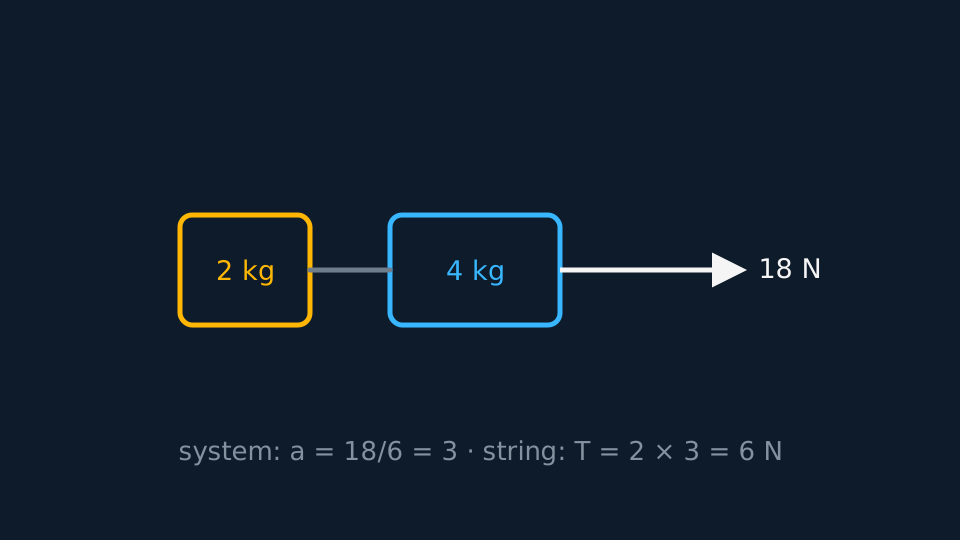
While a light inextensible string stays taut, the two particles it joins have equal accelerations along it and the tension is the same throughout the string. The tension is internal to the pair, so the two tension terms cancel when both objects are treated as one system, and that equation gives the acceleration. To find the tension, write a second equation for one object on its own.
Two blocks of 4 kg and 2 kg joined by a string and pulled by 18 N give a system of mass 6 kg, so a = 3 m s⁻². The rear 2 kg block is acted on horizontally only by the string, so T = 2 × 3 = 6 N.
The whole-system equation also applies over a smooth pulley, provided the positive direction is taken as the direction the string moves, followed all the way round. For 5 kg and 3 kg hanging, the resultant driving force is 5g − 3g and the moving mass is 8 kg. Adding the two weights as though they acted the same way is not valid; it gives a = g, which corresponds to free fall rather than to this system.
Over a smooth pulley
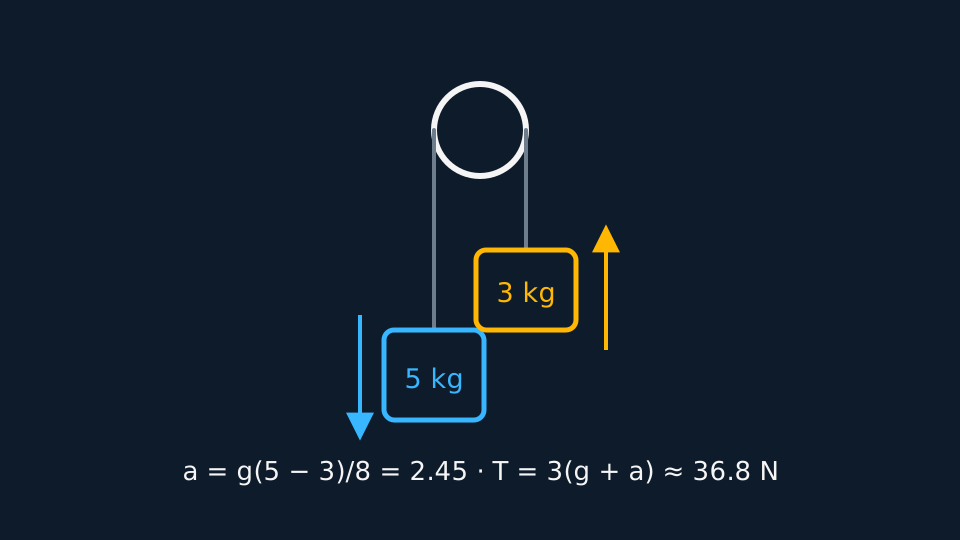
A smooth pulley redirects a string without changing its tension. With 5 kg and 3 kg hanging, take each mass's own direction of travel as positive and write Newton's second law twice.
WORKED EXAMPLE
Acceleration and tension
For the 5 kg mass: 5g − T = 5a. For the 3 kg mass: T − 3g = 3a.
Adding eliminates T: 2g = 8a, so a = g/4 = 2.45 m s⁻².
Then T = 3(g + a) = 3 × 12.25 = 36.75 N, about 37 N.
Check: T lies between 3g ≈ 29 N and 5g = 49 N. The lighter mass accelerates upwards, so T > 3g, and the heavier one accelerates downwards, so T < 5g.
A value of T above 49 N or below 29 N would therefore indicate an error in the two equations.
A pulley at the table edge
The other standard arrangement puts one mass on a horizontal table with the string running over a pulley at the edge to a second mass hanging. The hanging weight drives the system, the table mass contributes inertia but no driving force, and any friction on the table resists.
WORKED EXAMPLE
Smooth table, then rough
A 3 kg block on a smooth table is joined over a smooth pulley to a 2 kg mass hanging freely. Find the acceleration and the tension.
Around the string: 2g = 5a, so a = 19.6/5 = 3.92 m s⁻².
Isolating the block: T = 3a = 11.76 N, and checking on the hanging mass, 2(g − a) = 2 × 5.88 = 11.76 N, which agrees.
If the table is rough with μ = 0.2, friction is 0.2 × 3g = 5.88 N, so 2g − 5.88 = 5a and a = 2.74 m s⁻². Here R = 3g, since nothing pulls the block upwards.
When the hanging mass lands the string is no longer taut, so the shared-acceleration condition no longer holds. The block then moves alone, decelerating under friction or continuing at constant speed on a smooth table. Treat this as a separate stage with its own equations and suvat list.
The same arrangement on a tilted table is a particle on an inclined plane with the string over a pulley at the top. The equations have the same structure, with the additional term mg sin θ acting on the particle on the plane, down the slope. See friction and inclined planes for the resolved form.
ASSESSMENT FOCUS
- State the modelling as you use it. Light string, so one tension. Inextensible, so one acceleration. Smooth pulley, so the tension is unchanged around it.
- Write one equation per particle, each in that particle's own positive direction, then add them to eliminate T.
- Multi-stage questions change the model partway. Identify what happens when the string breaks or a mass lands, and start new equations there.
- When both masses hang freely from a smooth pulley, check that the tension lies between the two weights; in that arrangement it must. With a table, a slope or any other force acting, the check does not apply.
CHECK YOURSELF
Masses of 7 kg and 3 kg hang over a smooth pulley. Write the two equations of motion and find the acceleration in terms of g.
Show a hint
Each mass gets its own direction of travel as positive.
Show the answer
7g − T = 7a and T − 3g = 3a.
Adding: 4g = 10a, so a = 0.4g ≈ 3.92 m s⁻².
System for the acceleration, single particle for the tension.
One equation per mass, own direction positive, then add to eliminate T.
WORKBOOK
Printable practice for this topic: original exam-style questions with room to work, and a fully worked answer book. Free to use; please do not redistribute or sell.
Or read them with their worked answers on the connected particles and pulleys questions page.
CHECK YOUR PROGRESS
Rate how confident you feel with each objective for this lesson. Ratings are saved in this browser, on this device, unless you sign in.
- Model connected objects sharing one acceleration through a light inextensible string.
- Choose between whole-system and single-particle equations deliberately.
- Analyse smooth-pulley systems, including a mass on a table, finding acceleration and tension.
Open the full revision checklist to see every objective in the course in one place.