Maths › Mechanics › Projectiles
Projectiles
Resolve the initial velocity into horizontal and vertical components. In the model without air resistance, horizontal acceleration is zero and vertical acceleration is −g; the common time links the two components. Applying the constant-acceleration equations to each component gives position, velocity, maximum height, flight time, range and the equation of the path.
Builds on Kinematics with constant acceleration and Triangles and the sine and cosine rules.
Used in InkPhysics: Projectile motion.
IN THIS TOPIC
- Resolve a launch velocity into horizontal and vertical components.
- Write the launch velocity and the acceleration as vectors, with a = (0, −g) or −gj, and read the two component equations off the vector one.
- Apply constant-velocity motion horizontally and suvat with g vertically, linked by time.
- Find time of flight, range, greatest height, and the velocity at any instant.
- Derive and use the equation of the path.
COMMON MISCONCEPTION
A projectile's horizontal speed gradually decreases during flight.
The horizontal component u cos θ stays constant. With air resistance neglected the weight is the only force in the model, so the horizontal acceleration is zero and only the vertical component changes, at −g with up positive. A ball struck at 20 m s⁻¹ and 30° keeps 20 cos 30° = 17.3 m s⁻¹ across for the whole 2.04 s of flight, which is what makes the range 35.3 m.
Resolving the launch velocity
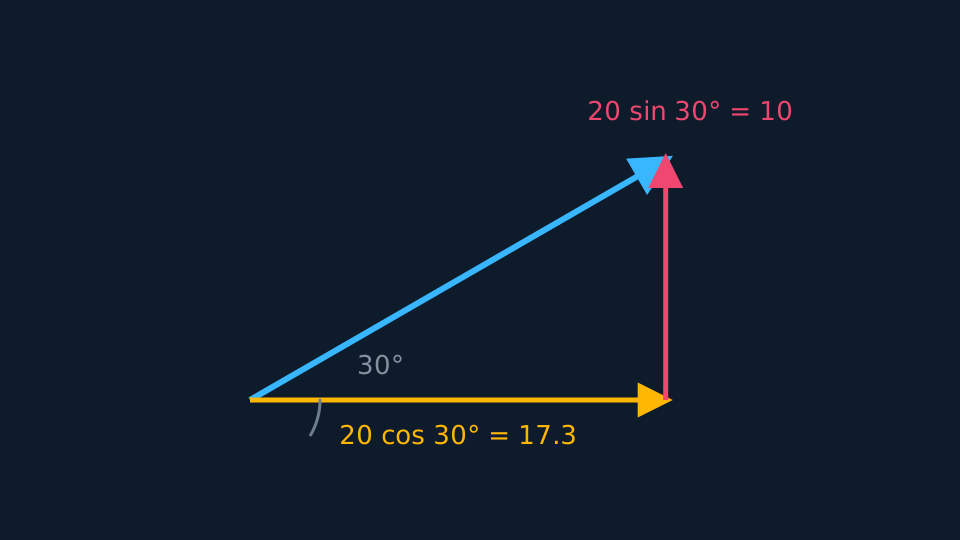
Launching at speed u and angle θ gives horizontal component u cos θ and vertical component u sin θ. When air resistance is neglected, the only force in the model is the weight, so the horizontal acceleration is zero and the vertical acceleration is −g. The horizontal component u cos θ remains constant during the modelled flight. The two component motions are independent and are linked only by the common time t.
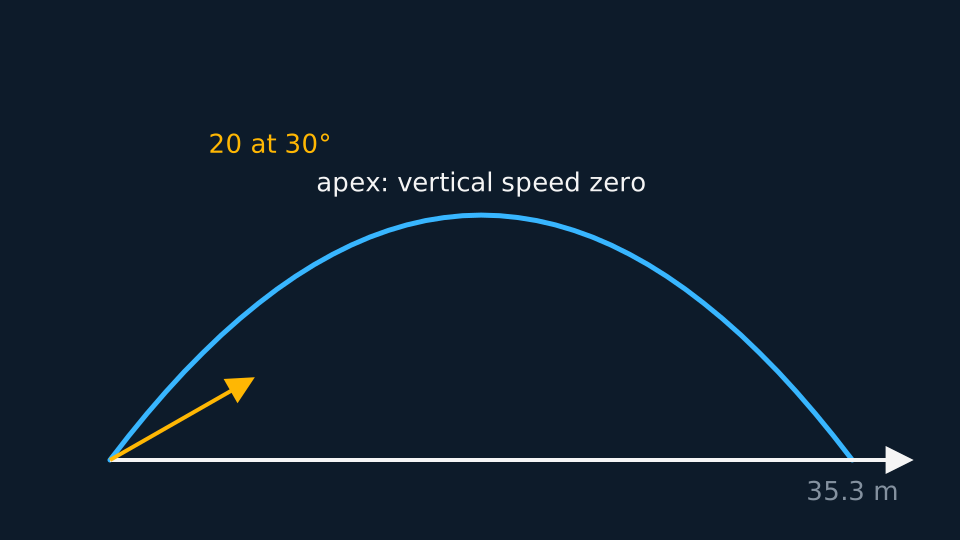
The model in vector form
The same model can be written in one vector equation. Gravity is the only force, so the acceleration is the vector a = (0, −9.8) m s⁻², written −9.8j in the other notation, or a = (0, −g) and a = −gj while g is kept as a letter. Its horizontal component is zero, so the horizontal velocity component is constant; its vertical component is −g, negative because up was chosen as positive.
Substituting into the constant-acceleration formulae in vector form, with u = (u cos θ, u sin θ), the equation v = u + at gives (u cos θ, u sin θ − gt), and s = ut + ½at² gives (ut cos θ, ut sin θ − ½gt²). These are the same component equations used below. The vector form and the pair of component equations state the same model, so answer in whichever notation the question uses.
WORKED EXAMPLE
A launch given in components
A ball is thrown from the origin with velocity u = (12i + 16j) m s⁻¹ and moves freely under gravity, so a = −9.8j m s⁻². Find its position vector and its velocity 2 s later.
s = ut + ½at² = 2(12i + 16j) + ½(−9.8j)(2²) = 24i + 32j − 19.6j = 24i + 12.4j m, so it is 24 m downrange and 12.4 m up.
v = u + at = 12i + 16j − 19.6j = 12i − 3.6j m s⁻¹, a speed of √(12² + 3.6²) ≈ 12.5 m s⁻¹ at tan⁻¹(3.6/12) ≈ 16.7° below the horizontal.
Check: the j component of the velocity is negative, so the ball is descending. This agrees with the highest point occurring at t = 16/9.8 = 1.63 s.
The standard questions
WORKED EXAMPLE
Flight of a golf ball
A ball is struck at 20 m s⁻¹ at 30° above the horizontal from level ground. Find the time of flight and the range.
Components: across 20 cos 30° = 17.3, up 20 sin 30° = 10.
Vertical suvat to return to the ground: 0 = 10t − 4.9t², so t = 10/4.9 = 2.04 s.
Range: 17.3 × 2.04 = 35.3 m.
Check: the greatest height 10²/(2 × 9.8) = 5.1 m arrives at half the flight, 1.02 s, and the symmetry holds.
Greatest height is a vertical question, with v = 0 upwards giving h = (u sin θ)²/(2g). Landing on level ground means the vertical displacement is zero, which is a different statement from the velocity being zero. A projectile launched horizontally is the same model with u sin θ = 0, starting at its highest point.
For the velocity partway through, recalculate the components. The horizontal component is unchanged. The vertical one is u sin θ − gt, negative while the ball descends. For the golf ball at t = 1.5 s, the components are 17.3 across and −4.7 vertically, giving speed √(17.3² + 4.7²) ≈ 17.9 m s⁻¹ at tan⁻¹(4.7/17.3) ≈ 15.2° below the horizontal.
The equation of the path
Eliminating t between the two component equations gives a relation between x and y that describes the whole path. Horizontally x = ut cos θ, so t = x/(u cos θ). Substituting into y = ut sin θ − ½gt² gives
which is a quadratic in x, so the path is a parabola. Check the current formula booklet for your awarding organisation; whether or not the result is supplied, derive it from the two component equations when a question asks for the equation of the path. Show the substitution for t, and give the result in the requested form, which may use sec²θ or (1 + tan²θ).
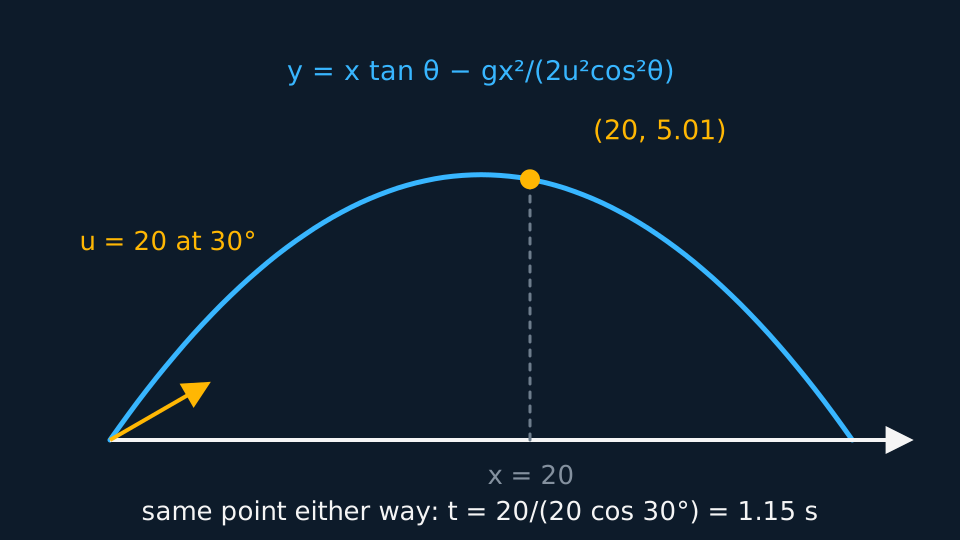
As a worked instance, a ball projected at 20 m s⁻¹ and 30° is at y = 20 tan 30° − 9.8 × 20²/(2 × 20² × cos²30°) = 11.55 − 6.53 = 5.01 m when it has travelled 20 m horizontally. That matches the t = 1.15 s answer from the two-equation route, as it must.
ASSESSMENT FOCUS
- Begin by writing the two components, with cos θ on the horizontal.
- Use the same value of t in the horizontal and vertical equations: find t from one direction and substitute it into the other.
- Landing on level ground means vertical displacement zero, not velocity zero. Landing below the launch point means the vertical displacement is negative, so keep the sign.
- For the equation of the path, show the elimination of t rather than quoting the finished result.
- Give answers to 2 or 3 significant figures, consistent with g = 9.8.
CHECK YOURSELF
A stone is thrown horizontally at 15 m s⁻¹ from a 19.6 m cliff. How long does it fall, and how far from the cliff base does it land?
Show a hint
The vertical motion is a straight drop from rest.
Show the answer
Vertically: 19.6 = 4.9t², so t = 2 s.
Horizontally: 15 × 2 = 30 m from the base.
Resolve once: u cos θ horizontally, constant during the modelled flight, and u sin θ vertically with acceleration −g.
Solve in whichever direction the given data allow, then use the same t in the other direction.
WORKBOOK
Printable practice for this topic: original exam-style questions with room to work, and a fully worked answer book. Free to use; please do not redistribute or sell.
Or read them with their worked answers on the projectiles questions page.
CHECK YOUR PROGRESS
Rate how confident you feel with each objective for this lesson. Ratings are saved in this browser, on this device, unless you sign in.
- Resolve a launch velocity into horizontal and vertical components.
- Write the launch velocity and the acceleration as vectors, with a = (0, −g) or −gj, and read the two component equations off the vector one.
- Apply constant-velocity motion horizontally and suvat with g vertically, linked by time.
- Find time of flight, range, greatest height, and the velocity at any instant.
- Derive and use the equation of the path.
Open the full revision checklist to see every objective in the course in one place.