Maths › Mechanics › Forces and Newton's laws
Forces and Newton's laws
Newton's second law relates the resultant force on a body to its acceleration. Draw force diagrams, resolve forces into components, and apply F = ma to particles in motion and at rest.
Builds on Kinematics with constant acceleration.
Used in InkPhysics: Newton's laws and the resultant force.
IN THIS TOPIC
- Draw free body diagrams with weight, normal reaction, tension, thrust and friction correctly placed.
- State Newton's first and third laws, and name the third-law partner of a force, which acts on the other body.
- Apply F = ma along a chosen direction, and the equilibrium condition when a = 0.
- Resolve a force at an angle into components, and see what that does to the normal reaction.
- Work with forces written in i and j notation, including the magnitude and direction of a resultant.
- Combine F = ma with suvat when a constant force produces constant acceleration.
COMMON MISCONCEPTION
A moving object always has a force pushing it along in the direction of motion.
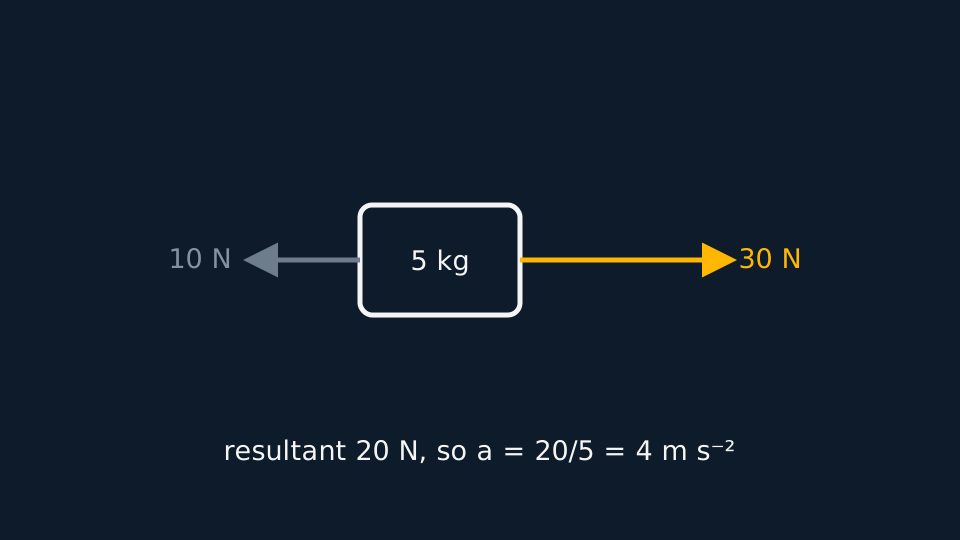
A resultant force changes velocity; it is not needed to maintain one. Newton's first law says that no resultant force means no change of velocity, so rest and steady speed are the same condition, equilibrium. A 5 kg crate pulled at 30 N against a resistance of 10 N accelerates at 4 m s⁻² because the resultant is 20 N; raise the resistance to 30 N and it keeps whatever speed it had.
Free body diagrams
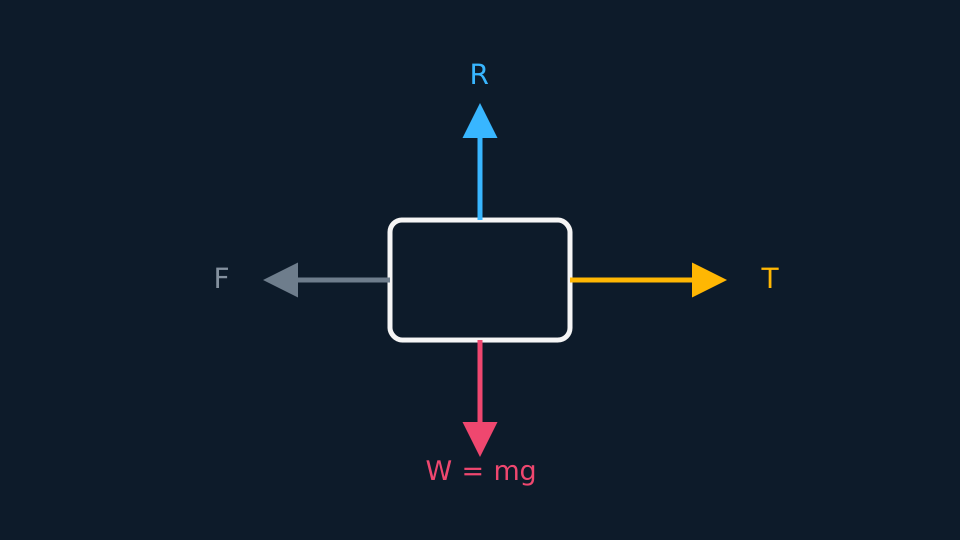
Draw every force on the object and no force that is not on the object. Weight mg straight down. Normal reaction R perpendicular to the surface. Tension pulling along a string, thrust pushing along a rod, friction opposing the sliding. Forces the object exerts on other things belong on their diagrams, not on this one.
Newton's laws at work
The first law says that no resultant force means no change of velocity, so rest and steady speed are the same condition, equilibrium. The second law quantifies everything else. Resultant force equals mass times acceleration, applied along a direction you have chosen, with the signs kept consistent. The third law says forces come in equal and opposite pairs acting on different objects, and that is the reason a free body diagram only ever shows one member of each pair.
WORKED EXAMPLE
Resultant first, then divide
A 5 kg crate is dragged by a horizontal rope with tension 30 N against a constant resistance of 10 N. Find the acceleration, and the speed after 4 s from rest.
Along the motion: F = 30 − 10 = 20 N, so a = 20/5 = 4 m s⁻².
A constant force gives constant acceleration, so suvat applies: v = 0 + 4 × 4 = 16 m s⁻¹.
There is no vertical acceleration, so R = mg = 49 N. Since R > 0, the crate remains in contact with the floor.
Forces at an angle
A force T at angle θ to the horizontal resolves into a horizontal component T cos θ and a vertical component T sin θ. Both components appear in the resolved equations: the vertical one changes the normal reaction.
WORKED EXAMPLE
An angled tow
A 10 kg sledge is pulled by a rope at 30° above the horizontal with tension 50 N, against a horizontal resistance of 15 N. Find the acceleration and the normal reaction.
Horizontally: 50 cos 30° − 15 = 43.3 − 15 = 28.3 N, so a = 28.3/10 = 2.83 m s⁻².
Vertically there is no motion, so R + 50 sin 30° = 10g, giving R = 98 − 25 = 73 N.
R is less than mg because the vertical component of the tension supports part of the weight. Taking R = mg here would give a value 25 N too large, and in a friction question that error carries into F = μR.
Forces as vectors
Forces can also be given in components, as (3i + 5j) N. They are then added component by component, and F = ma becomes a vector equation with the acceleration pointing along the resultant.
Take forces (3i + 5j) N and (−i + 2j) N acting on a particle of mass 2 kg. The resultant is 2i + 7j N, so a = i + 3.5j m s⁻², with magnitude √(1² + 3.5²) ≈ 3.64 m s⁻². The direction comes from tan⁻¹(3.5/1) ≈ 74.1° from the i direction. State the reference direction an angle is measured from; an angle given without one is ambiguous.
In vector form, equilibrium is the statement that the resultant vector is zero: the i components sum to zero and the j components sum to zero, so one vector equation gives two scalar equations.
ASSESSMENT FOCUS
- Draw and label the free body diagram before writing any equation; every resolved equation depends on it.
- Write F = ma along a stated direction and keep every sign consistent with it.
- When a pull or push is at an angle, resolve it in both directions before forming the equations, and recalculate R.
- Equilibrium means the resultant is zero in each direction. Resolve in two perpendicular directions, then solve.
- Where the force is constant the acceleration is constant, so F = ma may be followed by a suvat equation. State that the force is constant when using this step.
CHECK YOURSELF
A 1200 kg car accelerates at 2.5 m s⁻² against a total resistance of 600 N. Find the driving force.
Show a hint
F in F = ma is the resultant.
Show the answer
Resultant needed: ma = 1200 × 2.5 = 3000 N.
Driving force = 3000 + 600 = 3600 N.
Draw the diagram first: every force acting on the object, and no force it exerts on anything else.
Resolve, sum with signs, apply F = ma. Equilibrium is the a = 0 special case.
WORKBOOK
Printable practice for this topic: original exam-style questions with room to work, and a fully worked answer book. Free to use; please do not redistribute or sell.
Or read them with their worked answers on the forces and Newton's laws questions page.
USED LATER IN
CHECK YOUR PROGRESS
Rate how confident you feel with each objective for this lesson. Ratings are saved in this browser, on this device, unless you sign in.
- Draw free body diagrams with weight, normal reaction, tension, thrust and friction correctly placed.
- State Newton's first and third laws, and name the third-law partner of a force, which acts on the other body.
- Apply F = ma along a chosen direction, and the equilibrium condition when a = 0.
- Resolve a force at an angle into components, and see what that does to the normal reaction.
- Work with forces written in i and j notation, including the magnitude and direction of a resultant.
- Combine F = ma with suvat when a constant force produces constant acceleration.
Open the full revision checklist to see every objective in the course in one place.