Maths › Mechanics › Modelling, quantities and units
Modelling, quantities and units
Use the standard modelling assumptions for particles, light inextensible strings, smooth or rough surfaces and uniform rigid bodies. Work in SI units, distinguish scalar from vector quantities, and state how each assumption changes the model. Extension, not required for Edexcel 9MA0: use dimensions in mass M, length L and time T to check equations for dimensional consistency and determine unknown indices in proposed formulae.
Builds on Vectors in two dimensions.
IN THIS TOPIC
- Use the standard modelling words and say what each assumption removes.
- Work in SI units, converting into them before any calculation.
- Distinguish scalars from vectors, and signed values from magnitudes.
- Extension: write the dimensions of a quantity in M, L and T from its units, and recognise a dimensionless quantity.
- Extension: check an equation for dimensional consistency, and say what a pass and a fail each establish.
- Extension: find unknown indices by matching powers, to predict the shape of a formula or an equation of motion.
COMMON MISCONCEPTION
A negative velocity means the object is slowing down.
The sign carries the direction against the positive direction chosen at the start, and says nothing about whether the speed is increasing or decreasing. Speed is the magnitude, so −5 m s⁻¹ and 5 m s⁻¹ are the same speed in opposite directions. A particle is slowing down when its velocity and acceleration have opposite signs, so at −5 m s⁻¹ with an acceleration of −2 m s⁻² it is speeding up.
Modelling assumptions and what each one removes
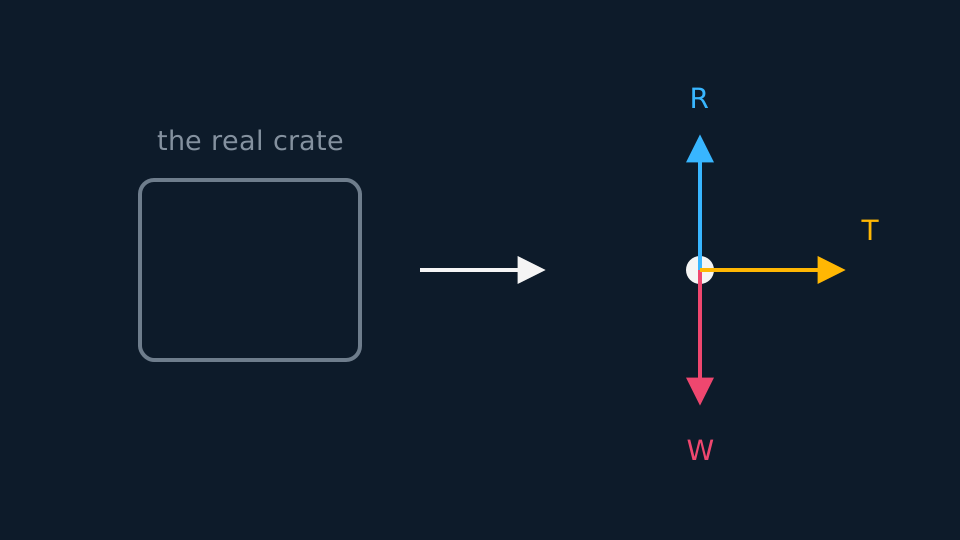
A model replaces the real object by a simpler one that can be analysed. Calling a crate a particle means its size and shape are ignored, so all its mass is concentrated at one point, every force acts at that point, and rotation is excluded from the problem.
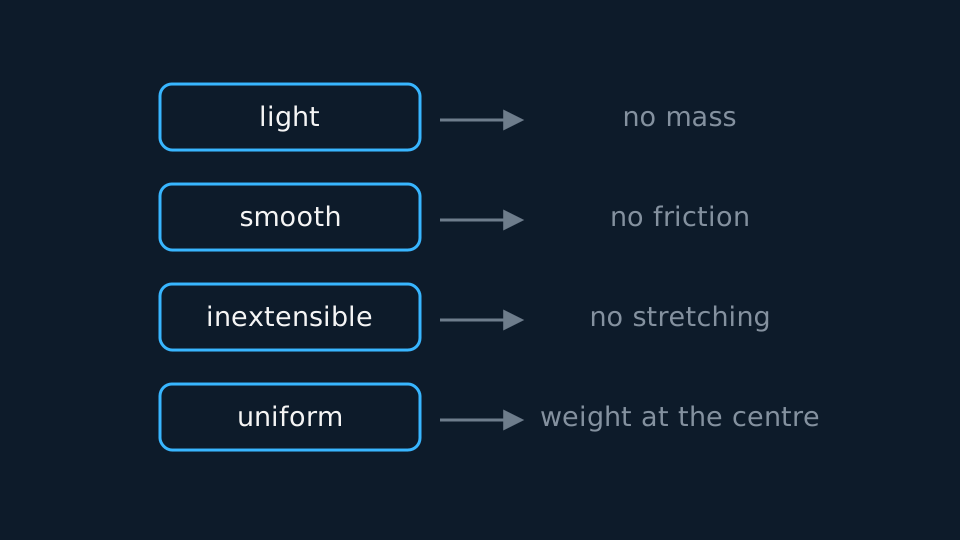
Each of the remaining modelling words removes one complication. A light string has no mass, so the tension is the same all along it, provided any pulley it passes over is smooth, since a rough pulley would let the tension differ across it. A smooth surface or pulley has no friction. An inextensible string cannot stretch, so while it is taut the objects it joins move together along it and their accelerations have the same magnitude along the string. For a taut string in a straight line, or over a single smooth pulley, that gives one shared acceleration in every equation. A uniform beam carries its weight at its midpoint and a rigid one does not bend.
A few more turn up in question stems. A rod is rigid and has length but no thickness. A lamina is flat with no thickness at all. A bead is threaded on a wire and can slide along it. A peg is a fixed point that a string can pass over. A further assumption is usually left implicit: air resistance and wind are ignored. Name it when a question asks for a criticism of the model.
Units and quantities
Mechanics runs on SI units: metres, seconds and kilograms, plus everything built from them, so newtons for force and m s⁻¹ and m s⁻² for motion. Convert before calculating: a speed left in km h⁻¹ and substituted into a suvat equation makes every subsequent value incorrect. Weight is a force, W = mg, with g = 9.8 m s⁻² unless a question says otherwise.
Quantities split into scalars, which have size only, and vectors, which have size and direction. Distance and speed are scalars; displacement and velocity are vectors. In one dimension the direction is carried entirely by the sign, so choose a positive direction at the start of a question, state it, and interpret the sign of every result against that choice.
Extension, dimensions: M, L and T
A unit is a chosen size for a quantity. A dimension is the kind of quantity it is, which is what is left once the choice of unit has been taken away. Mechanics needs three: mass M, length L and time T. Square brackets name one, so a mass has [m] = M, a distance [d] = L and a time [t] = T. This section and the next are an extension, not required for Edexcel 9MA0; AQA and OCR assess dimensional analysis in Further Mathematics.
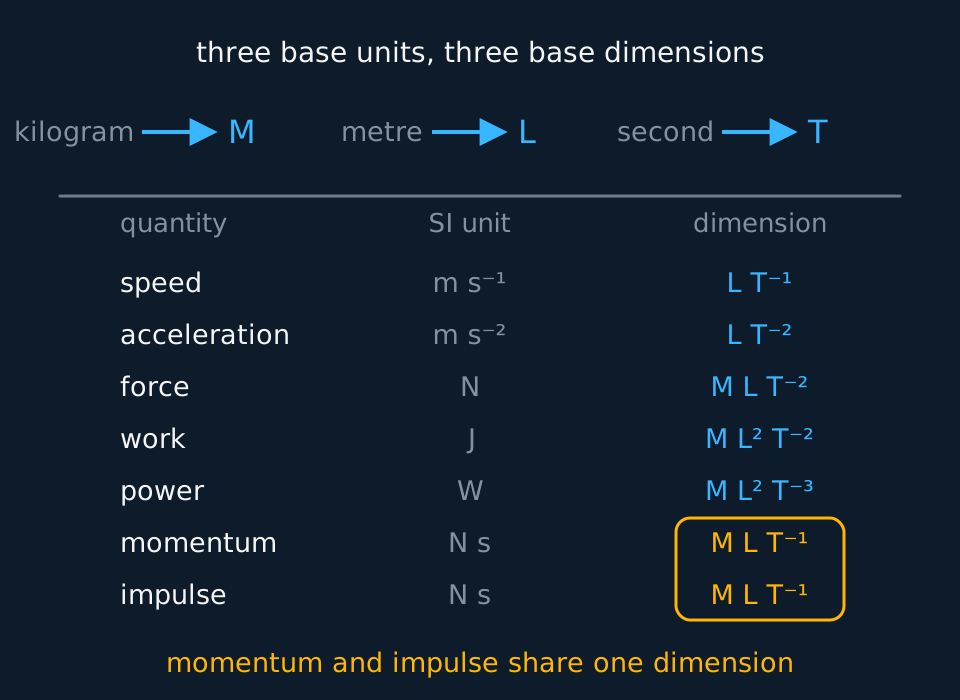
Reading dimensions off units is the method, and it covers any quantity whose units you know. A speed in m s⁻¹ is a length over a time, so [v] = L T⁻¹, and an acceleration in m s⁻² gives [a] = L T⁻². A newton is a kilogram metre per second squared, so [F] = M L T⁻². Work is a force times a distance, [W] = M L² T⁻², and power is work per unit time, [P] = M L² T⁻³. Momentum mv and impulse Ft agree at M L T⁻¹, as they should, since the impulse-momentum principle sets one equal to the other.
Describe the drawing
Two stacked bands. The upper one turns each base unit into its dimension: kilogram into M, metre into L, second into T. The lower one lists seven mechanical quantities with their units on the left and the dimensions those units force on them on the right, from speed at L T to the power of minus one down to power at M L squared T to the power of minus three. Momentum and impulse arrive in the same right-hand cell, M L T to the power of minus one, which is the impulse-momentum principle showing up in the dimensions.
The reading runs both ways. Read M L⁻¹ T⁻² back into units and it is kg m⁻¹ s⁻², a newton per square metre, which is a pressure. That direction is worth practising, because it is how you name the unit of a quantity a question has handed you as a dimension.
Some quantities have no dimensions. A ratio of two quantities of the same kind cancels, so the coefficient of friction is a force over a force, the coefficient of restitution a speed over a speed, and an angle in radians an arc length over a radius. Each is dimensionless, written [μ] = 1. Pure numbers are dimensionless too, ½ and 2 and π alike, which is why the method cannot determine a numerical constant. The argument of a sine, an exponential or a logarithm must also be dimensionless.
Extension, checking and predicting with dimensions
Terms that are added, subtracted or equated carry the same dimensions, so the two sides of a correct equation agree. That is a test you can run on anything. Take P = Fv: [F][v] = M L T⁻² × L T⁻¹ = M L² T⁻³, which is [P], so the relation survives. Take v² = u² + 2as: the left is L² T⁻², and [a][s] = L T⁻² × L = L² T⁻² matches it, with the 2 contributing nothing. Disagreement is decisive, since an inconsistent equation is wrong. Agreement is weaker: an incorrect dimensionless factor passes the test.
WORKED EXAMPLE
Two formulae, one test
A student writes s = ut + ½at³ for a displacement, and T = 2π√(g/l) for the period of a pendulum of length l. Test each for dimensional consistency.
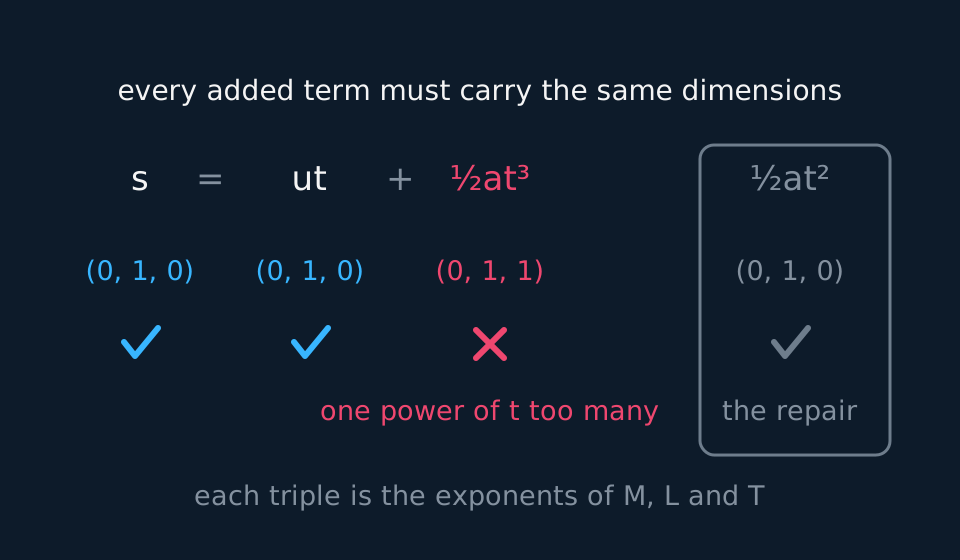
First: [ut] = L T⁻¹ × T = L, which matches [s]. But [at³] = L T⁻² × T³ = L T, which does not.
The equation is inconsistent, and the test also identifies where: the failing term carries one power of t too many, where ½at² was intended.
Second: [g/l] = L T⁻² ÷ L = T⁻², so the square root has dimension T⁻¹. That is a rate rather than a period, so the ratio has been written upside down; √(l/g) has dimension T and passes.
Neither test needed a value of g or a length, which is the point of running it before the arithmetic rather than after.
Describe the drawing
The equation s equals ut plus a half a t cubed, written once with the exponents of M, L and T under each term. The left side and the term ut both read nought, one, nought and are ticked. The last term reads nought, one, one, one power of time too many, and is crossed out. Beside it, greyed, sits the repair: a half a t squared, whose triple matches the other two.
Run the test backwards and it predicts. Propose that a quantity is a product of powers of the quantities it could depend on, with a dimensionless constant k in front, write the dimensions of both sides, and match the index of M, then of L, then of T. Three equations come out, one per base dimension, and they solve like any simultaneous set. The proposal is a modelling assumption rather than a derivation, and k is left undetermined, so what the argument delivers is the shape of a formula.
WORKED EXAMPLE
The period of a pendulum
The period T of a simple pendulum is taken to depend only on its mass m, its length l and g, so that T = k mp lq gr with k dimensionless. Find p, q and r.
Keep the two T's apart first. The period is called T and the time dimension is written T, so [T] = T says that the period has the dimension of time.
Right-hand side: Mp × Lq × (L T⁻²)r = Mp Lq+r T−2r. Left-hand side: M⁰ L⁰ T¹.
Matching M gives p = 0. Matching T gives −2r = 1, so r = −½. Matching L gives q + r = 0, so q = ½.
So T = k√(l/g). The index of m is zero, so mass does not appear: two pendulums of the same length have the same period whatever their bobs weigh, and quadrupling the length doubles the period.
The method leaves k undetermined. Its value is 2π, so a pendulum of length 1 m has period 2π√(1/9.8) = 2.01 s, where k = 1 would have predicted 0.32 s.
GUIDED PRACTICE
How far a stone falls
A stone falls from rest. Take the distance s it has fallen to depend only on g and on the time t, so that s = k gp tq with k dimensionless. Find p and q, then say what the argument has delivered and what it has not.
Show the working
Dimensions of the right-hand side: (L T⁻²)p Tq = Lp Tq − 2p, and the left-hand side is L.
Matching L gives p = 1. Matching T gives q − 2p = 0, so q = 2. Matching M gives no equation, since no mass appears on either side; in this model the distance fallen does not depend on the mass.
So s = k g t², an equation of motion obtained without using any force equation.
The constant k is undetermined. The suvat result supplies k = ½, so a two-second fall covers ½(9.8)(2²) = 19.6 m. The dimensional argument alone establishes only that doubling the time quadruples the distance.
ASSESSMENT FOCUS
- “State a modelling assumption and its effect” asks for two things: name the assumption, then state the simplification it allows, one sentence each.
- To criticise a model, name a specific neglected feature: air resistance ignored, the string not light, g taken as constant.
- Convert to SI units and state a positive direction before calculating, then interpret signs against that direction.
- Obtain a dimension from the units: read the units off, then replace kilogram by M, metre by L and second by T.
- State the conclusion of a dimensional check: consistent, so the equation is not ruled out; or inconsistent, so it is wrong, naming the term that fails.
- When matching powers, write one equation per base dimension, M then L then T, and state that the dimensionless constant is not determined by the method.
CHECK YOURSELF
A load hangs from a crane by a steel cable. The cable is modelled as a light inextensible string. State what each of the two words contributes to the model.
Show a hint
One word is about mass, the other about stretching.
Show the answer
Light: the cable's own weight is ignored, so the tension is the same throughout it.
Inextensible: the cable cannot stretch, so while taut the load moves exactly with the cable end and matches its acceleration along the cable.
Model first. Every standard word deletes one complication, and you should know which one.
SI units in, signed one-dimensional vectors throughout, magnitudes only at the end.
Dimensions come from the units: kilogram to M, metre to L, second to T, with ratios of like quantities dimensionless.
Matching dimensions across an equation tests it; matching powers predicts one, up to a dimensionless constant the method leaves open.
WORKBOOK
Printable practice for this topic: original exam-style questions with room to work, and a fully worked answer book. Free to use; please do not redistribute or sell.
Or read them with their worked answers on the modelling, quantities and units questions page.
CHECK YOUR PROGRESS
Rate how confident you feel with each objective for this lesson. Ratings are saved in this browser, on this device, unless you sign in.
- Use the standard modelling words and say what each assumption removes.
- Work in SI units, converting into them before any calculation.
- Distinguish scalars from vectors, and signed values from magnitudes.
- Extension: write the dimensions of a quantity in M, L and T from its units, and recognise a dimensionless quantity.
- Extension: check an equation for dimensional consistency, and say what a pass and a fail each establish.
- Extension: find unknown indices by matching powers, to predict the shape of a formula or an equation of motion.
Open the full revision checklist to see every objective in the course in one place.