Maths › Mechanics › Kinematics with constant acceleration
Kinematics with constant acceleration
The suvat equations relate displacement, initial and final velocity, acceleration and time for motion with constant acceleration. Derive them from the velocity-time graph and apply them to vertical motion under gravity, and use the vector form for motion in a plane.
Builds on Modelling, quantities and units.
Used in InkPhysics: Motion graphs and the SUVAT equations.
IN THIS TOPIC
- Read velocity from a displacement-time graph, and acceleration and displacement from a velocity-time graph.
- Derive the five suvat equations from the velocity-time graph, and obtain each of the last three from the first two.
- Select and use the five suvat equations for constant acceleration.
- Split a multi-stage motion at the moments the acceleration changes.
- Model vertical motion under gravity, using the symmetry of up-and-down flight.
- Read the formulae as vector equations, in column or i and j notation, and recover the two resolved equations from them.
COMMON MISCONCEPTION
At the top of its flight a thrown ball has zero acceleration.
The velocity is zero at the highest point; the acceleration is not. With up positive the acceleration is a constant −9.8 m s⁻² throughout the modelled flight, going up, at the highest point and coming down, since the weight is the only force in the model. A ball thrown up at 14.7 m s⁻¹ reaches the top after 14.7/9.8 = 1.5 s.
Reading displacement-time and velocity-time graphs
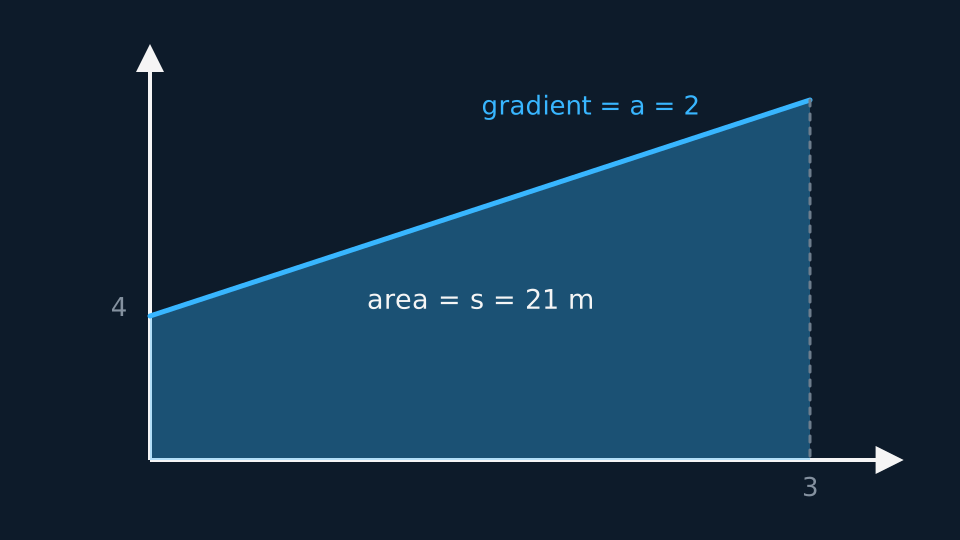
On a displacement-time graph the gradient is the velocity, so a horizontal stretch means the object has stopped and a straight sloping line means steady speed. On a velocity-time graph the gradient is the acceleration and the area underneath is the displacement. Constant acceleration draws a straight line, and the suvat equations express the gradient and area of the trapezium beneath it.
Multi-stage motion can be handled as an area calculation. A car accelerating from rest to 20 m s⁻¹ in 8 s, holding that for 30 s, then stopping in a further 12 s draws a trapezium with parallel sides 50 and 30 and height 20. Its area is ½(50 + 30) × 20 = 800 m, without using a suvat equation.
Area below the axis counts as negative displacement. For total distance, add the areas as magnitudes; for displacement, add them with their signs.
Deriving the five equations
Fix the letters first. Take u for the velocity at the start, v for the velocity at time t, a for the constant acceleration, and s for the displacement over that time. Constant acceleration is what makes the velocity-time graph a straight line, running from height u at time 0 to height v at time t. Its gradient and the area beneath it each have a kinematic meaning.
The gradient is the acceleration, so (v − u)/t = a, which rearranges to v = u + at. The area beneath is the displacement, and the shape is a trapezium with parallel sides u and v and width t, so s = ½(u + v)t. The graph supplies these two equations; the remaining three follow from them by algebra.
Substituting v = u + at into s = ½(u + v)t gives s = ½(u + u + at)t, that is s = ut + ½at². Substituting u = v − at into the same equation gives s = ½(v − at + v)t, that is s = vt − ½at². The two expressions correspond to splitting the trapezium in two ways: a rectangle of height u with a triangle of height at on top, or a rectangle of height v with the same triangle removed.
The fifth equation has no t in it, so t must be eliminated rather than substituted. From v = u + at, t = (v − u)/a, and putting that into s = ½(u + v)t gives s = (v + u)(v − u)/(2a) = (v² − u²)/(2a). Multiplying up, v² = u² + 2as. Dividing by a needs a ≠ 0, and nothing is lost, because with a = 0 the result reduces to v² = u², which is true of motion at constant velocity anyway.
A second derivation uses calculus. Acceleration is the rate of change of velocity, so a constant a integrates to v = at + c, and v = u at t = 0 gives c = u. Integrating v = u + at gives s = ut + ½at², with no constant when s is measured from the starting point.
The five equations
Check the current formula booklet for your awarding organisation. Whether or not the result is supplied, you must know when it applies and how to derive it if the question asks for a proof. Each of the five equations omits one of s, u, v, a and t, so select by known variables: list s, u, v, a, t, enter the three values given, and use the equation that omits the quantity you neither know nor need.
WORKED EXAMPLE
A braking train
A train slows from 24 m s⁻¹ to 12 m s⁻¹ over 300 m. Find the deceleration.
Known: u = 24, v = 12, s = 300. Wanted: a. Time is not involved, so use v² = u² + 2as.
144 = 576 + 600a, so a = −432/600 = −0.72 m s⁻², a deceleration of 0.72.
The sign is negative because the train slows while travelling in the positive direction.
These equations hold only while the acceleration is constant. If the forces change partway through, take the end of stage one as the start of stage two and begin a fresh suvat list.
Vertical motion under gravity
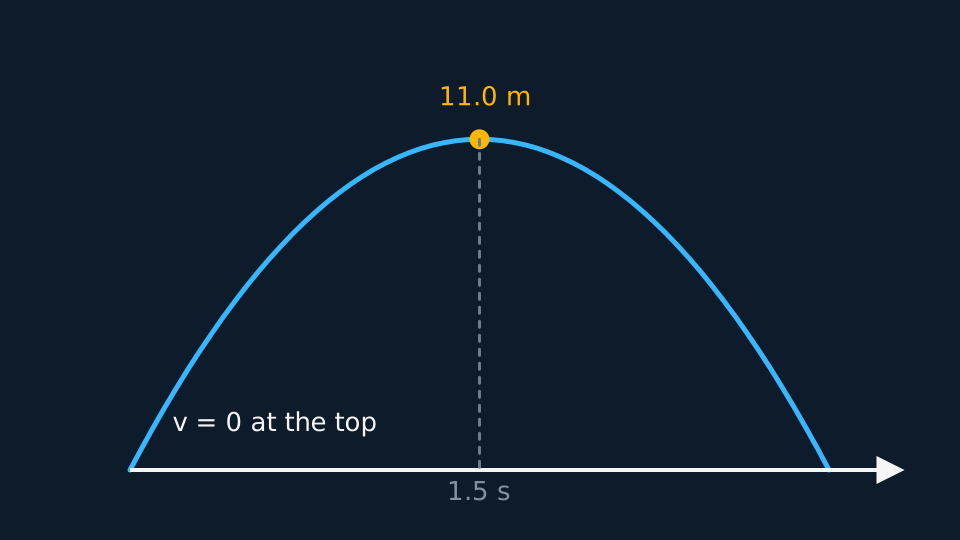
Free flight near the ground has constant acceleration g = 9.8 m s⁻² downwards, when air resistance is neglected. Take up as positive and a = −9.8 throughout the modelled flight, going up, at the highest point, and coming down. At the highest point the velocity is zero; the acceleration is still −9.8 m s⁻².
A ball thrown up at 14.7 m s⁻¹ reaches v = 0 when t = 14.7/9.8 = 1.5 s, at height 14.7 × 1.5 − 4.9 × 1.5² = 11.0 m, and returns to the hand with speed 14.7 again. Use that symmetry to check the times and speeds obtained.
The same formulae in two dimensions
Motion in a plane is normally handled by resolving into two perpendicular directions and running the formulae separately along each. The same equations can be written once in vector form. Let u, v, a and s stand for vectors; four of the five carry over unchanged: v = u + at, s = ut + ½at², s = ½(u + v)t and s = vt − ½at². Time is the only scalar in them, and the same value of t appears in every component.
The fifth equation does not carry over. v² = u² + 2as squares the velocities, and the square of a vector is not defined; the corresponding statement uses dot products, v·v = u·u + 2a·s, which is Further Mathematics content. In a plane, therefore, use the four vector equations, or work in components.
Two notations appear and questions swap between them freely. A velocity of 4i − 3j m s⁻¹ is the column vector (4, −3), and an acceleration written (1, 2) m s⁻² is i + 2j. Reading a vector equation one component at a time recovers the resolved pair: the i part of v = u + at says v₁ = u₁ + a₁t and the j part says v₂ = u₂ + a₂t. The vector equation and the two scalar ones are the same statement written twice.
WORKED EXAMPLE
Given the vectors, asked for the vectors
A particle starts at the origin with velocity u = (4, −3) m s⁻¹ and moves with constant acceleration a = (1, 2) m s⁻². Find its velocity and its displacement after 3 s.
v = u + at = (4, −3) + 3(1, 2) = (7, 3) m s⁻¹, which is 7i + 3j. Its speed is √(7² + 3²) = √58 ≈ 7.62 m s⁻¹, at tan⁻¹(3/7) ≈ 23.2° from the i direction.
s = ut + ½at² = 3(4, −3) + 4.5(1, 2) = (12, −9) + (4.5, 9) = (16.5, 0) m, so it is 16.5 m from the origin in the i direction and back at the level it started from.
Check it two ways. s = ½(u + v)t = 1.5(11, 0) = (16.5, 0) agrees, and running the components separately gives 4 × 3 + ½ × 1 × 9 = 16.5 across and −3 × 3 + ½ × 2 × 9 = 0 up, the same two numbers.
ASSESSMENT FOCUS
- Write the suvat list and fill it in before choosing an equation, then select the equation that omits the unwanted variable.
- suvat applies only while the acceleration is constant. Split the motion where the acceleration changes and do not apply one equation across the join.
- In vertical motion, state the positive direction and keep the sign of g consistent with it throughout the question.
- In a graph question, state whether you are using an area or a gradient.
- For “derive”, work from the graph: gradient for v = u + at, area for s = ½(u + v)t, then substitution for the rest. Show the substitution before the final equation.
- Answer a question posed in vectors in vector form. Take magnitudes only where a speed or a distance is asked for.
CHECK YOURSELF
A stone is dropped from rest down a well and hits the water after 2 s. Taking g = 9.8 m s⁻², find the depth and the speed at impact.
Show a hint
u = 0 makes two suvat equations very short.
Show the answer
Depth: s = ½ × 9.8 × 2² = 19.6 m.
Impact speed: v = 9.8 × 2 = 19.6 m s⁻¹.
List s, u, v, a, t, then pick the equation missing the letter you do not need.
With up positive, the acceleration is a constant −9.8 m s⁻² throughout the modelled flight, including at the highest point.
WORKBOOK
Printable practice for this topic: original exam-style questions with room to work, and a fully worked answer book. Free to use; please do not redistribute or sell.
Or read them with their worked answers on the kinematics with constant acceleration questions page.
USED LATER IN
CHECK YOUR PROGRESS
Rate how confident you feel with each objective for this lesson. Ratings are saved in this browser, on this device, unless you sign in.
- Read velocity from a displacement-time graph, and acceleration and displacement from a velocity-time graph.
- Derive the five suvat equations from the velocity-time graph, and obtain each of the last three from the first two.
- Select and use the five suvat equations for constant acceleration.
- Split a multi-stage motion at the moments the acceleration changes.
- Model vertical motion under gravity, using the symmetry of up-and-down flight.
- Read the formulae as vector equations, in column or i and j notation, and recover the two resolved equations from them.
Open the full revision checklist to see every objective in the course in one place.