Maths › Polar coordinates › Areas with polar coordinates
Areas with polar coordinates
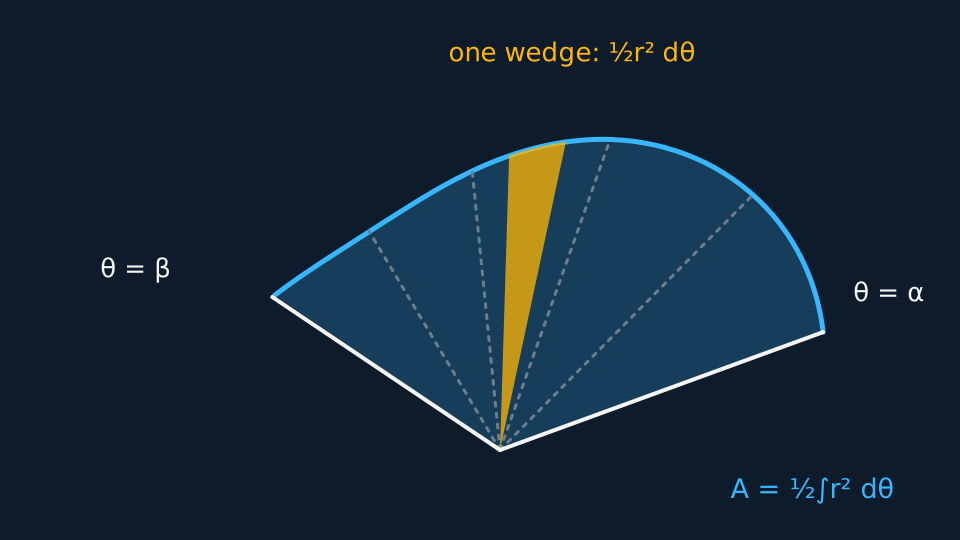
A polar region divides into thin sectors, each of area approximately ½r² dθ, so its area is ½∫r² dθ over an interval that traces the boundary once. For a region between two curves traced with non-negative radial distances, the area is ½∫(R² − r²) dθ with R ≥ r.
Builds on Polar curves and Compound angles and the harmonic form.
IN THIS TOPIC
- Apply A = ½∫r² dθ with limits that trace the region exactly once.
- Square and simplify r with double angle identities before integrating.
- Find the area of a region bounded by two polar curves.
COMMON MISCONCEPTION
Area in polar coordinates is the integral of r dθ, by analogy with the area under y = f(x).
The element is a thin sector rather than a strip: between θ and θ + dθ its area is about ½r × r dθ, so A = ½∫r2 dθ, with the radius squared. Check it on r = a over a full turn: ½ × a2 × 2π = πa2, the area of the circle, where ∫r dθ would have given 2πa, its circumference.
Sectors rather than strips
Between θ and θ + dθ the radius traces a thin sector, of area approximately ½r × r dθ. Integrating over the sectors gives the polar area formula:
Check the current formula booklet for your awarding organisation. The work in a question is in choosing limits that trace the region once and in squaring r correctly. The radius is squared: a cartesian strip has area y dx, whereas a sector's area is proportional to the square of its radius. Check on r = a over a full turn: ½ × a² × 2π = πa², the area of the circle.
WORKED EXAMPLE
A quarter of a circle
Find the area swept by r = 2 as θ runs from 0 to π/2.
A = ½∫4 dθ from 0 to π/2 = 2 × π/2 = π.
The full circle has area 4π and a quarter of it is π, so the formula agrees with geometry before any hard curve is attempted.
Cardioids and petals
Squaring r usually produces a squared trigonometric term, so use the double angle identity cos²θ = (1 + cos 2θ)/2. Choose limits that trace the region once, and use symmetry to reduce the working where the curve is symmetric.
WORKED EXAMPLE
The area inside a cardioid
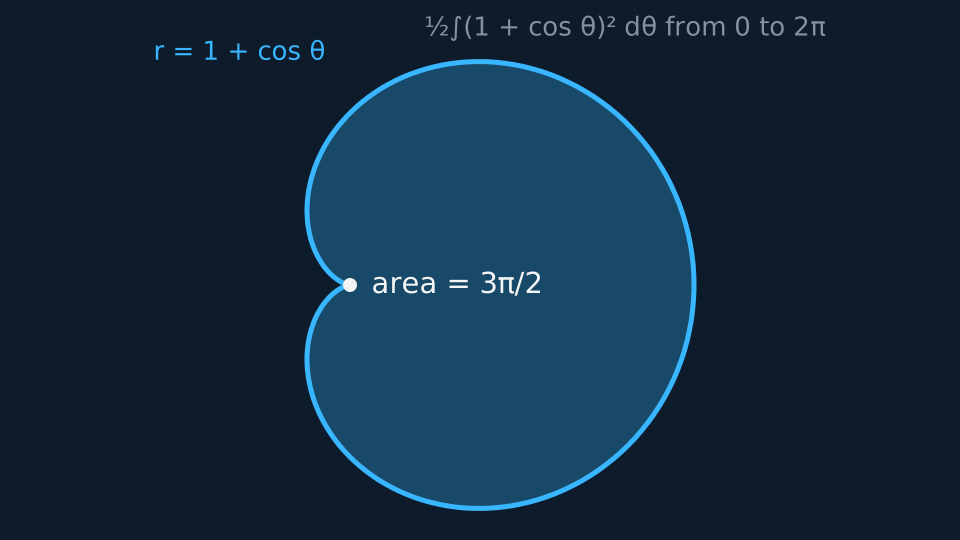
Find the area enclosed by r = 1 + cos θ.
A = ½∫(1 + cos θ)² dθ over 0 to 2π = ½∫(1 + 2 cos θ + cos²θ) dθ.
The cos θ term integrates to zero over a full turn, and cos²θ contributes π via the double angle.
A = ½(2π + 0 + π) = 3π/2.
INDEPENDENT PRACTICE
One petal of a rose
Find the area of one loop of r = cos 2θ, using the loop traced for −π/4 ≤ θ ≤ π/4.
Show the working
A = ½∫cos²2θ dθ = ½∫(1 + cos 4θ)/2 dθ over the loop.
The cos 4θ part integrates to zero because −π/4 to π/4 is one full period of cos 4θ, leaving ½ × ½ × π/2.
A = π/8. All four petals together cover π/2, half the unit circle's area.
Regions between two curves
For two curves traced with non-negative radial distances over the same interval, the area between them is A = ½∫(R² − r²) dθ, where R ≥ r. Split the integral where the curves meet, where the outer boundary changes, or where a signed value of r changes the represented ray. The limits come from solving r₁ = r₂.
WORKED EXAMPLE
Inside the cardioid, outside the circle
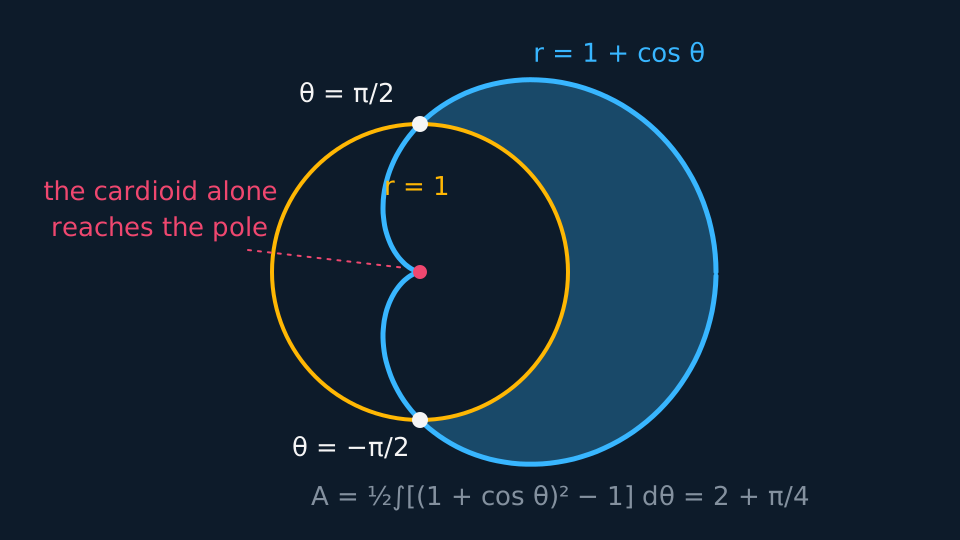
Find the area of the region inside r = 1 + cos θ and outside r = 1.
The curves meet where 1 + cos θ = 1, so cos θ = 0 and θ = ±π/2.
Between those angles the cardioid is the outer curve, so A = ½∫[(1 + cos θ)² − 1] dθ from −π/2 to π/2 = ½∫(2 cos θ + cos²θ) dθ.
The first part gives ½ × 4 = 2 and the second gives ½ × π/2.
A = 2 + π/4, approximately 2.79.
Two polar curves can pass through the pole at different values of θ and still intersect there, so solving r₁ = r₂ can miss that intersection. Check the pole separately whenever both curves reach it.
Describe the drawing
The cardioid r equals 1 plus cos theta wrapped round the amber unit circle, with the crescent inside the cardioid but outside the circle shaded cyan. The curves cross at theta equals plus and minus pi over 2, the limits of the subtraction integral, which measures the shaded region at 2 plus pi over 4. A coral dot marks the pole, which only the cardioid reaches: a meeting point there would never show up from solving r one equals r two, so the pole is checked separately.
ASSESSMENT FOCUS
- Square r before integrating, then apply the double angle identities.
- Choose limits by finding where r = 0: one loop runs between consecutive zeros.
- Over a full turn the integrals of cos θ and sin θ are zero; state this rather than evaluating them in full.
- For a region between curves, state the intersection angles on a separate line, and check whether both curves pass through the pole.
CHECK YOURSELF
Find the area swept by r = 3 as θ runs from 0 to 2π/3.
Show a hint
½∫9 dθ over the sector.
Show the answer
A = ½ × 9 × 2π/3 = 3π. As a check, that is one third of the full circle's 9π, matching the one-third turn.
Polar area is ½∫r² dθ, with the radius squared.
Expand the square, use cos²θ = (1 + cos 2θ)/2, and take limits between zeros of r or at intersections.
Between two curves traced with non-negative r over the same interval, the area is ½∫(R² − r²) dθ with R ≥ r; split the integral where the outer boundary changes.
WORKBOOK
Printable practice for this topic: original exam-style questions with room to work, and a fully worked answer book. Free to use; please do not redistribute or sell.
Or read them with their worked answers on the areas with polar coordinates questions page.
CHECK YOUR PROGRESS
Rate how confident you feel with each objective for this lesson. Ratings are saved in this browser, on this device, unless you sign in.
- Apply A = ½∫r² dθ with limits that trace the region exactly once.
- Square and simplify r with double angle identities before integrating.
- Find the area of a region bounded by two polar curves.
Open the full revision checklist to see every objective in the course in one place.