Maths › Trigonometry › Compound angles and the harmonic form
Compound angles and the harmonic form
Sine and cosine do not distribute over a sum, so compound angle formulae are needed for sin(A ± B) and cos(A ± B). They can be proved from two right-angled triangles and then from a rotation, which removes the acute-angle restriction. They give the double angle identities, further exact values, the half-angle forms used in integration, and the harmonic form, which writes a sin θ + b cos θ as a single sinusoid with a stated amplitude and phase.
Builds on Reciprocal and inverse trigonometric functions.
IN THIS TOPIC
- Use the compound angle formulae, forwards and backwards.
- Prove sin (A + B) and cos (A + B) from the two-triangle construction, and say what that figure assumes.
- Derive the double angle formulae by setting B = A, and choose between the three forms of cos 2A.
- Rearrange cos 2A into the half-angle forms that integration later depends on.
- Construct identity proofs of the kind the specification names.
- Write a sin θ + b cos θ in harmonic form, and use it for equations and extremes.
COMMON MISCONCEPTION
sin (A + B) = sin A + sin B.
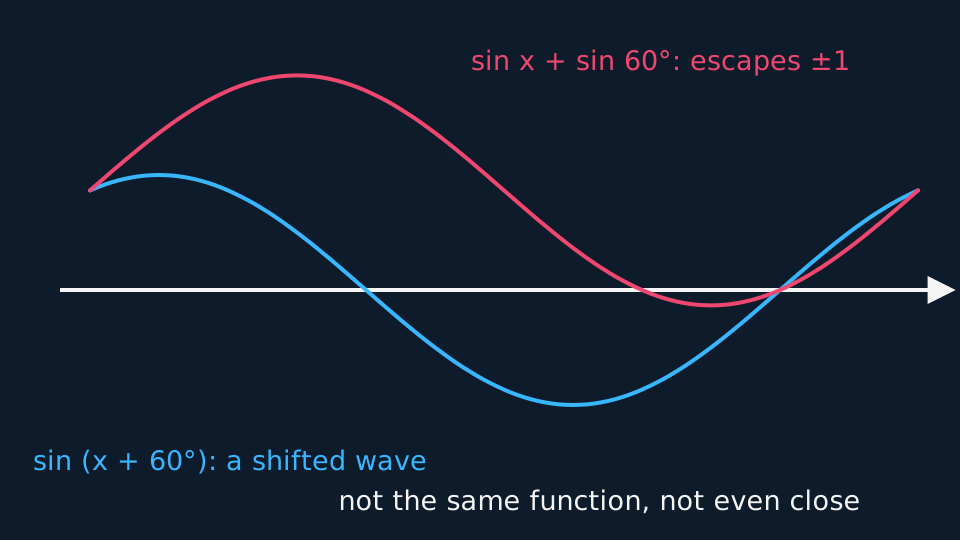
Sine does not distribute over addition. sin 90° = 1, while sin 30° + sin 60° = 1.37. The formula that expands a sum of angles is sin (A + B) = sin A cos B + cos A sin B, printed in the booklet, and setting B = A collapses it to sin 2A = 2 sin A cos A.
Angles that add
The first numbers anyone tries settle it. sin 90° is 1, while sin 30° + sin 60° is 1.37. Sine does not distribute over addition. The formulae that do expand a sum or difference of angles are given in the booklet,
The sign in the middle of the cosine formula is the opposite of the sign inside the bracket; copy it from the booklet rather than from memory. All three formulae can be proved from a pair of right-angled triangles, and that construction is given below, since a question may ask for the proof or for a partly given proof to be completed.
WORKED EXAMPLE
A new exact value
Find the exact value of sin 75°.
Split 75° into angles you already know. sin 75° = sin (45° + 30°) = sin 45° cos 30° + cos 45° sin 30°.
Substituting the exact values gives (√2/2)(√3/2) + (√2/2)(1/2) = (√6 + √2)/4.
The proof from two triangles
Two right-angled triangles, one on the other, prove all three formulae, and the work is identifying which length in the figure is which product. Draw the figure while reading the construction.
Start at a point O with a horizontal ray running to the right. Turn anticlockwise through A to a second ray, then through a further B to a third, so the third ray leaves O at angle A + B. Mark P on that third ray with OP = 1. Now drop four perpendiculars: from P to the middle ray, foot Q; from Q to the horizontal, foot M; from P to the horizontal, foot N; and from Q to the segment PN, foot R. Take A, B and A + B all acute, which is what keeps every one of those feet where the description has just put it.
Out of that come four right-angled triangles and one rectangle. The triangles are OQP with its right angle at Q, OMQ with its right angle at M, ONP with its right angle at N, and the small triangle QRP with its right angle at R. The rectangle is MNRQ, since MQ and NR both stand perpendicular to the horizontal while MN sits on it and QR runs parallel to it. The rectangle is the piece that does the adding, because it makes RN = QM and MN = QR.
Now measure, easy triangles first. In OQP the angle at O is B and the hypotenuse is OP = 1, so PQ = sin B and OQ = cos B. In OMQ the angle at O is A and the hypotenuse is that same OQ, so QM = cos B sin A and OM = cos B cos A. In ONP the angle at O is the whole of A + B and the hypotenuse is again 1, so PN = sin (A + B) and ON = cos (A + B). Those last two are the lengths the formulae are about.
The small triangle needs the one piece of angle-chasing in the proof. QR and ON are both perpendicular to PN, so QR is parallel to ON, and cutting that parallel pair with the line OQ makes angle OQR and angle QOM alternate angles. So angle OQR = A. The ray QR falls inside the right angle OQP, which leaves angle PQR = 90° − A, so the remaining angle of QRP is angle QPR = A. Its hypotenuse is PQ = sin B, and the two shorter sides are therefore PR = sin B cos A and RQ = sin B sin A.
| Segment | Triangle it comes from | Length, with OP = 1 |
|---|---|---|
| OQ | OQP, angle B at O | cos B |
| PQ | OQP, angle B at O | sin B |
| OM | OMQ, angle A at O | cos A cos B |
| QM | OMQ, angle A at O | sin A cos B |
| PR | QRP, angle A at P | cos A sin B |
| RQ | QRP, angle A at P | sin A sin B |
| PN | ONP, angle A + B at O | sin (A + B) |
| ON | ONP, angle A + B at O | cos (A + B) |
Read the upright side of the big triangle two ways. PN is PR followed by RN, and RN is the rectangle's copy of QM, so sin (A + B) = sin A cos B + cos A sin B, which is the booklet's first line with the upper sign taken.
Read the base the same way. ON is OM with MN taken off it, and MN is the rectangle's copy of RQ, so cos (A + B) = cos A cos B − sin A sin B. The minus sign in the cosine formula is that subtraction in the figure. Every other length is laid end to end, and the base is the only one where a piece has to come off.
GUIDED PRACTICE
Which triangle supplies which term
In the construction above, with OP = 1, write down PR and RN, name the right-angled triangle each comes from, and assemble them into a statement about PN, before opening the working.
Show the working
PR = cos A sin B, from the small triangle QRP, in which the angle at P is A and the hypotenuse is PQ = sin B.
RN = QM = sin A cos B, from triangle OMQ, in which the angle at O is A and the hypotenuse is OQ = cos B. It is the rectangle MNRQ that carries QM across to RN.
PN = PR + RN, and PN = sin (A + B) from triangle ONP, so sin (A + B) = sin A cos B + cos A sin B.
Name the triangle beside each length: a length quoted without the triangle it comes from is an assertion rather than a step of the proof.
The figure proves less than the formulae state, and a question may ask for that limitation. It was drawn with A, B and A + B all acute, and that assumption is needed: it is what puts Q on the middle ray rather than on its backward extension, R inside the segment PN, and N to the right of O. The formulae themselves hold for every angle, obtuse, reflex and negative alike, so the picture proves a special case and not the whole theorem.
The gap is closed by going back to sine and cosine as coordinates on the unit circle. The point at angle B is cos B of the way along (1, 0) plus sin B of the way along (0, 1). Rotate the whole plane about O through A. Then (1, 0) lands on (cos A, sin A) and (0, 1) lands on (−sin A, cos A), and a rotation carries a sum of two displacements to the sum of their images, because it carries the parallelogram built on them to a congruent parallelogram.
So the image of the point at angle B is cos B (cos A, sin A) + sin B (−sin A, cos A), which reads (cos A cos B − sin A sin B, sin A cos B + cos A sin B). That same rotation carries the point at angle B to the point at angle A + B, whose coordinates are (cos (A + B), sin (A + B)) by definition. Comparing the two coordinates gives both formulae again, with no acute angle anywhere in the argument and no restriction on A or B at all.
Only now is it safe to replace B by −B. Doing that, with sin (−B) = −sin B and cos (−B) = cos B, turns the sine formula into sin (A − B) = sin A cos B − cos A sin B and turns the cosine formula's minus into a plus, which is what the ± and the ∓ in the booklet are recording. The replacement feeds a negative angle into the formulae, so it needs the general case first, and the triangle picture on its own does not license it.
The tangent formula needs no new geometry either. Divide the sine formula by the cosine formula, then divide the top and the bottom of the fraction by cos A cos B. Every cosine either cancels outright or pairs off with a sine to become a tangent, and what is left is tan (A + B) = (tan A + tan B)/(1 − tan A tan B), with the same replacement of B by −B giving the minus version. That last division is legal only where cos A and cos B are non-zero, which is the condition the booklet's line carries silently.
Double angles, and the half-angle trick
Set B = A and the compound formulae collapse into the double angle formulae,
The formulae booklet gives the compound formulae but not these. Any of them can be recovered in one line by setting B = A in the printed formula.
Rearranging the last two forms of cos 2A is how half angles arrive. cos2A = (1 + cos 2A)/2 and sin2A = (1 − cos 2A)/2, which the integration unit then uses constantly. Choose the version of cos 2A containing the ratio the question already uses, which avoids converting between sin and cos afterwards.
GUIDED PRACTICE
An identity proof
Prove that cos x cos 2x + sin x sin 2x ≡ cos x, before opening the working.
Show the working
The left-hand side is the expansion of cos (2x − x), the compound cosine formula read from right to left.
cos (2x − x) = cos x, and the identity is proved. ∎
The proof uses the compound formula in reverse. Expanding both terms into single angles also works, in about five lines rather than two.
The harmonic form
Any expression a sin θ + b cos θ can be written as a single sinusoid. Expand R sin (θ + α), match the coefficients of sin θ and cos θ, and out come R = √(a2 + b2) with the angle pinned down by cos α = a/R and sin α = b/R together. When a and b are both positive, the case exam questions set, that pair collapses to tan α = b/a with α in the first quadrant; keep both equations in view when they are not, because tan alone cannot tell one quadrant from its opposite, and it fails outright when a = 0. That rewrite is the harmonic form, and it gives the maximum and minimum values directly and reduces a sin θ + b cos θ = c to a single trigonometric equation.
WORKED EXAMPLE
Harmonic form, then maximum
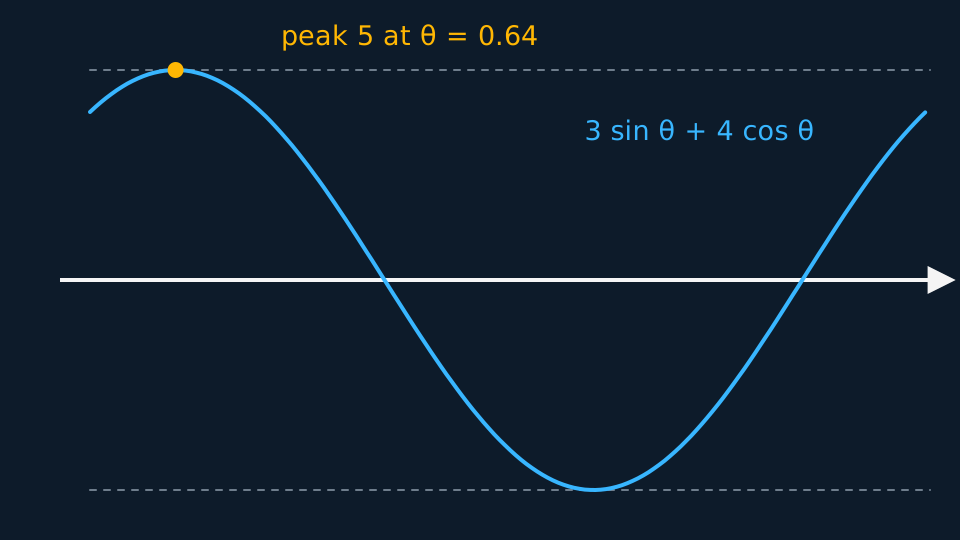
Express 3 sin θ + 4 cos θ in the form R sin (θ + α) with R > 0 and 0 < α < π/2, and state the maximum value and where it first occurs.
R = √(9 + 16) = 5, and tan α = 4/3 gives α = 0.927.
So 3 sin θ + 4 cos θ = 5 sin (θ + 0.927).
The maximum is 5, reached where the sine hits 1. That needs θ + 0.927 = π/2, so θ = 0.644.
No differentiation was needed: once the expression is a single sinusoid, its maximum is R.
INDEPENDENT PRACTICE
An equation through the fold
Using the form above, solve 3 sin θ + 4 cos θ = 2.5 for 0 ≤ θ < 2π.
Show the working
The equation becomes 5 sin (θ + 0.927) = 2.5, so sin (θ + 0.927) = ½.
With φ = θ + 0.927 running over (0.927, 0.927 + 2π), the solutions of sin φ = ½ in range are φ = 5π/6 and π/6 + 2π.
Translating back gives θ = 1.69 and 5.88 (3 significant figures).
The substitute, widen and translate method for trigonometric equations applies unchanged; the harmonic form is what reduces the equation to a single ratio.
ASSESSMENT FOCUS
- Copy the compound formulae from the booklet. The sign in the middle of the cosine formula is the opposite of the sign inside the bracket.
- The booklet does not print the double angle formulae. If you forget one, set B = A in the printed compound formula and derive it.
- For the geometrical proof, draw the construction and set OP = 1 before writing anything down. Then name the triangle each length comes from, and finish by reading PN and ON off the rectangle.
- Choose the form of cos 2A containing the ratio the question already uses; another form requires further conversion between sin and cos.
- In identity proofs work down one side only, name each formula as you use it, and finish with ≡.
- For harmonic form, R = √(a² + b²) every time. α satisfies cos α = a/R and sin α = b/R, so check the signs of a and b before choosing the quadrant.
- The maximum and minimum of a sin θ + b cos θ are ±R, which follows from the harmonic form without differentiation.
CHECK YOURSELF
Express 5 cos θ − 12 sin θ in the form R cos (θ + α) with R > 0 and 0 < α < π/2, and write down the minimum value of the expression.
Show a hint
Expand R cos (θ + α) and match both coefficients.
Show the answer
Matching gives R cos α = 5 and R sin α = 12, so R = √(25 + 144) = 13 and tan α = 12/5, α = 1.176.
So 5 cos θ − 12 sin θ = 13 cos (θ + 1.176).
The minimum is −13, attained where the cosine equals −1. R is a whole number here because 5, 12 and 13 form a Pythagorean triple.
A sum of angles is expanded by the compound formulae; sine and cosine do not distribute over addition.
a sin θ + b cos θ is a single sinusoid of amplitude √(a² + b²); write the harmonic form first, then read off the extreme values and solve.
WORKBOOK
Printable practice for this topic: original exam-style questions with room to work, and a fully worked answer book. Free to use; please do not redistribute or sell.
Or read them with their worked answers on the compound angles and the harmonic form questions page.
USED LATER IN
CHECK YOUR PROGRESS
Rate how confident you feel with each objective for this lesson. Ratings are saved in this browser, on this device, unless you sign in.
- Use the compound angle formulae, forwards and backwards.
- Prove sin (A + B) and cos (A + B) from the two-triangle construction, and say what that figure assumes.
- Derive the double angle formulae by setting B = A, and choose between the three forms of cos 2A.
- Rearrange cos 2A into the half-angle forms that integration later depends on.
- Construct identity proofs of the kind the specification names.
- Write a sin θ + b cos θ in harmonic form, and use it for equations and extremes.
Open the full revision checklist to see every objective in the course in one place.