Maths › Polar coordinates › Polar curves
Polar curves
A polar equation gives a signed radial coordinate as a function of angle. Determine a complete tracing interval, test symmetry, find zeros and extrema, and calculate enough intermediate values to identify the curve. For tangents, use dx/dθ and dy/dθ; if both vanish, evaluate the limiting gradient rather than discarding the point.
Builds on Radians, arcs and small angles and Circles.
IN THIS TOPIC
- Plot points from (r, θ) and convert both ways with x = r cos θ, y = r sin θ.
- Convert polar equations to cartesian form and recognise the result.
- Sketch the standard families, including circles, half-lines, cardioids and roses.
- Locate tangents parallel and perpendicular to the initial line.
COMMON MISCONCEPTION
Every point has exactly one pair of polar coordinates.
Polar representations are not unique. Adding 2π to θ names the same point, the pole is (0, θ) for every θ, and in a polar curve equation a negative value is read by (−r, θ) = (r, θ + π), which is how r = a cos 2θ traces four petals. A question that fixes an interval such as 0 ≤ θ < 2π is fixing which representation to quote.
Polar coordinates and the sign convention for r
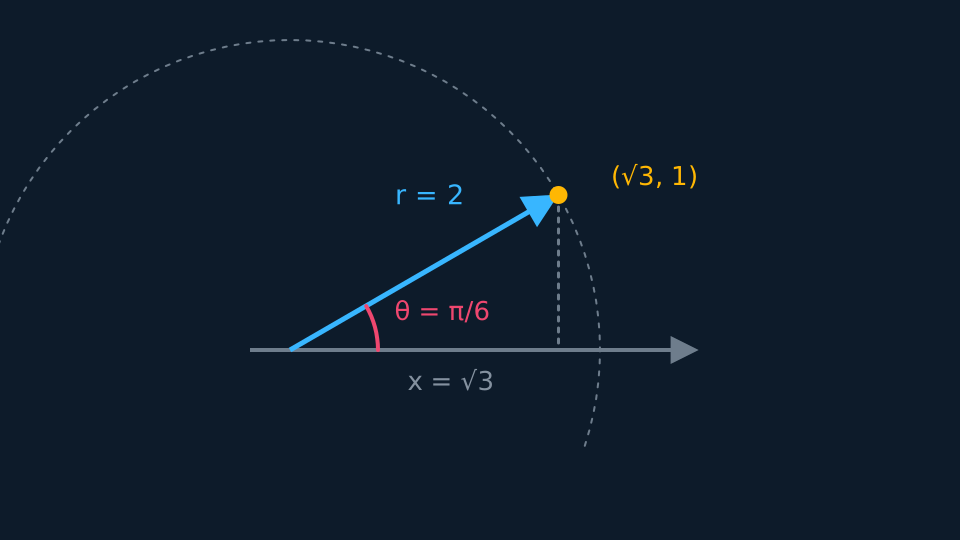
A point's polar coordinates are (r, θ), the distance from the pole and the anticlockwise angle from the initial line. The conversions follow from one right-angled triangle:
Check the current formula booklet for your awarding organisation; whether or not these are supplied, you must know when they apply and be able to derive them from the triangle.
A point may be represented by (r, θ) with r ≥ 0; in a polar curve equation, a negative value is interpreted by (−r, θ) = (r, θ + π). Polar representations are not unique: adding 2π to θ gives the same point, and the pole is (0, θ) for every θ.
WORKED EXAMPLE
A polar equation in cartesian clothing
Convert r = 4 cos θ to cartesian form and identify the curve.
Multiply both sides by r to get r² = 4r cos θ.
Substitute: x² + y² = 4x.
Complete the square: (x − 2)² + y² = 4, a circle of radius 2 centred at (2, 0).
Check with θ = π/3, which gives r = 2 and the point (1, √3). Then (1 − 2)² + 3 = 4.
Sketching the standard curves
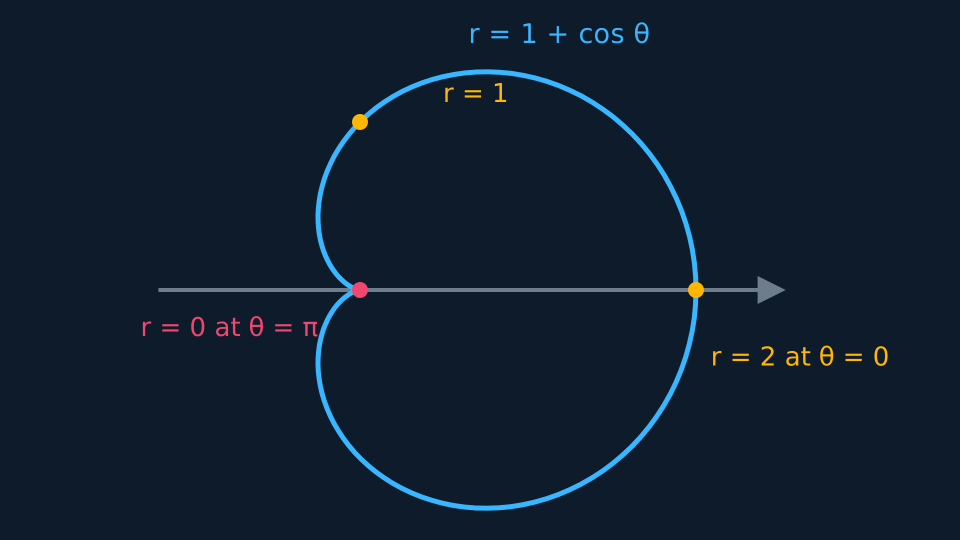
To sketch a polar curve, determine a complete tracing interval, test symmetry, find the zeros and extrema of r, and calculate enough intermediate values to identify the shape. r = a is a circle centred on the pole, θ = α a half-line from the pole, and r = a(1 + cos θ) is the cardioid, with r = 2a on the initial line and r = 0 in the opposite direction. r = a cos 2θ is a four-petal rose.
The rose requires the sign convention. r = a cos 2θ is negative over part of the turn, and (−r, θ) denotes the point (r, θ + π). Where cos 2θ ≥ 0, on −π/4 ≤ θ ≤ π/4 and on 3π/4 ≤ θ ≤ 5π/4, the curve traces two petals along the initial line; the intervals where cos 2θ < 0 give the other two, perpendicular to them. For an area, integrate over one loop at a time, on an interval where r ≥ 0.
WORKED EXAMPLE
Reading values off a cardioid
For r = 1 + cos θ, find r at θ = 0, π/2 and π, and describe the curve.
θ = 0 gives r = 2. θ = π/2 gives r = 1. θ = π gives r = 0.
The curve reaches r = 2 along the initial line, passes 1 unit above the pole, and returns to the pole at θ = π.
The cusp at the pole occurs because r = 0 there. A curve r = a + b cos θ with a > b > 0 has r > 0 throughout and does not reach the pole.
GUIDED PRACTICE
Cartesian to polar
Find polar coordinates for the cartesian point (−3, 3), with 0 ≤ θ < 2π.
Show the working
r = √(9 + 9) = 3√2.
The point sits in the second quadrant, so θ = π − π/4 = 3π/4.
So (r, θ) = (3√2, 3π/4). The calculator value arctan(−1) = −π/4 is in the fourth quadrant, so the quadrant must be checked before quoting θ.
Tangents parallel and perpendicular to the initial line
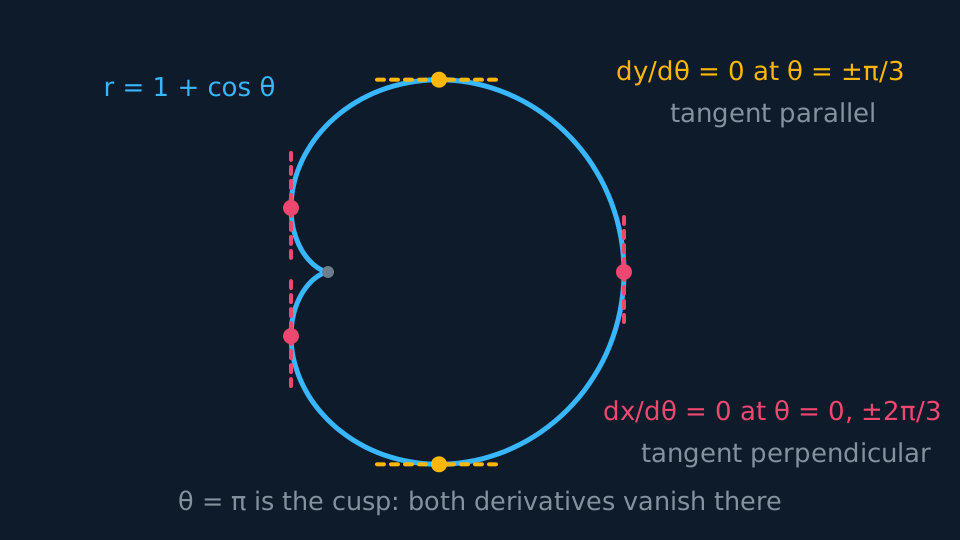
Work in cartesian components. Write x = r cos θ and y = r sin θ as functions of θ alone. A tangent parallel to the initial line requires dy/dθ = 0 with dx/dθ ≠ 0; a tangent perpendicular to it requires dx/dθ = 0 with dy/dθ ≠ 0. If both derivatives vanish, as at a cusp, evaluate the limiting gradient (dy/dθ)/(dx/dθ) instead. Differentiate, factorise, solve for θ, then find the corresponding values of r.
WORKED EXAMPLE
Where the cardioid runs flat
Find the points on r = 1 + cos θ where the tangent is parallel to the initial line.
y = (1 + cos θ)sin θ, so dy/dθ = cos θ + cos 2θ.
Using cos 2θ = 2cos²θ − 1, that factorises as (2 cos θ − 1)(cos θ + 1).
cos θ = 1/2 gives θ = ±π/3, and cos θ = −1 gives θ = π, the cusp, where dx/dθ also vanishes and the test above does not apply.
At θ = π/3, r = 3/2, so the points are (3/2, π/3) and (3/2, −π/3), symmetric about the initial line.
At θ = π both derivatives vanish. Taking the limiting ratio (dy/dθ)/(dx/dθ), or expanding near π, gives gradient 0; the cusp has tangent y = 0.
Apply the same method to x for the perpendicular case. Here dx/dθ = −sin θ(1 + 2cos θ), giving tangents at θ = ±2π/3 and at θ = 0. Check whether a solution is a cusp or the pole before quoting it.
Describe the drawing
The cardioid with five marked points. Amber dots at theta equals plus and minus pi over 3 carry dashed horizontal tangents, where dy by d theta vanishes; coral dots at theta equals 0 and plus and minus 2 pi over 3 carry dashed vertical tangents, where dx by d theta vanishes. At the cusp, theta equals pi, both derivatives vanish at once and neither test applies, so the pole point is marked grey and excluded.
ASSESSMENT FOCUS
- To convert an equation, produce r², r cos θ and r sin θ; multiplying through by r is usually the first step.
- Check the quadrant before writing θ: arctan alone does not distinguish (−3, 3) from (3, −3).
- Sketch from symmetry, the zeros and extrema of r, and enough intermediate values to fix the shape.
- State the interval of θ that traces the curve once; it is part of a complete answer.
- For tangents, differentiate r sin θ and r cos θ, not r; dr/dθ = 0 locates extreme values of r instead.
- If dx/dθ and dy/dθ both vanish, evaluate the limiting gradient (dy/dθ)/(dx/dθ) rather than discarding the point.
CHECK YOURSELF
Convert the polar point (2, π/6) to cartesian coordinates, exactly.
Show a hint
x = r cos θ, y = r sin θ.
Show the answer
x = 2 cos(π/6) = √3 and y = 2 sin(π/6) = 1, so the point is (√3, 1).
x = r cos θ and y = r sin θ; form r² and r cos θ to convert equations. In a curve equation, (−r, θ) denotes (r, θ + π).
Sketch a polar curve from a complete tracing interval, its symmetry, the zeros and extrema of r, and sufficient intermediate values.
Tangents parallel to the initial line come from dy/dθ = 0 and perpendicular ones from dx/dθ = 0, each with the other derivative non-zero; if both vanish, take the limiting gradient.
WORKBOOK
Printable practice for this topic: original exam-style questions with room to work, and a fully worked answer book. Free to use; please do not redistribute or sell.
Or read them with their worked answers on the polar curves questions page.
USED LATER IN
CHECK YOUR PROGRESS
Rate how confident you feel with each objective for this lesson. Ratings are saved in this browser, on this device, unless you sign in.
- Plot points from (r, θ) and convert both ways with x = r cos θ, y = r sin θ.
- Convert polar equations to cartesian form and recognise the result.
- Sketch the standard families, including circles, half-lines, cardioids and roses.
- Locate tangents parallel and perpendicular to the initial line.
Open the full revision checklist to see every objective in the course in one place.