Physics › Astrophysics › Detecting exoplanets
Detecting exoplanets
Direct imaging of an exoplanet rarely works, because the planet is about a billion times fainter than its star and too close to it in angle. The radial velocity method measures the star's periodic Doppler shift about the common centre of mass; the transit method measures a brightness dip that repeats once per orbit.
Choose your exam board to show the notes and questions relevant to your specification. You can change this setting at any time, and content for other boards remains available.
Quasars and exoplanets, part 2 of 2. Part 1 is Quasars.
Builds on Quasars and The Doppler effect and red shift.
IN THIS TOPIC
- Explain why direct exoplanet detection fails, and interpret the radial velocity method and the transit light curve.
COMMON MISCONCEPTION
We find planets around other stars by photographing them beside their suns.
Direct photographs are rare because the star vastly outshines the planet: most exoplanets are found indirectly, from the star's periodic Doppler shift or the small dip in brightness during a transit.
Exoplanets: why looking fails
A planet orbiting another star emits almost nothing of its own and reflects only a scrap of its star's light. Two problems follow, and an exam answer needs both. The star typically outshines the planet by a factor of a billion, and at interstellar distances the angular separation between them falls below what any telescope's diffraction limit can cleanly resolve. Direct images therefore remain rare, managed only for a few giant, young, widely separated planets, and nearly everything we know comes from two indirect methods.
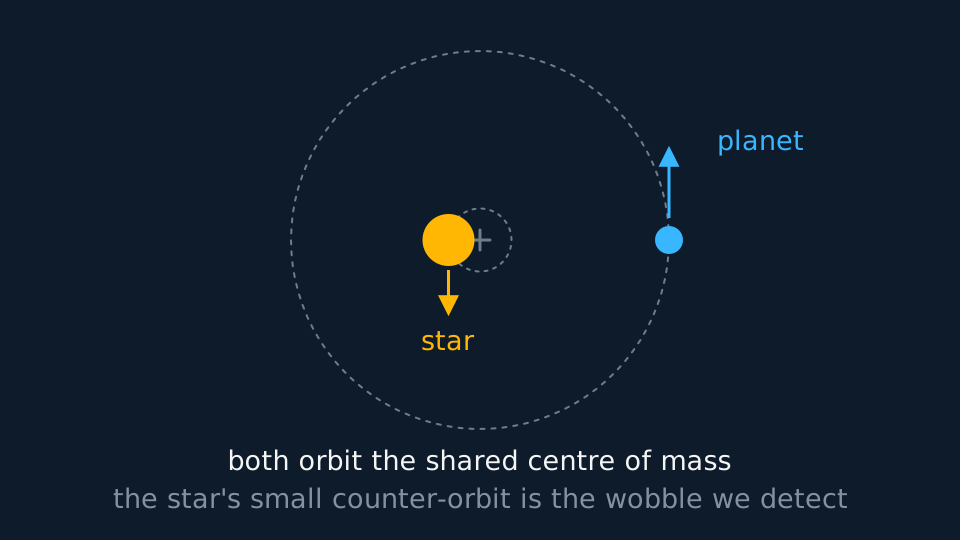
The radial velocity method is the binary-star method of The Doppler effect and red shift, pushed to extremes. The planet does not orbit a stationary star. Both bodies orbit their common centre of mass, so the star performs a miniature mirror-orbit and its spectral lines swing to and fro with the planet's period. The period of that variation gives the planet's orbital period. Its amplitude depends on the planet's mass, because a more massive planet gives the star a larger counter-orbital speed.
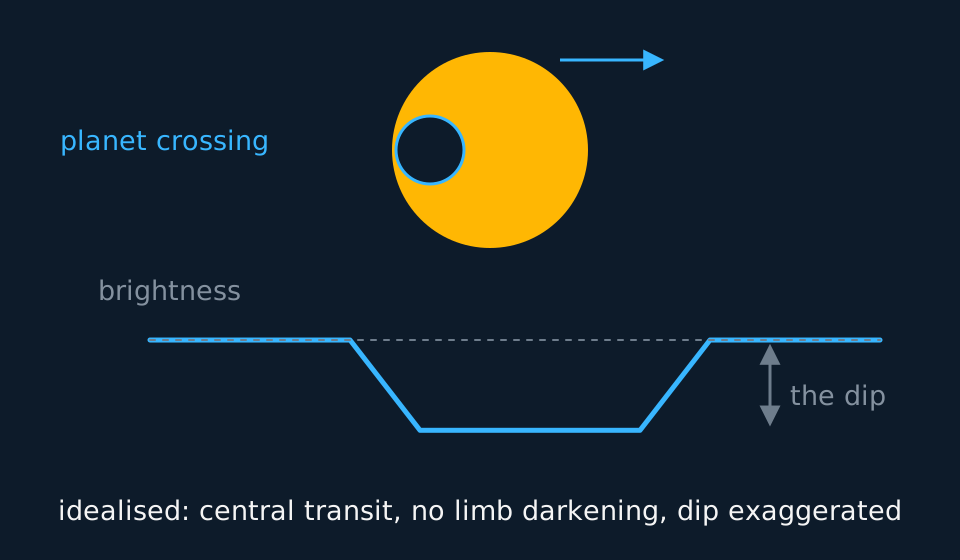
The transit method looks for the small regular eclipse of a star whose planetary system happens to lie edge-on to us. Each orbit, the planet's disc blocks a fraction of the starlight equal to the ratio of the two discs' areas, so the fractional dip equals (rp/rs)2. The light curve's depth measures the planet's size and its repeat interval gives the orbital period. A Jupiter crossing a Sun dims it by about one per cent. An Earth manages one part in ten thousand.
GUIDED PRACTICE
Sizing a planet from a dip
A star of radius 6.96 × 10⁸ m dims by a fraction 4.0 × 10⁻⁴ during each transit. Find the planet's radius, and compare it with the Earth's 6.37 × 10⁶ m.
Show the working
(rp/rs)2 = 4.0 × 10⁻⁴, so rp/rs = 0.020 and rp = 0.020 × 6.96 × 108 = 1.4 × 10⁷ m.
That is about 2.2 Earth radii, a super-Earth. The square root is a required step. The dip compares areas, and the answer wants a radius.
INDEPENDENT PRACTICE
Why the wobble is hard
Jupiter makes the Sun orbit their shared centre of mass at about 13 m s−1. Find the fractional Doppler shift this produces, and the wavelength shift on a 550 nm line.
Show the working
Δλ/λ = v/c = 13 / (3.0 × 10⁸) = 4.3 × 10⁻⁸.
Δλ = 4.3 × 10−8 × 550 nm = 2.4 × 10⁻⁵ nm, a shift a hundred-thousandth of a nanometre wide. Exoplanet spectrographs are consequently among the most stable instruments ever built, and the first planets found this way were heavy ones huddled close to their stars.
ASSESSMENT FOCUS
- Direct detection fails for two stated reasons, and one alone will not do. The star's overwhelming brightness, and an angular separation below the resolving limit.
- Transit questions live on the light curve, so sketch it. Flat, dip, flat, with depth (rp/rs)2 and the repeat time giving the orbital period. Radial velocity answers must mention the centre of mass, because the star wobbles only since both bodies orbit it.
- The two methods answer different questions, so pair them when a question offers both. The dip's depth gives the planet's size, the wobble's size reflects its mass, either period is the planet's year, and mass with radius gives a density and a rocky-or-gaseous verdict.
CHECK YOURSELF
A star of radius 7.0 × 10⁸ m dims by a fraction 1.6 × 10⁻⁴ once every 12 days. Find the planet's radius and orbital period, and state what a radial velocity measurement with the same period would add.
Show a hint
The dip compares disc areas, so a square root is compulsory before any radius appears.
Show the answer
(rp/rs)2 = 1.6 × 10⁻⁴, so rp/rs = 0.0126 and rp = 0.0126 × 7.0 × 108 ≈ 8.9 × 10⁶ m, about 1.4 Earth radii.
The dips repeat once per orbit, so the orbital period is 12 days.
The amplitude of the star's radial-velocity variation depends on the planet's mass, because a more massive planet gives the star a larger counter-orbital speed about their shared centre of mass. Mass and radius together give a density, and with it a rocky or gaseous verdict.
Direct imaging fails for two reasons: the star is about a billion times brighter than the planet, and their angular separation is below the diffraction limit.
The transit dip is (rp/rs) squared and repeats once per orbit; the star's Doppler wobble shares that period, and its size scales with the planet's mass.
Or read them with their mark schemes on the quasars questions page.
CHECK YOUR PROGRESS
Rate how confident you feel with each objective for this lesson. Ratings are saved in this browser, on this device, unless you sign in.
- Explain why direct exoplanet detection fails, and interpret the radial velocity method and the transit light curve.
Open the full revision checklist to track your progress across the whole unit.